
What if the next sixty months were the most influential period of your entire financial life? If you’re feeling a bit of a squeeze between the desire to finish work and the worry that your savings might not stretch far enough, you aren’t alone. Many Australians find the final countdown to be the most stressful part of their career. Learning how to financially prepare for retirement in 5 years is the key to replacing that anxiety with a sense of control and quiet confidence.
You’ve worked hard for decades, yet questions about complex superannuation rules or how to finally clear that mortgage can still keep you up at night. In this guide, we’ll walk you through a clear roadmap to help you maximise your super balance and reduce your tax liability. We’ll look at how to navigate Centrelink thresholds and ensure your desired lifestyle is sustainable for the long haul. By the time you finish reading, you’ll have the clarity and confidence needed to step into this next chapter with total peace of mind. It’s about making precise, strategic choices today so you can enjoy the future you’ve earned.
Key Takeaways
- Recognise why the final five-year window is your most powerful opportunity to shift from simple saving to strategic asset optimisation.
- Learn how to financially prepare for retirement in 5 years by utilising catch-up contributions and maximising concessional caps to lower your tax.
- Determine the most effective way to manage debt by weighing the benefits of clearing your mortgage against boosting your superannuation balance.
- Understand how Centrelink’s asset and income tests apply to your situation, including the specific treatment of your family home and Age Pension eligibility.
- Discover how an annual financial health check with a trusted mentor can help you navigate complex rules and maintain your desired lifestyle.
The Five-Year Countdown: Why This Window Is Your Greatest Opportunity
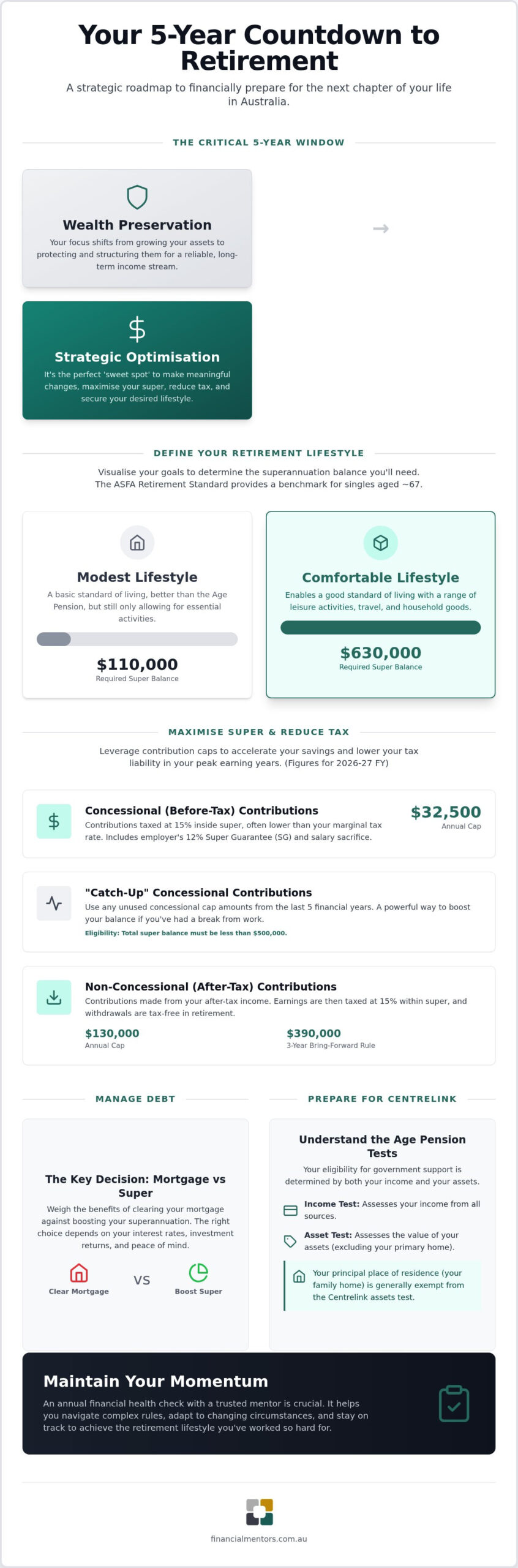
Five years might seem like a distant horizon, but in the context of Superannuation in Australia, it’s the perfect “sweet spot” for meaningful structural change. This window allows you to move beyond simply saving and start focusing on the long-term integrity of your wealth. If you’ve spent decades in the “wealth creation” phase, shifting your mindset toward “wealth preservation” can feel like a significant transition. It’s a period where the goal is no longer just to grow the pile, but to ensure that pile is protected and structured to provide for you throughout your later years.
Learning how to financially prepare for retirement in 5 years means identifying the gap between what you have now and the “number” you’ll actually need to maintain your lifestyle. Many Australians find that this five-year mark is when the abstract concept of retirement suddenly becomes a tangible reality. It’s the ideal time to ask yourself whether your current trajectory aligns with your aspirations. Are you envisioning a retirement filled with overseas travel and frequent dining out, or a more modest, quiet life closer to home? Defining these goals early is vital, as it dictates every financial move you make from this point forward.
Calculating Your Retirement Income Needs
Start by estimating your annual expenses based on your desired post-work activities. You’ll need to account for the creeping effect of inflation and the likely increase in healthcare costs as the years pass. The ASFA Retirement Standard serves as the industry benchmark for Australian couples, detailing the annual expenditure required for either a “modest” or “comfortable” post-work lifestyle. For a comfortable retirement at age 67, current estimates suggest a single person needs a superannuation balance of around $630,000, while a modest retirement requires approximately $110,000. These benchmarks help you visualise the finish line and adjust your strategy accordingly.
The Role of a Planned Retirement Foundation
Establishing a solid planned retirement foundation today prevents reactive, stressful decision-making when you finally decide to finish work. Take a moment to assess your current net worth, distinguishing between your liquid assets, like cash and shares, and your non-liquid assets, such as the family home. If much of your wealth is tied up in property, you might need these five years to restructure those holdings into income-producing streams. Setting this baseline for your five-year financial roadmap gives you a clear starting point and the confidence to move forward with purpose.
Maximising Superannuation and Tax Strategies Before You Stop Work
Have you ever wondered if you’re paying more tax than necessary during these peak earning years? When considering how to financially prepare for retirement in 5 years, your tax strategy becomes just as important as your savings rate. By integrating your annual tax return preparation with a forward-looking contribution plan, you can ensure every dollar is working efficiently. This integrated approach allows you to see the immediate tax benefit of your contributions while building a more robust foundation for the future.
For the 2026-27 financial year, the concessional contribution cap is $32,500. This figure includes your employer’s 12% Superannuation Guarantee and any salary sacrifice you arrange. If you have a total super balance of less than $500,000, you might be eligible for “catch-up” contributions. This allows you to carry forward unused cap space from the previous five years, which is a powerful way to bolster your nest egg if you’ve had a break from the workforce or a lower-income period. Non-concessional (after-tax) contributions are another vital tool, with an annual cap of $130,000, or up to $390,000 if you utilise the three-year bring-forward rule.
The ATO provides extensive guidance on Super and planning for retirement, illustrating how these caps function to support your long-term goals. If you’re feeling unsure about which lever to pull first, a tailored retirement planning consultation can help clarify your path.
Transition to Retirement (TTR) Strategies
If you are aged 60 or over, a TTR strategy could allow you to access a portion of your super as a pension while you continue to work. This can be a game-changer if you want to reduce your working hours without sacrificing your take-home pay, or if you wish to use the pension income to fund further salary sacrifice contributions. It’s about finding that delicate balance between meeting today’s needs and preserving your capital for the decades ahead.
Spouse Splitting and Co-contributions
Could your partner’s super account be the key to a more tax-effective retirement? Spouse splitting allows you to transfer up to 85% of your concessional contributions to your partner’s account, which is particularly useful if you need to stay under the $2.1 million transfer balance cap. Additionally, if your spouse is a low-to-middle income earner, making a non-concessional contribution to their account might trigger a government co-contribution. These small, strategic adjustments often lead to much larger outcomes over a five-year horizon.
Clearing the Path: Managing Debt and Structuring Assets
As you enter the final stretch, the conversation often shifts from how much you can grow to how much you can keep. One of the most frequent debates we navigate with our clients is whether to prioritise paying off the mortgage or boosting superannuation. While the emotional relief of a debt-free home is significant, the tax-effective environment of super often offers a superior return on investment. Since earnings in the pension phase are generally tax-free, the mathematical advantage often lies with your super fund. Balancing these two goals is a core part of how to financially prepare for retirement in 5 years, ensuring you don’t sacrifice long-term growth for short-term comfort.
If your family home is larger than you now require, the Downsizer Contribution rules offer a unique opportunity. You may be able to contribute up to $300,000 per person into your super from the sale proceeds of your primary residence, provided you’ve owned it for at least ten years. This doesn’t count toward your standard contribution caps, making it a powerful tool for those who need a final capital injection. At the same time, this is the window to consolidate any lingering multiple super funds. Doing so can reduce unnecessary fees and ensure you aren’t paying for duplicate insurance premiums that may no longer be fit for purpose.
Debt Reduction Framework
Entering retirement with high-interest consumer debt is like trying to run a marathon with a heavy backpack. Clearing credit cards and personal loans should be your absolute first priority during these five years. By the time you reach your retirement date, the goal is to have the primary residence mortgage fully extinguished or structured so it can be managed without stress. If you own investment properties, consider the tax implications of selling now versus later. Capital Gains Tax can take a sizeable bite out of your proceeds, so timing the sale to coincide with a lower-income year could be a wise move.
Wealth Creation Strategies for the Final Push
Refining your wealth creation strategies australia during this period is about finding the right balance between stability and growth. While super is your primary vehicle, holding some diversified assets outside of superannuation provides essential liquidity and flexibility. This is also the time to review your investment risk profile. As your timeframe shortens, you might choose to shift away from aggressive growth assets toward more defensive positions to protect your capital. We also recommend maintaining a dedicated emergency cash buffer, ideally three to six months of expenses, to ensure you never have to sell investments during a market downturn.
Preparing for the Centrelink and Age Pension Reality
Have you considered how the Age Pension might complement your private savings? Even if you don’t expect to rely on government support, understanding how the system works is a vital part of how to financially prepare for retirement in 5 years. For many Australians, the Age Pension acts as a safety net or a supplement that provides extra breathing room. As of July 2026, the pension age is 67, and the system uses two distinct tests to determine eligibility: the Assets Test and the Income Test. Centrelink applies whichever test results in the lower pension rate, so it’s essential to understand where you stand before you reach the finish line.
Understanding the interaction between your assets and your entitlements can be complex. Your family home is generally exempt from the Assets Test, which is a significant advantage for many homeowners. However, being a homeowner also means you face lower asset thresholds for a full pension. Currently, the threshold for a full pension for a homeowner couple is $499,000, while for a single homeowner, it’s $333,000. If you’re planning to help your children with a financial gift, be mindful of the gifting rules; Centrelink limits gifts to $10,000 per financial year or $30,000 over a rolling five-year period. Exceeding these limits could see the excess amount still counted as your asset for five years.
If you’d like to explore how your specific assets might impact your future entitlements, you can book a retirement planning session to discuss your circumstances. Organising your documentation now, such as bank statements and superannuation records, will make the eventual application process much smoother.
Strategic Asset Restructuring
The way you structure your wealth can significantly influence your Centrelink assessment. Certain lifetime annuities receive favourable treatment under the Assets Test, potentially helping you qualify for a higher pension rate while securing a guaranteed income stream. If you decide to keep working part-time, the Work Bonus scheme allows working retirees to earn up to $300 per fortnight without it reducing their Age Pension payments. This flexibility allows you to stay active and engaged without being penalised at the checkout.
Estate Planning and Future Security
Beyond the numbers, true peace of mind comes from knowing your loved ones are protected. Seeking professional estate planning advice is a critical part of your five-year countdown. This is the time to review your binding death benefit nominations within your super fund to ensure your balance goes exactly where you intend. Having up-to-date Wills and Powers of Attorney ensures that your wishes are respected, even if you’re no longer able to speak for yourself. It’s about stewardship and ensuring the legacy you’ve built is managed with care.
Navigating the Transition with a Trusted Mentor
While the technical steps we’ve discussed are clear, the actual implementation often involves a level of complexity that can feel overwhelming. Many Australians consider a DIY approach to save on costs, yet this often leads to missed tax opportunities and structural errors that are difficult to correct later. When you’re looking at how to financially prepare for retirement in 5 years, having a partner who understands the intersection of tax law and wealth management is invaluable. It’s about more than just numbers; it’s about the quiet confidence that comes from knowing your plan has been stress-tested by an expert who has walked this path with many others.
An annual financial “health check” during this five-year countdown serves as your navigational beacon. These regular reviews allow you to adjust your strategy as legislation changes or as your personal goals evolve. Perhaps you’ve decided to retire six months earlier, or maybe a family inheritance has changed your asset base. If these shifts occur, your mentor is there to ensure your roadmap remains accurate. This ongoing partnership provides the emotional reassurance needed during a major life transition, transforming uncertainty into a structured, manageable process.
Selecting the Right Wealth Management Office
Choosing the right wealth management office is a decision rooted in trust and shared values. You should look for a firm that offers a national focus, ensuring they understand the broader Australian economic landscape while providing personalised, human-centric advice. Transparency is equally vital. A professional advisor will always be clear about their fee structure and the specific value they bring to your retirement journey. At Financial Mentors Wealth Management, we pride ourselves on being a steady companion, helping you navigate the complexities of AFSL regulations and tax integration with ease.
Your Retirement Readiness Checklist
As you begin this final five-year stretch, it helps to have a clear summary of your action items. From maximising your super contributions and clearing consumer debt to reviewing your estate planning and Centrelink eligibility, each step is a building block for your future. We’ve designed our service to support you through every one of these milestones, ensuring no detail is overlooked. To help you get started today, we invite you to download our comprehensive retirement planning checklist australia. This resource serves as a practical guide to keep you organised and focused on the lifestyle you’ve worked so hard to achieve.
Taking Ownership of Your Next Chapter
The final sixty months of your career represent more than just a countdown; they are a unique opportunity to align your finances with your values. By focusing on integrated tax strategies, clearing high-interest debt, and understanding your future Centrelink eligibility, you can replace uncertainty with a sense of quiet confidence. Understanding how to financially prepare for retirement in 5 years isn’t just about the numbers on a spreadsheet. It’s about securing the freedom to live life on your own terms.
You don’t have to navigate these complex rules alone. With over 20 years of experience helping Australians retire with confidence, our team provides strategic advice under AFSL 2003. We are specialists in integrated tax and wealth management, ensuring every part of your plan works in harmony. If you’re ready to build your personal roadmap, book a consultation with Financial Mentors to secure your 5-year retirement roadmap. Your journey toward a stable and fulfilling future is well within reach, and we’re here to guide you every step of the way.
Frequently Asked Questions
How much super do I need to retire comfortably at 60 in Australia?
For a comfortable retirement at age 67, ASFA estimates a single person needs around $630,000 in superannuation. If you plan to retire at 60, you’ll likely need a higher balance to fund the seven-year gap before you become eligible for the Age Pension. Your exact target depends on your desired lifestyle and whether you’ve cleared your mortgage. We can help you calculate a personalised figure based on your specific spending goals and aspirations.
Can I still make catch-up contributions if I am 5 years from retirement?
Yes, catch-up contributions are a powerful way to boost your balance if your total superannuation remains below $500,000. This rule allows you to carry forward any unused concessional cap space from the previous five years. It’s a vital part of how to financially prepare for retirement in 5 years, especially if you’ve had periods of lower income. Utilising these can significantly increase your nest egg while reducing your taxable income during your peak earning years.
What is the best way to pay off my mortgage before I retire?
The most effective approach often involves a combination of extra repayments and strategic superannuation contributions. If you use surplus income to boost your super, the tax savings might provide a better net result than paying the mortgage directly. However, the emotional security of entering retirement debt-free is also a valid goal. We often suggest reviewing your offset account balance to ensure your cash is working as hard as possible to reduce interest costs.
How does the downsizer contribution work if I sell my home?
If you sell your primary residence after owning it for at least ten years, you can contribute up to $300,000 per person into your super. These “downsizer contributions” don’t count toward your standard contribution caps, providing a significant final capital injection. It’s a wonderful way to move equity from your home into a tax-effective retirement environment. You must make this contribution within 90 days of receiving the sale proceeds to ensure you stay compliant with the rules.
Will my superannuation affect my eligibility for the Age Pension?
Yes, your superannuation balance is assessed under both the Assets Test and the Income Test once you reach the Age Pension age of 67. While you are in the accumulation phase and under pension age, your super is generally exempt. However, once you start an account-based pension, the value of those assets and the deemed income they produce will influence your Centrelink entitlements. Strategic planning helps you understand how these tests apply to your specific situation.
Is a Transition to Retirement (TTR) strategy right for everyone?
A TTR strategy is most beneficial if you’re aged 60 or over and want to reduce your working hours or boost your super through salary sacrifice. It isn’t a “one size fits all” solution, as the tax benefits depend on your marginal tax rate and your overall balance. If you don’t need the extra income and aren’t gaining a clear tax advantage, it might be better to leave your super untouched to maximise its long-term growth.
What happens if I haven’t started planning and only have 5 years left?
Five years is still a significant window to make impactful changes to your financial future. While you might feel behind, this period is the ideal time for structural optimisations that can drastically improve your outcome. Learning how to financially prepare for retirement in 5 years involves focusing on aggressive super contributions and debt reduction. It’s never too late to start, and even small, strategic adjustments today can lead to a much more comfortable lifestyle later.
How often should I review my retirement plan in the final countdown?
We recommend an annual review during your final five-year lead-up to retirement. Retirement rules and tax laws change frequently, and your personal circumstances or health might also shift during this time. A yearly health check ensures your roadmap stays on track and allows you to pivot if your goals change. This regular rhythm provides peace of mind, knowing that you’re always making decisions based on the most current information and regulatory environment.