
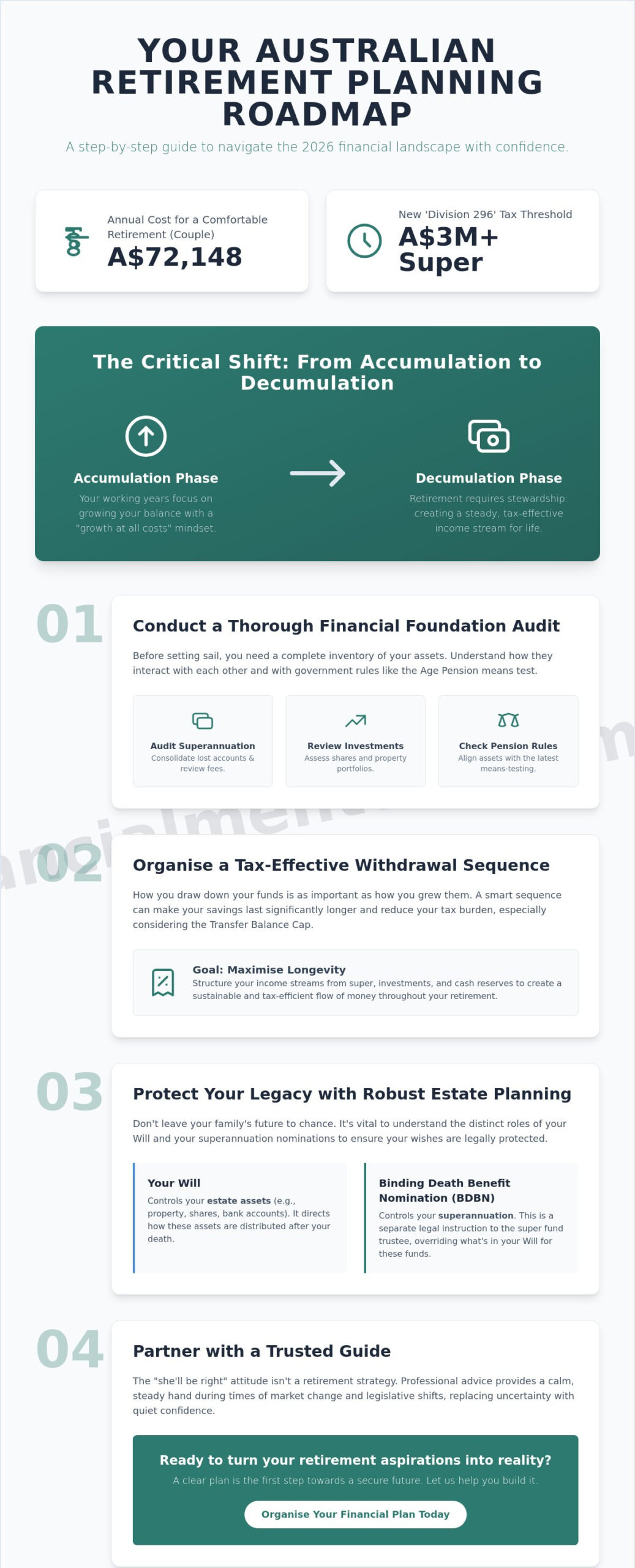
What if the “magic number” you’ve been saving for is no longer enough to sustain the lifestyle you’ve worked so hard to build? With the annual cost of a comfortable retirement for a couple now estimated at A$72,148, it’s easy to feel a sense of anxiety about how far your nest egg will truly stretch. If you’re feeling overwhelmed by the new Division 296 tax or shifting superannuation caps, following a retirement planning checklist australia can provide the structure you need to regain control. It’s a lot to process, and it’s perfectly normal to want a bit of certainty in an ever-changing financial environment.
We believe that retirement should be a time of quiet confidence rather than a source of stress. This guide provides you with a clear, chronological roadmap to help you organise your finances and protect your family’s future. We’ll explore how to maximise your income through smart tax strategies, ensure your estate planning is robust, and help you transition into this new chapter with a sense of purpose and security. By the end of this article, you’ll have the tools to turn your retirement aspirations into a well-protected reality.
Key Takeaways
- Gain a clear, step-by-step roadmap for your transition using a retirement planning checklist australia tailored for the 2026 economic environment.
- Learn how to conduct a thorough audit of your super, shares, and property to see how they align with the latest Age Pension means-testing rules.
- Discover how to organise a tax-effective withdrawal sequence to help your savings last longer and ensure your family’s future is secure.
- Understand the vital role of estate planning advice in distinguishing between your Will and Binding Death Benefit Nominations to protect your legacy.
- Explore why partnering with a trusted guide for your financial planning can provide the calm, steady hand needed during times of market change.
What is a Retirement Planning Checklist and Why Does it Matter in 2026?
A retirement planning checklist australia is more than just a list of tasks. It is a chronological roadmap designed to guide you through the transition from your working years into a life of intentional leisure. In 2026, this process has become more complex than in previous decades. We are seeing a unique intersection of inflationary pressures and significant legislative shifts, such as the introduction of the Division 296 tax on superannuation balances over A$3 million. Merely “having enough” is no longer the primary goal for many. Instead, the focus has shifted to “organising for impact”—ensuring your assets work as hard as they can to support your specific lifestyle goals while protecting your family’s inheritance.
It is perfectly natural to feel a tug-of-war between excitement and anxiety. You might be looking forward to more time with your family or travel, yet feel a lingering worry about whether your nest egg can withstand the rising costs of insurance, utilities, and groceries. This checklist is here to provide clarity and replace that uncertainty with a sense of quiet confidence. It validates the work you have already done while providing the structure needed for the final steps of the journey.
The Shift from Accumulation to Decumulation
For most of your life, the goal was simple: grow the balance. However, as you approach your retirement date, your investment strategy must evolve. This is the shift from accumulation to decumulation. It is often a significant psychological hurdle to start spending the capital you have spent decades protecting. Successful management of Superannuation in Australia requires a transition toward stewardship. This means viewing your wealth not just as a savings account, but as a resource to be managed wisely to provide a steady, tax-effective income stream for the next thirty years. Your portfolio needs to move from a “growth at all costs” mindset to one that prioritises sustainable cash flow and capital preservation.
Why ‘She’ll Be Right’ Isn’t a Retirement Strategy
The classic Australian “she’ll be right” attitude is wonderful for many things, but it is a risky approach to your financial future. With life expectancies increasing, the risk of outliving your savings is a genuine concern that requires proactive management. A structured retirement planning checklist australia helps eliminate the decision fatigue that often comes with complex financial choices. By moving from the identity of a “worker” to a “steward” of your family’s future, you can focus on what truly matters. Having a plan in place means you aren’t guessing about your next move. You are following a deliberate path that respects the gravity of your hard-earned wealth and ensures you don’t leave your legacy to chance.
The Financial Foundation: Superannuation, Investments, and the Age Pension
Building a secure future is much like preparing for a long voyage. You need to know exactly what is in your cargo hold before you set sail. A key part of any retirement planning checklist australia involves conducting a thorough audit of your entire financial landscape. This means looking beyond your superannuation balance to include personal share portfolios, investment properties, and cash reserves. Have you considered how these different assets will interact once your regular salary stops? Understanding how super works in conjunction with your outside investments is vital for creating a reliable income stream. It is also the ideal time to consolidate any lost super accounts and review your fee structures. Every dollar saved on unnecessary management fees today is a dollar that stays in your pocket during retirement.
As you approach this milestone, the Transfer Balance Cap (TBC) becomes a critical figure in your planning. This cap limits the total amount of super you can move into a tax-free retirement phase account. If your balance is approaching these limits, you might need to consider alternative financial planning strategies to remain tax-efficient. By organising these details now, you can avoid the stress of complex adjustments later, allowing you to focus on the life you want to lead.
Maximising Your Super Contributions
If you have a few years left before you finish work, you have a valuable window to boost your balance. For the 2025-2026 financial year, the concessional contributions cap is A$30,000, rising to A$32,500 from 1 July 2026. Are you taking full advantage of these before-tax limits? You might also consider the “bring-forward” rule for non-concessional contributions, which allows you to contribute up to A$120,000 per year, or up to three years’ worth in one go, depending on your total super balance. For couples, strategies like spouse splitting or co-contributions can help balance your combined wealth, potentially reducing future tax liabilities and making the most of both partners’ caps.
The Age Pension: A Safety Net or a Strategic Component?
Many Australians find that their retirement is funded by a combination of personal savings and the Age Pension. As of March 2026, the maximum full rate for a single person is A$1,200.90 per fortnight. However, eligibility depends on the means test, which looks at both your income and your assets. It is worth noting that while your family home is generally exempt from the asset test, your investment properties and share portfolios are not. If you find yourself just over the threshold, certain strategies, such as gifting within legal limits or improving your primary residence, may help you qualify for a part pension. Timing your retirement to align with your pension eligibility age, which is now 67, can ensure there are no uncomfortable gaps in your cash flow.
Checklist Step 1: Tax-Effective Income and Protecting Your Legacy
Once you have audited your assets, the next phase of your retirement planning checklist australia focuses on how you will actually access your money. It isn’t just about the total balance; it is about the sequence in which you draw down your funds. If you spend your taxable assets first while allowing your tax-free superannuation to continue growing, you could significantly increase the longevity of your portfolio. This strategy helps plug “tax leaks” that often go unnoticed in a standard investment structure. Have you considered setting up a transition-to-retirement (TTR) income stream? This allows you to access a portion of your super while you are still working, potentially reducing your overall tax bill and boosting your final savings as you approach the finish line.
Professional tax return preparation plays a vital role during this transition. By coordinating your final years of salary with your initial pension payments, you can avoid unnecessary tax brackets. This methodical approach ensures that your transition is smooth and that you aren’t leaving money on the table that could otherwise fund your retirement lifestyle.
Navigating the ‘Death Tax’ on Superannuation
Many Australians are surprised to learn about the hidden costs of passing on their super to adult children. If your super is paid to a non-dependant beneficiary, the “taxable component” can be hit with a tax rate of 17%. To protect your legacy, you might consider a re-contribution strategy. This involves withdrawing a portion of your super and contributing it back as a non-concessional payment, effectively “washing” the funds of future tax liabilities. A wise mentor acts as a second pair of eyes to help you identify these hidden tax traps before they impact your family’s inheritance.
The Intersection of Tax Compliance and Wealth Growth
Your final few Australian Taxation Office retirement planning steps involve more than just checking a box. In fact, your final tax returns as an employee are arguably the most important you will ever file. Integrating your tax return preparation with your broader wealth management roadmap ensures that your income remains stable and your compliance is handled with care. If you are planning on downsizing the family home, you’ll need to manage potential capital gains tax (CGT) implications carefully, even though the main residence exemption usually applies. By taking these methodical steps, you move closer to the peace of mind that comes from knowing your financial affairs are in perfect order.
Checklist Step 2: Estate Planning and the Emotional Transition
While the numbers on your balance sheet are vital, the true value of a retirement planning checklist australia lies in the security it provides for your loved ones. It’s a common misconception that a Will covers everything you own. In reality, your superannuation sits outside your estate. This makes a Binding Death Benefit Nomination an essential companion to your Will. Without it, the distribution of your super could be left to the discretion of a fund trustee, potentially leading to outcomes you never intended. Have you taken the time to ensure these documents are actually talking to each other?
Establishing an Enduring Power of Attorney and Medical Guardianship is another act of stewardship. These roles ensure that if you are ever unable to make decisions for yourself, someone you trust is empowered to act in your best interests. A comprehensive retirement planning checklist australia should always include these protective measures to avoid leaving your family in a difficult position. Communicating this ‘legacy plan’ to your family early is a practical way to avoid future conflict. It allows your children and partner to understand your wishes clearly, reducing stress during already difficult times. It’s about creating a culture of transparency and care within your family.
Estate Planning Beyond the Legal Documents
True estate planning is about more than just signing papers; it’s about ensuring your wealth creation strategies align with your ultimate distribution goals. You might consider the role of testamentary trusts to protect your children’s inheritance from unforeseen challenges like relationship breakdowns or financial instability. This level of preparation provides the ultimate peace of mind for your partner, knowing that a clear roadmap exists even when you aren’t there to guide it. If you’re ready to secure your family’s future, our team can provide the estate planning advice you need to move forward with confidence.
Preparing for the ‘Identity Shift’
Have you thought about what your ‘typical Tuesday’ will look like once you’ve hung up the boots? The first year of retirement often brings a significant identity shift. You’re moving from a life defined by professional achievements to one focused on personal stewardship and social connection. It’s a transition that requires as much emotional preparation as financial planning. A mentor’s perspective can be incredibly grounding during these first 12 months, helping you focus on your health and the new purpose you wish to build. Retirement isn’t an end point; it’s the start of a chapter where you finally have the time to be the person you’ve always wanted to be.
Partnering with a Mentor: Why Professional Advice is the Final Step
Completing a retirement planning checklist australia is a significant achievement that brings you closer to your goals. However, the true power of a plan lies in its execution and ongoing management. Many Australians find that while they can manage the individual components of their finances, coordinating the interplay between tax, superannuation, and estate planning requires a more holistic approach. This is where a wealth management office provides immense value. Instead of dealing with fragmented advice from different sources, you benefit from a unified strategy where every decision is made with your total financial picture in mind. It’s the difference between having a collection of parts and a finely tuned engine.
A retirement financial advisor often serves as a “behavioural coach” during times of economic change. With the RBA cash rate sitting at 4.35% as of May 2026, market conditions can feel uncertain. It’s during these moments of volatility that a mentor helps you stay the course, preventing emotional decisions that could impact your long-term stability. Moving from a DIY checklist to a professionally managed roadmap means you no longer have to shoulder the burden of complex legislative changes alone. You gain the peace of mind that comes from knowing a dedicated partner is watching your back, allowing you to focus on enjoying the lifestyle you’ve worked so hard to fund.
What to Look for in a Financial Mentor
When choosing someone to guide your retirement journey, ensure they hold a valid Australian Financial Services Licence (AFSL) and adhere to the highest professional standards. You need a partner who understands the deep connection between strategic retirement planning and tax compliance. An advisor who can integrate your tax return preparation with your wealth creation strategies will always be more effective than one who looks at your investments in isolation. To prepare for your first meeting, gather your latest super statements, property valuations, and a rough idea of your desired annual spending. This allows for a more meaningful conversation from the very beginning.
Your Next Move: From Planning to Action
Turning your aspirations into a reality starts with a few deliberate steps. If you’re ready to move forward, consider these three actions for your week ahead:
- Audit your assets: Collate your latest balances for super, shares, and savings to get a clear starting point.
- Check your nominations: Verify that your Binding Death Benefit Nominations are current and reflect your wishes.
- Start a dialogue: Reach out to a professional to discuss how your specific life goals align with the 2026 regulations.
We invite you to share your unique story and aspirations with us. Retirement is a deeply personal transition, and you deserve a plan that is as individual as you are. By taking action today, you ensure that your transition is handled with the care, wisdom, and stewardship it deserves. Secure your future with Financial Mentors today and take the first step toward a retirement defined by confidence and clarity.
Taking the First Step Toward Your New Chapter
Preparing for the future is one of the most significant acts of stewardship you can undertake for yourself and your family. By following a structured retirement planning checklist australia, you’ve already begun the vital work of organising your assets for maximum impact. You now understand that a successful transition requires more than just a healthy super balance; it demands a careful orchestration of tax-effective income streams and robust estate planning advice to protect your beneficiaries from unnecessary tax burdens. It is about turning complexity into a clear, manageable path forward.
At Financial Mentors, we’ve been helping Australian families navigate these complex milestones since 2003. As an AFSL licensed firm, we pride ourselves on our deep expertise in both wealth management and professional tax return preparation. We don’t just look at the numbers; we look at the life those numbers are meant to support. If you’re ready to move from a list of tasks to a living, breathing roadmap, we’re here to walk beside you as a trusted guide.
Why leave your hard-earned legacy to chance when you can have a mentor by your side? Start your retirement journey with a trusted mentor at Financial Mentors and gain the clarity you deserve. Your best years are still ahead of you, and we look forward to helping you reach them with quiet confidence.
Frequently Asked Questions
When should I start using a retirement planning checklist in Australia?
Ideally, you should begin using a structured checklist five to ten years before your intended retirement date. This timeframe gives you enough room to maximise your superannuation contributions and adjust your investment strategy without feeling rushed. Starting early allows you to transition from a growth mindset to one of stewardship, ensuring your assets are organised well before you stop working.
What is the ‘death tax’ on superannuation and how can I avoid it?
The so-called ‘death tax’ is a 17% tax applied to the taxable component of your super when it is paid to non-dependants, such as adult children. You can often reduce this liability through a re-contribution strategy. This involves withdrawing funds and contributing them back as non-concessional payments, effectively converting the balance into a tax-free component for your beneficiaries.
How much super do I actually need for a comfortable retirement in 2026?
According to the ASFA Retirement Standard for the March 2026 quarter, a single person needs an annual income of A$51,278 for a comfortable lifestyle, while a couple requires A$72,148. The total super balance you need depends on your eligibility for the Age Pension. Following a retirement planning checklist australia helps you calculate your specific requirements based on your unique lifestyle aspirations.
Can I still get the Age Pension if I own my own home?
Yes, you can certainly qualify for the Age Pension as a homeowner. Centrelink generally excludes your principal place of residence from the asset test, though they apply different asset thresholds for homeowners compared to renters. It is a strategic balance, as your other assets, including super and shares, will still be assessed to determine if you receive a full or part pension.
What is a Binding Death Benefit Nomination and why do I need one?
A Binding Death Benefit Nomination is a formal instruction to your super fund trustee that dictates exactly who receives your super balance when you pass away. Since superannuation isn’t automatically covered by your Will, this document is essential for certainty. It removes the trustee’s discretion, ensuring your hard-earned savings are distributed to your loved ones according to your specific wishes.
How often should I review my retirement plan with a financial advisor?
You should aim to review your plan at least once a year or whenever your personal circumstances change significantly. Regular reviews are vital for staying ahead of legislative shifts, such as changes to contribution caps or new taxes like Division 296. These check-ins act as a steadying hand, ensuring your roadmap remains practical and aligned with the current economic environment.
Is it better to pay off my mortgage or put more into super before I retire?
This decision often depends on your individual tax position and the interest rate on your debt. While paying off a mortgage provides immense psychological peace of mind and reduces monthly outgoings, salary sacrificing into super can offer significant tax advantages. Many people find a balanced approach works best, but it’s a choice that deserves careful, personalised attention to ensure your cash flow remains stable.
What are the common mistakes Australians make when planning for retirement?
A frequent mistake is underestimating the rising cost of living and its impact on a long-term nest egg. Many also overlook the importance of estate planning, leaving their families to deal with unexpected tax bills on super death benefits. Using a retirement planning checklist australia helps you avoid these pitfalls by providing a methodical, step-by-step guide to every aspect of your financial transition.