

What if the decision to move a loved one into residential care didn’t have to feel like a choice between their comfort and your family’s inheritance? When a health crisis hits, the pressure to understand the difference between a Refundable Accommodation Deposit (RAD) and a Daily Accommodation Payment (DAP) can feel overwhelming. You’re likely worried about how the current 8.43% Maximum Permissible Interest Rate might impact your cash flow or whether your Age Pension entitlements will suddenly vanish. It’s a heavy burden to carry alone, and it’s completely natural to feel protective of the legacy you’ve worked a lifetime to build. Engaging aged care financial advice specialists can provide the clarity you need to move forward with confidence rather than fear.
In this guide, you’ll discover how professional planning helps you navigate the new rules under the Aged Care Act 2024 to secure your family’s future. We’ll show you how to structure your assets to maximise your pension benefits while managing the new RAD retention fees. By the end of this article, you’ll have a clear roadmap for funding the high-quality care your family deserves without compromising the inheritance you intend to leave behind for the next generation.
Key Takeaways
- Understand why partnering with aged care financial advice specialists can transform a stressful health crisis into a calm, methodical transition for your family.
- Decode the differences between RAD and DAP payments to make informed decisions that protect your cash flow and daily liquidity.
- Discover strategies to manage means-tested care fees and safeguard your Age Pension entitlements through precise asset and income modelling.
- Evaluate the financial consequences of keeping, renting, or selling the family home, including how to utilise downsizer contributions for your superannuation.
- Learn how an integrated approach that combines financial planning with tax and estate strategy ensures your family legacy remains protected for the next generation.
Why the Transition to Aged Care Requires a Specialist Perspective
Moving a parent or partner into residential care is rarely a choice made over a quiet cup of tea. For many Australian families, it’s a decision forced by a sudden fall or a medical emergency, leaving everyone scrambling to understand a system that feels intentionally complex. This is where aged care financial advice specialists step in. They act as a steady hand during a storm, moving you away from reactive crisis planning and toward a calm, mentored strategy that respects your family’s history.
While a generalist financial planner might be excellent at managing a share portfolio or superannuation balance, they often lack the deep technical knowledge required to handle the nuances of the Department of Veterans Affairs (DVA) or the specific asset assessment rules used by Services Australia. An aged care specialist is a professional who optimises the intersection of care fees, tax, and pension. This expertise sits within the broader field of Financial Gerontology, which combines the study of ageing with strategic wealth management to ensure older Australians are treated with dignity and financial fairness.
The High Cost of “DIY” Aged Care Planning
Trying to navigate the application process alone often leads to expensive mistakes that are difficult to reverse. One of the most common pitfalls is overpaying the means-tested care fee simply because assets weren’t structured correctly before the assessment. A single error on a Centrelink form can result in months of Age Pension delays and thousands of dollars in lost entitlements. Having a mentor to liaise with government departments on your behalf ensures the paperwork is right the first time. It’s about more than just numbers; it’s about removing the administrative friction that adds to an already emotional time.
Aged Care as a Milestone in Your Wealth Journey
It’s helpful to view this transition not as a loss of independence, but as a structured phase of your planned retirement. When you have a clear plan, the “mental load” on your children is significantly reduced. They can focus on being your family rather than acting as unpaid accountants or legal researchers. For families spread across different Australian states, having a guide with a national perspective ensures that everyone stays informed and aligned. Aged care financial advice specialists provide the stability needed to make these permanent decisions with confidence, ensuring your legacy remains intact while your care needs are fully met.
Decoding the Fees: RAD, DAP, and the Means-Tested Maze
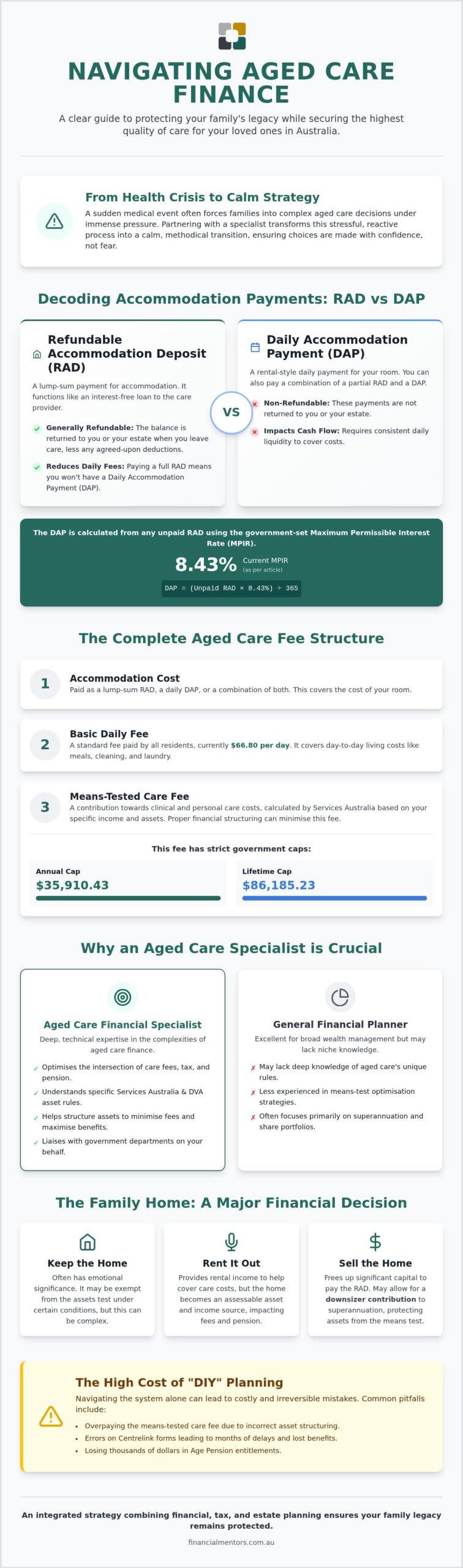
Walking through the door of a residential care facility for the first time often brings a mix of relief and financial apprehension. The fee structure in Australia is designed to be equitable, but its complexity can be daunting. You’ll primarily deal with two ways to cover your room cost: the Refundable Accommodation Deposit (RAD) and the Daily Accommodation Payment (DAP). While the RAD is a lump sum that is generally returned to your estate, the DAP is a non-refundable daily fee. For the period between 1 July 2026 and 30 September 2026, the Maximum Permissible Interest Rate (MPIR) is 8.43%, which means the cost of choosing a daily payment over a lump sum has become a significant factor in household budgeting. This interest rate directly influences your monthly liquidity, as a higher MPIR increases the daily cost for any portion of the accommodation price left unpaid as a deposit.
Beyond the room itself, every resident pays a Basic Daily Fee, currently set at $66.80. This covers the essentials of daily life, such as meals, cleaning, and laundry. However, the “Means-Tested Care Fee” is where aged care financial advice specialists provide the most strategic value. This fee is a contribution toward the cost of your clinical care, calculated based on your specific income and assets. Because it is subject to an annual cap of $35,910.43 and a lifetime cap of $86,185.23, understanding how to structure your wealth can prevent you from reaching these limits sooner than necessary. If you’re looking for the most current thresholds, the Australian Government’s My Aged Care website provides a helpful starting point for general rates.
Strategic Funding: Should You Pay the RAD in Full?
Deciding whether to pay a lump sum or a daily payment is rarely just about the math. Paying the RAD in full can be an effective way to reduce your assessable assets for the Age Pension, as the money paid to the facility is typically exempt from the pension asset test. It also offers security, as these deposits are backed by the Australian Government Guarantee. However, it may leave you with limited cash for other needs. A mentor can help you weigh these pros and cons, ensuring you don’t compromise your lifestyle for the sake of a deposit. If you’re feeling overwhelmed by these choices, reaching out for a professional consultation can provide much-needed perspective.
The Means-Tested Care Fee: Finding the Cap
Your assessment for care fees relies heavily on the data held by Centrelink and the Australian Taxation Office. This is why accurate tax return preparation is vital before you enter care. If your records are out of date, you might find yourself paying a higher Means-Tested Care Fee than your actual financial position warrants. Aged care financial advice specialists use sophisticated modelling to project your costs over several years, helping you find the “sweet spot” where your care is funded sustainably while your capital is preserved for your family.
Specialist vs. Generalist: Why Aged Care Advice is Unique
Choosing a financial partner for this stage of life requires more than just a general understanding of superannuation. While a generalist might help you balance a budget, aged care financial advice specialists act as a wise mentor, looking at your family’s total wealth rather than just the immediate care entry. This distinction matters because the decisions you make today impact your family’s financial health for years. For instance, specialists coordinate closely with legal professionals to ensure your Enduring Power of Attorney (EPOA) is correctly activated, preventing administrative roadblocks when you need to sign accommodation agreements or manage bank accounts. Even after entering care, professional wealth creation strategies remain essential to ensure your capital continues to support your lifestyle and eventual legacy.
As we move through 2026, navigating the Age Pension asset limits requires absolute precision. With the asset free area currently set at $64,500, even a small miscalculation in your assessable wealth can reduce your pension entitlements or increase your care fees. Industry insights from Mercer’s aged care financial advice highlights that the intersection of legislative rules and personal finance is becoming increasingly tight. A specialist doesn’t just fill out paperwork; they model how your pension will react to different funding scenarios, ensuring you don’t inadvertently trigger a reduction in your fortnightly income.
Centrelink and DVA Advocacy
The “Request for a Combined Assets and Income Assessment” form is a notorious labyrinth that can overwhelm even the most organised families. Aged care financial advice specialists understand the nuances of this process, particularly when it comes to “Gifting” rules. If you’ve given away more than $10,000 in a single financial year or $30,000 over five years, Centrelink may still count those funds as your assets, potentially penalising your pension for years. Your specialist ensures your income stream is optimised and that every disclosure to Services Australia or the DVA is accurate, protecting you from avoidable debt notices.
The Intersection of Tax and Aged Care
Tax doesn’t stop being a concern once you enter a facility. In fact, you may become eligible for specific tax offsets related to medical expenses or care fees that a generalist might overlook. This is why your wealth management office should ideally handle both your strategic advice and your annual tax filing. If you need to sell an investment property to fund a RAD, managing the resulting capital gains tax (CGT) is vital to preserving your capital. By integrating tax planning with aged care strategy, you can often offset these liabilities and keep more of your hard-earned wealth within the family.
The Family Home Decision: To Sell, Rent, or Keep?
For many Australians, the family home is far more than a line item on a balance sheet; it is a repository of decades of memories and a symbol of hard-earned security. When the time comes to move into residential care, deciding what to do with this asset is often the most emotional part of the journey. Under current rules, your home is generally treated as an “exempt asset” for the Age Pension for a set period, but it is assessable for aged care fees up to a specific cap. Because this decision carries significant weight for your pension, your care costs, and your eventual estate, aged care financial advice specialists are essential for modelling the long term impact of each choice.
If you choose Scenario A and sell the home, you can use the proceeds to pay a Refundable Accommodation Deposit (RAD) in full, which reduces your daily interest costs. This path also opens the door to superannuation downsizer contributions, allowing you to top up your retirement savings even later in life. Scenario B involves keeping the home, which might feel right emotionally, but you must consider how its value will eventually be assessed against the means-tested care fee. Scenario C, renting the home, provides a steady income stream to help cover care costs, yet this rent is assessable under the income test and can attract capital gains tax issues later. If you are struggling to weigh these options, you can speak with an advisor about your home to see which path aligns with your family’s goals.
The Two-Year Rule and Asset Testing
If you move into care and your home is left vacant, it is usually exempt from the Age Pension asset test for the first 24 months. This “two-year rule” provides a vital window to settle into your new environment without making a rushed sale. However, if a “protected person,” such as a spouse or a long term carer who meets specific criteria, remains living in the home, it remains an exempt asset indefinitely for as long as they reside there. Understanding these nuances ensures you don’t inadvertently trigger a pension reduction during an already challenging transition.
Protecting the Inheritance
Without a clear strategy, the high cost of care can slowly erode the inheritance you intend to leave behind. This is why care entry is the most critical time to seek professional estate planning advice. It’s a time to refresh your Will and update beneficiary nominations to reflect your new circumstances. Aged care financial advice specialists work to ensure that while you receive the highest quality care, the “surviving spouse” remains financially secure and the family legacy is preserved for the next generation.
Choosing Your Guide: How Financial Mentors Wealth Management Helps
Finding the right path through the aged care system requires more than just a calculator; it requires a partner who understands the emotional weight of these decisions. At Financial Mentors Wealth Management, our philosophy is built on being a trusted guide rather than a distant corporate entity. We sit on your side of the table to reduce the stress that naturally comes with such a significant life transition. As aged care financial advice specialists, we don’t look at care entry as an isolated event. Instead, we view it as a critical chapter in your broader wealth journey, ensuring that every financial move supports your comfort today and your legacy tomorrow.
One of the most significant advantages of our service is our integrated approach. We bring financial planning, tax return preparation, and estate strategy under one roof. This is vital because a single decision, such as selling a property to fund a RAD, triggers immediate tax and estate consequences. By managing these moving parts together, we ensure that your strategy is cohesive and that no opportunities for fee reduction are missed. Our national service means we can support your family whether you’re in a major city or a regional centre, providing a consistent point of contact for children and siblings who may be spread across different states.
Our Commitment to Clarity and Transparency
We are committed to providing clarity in an environment that often feels intentionally confusing. The aged care sector is prone to complex legislative shifts, and we make it our mission to translate these updates into plain English. Our focus is on future-proofing your family’s financial stability, ensuring that the plan we build today remains robust as rules evolve. We follow a methodical, step-by-step process that begins with a thorough assessment of your current position and moves into a tailored strategy designed for your specific goals. Getting started is as simple as having a quiet, confidential conversation about your family’s needs.
The Value of Professional Stewardship
Professional stewardship often pays for itself through the tangible benefits of fee savings and the maximisation of Age Pension entitlements. When aged care financial advice specialists manage the “means-tested maze,” the resulting increase in fortnightly income can be substantial. Beyond the numbers, there is an immeasurable peace of mind that comes from knowing every detail has been handled with precision. You can focus on the well-being of your loved one while we handle the technical complexities. When you’re ready to secure your family’s future, you can Book a consultation with our aged care specialists to begin crafting your roadmap.
Securing Your Family’s Peace of Mind
Deciding on the right care for a loved one is a significant life milestone that deserves a thoughtful, methodical approach. It’s about more than just finding a room; it’s about ensuring that your family’s hard-earned wealth continues to serve you well during this transition. Whether you are weighing up the benefits of paying a RAD in full or trying to protect the family home for the next generation, you don’t have to navigate these complex rules on your own. Partnering with aged care financial advice specialists allows you to replace the stress of crisis planning with the quiet confidence of a prepared strategy.
At Financial Mentors Wealth Management, we’ve been AFSL licensed since 2003, offering a compassionate, mentor-led approach that integrates tax return preparation with long-term wealth management. We sit on your side of the table to ensure every decision you make is future-proofed and respectful of your legacy. If you’re ready to find clarity in the noise, Secure your family’s future with expert aged care advice. You’ve worked hard to build your life’s work; let’s work together to protect it and ensure you have the support you deserve.
Frequently Asked Questions
What is the difference between a government ACSO and a private aged care financial advisor?
Aged Care Specialist Officers (ACSOs) are government employees who help you understand My Aged Care processes and general rules, but they cannot provide financial advice. Private aged care financial advice specialists act as your personal mentors, looking at your entire wealth portfolio to build a strategy. They provide specific recommendations on how to structure your assets to reduce your care fees and protect your family inheritance.
Do I have to sell my house to pay for aged care in Australia?
No, selling your home is not a mandatory requirement for entering residential care. If a “protected person,” such as your spouse or a long-term carer, continues to live in the home, it is generally exempt from the aged care asset test. If the home is vacant, it remains exempt for the Age Pension for two years, but its value is assessable for care fees up to a specific cap.
Can an aged care specialist help me get a higher Age Pension?
Yes, professional advice can often result in an increase in your fortnightly pension payments. This is usually achieved by moving assessable assets into exempt areas, such as a Refundable Accommodation Deposit (RAD). Because a RAD is generally exempt from the Age Pension asset test, paying a larger deposit can sometimes lower your assessable wealth enough to trigger a higher pension entitlement.
How much does aged care financial advice cost and is it worth it?
The cost of advice varies based on the complexity of your family’s situation, but it is widely considered a wise investment for long-term stability. The right strategy often pays for itself by identifying significant savings in means-tested care fees and maximising your government entitlements. Beyond the financial ROI, the peace of mind that comes from having a professional handle the Centrelink maze is invaluable during a crisis.
What happens to my superannuation when I move into residential aged care?
Your superannuation is treated as an assessable asset once you reach Age Pension age, regardless of whether you live at home or in a facility. If you are in the pension phase, the income drawn from your super is also included in your income test. A specialist can help you determine if it’s better to keep funds in the super system or use them to fund your accommodation deposit.
Is the Refundable Accommodation Deposit (RAD) really refundable?
Yes, the RAD is generally fully refundable to you or your estate when you leave the aged care facility. It is also backed by an Australian Government guarantee, making it a very secure way to hold your capital. If you have chosen to have other daily fees deducted from the deposit balance, those specific amounts will be subtracted before the remaining balance is returned to your beneficiaries.
How long does it take to get a financial assessment from Centrelink?
You should generally allow between four to six weeks for Centrelink or the DVA to process a “Combined Assets and Income Assessment” form. Delays often happen if the paperwork is incomplete or if your tax records aren’t up to date. Working with aged care financial advice specialists ensures your application is accurate from the start, which helps avoid stressful back-and-forth communication with government departments.
Can I give money to my children before I enter aged care to reduce my fees?
You can give money away, but you must stay within the strict “gifting” limits to avoid financial penalties. Centrelink allows you to gift up to $10,000 in a single financial year or $30,000 over a rolling five-year period. If you exceed these amounts, the excess is still counted as your assessable asset for five years, which can negatively impact both your pension and your care fees.