
What if the most daunting part of your career isn’t the work itself, but the day you decide to finish? It’s a question many Australians face as they approach their late sixties, wondering if their hard-earned savings will truly last a lifetime. If you’ve spent decades building a life for your family, it’s natural to feel a sense of unease about transitioning from a regular paycheque to drawing on your superannuation. A successful planned retirement is about more than just a final balance; it’s about the quiet confidence that comes from knowing exactly where your next dollar is coming from.
You deserve to feel secure in the knowledge that your legacy is protected and your lifestyle is sustainable. This guide will show you how a deliberate strategy can transform your financial position into a lasting foundation for the years ahead. We’ll guide you through the latest 2026 Centrelink asset thresholds and the new $2.1 million transfer balance cap, ensuring you’re positioned to maximise growth while legally minimising tax. By following this roadmap, you’ll gain a clear path for your income and the peace of mind that your future is firmly under control.
Key Takeaways
- Learn how a proactive planned retirement strategy shifts your focus from accidental saving to a deliberate design for your financial legacy.
- Discover how to optimise your superannuation as a tax-effective environment that evolves with your changing risk profile as you approach life’s next chapter.
- Understand the importance of a debt roadmap to help you clear non-deductible liabilities like a mortgage before you transition from earning to spending.
- Gain clarity on the Centrelink maze, including how the Age Pension can act as a reliable supplement to your private wealth.
- Explore how professional guidance and integrated tax preparation can simplify complex rules and provide a clear path forward for your family.
What is a Planned Retirement? Moving Beyond Accidental Saving
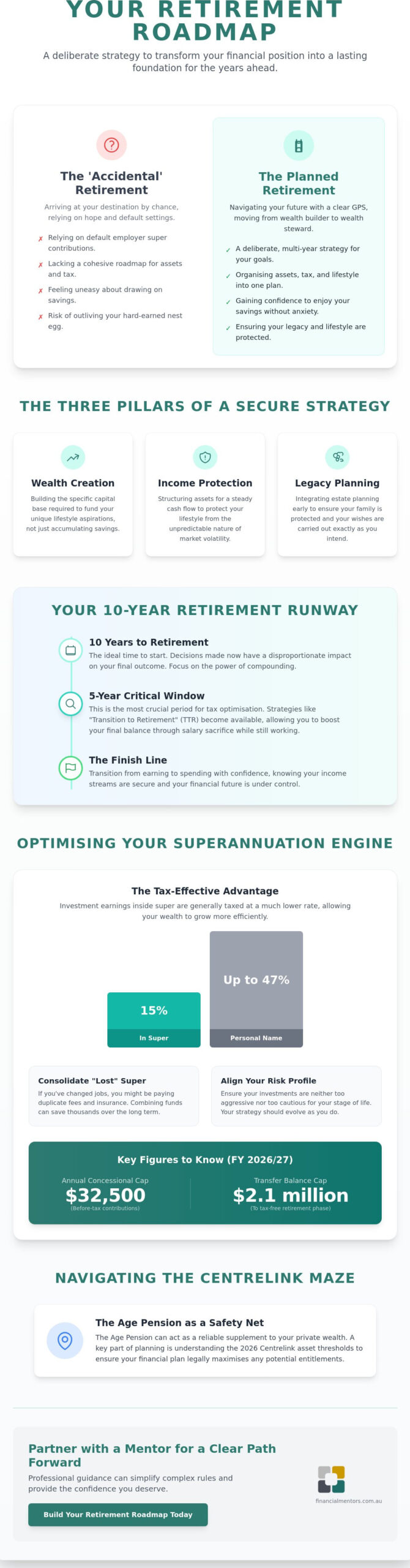
Have you ever wondered if your superannuation balance is simply a number on a screen or a genuine engine for your future? Many Australians fall into the trap of “accidental retirement,” where they rely on default employer contributions and hope for the best. A planned retirement, however, is a deliberate, multi-year strategy that organises your assets, tax obligations, and lifestyle goals into a cohesive roadmap. It’s the difference between arriving at a destination by chance and navigating there with a clear GPS.
What is retirement planning? At its heart, it’s about shifting your mindset from being a wealth builder to becoming a wealth steward. This transition carries significant emotional weight. After decades of focusing on growth, the idea of drawing down on your capital can feel unsettling. A proactive plan provides the validation you need to enjoy your hard-earned savings without the constant anxiety of outliving them. It transforms your financial security into a legacy you can be proud of.
The Three Pillars of a Secure Strategy
Building a foundation for the years ahead requires a balanced approach to three core areas:
- Wealth creation: This involves more than just saving; it’s about building the specific capital base required to fund your unique lifestyle aspirations.
- Income protection: We help you structure your assets to ensure a steady cash flow, protecting your lifestyle from the unpredictable nature of market volatility.
- Legacy planning: Your strategy should integrate estate planning advice early on, ensuring your family is protected and your wishes are carried out exactly as you intend.
Why Timing Matters More Than You Think
If you’re within ten years of finishing work, the decisions you make now will have a disproportionate impact on your final outcome. The five years immediately preceding your finish line are often the most critical for tax optimisation. This is the window where strategies like “Transition to Retirement” (TTR) become available, allowing you to access a portion of your super while you’re still working to boost your final balance through salary sacrifice.
By starting early, you allow the power of compounding to work in your favour, even in the later stages of your career. It isn’t just about the money; it’s about giving yourself the gift of time to adjust your course. If you wait until the day you stop working to look at the numbers, you may miss out on valuable opportunities to maximise your growth and minimise your tax burden legally. A well-timed strategy ensures that every pillar of your wealth is working as hard as you do.
The Superannuation Engine: Optimising Your Primary Retirement Fund
Think of your superannuation not as a static savings account, but as a high-performance engine designed to power your planned retirement. Unlike a standard bank account, super is a unique tax-effective environment where investment earnings are generally taxed at a lower rate of 15 per cent. If you’re still working, this structure allows your wealth to grow more efficiently than it would in your own name. However, the true value of super is only realised when it’s aligned with your personal journey. This means selecting superannuation retirement options that reflect your specific risk profile, ensuring your investments are neither too aggressive nor too cautious for your stage of life.
One of the simplest ways to improve your fund’s performance is to look for “lost” or multiple accounts. If you’ve changed jobs over the years, you might be paying duplicate sets of insurance premiums and administration fees that quietly erode your balance. Consolidating these into a single, high-performing fund can save thousands over the long term. Beyond consolidation, you can choose how to add to your nest egg. “Concessional” contributions are made from your before-tax income, such as employer payments or salary sacrifice, while “non-concessional” contributions are made using funds you’ve already paid tax on. If you’re unsure which path suits your goals, a tailored approach to Retirement Planning can provide the clarity you need.
Understanding Contribution Caps and Limits
For the 2026/27 financial year, the annual limit for concessional contributions is $32,500, while the non-concessional cap sits at $130,000. If you haven’t used your full concessional cap in previous years and your balance is below $500,000, you may be able to “carry forward” those unused amounts to make a larger contribution now. From 1 July 2026, the bring-forward rule allows eligible individuals under 75 to contribute up to $390,000 in non-concessional payments over a three-year period by using future caps early. These rules are designed to help you catch up if you’ve had time out of the workforce or received a sudden windfall.
SMSF vs. Industry and Retail Funds
While many Australians are well-served by industry or retail funds, some prefer the direct control of a Self-Managed Super Fund (SMSF). An SMSF might be appropriate for wealth creation if you wish to invest in specific assets like commercial property or have a complex family structure. It offers significant flexibility, but it also comes with the responsibility of being a trustee. If you choose this path, you must ensure you meet strict professional audit and compliance standards every year. For those who prefer a “hands-off” approach, a high-performing retail or industry fund provides professional management and simplicity without the administrative burden.
The Transition Phase: Balancing Debt and Spending Psychology
One of the most frequent hurdles we see is the belief that you must be entirely debt-free before you can even consider a planned retirement. It’s a common objection: “I still have a mortgage, so I can’t retire yet.” While entering your golden years with a clean slate is the ideal scenario, it isn’t always the only path forward. The key lies in understanding the difference between non-deductible debt and strategic liabilities, and having a clear roadmap to manage both as your regular salary comes to an end.
This phase also brings a significant psychological shift. For forty years, you’ve been a wealth builder, watching your balance grow with every contribution. Suddenly, you’re asked to become a wealth steward, drawing down on those very same funds to live. This can trigger a deep-seated anxiety about “spending the kids’ inheritance” or running out of money too soon. Validation of these feelings is the first step toward peace of mind. By putting a deliberate structure in place, you can move from a place of worry to one of quiet confidence, knowing that your spending is sustainable and your family’s future remains a priority.
Creating a Realistic Debt Roadmap
A successful transition requires prioritising high-interest debts, such as credit cards or personal loans, well before you stop work. If you still have a home loan, you might consider using an offset account effectively in your final working years to reduce interest costs while keeping cash accessible. For some, downsizing the family home is a practical way to clear the mortgage and use the “downsizer contribution” rule to boost your super by up to $300,000 per person. This strategy can turn a large, high-maintenance property into a more manageable lifestyle and a healthier retirement fund simultaneously.
Determining Your Retirement Income Needs
How much is enough? The answer depends entirely on your personal goals and the life you’ve imagined for yourself. We often guide clients through determining retirement income by comparing “modest” lifestyles with “comfortable” ones. A modest budget covers the basics, while a comfortable one allows for regular travel, dining out, and higher-quality household goods. To manage this cash flow, many retirees adopt a “bucket strategy.” This involves keeping one to two years of spending in a cash bucket, a few years in fixed interest for stability, and the remainder in growth assets to combat inflation. Over a 30-year retirement, inflation is a silent thief. Maintaining a portion of your wealth in growth-oriented investments ensures your spending power doesn’t vanish as the cost of living rises.
Navigating the Centrelink Maze: Age Pension and Asset Limits
What if you could treat the Age Pension not as a source of stress, but as a reliable partner in your financial journey? For about seven out of ten Australian retirees, this payment acts as either a vital safety net or a helpful supplement to their private superannuation. In a well-executed planned retirement, understanding how to interact with Services Australia is just as important as choosing the right investments. It’s about ensuring you receive every dollar you’re entitled to while staying within the rules of the system.
Centrelink applies two distinct tests to determine your eligibility: the Income Test and the Assets Test. The rule is simple yet often confusing; the test that results in the lower pension payment is the one that applies to you. If you’re still keen to contribute your skills to the workforce, the “work bonus” is a fantastic feature. it allows you to earn a certain amount of income from working without it reducing your pension payments. To keep the system running smoothly, you have a legal obligation to keep your contact details and asset values up to date. Small changes in your circumstances can impact your payments, so regular reporting is essential for maintaining your financial stability.
Understanding Age Pension Asset Limits
From 1 July 2026, the thresholds for receiving a full pension have been indexed. For a single homeowner, the limit is $333,000, while for homeowner couples, it sits at $499,000. It’s reassuring to know that your family home is generally exempt from this test, allowing you to stay in your own space without it affecting your pension eligibility. If your assets exceed these amounts, a taper rate applies, gradually reducing your fortnightly payment until you reach the part-pension cut-off. Be cautious with “gifting rules” as well. Trying to give away large sums to family members late in the piece can backfire, as Centrelink may still count those funds as your assets for five years.
The Role of the Commonwealth Seniors Health Card
If your assets or income are too high to qualify for the Age Pension, you might still find significant value in the Commonwealth Seniors Health Card. The income test for this card is often much more generous than the pension requirements, making it accessible to a wider range of self-funded retirees. Holding this card can lead to substantial savings on PBS-listed medicines and can often secure you discounts on utility bills and property rates. These small wins add up, helping you preserve your capital while enjoying a high standard of living. If you’re feeling overwhelmed by the paperwork, seeking professional Retirement Planning can help you navigate these applications with confidence.
Partnering with a Mentor: The Role of Strategic Financial Advice
While the rules and figures we’ve explored are the building blocks of security, a truly successful planned retirement requires a human touch. It’s one thing to understand the thresholds of the Age Pension or the limits of superannuation; it’s quite another to weave them into a lifestyle that feels right for you. Think of a financial mentor as a wise guide who sits on your side of the table. We’re here to help you filter out the noise and focus on the decisions that actually move the needle for your family’s future. Our role is to provide the quiet confidence that comes from knowing your strategy is robust, compliant, and deeply personal.
A secure plan isn’t a static document you lock in a drawer. It’s a living roadmap that needs to breathe. Legislative changes, like the recent indexation of pension assets or the increase in the transfer balance cap to $2.1 million, can create new opportunities if you’re prepared to act. An annual review ensures your strategy remains aligned with the world around you and your own evolving goals. At the end of the day, the best plan isn’t necessarily the one that chases the highest possible market return. It’s the one that provides the peace of mind to sleep soundly, knowing your foundation is firm.
Why Tax Strategy is Inseparable from Retirement
Professional tax return preparation is a cornerstone of wealth stewardship, especially during the drawdown phase. When you’re no longer receiving a salary, every dollar saved in tax is an extra dollar available for your lifestyle. A specialist can identify deductions you might miss as an investor and ensure your assets are structured to be as tax-efficient as possible. This integration is also vital for managing the “death tax” on superannuation. By seeking estate planning advice early, you can structure your death benefit nominations to minimise the tax burden on non-dependant beneficiaries, ensuring more of your legacy stays with the people you love.
Your Next Steps: From Reflection to Action
If you’re feeling a mix of excitement and hesitation about the road ahead, you aren’t alone. The transition from earning to spending is one of life’s biggest milestones. We encourage you to gather your current super statements and bank balances as a starting point for a conversation. In an initial consultation, don’t expect a dry lecture on spreadsheets. Instead, we’ll focus on your aspirations. What does a “comfortable” life look like to you? Once we understand your “why,” the “how” becomes much clearer. Whether you’re five years away or already at the finish line, it’s never too early, and rarely too late, to begin your planned retirement journey with a partner you can trust.
Taking the First Step Toward Your Lifestyle Legacy
Your future is too important to be left to chance. By shifting your focus from simple saving to a deliberate planned retirement, you can ensure your hard-earned wealth serves the lifestyle you’ve always imagined. We’ve explored how optimising your superannuation, navigating the latest Centrelink thresholds, and clearing the path of debt can transform your financial outlook. The most vital component, however, is the clarity that comes from having a professional roadmap tailored specifically to your family’s unique aspirations.
At Financial Mentors Wealth Management, we provide more than just numbers on a page; we offer a partnership rooted in quiet confidence and expertise. Under the personal mentorship of Murray Frean and our AFSL 2003 licensing, we integrate tax return preparation and estate planning into every strategy. This holistic approach ensures your wealth remains protected and your legacy is secure. If you’re ready to move from uncertainty to action, we’re here to help you navigate every transition with ease.
Start your journey with a trusted mentor at Financial Mentors Wealth Management and discover the peace of mind that comes from being truly prepared.
Frequently Asked Questions
How much money do I actually need for a comfortable planned retirement in Australia?
The amount you need depends entirely on your personal goals and whether you own your home. For a comfortable lifestyle, industry standards suggest a couple needs approximately $72,000 per year, while a single person requires about $51,000. These figures cover regular travel, dining out, and maintaining a high standard of living. Your planned retirement should be tailored to your specific aspirations, ensuring your capital base supports the life you’ve imagined.
Can I still contribute to my superannuation after I turn 65?
Yes, you can generally make contributions to your super until you turn 75. While the “work test” has been removed for non-concessional contributions, you must still meet it if you wish to claim a tax deduction on personal concessional contributions between the ages of 67 and 74. This flexibility is a valuable tool for those who wish to continue building their nest egg while working part-time or transitioning into their finishing years.
What happens to my planned retirement if the share market crashes?
A robust strategy is built to weather market volatility through smart asset allocation and the use of a “bucket strategy.” By keeping one to two years of living expenses in a cash bucket, you avoid the need to sell growth assets when prices are low. This approach provides the peace of mind that your immediate income is secure, allowing your long-term investments the time they need to recover and grow again.
Is it better to pay off my mortgage or put extra money into super?
The right choice depends on your specific interest rate and tax position. Paying off a mortgage provides a guaranteed “return” by eliminating interest costs, which can be a huge psychological relief. However, putting extra money into super can offer significant tax savings and long-term compounding growth. Often, a balanced approach that reduces non-deductible debt while maximising tax-effective contributions provides the most stable foundation for your future.
What is the difference between a transition to retirement pension and a normal pension?
A Transition to Retirement (TTR) pension allows you to access your super while you are still working, provided you have reached your preservation age. It’s designed to help you reduce your working hours or boost your super through salary sacrifice. A normal account-based pension is typically started after you have fully retired or reached age 65. The main difference lies in the withdrawal limits and the tax treatment of investment earnings within the fund.
How does estate planning advice differ from just having a simple Will?
Estate planning is a comprehensive strategy that covers assets your Will often cannot reach, such as your superannuation and life insurance. While a Will is a vital document, professional advice ensures that your binding death benefit nominations are correctly structured to minimise tax for your beneficiaries. This holistic approach protects your family from unnecessary legal hurdles and ensures your hard-earned legacy is distributed exactly as you intended.
Will my superannuation be taxed when I withdraw it after age 60?
For the vast majority of Australians, withdrawals from superannuation are completely tax-free once you reach age 60. This applies whether you take the money as a lump sum or as a regular income stream from an account-based pension. It’s a significant advantage of the Australian system, ensuring that you get to keep the full value of your savings to fund your planned retirement lifestyle without the burden of additional tax.
How often should I review my retirement plan with a financial advisor?
You should ideally review your roadmap at least once a year to account for legislative changes and shifts in the economy. Major life events, such as receiving an inheritance, selling a large asset, or a change in your health, should also prompt an immediate conversation. Regular reviews with your mentor provide the validation you need to stay on track, ensuring your strategy evolves as your life and the world around you change.