

If your current financial plan was a map for a journey you haven’t yet taken, would you feel confident that it leads exactly where you want to go? Many Australians find that as life becomes more rewarding, it also becomes more complex. You might feel the weight of navigating the latest superannuation changes or the 12% super guarantee rate, while also wondering if a large, impersonal bank truly understands your family’s unique aspirations. It’s understandable to feel cautious when the stakes involve your hard-earned legacy and the fear of hidden costs. Finding a dedicated wealth management office should feel like finding a trusted guide, someone who sits on your side of the table and speaks your language rather than hiding behind industry jargon.
If you can secure a partnership built on transparency and shared values, then the path toward retirement becomes much clearer. This article will show you how to evaluate a wealth management office to ensure they align with your specific life goals and provide the stability you deserve. We’ll walk through the essentials of creating a robust financial roadmap, from tax-optimised wealth strategies to estate planning advice that protects your loved ones. By the end, you’ll have the clarity needed to choose a partner who focuses on your long-term well-being, helping you move forward with quiet confidence.
Key Takeaways
- Learn how a dedicated wealth management office moves beyond simple asset management to provide a holistic strategy for your entire financial life.
- Understand the essential pillars of professional advice, including tailored retirement planning that ensures your income remains sustainable throughout your post-work years.
- Discover the importance of fee transparency and why choosing an advisor with a focus on stewardship can help you avoid the common pitfalls of institutional bias.
- Identify the critical steps to vet a potential partner, such as verifying their Australian Financial Services Licence (AFSL) status and their experience with complex estate planning.
- Explore how a mentor-style approach can transform overwhelming financial decisions into a clear, manageable roadmap for your family’s future.
What is a Wealth Management Office and Why Does it Matter?
If you’ve ever felt that your financial life is a collection of moving parts that don’t quite fit together, you aren’t alone. Many Australians reach a point where managing superannuation, tax obligations, and family investments becomes a source of quiet anxiety rather than a source of pride. This is where the role of a wealth management office becomes essential. It isn’t merely a service for picking stocks; it’s a dedicated space where your life goals are translated into a structured, sustainable plan. To truly understand the breadth of this service, it helps to look at What is Wealth Management? and how it differs from traditional banking or isolated investment tips.
While a stockbroker focuses on the success of a single transaction, a wealth office focuses on the success of your entire life journey. With the Superannuation Guarantee (SG) rate reaching 12% for the 2025-2026 financial year, the complexity of managing these growing assets has increased. Professional stewardship ensures that these funds aren’t just sitting there; they’re being actively guided to support the lifestyle you’ve worked hard to build. The true benefit is emotional. When you have a clear roadmap, that nagging feeling of “am I doing enough?” is replaced by a sense of quiet confidence and the peace of mind that comes from being prepared.
The Holistic Scope of Modern Wealth Management
Modern wealth management is about integration. If your investment strategy doesn’t talk to your estate planning advice, you might find yourself with a plan that works on paper but fails your family in reality. A professional wealth management office looks at how every decision impacts the next. Key areas of focus include:
- Integrating tax return preparation with long-term wealth creation strategies to reduce leakage.
- Developing retirement planning that accounts for shifting interest rates, such as the current 4.35% cash rate.
- Protecting your family across generations through thoughtful estate planning advice.
- Providing proactive guidance that helps you stay steady during Australian market shifts.
Stewardship vs. Transactional Advice
Transactional advice is often reactive; it’s a response to a specific event or a market trend. In contrast, stewardship is a long-term partnership that prioritises your well-being over a quick win. Think of your advisor as a wise mentor who sits across the table from you. They don’t just provide a one-off plan and disappear. Instead, they offer regular reviews to ensure your strategy remains aligned with your changing circumstances. If your family grows or your career path shifts, your financial plan should evolve too. This ongoing dialogue ensures that your wealth remains a tool for your happiness rather than a burden to manage alone.
The Pillars of a Professional Australian Wealth Management Firm
Choosing the right wealth management office means looking for a firm that understands the Australian regulatory environment as well as they understand your personal dreams. It isn’t enough to just have an investment portfolio; you need a structure that supports your specific life milestones. Whether you’re aiming for a comfortable retirement or building a legacy for your grandchildren, the pillars of a professional firm should provide a steady foundation. This involves more than just numbers. It’s about a collaborative process, much like working with a financial adviser to map out every stage of your journey with clarity and purpose.
A professional firm acts as a steward for your future, ensuring that your financial roadmap is both practical and forward-looking. This means going beyond surface-level tips to provide genuine, strategic financial planning. If your plan doesn’t account for the current 4.35% cash rate or the rising cost of living, it may not be serving your long-term interests. By focusing on sustainable outcomes, a dedicated wealth management office helps you transition from a mindset of accumulation to one of security and peace of mind.
Integrated Tax and Wealth Strategies
One of the most overlooked aspects of financial success is the harmony between your investments and your tax obligations. If your wealth advisor also manages your tax return preparation, they gain a bird’s-eye view of your financial health that a standard accountant might miss. This integration allows for the identification of tax-effective investment structures, such as discretionary trusts or specific superannuation strategies, that align with the 2025-2026 tax brackets. For instance, with the top tax rate of 45 cents for each $1 over $190,000, having a single point of contact ensures that your wealth creation strategies aren’t being eroded by unnecessary tax leakage. This streamlined approach reduces your administrative burden and provides a clearer picture of your net progress.
Retirement and Estate Security
As you move toward the later stages of your career, the focus shifts toward sustainability. Retirement planning in the current climate requires a deep understanding of the Transfer Balance Cap, which increased to $2 million on July 1, 2025. A professional firm will help you structure your assets to provide a reliable post-work income while also considering how your superannuation fits into a broader wealth creation plan. Equally vital is estate planning advice that reflects your current family situation. Life is rarely static. Families grow, relationships change, and your wishes for your legacy might evolve. Ensuring that your estate plan is robust helps avoid future conflict and provides your loved ones with a clear path forward. If you’re ready to see how a mentor-led approach can simplify these complexities, you might consider how professional financial planning can bridge the gap between your current position and your future goals.
How to Compare Wealth Management Offices: Finding Your Strategic Fit
Selecting a partner to guide your financial future is a decision that carries significant weight. It isn’t just about who has the flashiest office or the most impressive charts. Instead, it’s about finding a wealth management office that genuinely aligns with your values and understands the specific rhythm of your life. When you begin comparing firms, you’ll notice that while many offer similar services, their underlying philosophies can vary wildly. The goal is to move past the sales pitch and look at the structural foundations of how they operate.
One of the first things you should look for is transparency, particularly regarding costs. Industry research from 2025 showed that the median ongoing advice fee reached A$4,668, reflecting an 18% increase in just one year. With costs rising, you need to be certain about what you’re paying for. Many Australians are now preferring fixed-fee models over traditional asset-based percentages. This shift helps ensure that the advice you receive remains focused on your outcomes rather than the size of your portfolio. If a firm is hesitant to provide a clear, plain-English breakdown of their fees, it may be a sign to keep looking.
The Question of Independence
Who actually owns your advisor? This is a question many people forget to ask, yet it’s perhaps the most critical factor in ensuring unbiased advice. Many firms are still tied to large institutional banks or insurance companies through their Australian Financial Services Licence (AFSL). While these large entities offer a sense of scale, they can sometimes create subtle conflicts of interest. In contrast, working with a privately owned Australian firm often allows for greater flexibility. If your advisor is a “wise mentor” rather than a corporate representative, they can focus entirely on stewardship and the long-term health of your estate.
Value Beyond the Portfolio
A high-quality wealth management office provides value that you can’t always see on a balance sheet. This “peace of mind” factor comes from knowing that every detail, from your tax return preparation to your estate planning advice, is being handled with care. You should look for a firm that offers depth in their service. Do they have in-house expertise to navigate complex Australian tax law nuances, such as the Division 7A benchmark interest rate of 8.37%? Having a single point of contact who understands these technicalities ensures your strategy remains robust. Finally, consider their communication style. Do they speak your language, or do they hide behind jargon? You deserve a partner who makes the complex feel simple and the future feel secure.
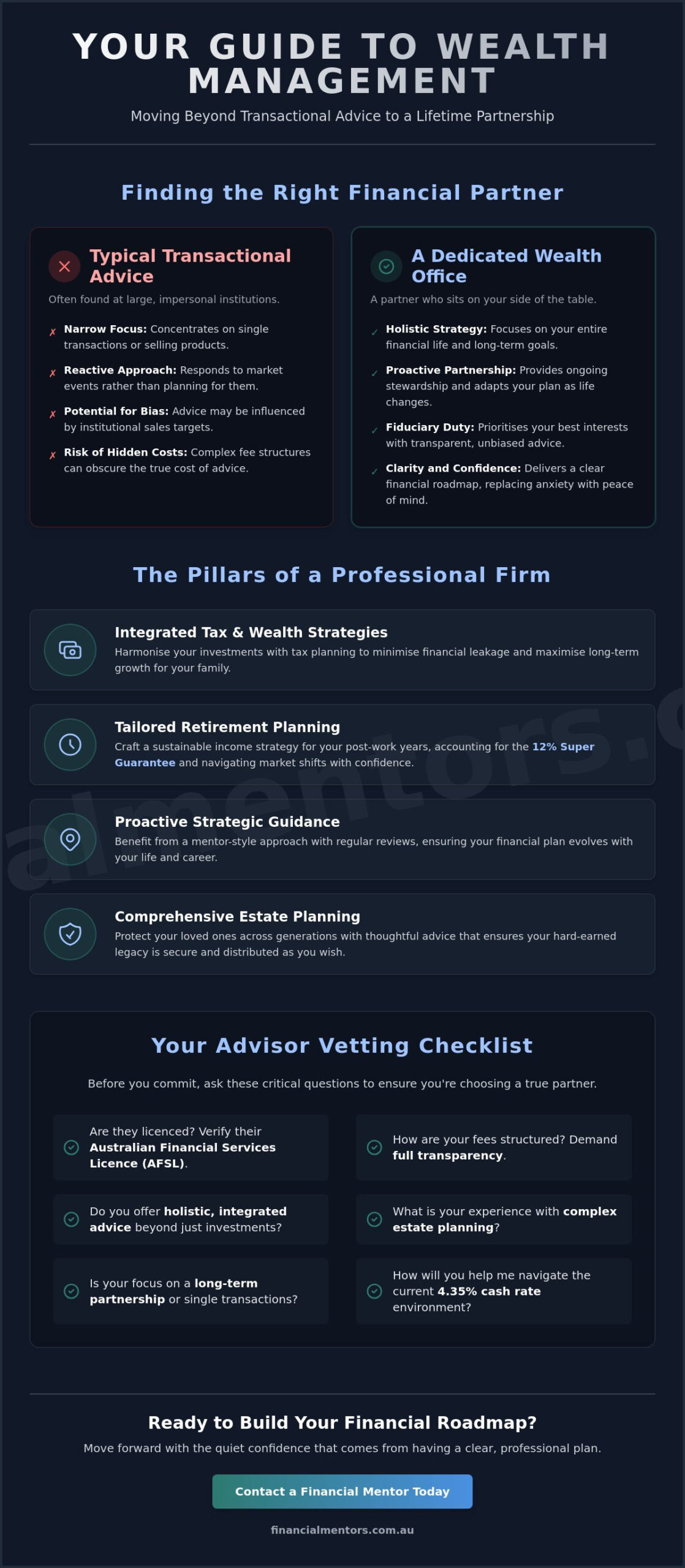
Vetting Your Advisor: Questions to Ask Before You Commit
Once you have identified a potential wealth management office, the next step is to sit down for a consultation. This meeting is your opportunity to look past the brochures and see if the firm truly embodies the role of a trusted guide. Think of it as a professional interview where you are the lead. Does the advisor spend more time explaining their products or asking about your family’s aspirations? A mentor-style relationship is built on listening; if they don’t understand your “why,” they can’t effectively manage your “how.”
Before you commit, you need to be comfortable asking the hard questions. Transparency is the bedrock of stewardship. If an office is hesitant to discuss their fee structure or their history with complex estate planning, they might not be the right fit for your legacy. You deserve a partner who is open about the costs, whether it’s the initial Statement of Advice fee or the ongoing management costs. Industry data from 2025 and 2026 shows these costs have been rising, so knowing exactly what you’re paying for is essential for your long-term peace of mind.
Regulatory Checkpoints in Australia
In the Australian financial landscape, trust is verified through strict regulatory standards. Your first task is to confirm that the firm holds a valid Australian Financial Services Licence (AFSL). You can easily check this on the ASIC Financial Advisers Register. This register also provides a history of the advisor’s experience and any past disciplinary actions. When you receive your Statement of Advice (SOA), it should feel like a clear, personalised blueprint for your future rather than a generic template. A high-quality SOA will detail how their recommendations help you achieve your goals while clearly outlining any potential conflicts of interest. If the document feels overly technical, don’t hesitate to ask for a plain-English explanation.
Assessing the Mentorship Quality
A true mentor helps you through life’s transitions, not just market fluctuations. Ask how the office handles major changes, such as receiving an inheritance or navigating the financial nuances of a career change. These are emotional times that require more than just a spreadsheet; they require empathy and a steady hand. Consider their communication rhythm. Will they reach out only when there is a product to sell, or will they provide regular, methodical reviews to ensure your tax return preparation and superannuation strategies remain on track? If you value a partnership that prioritises your journey, you can book a consultation with our team to see how we put your goals at the centre of every decision.
Why Financial Mentors Wealth Management is Your Partner in Growth
Choosing a wealth management office is an act of stewardship for your future self. At Financial Mentors, we believe that your financial plan should be as unique as your life story. If you’re looking for a partner who values your aspirations as much as your assets, then our “Wise Mentor” approach might be the fit you’ve been seeking. We don’t act as a distant corporate entity. Instead, we sit across the table from you, offering nationwide expertise in retirement and estate planning while keeping the human element at the centre of every conversation. Our goal is to reduce the stress of complex decision-making, allowing you to focus on the milestones that matter most.
One of the ways we provide better oversight is through the seamless integration of tax return preparation with your broader wealth strategy. Why should your tax affairs and your financial planning work in isolation? When these two areas are aligned, we can identify efficiencies that might otherwise be missed. This ensures that your wealth creation strategies are truly tax-optimised according to the 2025-2026 tax brackets. This holistic view provides a level of clarity and coordination that traditional, transactional firms simply cannot match. It’s about building a future-proof foundation that stands steady regardless of market shifts.
Tailored Financial Roadmaps
We focus on organising your assets for long-term sustainable growth. This isn’t about chasing the latest market fad; it’s about practical, forward-looking advice that respects your risk tolerance and life stage. Our AFSL-licensed strategic advice ensures that every recommendation is backed by professional standards and a deep understanding of Australian regulations. If you’re ready to move from financial complexity to a clear path forward, you can Book a consultation with Financial Mentors to start that dialogue. We’ll help you map out a strategy that accounts for everything from your superannuation to your legacy goals.
A Legacy of Trust Since 2003
Since 2003, we’ve helped Australians navigate the emotional and technical nuances of major life changes. Whether you’re entering retirement or planning for the next generation, our supportive, human-centric tone aims to provide the reassurance you need. We’ve seen the 12% super guarantee rate come into effect and watched the Transfer Balance Cap grow to $2 million in 2025. Through every regulatory shift, our priority remains your long-term well-being. Experience the peace of mind that comes from a professional plan designed by a wealth management office that truly cares about your journey and your legacy.
Step Into a Future Defined by Clarity and Confidence
Your financial journey is personal, and the partner you choose to guide it should reflect that. By selecting a wealth management office that prioritises stewardship over transactions, you’re ensuring that your family’s legacy is protected. We’ve discussed the importance of verifying AFSL credentials and the immense value of integrating tax return preparation with your broader financial planning. These aren’t just administrative tasks; they are the building blocks of a stable and tax-optimised future that respects your unique life milestones.
At Financial Mentors, we’ve provided specialised retirement and estate planning advice since 2003. Our integrated approach means you don’t have to juggle multiple advisors to get the results you deserve. We take pride in being the wise mentor you can rely on through every life transition. If you’re ready to replace uncertainty with a clear, professional roadmap, we invite you to reach out. Secure your financial future with a mentor who cares – Contact us today. It’s time to move forward with the quiet confidence that comes from being truly prepared.
Frequently Asked Questions
What is the difference between a financial planner and a wealth management office?
A wealth management office generally provides a more integrated and holistic service than a standard financial planner. While a planner might focus on specific areas like insurance or a single investment, a wealth office coordinates your entire financial ecosystem. This includes everything from retirement planning and wealth creation strategies to tax return preparation and estate planning advice, ensuring all parts of your financial life work in harmony.
How much does a wealth management office typically charge in Australia?
The cost of professional advice in Australia depends on the complexity of your financial situation and the level of ongoing support you require. Industry data shows that fees have increased recently due to a higher compliance workload and inflationary pressures. You should always expect a transparent, plain-English breakdown of all costs in your Statement of Advice before you agree to move forward with any recommendations.
Do I need a certain amount of assets to join a wealth management firm?
Different firms cater to different stages of the financial journey. Some offices focus on individuals who are in the early stages of wealth creation, while others specialise in managing large portfolios for those transitioning into retirement. If you’re unsure whether you’re a fit, an initial conversation can help determine if the firm’s expertise aligns with your current asset level and future aspirations.
Can a wealth management office help with my annual tax return?
Yes, many comprehensive firms like Financial Mentors offer integrated tax return preparation as part of their service suite. Having your wealth advisor handle your tax affairs ensures that your investments are managed with a full understanding of your tax obligations. This joined-up approach can lead to better oversight and ensures that your overall strategy remains as tax-effective as possible under current Australian law.
What should I bring to my first meeting with a wealth advisor?
You’ll get the most out of your first consultation if you bring documents that outline your current financial position. This usually includes your latest superannuation statements, recent tax returns, bank balance summaries, and details of any debts or insurance policies. It’s also helpful to have a clear list of your life goals, such as when you’d like to retire or how you want to support your children’s education.
How often should I meet with my wealth management mentor?
The frequency of your reviews will depend on the complexity of your affairs and how quickly your circumstances are changing. Most people find that a formal annual review is enough to ensure their plan stays on track, but you might prefer quarterly check-ins during major life transitions. A good mentor provides a steady, methodical rhythm of communication that keeps you informed without feeling overwhelmed.
Is my money safe with a private wealth management firm?
Financial security in Australia is supported by strict regulations and the requirement for firms to hold an Australian Financial Services Licence (AFSL). Most private firms use independent third-party custodians to hold your actual assets, meaning the firm itself doesn’t have direct access to your capital. This structure, combined with regular audits and ASIC oversight, provides a robust framework for protecting your hard-earned wealth.
How does estate planning integrate with my wealth management strategy?
Estate planning advice ensures that the wealth you build is eventually distributed exactly how you intend. It integrates with your broader strategy by looking at the tax implications for your beneficiaries and ensuring your superannuation binding nominations align with your will. By treating estate planning as part of your ongoing wealth strategy, you can secure your legacy and provide your loved ones with long-term stability.