
What if your annual tax lodgement wasn’t just a deadline to survive, but the most important health check for your entire financial future? It is completely natural to feel a sense of unease when tax season rolls around. You might worry about missing legitimate deductions, or perhaps the complexity of investment and superannuation rules feels like a weight on your shoulders. With the ATO’s increased focus on work-related expenses and capital gains, the stress of a potential audit is a burden nobody should have to carry alone.
We understand that you want to feel confident that your affairs are in order while ensuring your hard-earned money is working as hard as it can for you. This is where a strategic approach to tax return preparation changes the narrative. It transforms a yearly chore into a powerful tool for wealth stewardship and long-term peace of mind. By looking beyond the immediate refund, you can align your tax position with your broader life goals.
In this article, we will explore how professional guidance helps you maximise your legal position, maintain strict compliance, and ensure your tax strategy supports your journey toward a comfortable retirement.
Key Takeaways
- Discover how shifting your perspective from simple lodgement to strategic tax return preparation can uncover hidden value and improve your overall financial health.
- Compare the true cost of DIY methods against the risk management and long-term wealth benefits of partnering with a registered professional.
- Learn a methodical approach to organising your records to ensure every legitimate deduction is captured while staying compliant with the latest 2026 ATO rulings.
- Understand how your annual tax strategy serves as a vital pillar for your retirement planning and broader wealth creation goals.
- Gain the confidence that comes from knowing your complex investment and superannuation affairs are being managed with care, foresight, and professional stewardship.
Tax Return Preparation in Australia: More Than Just a Yearly Task
For many Australians, the end of the financial year brings a familiar sense of paperwork fatigue. It is easy to view the process as a mere administrative hurdle or a box to be ticked by the 31 October deadline. However, if we shift our perspective, we can see that tax return preparation is actually a vital mirror reflecting the current state of your wealth. It is the one time of year when every stream of income, every investment expense, and every contribution to your future is laid bare for review.
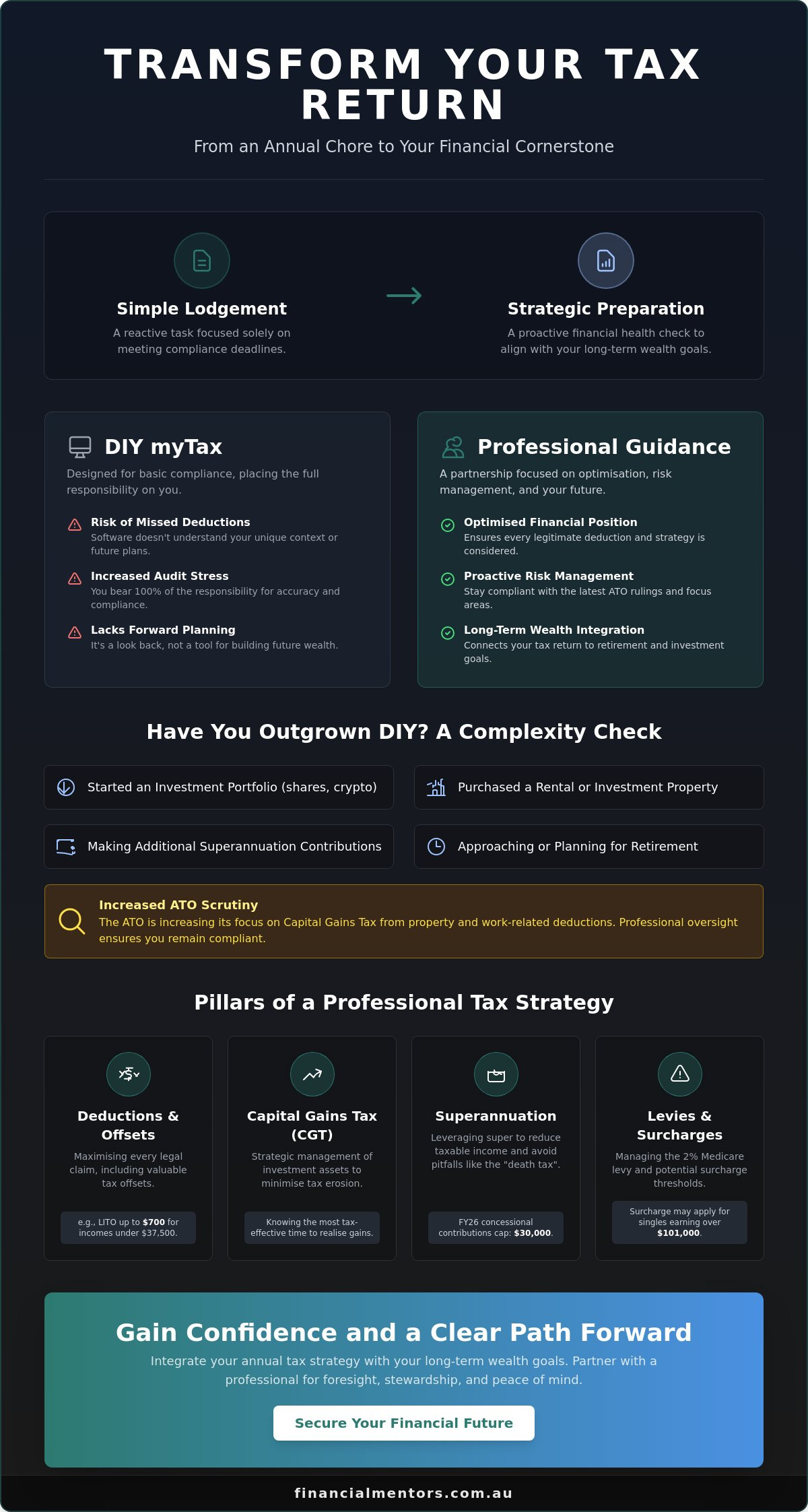
There is a significant difference between simple “lodgment” and “strategic preparation.” While the ATO’s myTax platform provides a functional way to report income, it is designed for compliance rather than optimisation. For a foundational Overview of Australian tax returns, it is helpful to understand that the system is built on self-assessment, which places the responsibility of claiming correct deductions squarely on your shoulders. Strategic preparation involves looking at these figures through the lens of your long-term goals, ensuring that your tax position today doesn’t hinder your wealth creation for tomorrow.
The Mindset of Financial Stewardship
Have you ever wondered if your tax return could do more than just settle a bill? Shifting from a mindset of “getting a refund” to “optimising your position” is the first step toward true financial stewardship. When you treat tax return preparation as a proactive financial review, you gain valuable data that informs your future planning. Professional oversight provides the peace of mind that you aren’t just meeting your obligations, but you’re also protecting your assets. It’s about the quiet confidence that comes from knowing a trusted guide has reviewed your records with a wise, forward-looking eye.
When Does Your Situation Become “Complex”?
It can be difficult to know when you have outgrown DIY tax software. Often, the transition happens gradually as life milestones occur. If you have started an investment portfolio, purchased a rental property, or begun making additional contributions to your superannuation, your tax affairs have entered a new level of complexity. The ATO is currently increasing its scrutiny on capital gains from property sales and work-related deductions, making the stakes higher for those with diverse assets. If you are approaching retirement, the need for a sharper tax focus becomes even more critical. These life transitions require a steady, methodical approach to ensure that your tax strategy remains a reliable partner in your journey toward stability.
The Components of a Professional Tax Preparation Strategy
While many people focus on gathering receipts for laundry or home office equipment, professional tax return preparation looks much deeper into the fabric of your financial life. It explores how various tax offsets and rebates can be used as active wealth tools rather than passive windfalls. For instance, the Low Income Tax Offset (LITO) provides a maximum of $700 for taxable incomes up to $37,500 in the 2025-2026 financial year. While these amounts might seem small in isolation, when they are managed as part of a broader strategy, they contribute to a more robust financial position.
Staying compliant with the Australian Taxation Office guide to lodging is the baseline for any taxpayer. However, a strategic approach goes beyond the basics to manage Capital Gains Tax (CGT) within your investment portfolio. Do you know the most tax-effective time to sell an asset? Or how the 2% Medicare levy and potential Surcharge thresholds, currently $101,000 for singles, might affect your final outcome? These are the questions a professional helps you answer, ensuring your portfolio is protected from unnecessary tax erosion.
Superannuation and Your Tax Return
Superannuation is a cornerstone of Australian wealth, yet its tax benefits are often underutilised. For the 2025-2026 financial year, the concessional contributions cap is $30,000. If you are looking to reduce your taxable income while building your nest egg, understanding these limits is essential. Professional preparation also safeguards you against “death tax” traps. These occur when superannuation death benefits are paid to non-dependants, potentially leaving your loved ones with a significant tax bill. A wise mentor can help you structure your fund options to avoid these pitfalls, ensuring your legacy remains intact.
Investment Property and Asset Management
If you own rental property, your tax return serves as a critical annual health check for your investment. It is about more than just claiming interest. It involves accurately managing depreciation schedules and the strategic timing of asset sales to manage CGT. When property tax data is integrated into your broader wealth roadmap, you can make informed decisions about your property’s performance. If you feel your current approach could be more cohesive, you might consider how wealth creation strategies can help align your property investments with your long-term aspirations. This level of integration ensures that every asset you own is contributing effectively to your future stability.
DIY myTax vs. Professional Preparation: A Comparison
Choosing between a DIY approach and professional tax return preparation often feels like a choice between saving money and saving time. It’s tempting to look at the “free” price tag of myTax and assume it’s the most efficient path. But have you considered the hidden cost of your own time? For those with complex investments, spending hours navigating digital screens and help files can be exhausting. When you partner with a professional, you aren’t just paying for a form to be filled; you are investing in a protective shield. Tax agents offer an extended lodgement window, often stretching to 15 May 2027, provided you are registered with them by October. This extra time allows for a methodical review rather than a rushed deadline, reducing the stress that often accompanies the end of October.
Beyond the calendar, there is the matter of risk management. If a mistake is made in a self-lodged return, the responsibility and the potential penalties rest entirely with you. A registered tax agent provides a layer of protection and professional indemnity. Should the ATO ever have questions about your claims, having a professional by your side is invaluable. They act as your representative, translating complex queries into plain English and ensuring you remain compliant. This level of support provides a sense of security that no automated system can replicate.
Evaluating the Professional Fee
If you view a professional fee as a cost, it feels like a burden. If you view it as an investment, the perspective shifts. In Australia, the fees you pay to a registered tax agent for tax return preparation are generally tax-deductible in the year the expense is incurred. This creates a unique “value gap” where the service often pays for itself. Imagine if a single missed deduction on a rental property or a miscalculated capital gain cost you more than the fee itself. In that scenario, the professional guidance wasn’t an expense; it was a saving. This is the difference between a cost-centre and a value-add approach to your wealth stewardship. To understand exactly what you might expect to pay for ongoing professional guidance, it is worth reviewing a detailed breakdown of wealth management fees in Australia so you can make a fully informed decision.
The myTax Limitation for Investors
The ATO’s automated pre-fill data is a helpful starting point, but it isn’t a complete picture. For investors, software often falls short when dealing with corporate actions, nuanced property expenses, or complex superannuation structures. A “set and forget” attitude in a changing regulatory environment can lead to unintended errors. Software follows rigid rules; it cannot provide the “if-then” logic that a human mentor offers. If your circumstances change, such as starting a family or transitioning toward retirement, you need a partner who understands the emotional and financial nuances of those milestones. A computer programme won’t call you to explain how a new ruling affects your specific goals, but a trusted guide will.
How to Organise Your Records for a Stress-Free Tax Season
The secret to a calm tax season isn’t just about the numbers; it is about the systems you have in place to capture them. When your records are organised, the process of tax return preparation shifts from a frantic search for receipts to a methodical review of your progress. By following a structured approach, you can ensure that every legitimate deduction is claimed and your compliance is beyond reproach. Here is a simple, five step path to getting your affairs in order.
- Step 1: Gather your income and superannuation data. Ensure your employer has finalised your income statement. If you have made personal concessional contributions to your super, keep your “Notice of Intent” and the fund’s acknowledgment handy. Remember that the Superannuation Guarantee rate is 12% for the 2025-2026 financial year, so verify that your records match your expectations.
- Step 2: Categorise investment expenses. If you have investment loans, gather your interest statements. Categorise any costs related to managing your portfolio, such as investment journals or professional advice fees.
- Step 3: Document capital improvements. If you have renovated a rental property or purchased new shares, keep these records separate. They are vital for calculating your cost base and managing future capital gains tax.
- Step 4: Review life changes. Have you recently married, started a family, or moved toward retirement? These milestones often change your tax obligations and your eligibility for certain offsets.
- Step 5: Book a consultation. Once your data is ready, a conversation with a mentor ensures your tax strategy aligns with your broader wealth plan.
Essential Documentation for Wealth Management Clients
For those with more complex affairs, standard receipts are only the beginning. You must maintain precise records for cost base calculations, especially for assets held over many years. If you receive distributions from trusts or partnerships, ensure you have the annual tax statements, as these often contain nuanced data that myTax might miss. It is also a wise time to review your Medicare Levy Surcharge position. With the 2025-2026 threshold at $101,000 for singles and $202,000 for families, having your private health insurance statement ready is essential to avoid unnecessary surcharges. If you feel overwhelmed by these requirements, our tax return preparation service can help you navigate the complexity with ease.
Digital vs. Physical Record Keeping
Do you still have a shoebox of fading thermal receipts? While the ATO accepts physical records, digital organisation significantly speeds up the process. Using a dedicated app or a simple cloud folder to snap and store receipts as they occur prevents the end-of-year stress. Digital records are also easier for your mentor to review, allowing more time for strategic discussion and less time for data entry. A trusted guide doesn’t just look at the numbers you provide; they help you refine your record-keeping habits. This collaborative approach ensures that your documentation is robust enough to satisfy any ATO enquiry while keeping your focus on your long-term financial stability.
Partnering for the Future: Integrating Tax with Wealth Management
Viewing tax as an isolated event is a common oversight that can hinder your long term financial progress. At Financial Mentors Wealth Management, we see tax return preparation as a yearly opportunity to recalibrate your entire financial trajectory. It is the moment where we can see exactly how your assets are performing and whether your current structure still serves your aspirations. By treating your tax return as a pillar of your retirement planning, we ensure that every dollar you save today is effectively contributing to the lifestyle you envision for your future years.
This integrated approach is particularly valuable when it comes to estate planning advice. Your tax documents provide a clear map of your asset holdings and income streams, allowing us to identify potential tax liabilities for your beneficiaries before they become a problem. Having a single point of contact who understands both your tax position and your family’s needs means you can make decisions with quiet confidence. As you move through different life milestones, your strategy should be flexible enough to evolve, ensuring your wealth remains a source of comfort rather than a complex puzzle to solve.
The Financial Mentors Wealth Management Approach to Tax
We believe in looking at the person behind the numbers, acknowledging that your Tax File Number represents a life full of unique challenges and goals. Our approach is defined by collaborative progress; we use the data gathered during your tax review to refine your wealth roadmap. Stewardship, in our view, is about more than just numbers on a spreadsheet. It is about the careful, personalised attention required to build a lasting legacy. We act as a reliable partner sitting across the table, providing the wise counsel you need to navigate the nuances of the Australian tax system while staying focused on your long term well-being.
Your Next Steps Toward Peace of Mind
Preparing for the 2026 tax season doesn’t have to be a source of stress. When you have a clear plan and a trusted guide, you can approach your lodgement with a sense of order and clarity. We invite you to start a dialogue about how your tax strategy can better support your broader life goals. If you are looking for a partnership that values your individual journey and provides steady, methodical guidance, we are here to help. Organise a consultation with Financial Mentors Wealth Management today and take the first step toward a more integrated and future-proofed financial life.
Taking the Next Step Toward Lasting Stability
Your financial journey is unique, and it deserves a level of care that goes beyond standard calculations. When you choose to view tax return preparation as a tool for wealth stewardship, you’re not just settling a yearly account; you’re actively shaping the legacy you wish to build. This strategic shift allows you to move away from the anxiety of compliance and toward a future where your tax position is a source of strength and clarity.
Since 2003, Financial Mentors Wealth Management has held an AFSL license, offering the specialised expertise required to link your tax strategy with retirement and estate planning. Under the steady and personalised stewardship of Murray Frean, we focus on the person behind the figures, ensuring your aspirations remain the priority. If you’re ready to transform your approach to the end of the financial year, we invite you to start a conversation about your strategic tax return. Let’s work together to ensure your hard-earned wealth is protected, optimised, and aligned with the life you want to lead.
Common Questions About Strategic Tax Preparation
Is the cost of professional tax return preparation tax-deductible in Australia?
Yes, the fees you pay to a registered tax agent for tax return preparation are generally tax-deductible in the financial year you incur the expense. This means that the professional support you receive today actually helps to reduce your taxable income in the following year. It is a practical example of how investing in professional stewardship can help the service pay for itself over time.
What is the deadline for lodging my tax return if I use a registered tax agent?
If you are registered with a tax agent before 31 October 2026, your lodgement deadline for the 2025-2026 financial year can often be extended to 15 May 2027. This extra time is particularly helpful for those with complex investment properties or share portfolios that require a methodical review. If you haven’t registered with an agent by the October date, you will generally need to meet the standard 31 October deadline.
Can a financial advisor also prepare my tax return?
A financial advisor is only permitted to prepare and lodge your tax return if they are also a registered tax agent. At Financial Mentors, we provide both services so that your tax strategy and wealth creation goals are perfectly aligned. Having one trusted guide manage both areas ensures that your annual tax return preparation informs your broader financial plan without anything being lost in translation.
What happens if I have multiple years of overdue tax returns?
If you have overdue returns, the most responsible path is to lodge them as soon as possible through a “voluntary disclosure.” The ATO is often more supportive of taxpayers who come forward to fix errors before they are audited. We can act as your representative to help gather your records and manage this process, which may help in reducing potential failure-to-lodge penalties.
How does a professional help me avoid a “death tax” on my superannuation?
We help you manage the taxable and tax-free components of your superannuation by reviewing your beneficiary nominations and implementing recontribution strategies where appropriate. If your superannuation death benefits are paid to “non-dependants” for tax purposes, such as adult children, they could be taxed at 15% plus the Medicare levy. Strategic planning ensures your hard-earned legacy is protected for your loved ones.
Do I need to lodge a tax return if I am fully retired?
You generally don’t need to lodge a return if your taxable income is below the $18,200 threshold and no tax was withheld from your income. However, many retirees still choose to lodge to claim refunds on franking credits from share dividends or to access specific tax offsets. If you’re unsure, a quick conversation can help you determine if you have a lodgement obligation or an opportunity to claim money back.
What is the difference between a tax refund and a tax offset?
A tax refund is the repayment of tax you have already paid throughout the year that exceeded your actual liability. A tax offset, such as the Low Income Tax Offset, directly reduces the amount of tax you owe on your taxable income. While a refund is money coming back to you, an offset is a tool that prevents you from having to pay that money in the first place.
How often should I review my tax strategy with my wealth manager?
We recommend a formal review at least once a year during your tax return preparation, but you should also reach out whenever a major life milestone occurs. If you are starting a family, purchasing an investment property, or moving toward retirement, your strategy needs to evolve. Regular dialogue ensures your financial plan remains a constant and reliable companion through all of life’s transitions. Before committing to a professional partnership, you may also find it helpful to understand typical wealth management fees in Australia so you can budget confidently for the ongoing guidance your situation deserves.