
What if the greatest risk to your retirement isn’t the market, but a lack of personal control over your assets? For many Australians, the appeal of direct investment is often dampened by the fear of making a costly administrative error. If you’ve been feeling overwhelmed by technical jargon or worried that the time commitment might outweigh the tax benefits, you aren’t alone. It’s a significant responsibility to manage your own future, and it’s vital to get the foundation right from day one. That’s why having a comprehensive setting up a self managed super fund checklist is the first step toward true financial stewardship.
We understand that you’re looking for more than just a list of rules; you want peace of mind and a strategy that works for your family. This guide provides a clear, step-by-step roadmap for 2026 to help you master the complexities of establishment with confidence. We’ll explore how to structure your fund to meet ATO requirements while ensuring it integrates perfectly with your long-term estate and tax planning goals. By the end of this article, you’ll have a practical path forward to turn your retirement vision into a stable, well-governed reality.
Key Takeaways
- Determine if your superannuation balance meets the $200,000 viability threshold and assess your readiness for the legal duties of a trustee.
- Follow our setting up a self managed super fund checklist to choose the most appropriate trustee structure and build a secure foundation for your retirement.
- Master the essential operational steps, from ABN registration to ATO compliance, to help you avoid penalties and reduce administrative stress.
- Learn how to craft a purposeful investment strategy that aligns with your lifestyle and integrates with your broader estate planning goals.
- Understand how professional mentorship can simplify the compliance process, allowing you to focus on achieving your long-term wealth creation strategies.
Is an SMSF Right for You? The Initial Suitability Checklist
Deciding to manage your own super is a significant life milestone. It’s about moving from a passive observer to an active steward of your future. Before you dive into the technical details of a setting up a self managed super fund checklist, it’s wise to pause and reflect on whether this path aligns with your current lifestyle and long-term aspirations. While the allure of control is strong, an SMSF requires a genuine commitment of both capital and character.
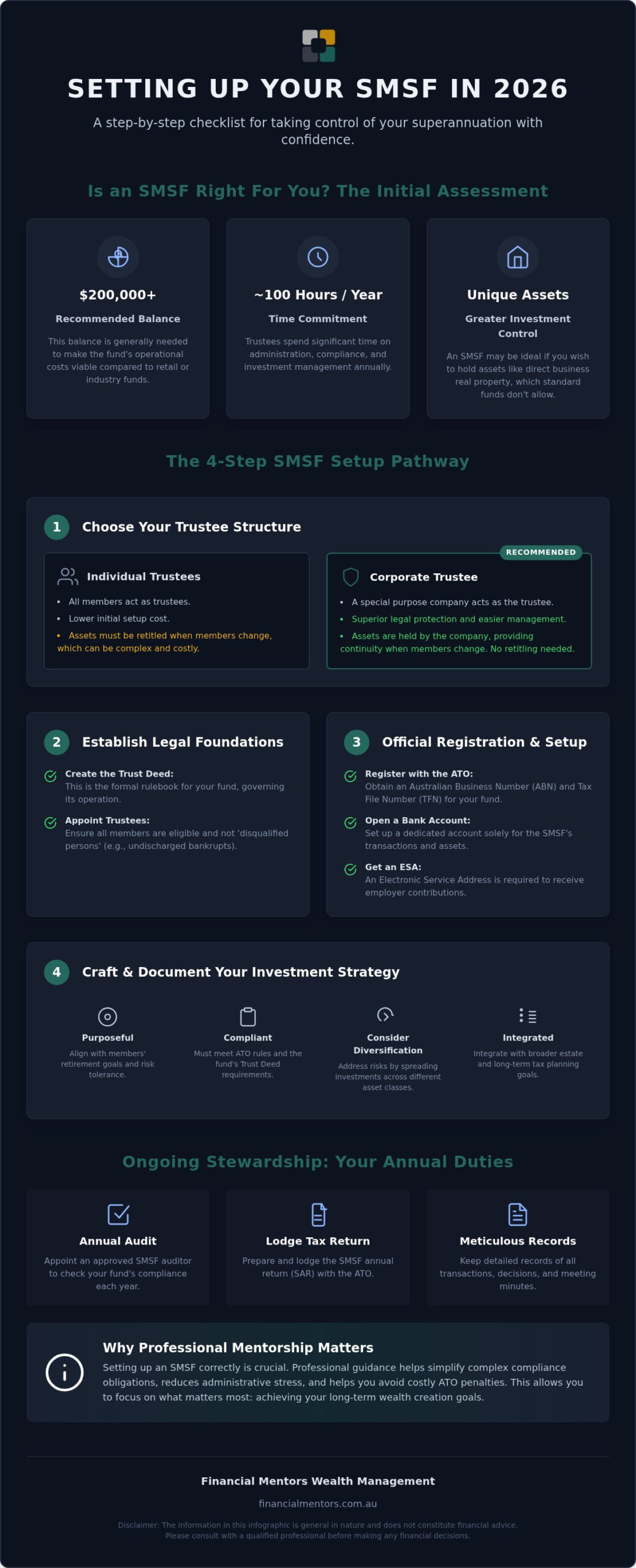
Generally, industry experts recommend a minimum combined balance of $200,000 to $300,000 to make the fund’s operational costs viable compared to a retail fund. You also need to consider the time investment. On average, trustees spend approximately 100 hours a year on management and compliance. If you’re looking to hold unique assets, such as business real property, that a standard fund won’t allow, an SMSF might be the ideal vehicle for your vision. This is why the first item on any setting up a self managed super fund checklist is always a thorough self-assessment of your resources and goals.
The “Mentor” Assessment: Reflecting on Your Goals
Why do you feel drawn to more control over your superannuation? Perhaps you have a specific vision for your family’s future that requires a more bespoke approach than a one-size-fits-all fund. It’s helpful to consider if you’re prepared for the emotional weight of managing your own retirement nest egg. This decision should never be made in isolation; instead, think about how this fund integrates with your broader wealth creation strategies australia. When you take the reins, you aren’t just an investor; you’re the person responsible for ensuring the fund provides for your later years.
Understanding the Costs of Stewardship
The history of Superannuation in Australia shows that while the system is robust, the rules are strict. This means that “cheap” setup options can often lead to expensive compliance headaches later if the foundation isn’t laid correctly. You’ll need to balance initial setup costs against ongoing annual audit and accounting fees. Using a professional retirement planning checklist australia can help you see the bigger picture and prevent costly errors. Investing in professional advice early on often pays dividends in the form of peace of mind and long-term stability. If you value the security of knowing your fund is fully compliant, then prioritising quality over the lowest price is a wise move for your future self.
Structural Foundations: Choosing Your Trustee and Creating the Deed
Once you’ve decided that an SMSF is the right path, the next step on your setting up a self managed super fund checklist is building a robust legal framework. This isn’t just a matter of filing forms; it’s about creating the vessel that will carry your retirement dreams safely through the decades. You’ll need to choose who holds the legal title to the fund’s assets and establish the rules they must follow. Getting this right now prevents significant administrative heartaches in the years to come.
Before proceeding, you must ensure all proposed trustees or directors are eligible. Under Australian law, a “disqualified person” cannot run an SMSF. This includes individuals who are undischarged bankrupts or those with certain past criminal convictions. Verifying this early is a simple but essential act of due diligence that protects the integrity of your fund from the very start.
Individual vs. Corporate Trustees: Which Offers Better Protection?
If you’re weighing up whether to act as individual trustees or set up a special purpose company to serve as a corporate trustee, it’s worth looking beyond the initial setup fees. While individual structures are often cheaper to establish, a corporate trustee usually provides superior protection and ease of management. In a corporate structure, the fund’s assets are held in the company name. This means they don’t need to be retitled if a member leaves or passes away, which can be an expensive and time-consuming process for individual trustees.
This continuity is a cornerstone of sound estate planning advice, as it significantly reduces the administrative burden on your loved ones during difficult times. If you value long-term stability and simpler succession, a corporate trustee is often the wiser choice for your setting up a self managed super fund checklist. If you’re feeling unsure about which path offers the best future-proofing for your situation, seeking personalised financial guidance can provide the clarity you need to move forward with confidence.
The Trust Deed: Your Fund’s Rulebook
Your Trust Deed is the fund’s rulebook. It must be carefully drafted to comply with the Superannuation Industry (Supervision) Act (SIS Act) while remaining flexible enough to support your investment goals. Does your deed allow for the specific assets you wish to acquire? Does it clearly outline how benefits will be paid? In 2026, with shifting regulations like the new taxes on high balances and restrictions on borrowing, ensuring your deed is current is more important than ever. Every trustee must also sign a Trustee Declaration within 21 days of their appointment, acknowledging they understand their legal duties and the gravity of their role as a steward.
Operational Setup: Registration, Banking, and Compliance Infrastructure
The operational phase of your setting up a self managed super fund checklist is where your vision begins to interact with the real world. Think of this stage as building the engine room of your fund. Without the right registrations and accounts, your fund cannot receive contributions or make investments. It’s a methodical process that requires patience, as the order of operations matters significantly for a smooth rollout.
Once your trust deed is signed and trustees are appointed, you must apply for an Australian Business Number (ABN) and a Tax File Number (TFN). During this application, you’ll also register the fund as a “Regulated Superannuation Fund” with the ATO. This status is critical. Without it, you won’t be eligible for the concessional tax rates that make superannuation such an effective vehicle for building your future. Getting these details right from the start ensures your fund is recognised by the broader financial system.
Opening a dedicated bank account is your next priority. You must keep the fund’s money entirely separate from your personal or business finances to meet the “sole purpose test.” Along with this, you’ll need to obtain an Electronic Service Address (ESA). This digital address allows you to receive employer contributions and process rollovers from other funds via SuperStream, ensuring your money moves securely and efficiently.
Navigating the ATO Registration Process
The ATO typically has a 60-day window to review your application. During this time, they may contact you to verify details or ensure you understand your duties as a trustee. One common pitfall is providing inconsistent information, which can lead to the ATO “withholding” your fund’s regulated status on the Super Fund Lookup. This delay can halt your progress for weeks. It’s helpful to remember that accurate tax return preparation and compliance actually begin during this registration phase. If your data is clean and your intentions are clear, the path to approval is much smoother.
Setting Up Your Financial Infrastructure
When choosing a bank account, look for one that integrates easily with modern accounting software. This automation reduces the manual administrative burden and makes the annual audit less stressful. Your ESA is more than just a digital mailbox; it’s a requirement for SuperStream compliance that ensures funds are transferred correctly. Establishing a disciplined record-keeping system now—storing every receipt, minute, and statement—is the best gift you can give your future self. It ensures that when the time comes for your first audit, you can demonstrate the steady stewardship of your retirement savings with confidence.
Strategic Stewardship: Investment Strategies and Exit Plans
Once the “engine room” is operational, your focus shifts to the actual stewardship of your wealth. This is the heart of the journey. As you progress through your setting up a self managed super fund checklist, crafting a written investment strategy is the most personal and critical step. This document isn’t just a compliance hurdle; it’s the blueprint that ensures your fund stays true to the “sole purpose test.” This test requires every investment decision to be made purely for the benefit of your retirement, rather than for personal or business gain.
Your strategy must carefully weigh risk, expected returns, and the liquidity required to pay future pensions or taxes. It also needs to explicitly document the fund’s approach to diversification and whether you’ll hold insurance for members. This isn’t a “set and forget” task. You should review this strategy at least once a year, or whenever a major life event occurs, to ensure it still reflects your unique aspirations and the current economic landscape.
Crafting a Compliant Investment Strategy
Building a strategy that balances growth with safety is a delicate act. If you’re looking to invest in property or unlisted assets, how will you ensure you have enough cash on hand for annual expenses? This is where the guidance of a professional wealth management office becomes invaluable. They can help you tailor your asset allocation to your specific risk profile, ensuring your fund remains robust through different market cycles. If you find yourself unsure how to document these complex decisions, reaching out for professional investment advice can help bridge the gap between your goals and regulatory requirements.
The Exit Plan: Preparing for Life’s Transitions
It might seem counterintuitive to plan for the end of your fund while you’re just starting, but the ATO insists on a wind-up strategy from day one. An SMSF is a long-term vehicle, but life is unpredictable. What happens if a trustee passes away, or if you simply reach a stage where you no longer wish to manage the administrative burden? A proactive exit plan ensures that the transition is orderly and that your assets are protected. By aligning your wind-up strategy with your planned retirement goals, you ensure that your hard-earned wealth remains a source of comfort rather than a source of stress for your family. Planning for the “finish line” is just as important as the first step on your checklist.
The Path Forward: Why Professional Mentorship Matters for SMSF Success
Completing your setting up a self managed super fund checklist is a major achievement, but it’s only the start of your journey as a trustee. While the technical setup creates the vehicle, professional mentorship provides the fuel and the navigation for the road ahead. Having a wealth management advisor by your side doesn’t just reduce your administrative burden; it transforms a complex legal obligation into a streamlined strategy for your future. This partnership ensures that your fund isn’t just compliant on paper, but actively working toward your personal milestones.
The peace of mind that comes from knowing your fund is fully governed cannot be overstated. When you have a dedicated partner to handle the technical heavy lifting, you’re free to focus on the “why” behind your fund. Whether it’s securing a family home through business real property or building a diverse portfolio for your grandchildren, professional guidance ensures these choices are made with quiet confidence rather than administrative anxiety.
Bridging the Gap Between Control and Compliance
Many investors feel they must choose between the control of a DIY approach and the safety of a managed fund. We believe you can have both. By acting as your “wise mentor,” we help you navigate the grey areas where financial planning meets strict ATO regulations. The real magic happens in the synergy between your investment choices and professional tax return preparation. When these elements work in harmony, you gain the confidence to make bolder investment choices, knowing the compliance safety net is firmly in place. A partnership approach beats a pure “DIY” strategy because it accounts for the “cost of no advice,” such as missed tax offsets or accidental breaches that could lead to heavy penalties.
Your Next Steps to Financial Freedom
If you’re ready to move from planning to action, the first step is simply starting a conversation. You don’t need to have every answer today. When you come for your first consultation, it’s helpful to bring your current superannuation statements, recent tax records, and a list of the specific assets you’re passionate about holding. Most importantly, bring your vision for what a “good life” looks like in retirement. We can then look at your setting up a self managed super fund checklist together and determine the most efficient path forward for your family. Stewardship is the bridge between the assets you hold today and the security you deserve tomorrow.
Taking the First Step Toward Your Financial Legacy
Taking the reins of your superannuation is a profound act of stewardship. We’ve explored how a robust foundation, from choosing a protective corporate structure to crafting a strategy that balances growth with liquidity, provides the stability your retirement deserves. By using a comprehensive setting up a self managed super fund checklist, you can navigate the 2026 regulatory landscape with clarity. It’s about ensuring every administrative detail serves your broader vision for a comfortable and secure life.
It’s natural to feel the weight of these responsibilities, but you don’t have to manage them alone. Our authorised representatives have been AFSL licensed since 2003, offering deep expertise in complex estate planning and tax strategy to keep your fund on the right path. If you’re ready to explore how this vehicle fits into your life, we invite you to request a consultation with Financial Mentors to see if an SMSF is right for you. Your journey toward financial freedom is one we’d be honoured to support. Let’s build a future you can look forward to with quiet confidence.
Frequently Asked Questions
How much money do I actually need to set up an SMSF in 2026?
While there is no legal minimum, industry experts generally suggest a combined balance of $200,000 to $300,000 to make the fund’s operational costs viable. If your balance is lower, the fixed costs for annual audits and tax preparation might outweigh the benefits compared to a retail fund. It’s wise to consider whether your balance supports the estimated setup costs of $6,000 to $15,000 while still allowing for meaningful growth.
Can I use my SMSF to buy a residential investment property?
Yes, you can purchase residential property, but it must be for the sole purpose of providing retirement benefits. You cannot live in the property or rent it to any family members. It’s also vital to note that from August 10, 2026, new borrowing arrangements are restricted to business real property only. This means if you wish to acquire residential property now, you will likely need to use the fund’s existing cash reserves.
What are the main risks of running my own super fund?
The primary risks involve personal liability for all fund decisions and the potential for significant ATO penalties if you breach compliance rules. Unlike retail funds, you don’t have access to the same government compensation schemes if the fund is a victim of fraud. Managing the fund also requires a significant time commitment to ensure your setting up a self managed super fund checklist remains current and every investment meets the sole purpose test.
How often do I need to audit my self-managed super fund?
You must appoint an approved SMSF auditor to perform a financial and compliance audit every single year. This audit must be completed before you lodge your annual return with the ATO. If the auditor identifies a breach, they are legally required to report it to the regulator. This is why integrating your tax return preparation with professional wealth management is so helpful for maintaining a healthy, compliant fund over the long term.
Can I be the only member of an SMSF?
Yes, you can have a single-member fund, though the legal structure depends on your choice of trustee. If you use a corporate trustee, you can be the sole director. However, if you choose an individual trustee structure, you generally need a second person to act as a co-trustee. Many Australians prefer the corporate structure for single-member funds because it simplifies succession planning and provides a more stable legal framework for the future.
What happens to my SMSF if I move overseas?
Moving overseas can jeopardise your fund’s status as an “Australian Superannuation Fund,” which could lead to it being taxed at the highest marginal rate. To remain compliant, the central management and control of the fund must usually stay within Australia. If you’re planning an international move, it’s vital to review your setting up a self managed super fund checklist with a professional to discuss appointing an Australian-based attorney or shifting to a different structure.
Is it possible to close an SMSF once it has been set up?
Yes, you can wind up your fund at any time, provided you follow the specific legal steps required by the ATO. This process involves selling or transferring all assets, performing a final audit, and paying out all member benefits or rolling them into another regulated fund. Having a proactive exit plan from the start ensures that if your life circumstances change, you can close the fund without unnecessary stress or administrative burden for your family.
Can I pay myself a salary for managing my SMSF?
No, you cannot receive any remuneration or salary for your services as a trustee or director of an SMSF. This is a core rule designed to ensure the fund is maintained solely for the purpose of providing retirement benefits. While you can be reimbursed for certain out-of-pocket expenses incurred on behalf of the fund, any form of personal payment for your time or expertise is strictly prohibited and carries heavy penalties from the ATO.