
What if the sense of security you feel about your superannuation is actually masking a missed opportunity to truly own your financial future? It’s completely natural to feel a bit overwhelmed by the constant shifts in Australian super laws or to worry if your savings will actually go the distance. When weighing up SMSF vs industry super for retirement, the right choice isn’t just about who has the lowest fees this month. It’s about which structure gives you the peace of mind you deserve.
You’ve worked far too hard to feel like a passenger in your own story, especially when the stakes for your family’s legacy are so high. Through this mentor-led comparison, you’ll discover whether the hands-on control of a Self-Managed Super Fund or the streamlined simplicity of an Industry Super Fund better aligns with your personal vision. We’ll explore the practical realities of compliance, the impact of new tax thresholds, and how each path influences your long-term estate planning so you can feel confident your money is working as hard as possible.
Key Takeaways
- Determine whether the “set and forget” convenience of an industry fund or the direct investment control of an SMSF better suits your personal lifestyle.
- Evaluate the cost-effectiveness of SMSF vs industry super for retirement by applying the $500,000 balance benchmark to your specific financial circumstances.
- Gain clarity on how 2026 regulatory updates, such as new tax caps and contribution rules, impact your long-term retirement security and peace of mind.
- Learn how to align your super fund choice with a broader wealth strategy to ensure your hard-earned savings support both your retirement and your family’s legacy.
The Great Super Dilemma: Industry Fund or SMSF?
Deciding how to manage your life’s savings often feels like standing at a crossroad with two very different maps. On one hand, you have the professional management of an industry fund, where experts handle the heavy lifting while you focus on your career and family. On the other, a Self-Managed Super Fund (SMSF) offers personal autonomy, giving you the keys to the vehicle and the right to choose exactly where your money is parked. This choice between SMSF vs industry super for retirement isn’t just a financial transaction; it’s a decision about how much of your own time and energy you want to invest in your financial future.
Why is 2026 such a pivotal moment to review your strategy? We’ve seen significant shifts this year, including the Superannuation Guarantee rate rising to 12% and the introduction of the Division 296 tax on balances over $3 million. With “payday super” rules also coming into effect in July 2026, the way your contributions land in your account has changed. These updates mean that an Overview of Australian superannuation is no longer just helpful background reading; it’s essential for anyone who wants to ensure their legacy isn’t eroded by avoidable tax or outdated structures. At its heart, superannuation is a vehicle for the quiet, consistent stewardship of your future self.
Understanding the Stakes for Your Planned Retirement
The fund you choose today dictates the rhythm of your daily life in twenty years. If you’re in a fund with high relative fees, even a difference of 0.5% can potentially shave tens of thousands of dollars off your final balance due to the relentless nature of compounding. It’s completely valid to feel a sense of anxiety when you look at your balance and wonder if it’s enough. Does your current fund make you feel like your money is working as hard as you do? If the answer is “I’m not sure,” it might be time to look under the bonnet and see if your current path still aligns with your destination.
The Fundamental Differences at a Glance
While both paths aim to grow your wealth, they operate under very different rules. Understanding these distinctions helps reduce the stress of the unknown.
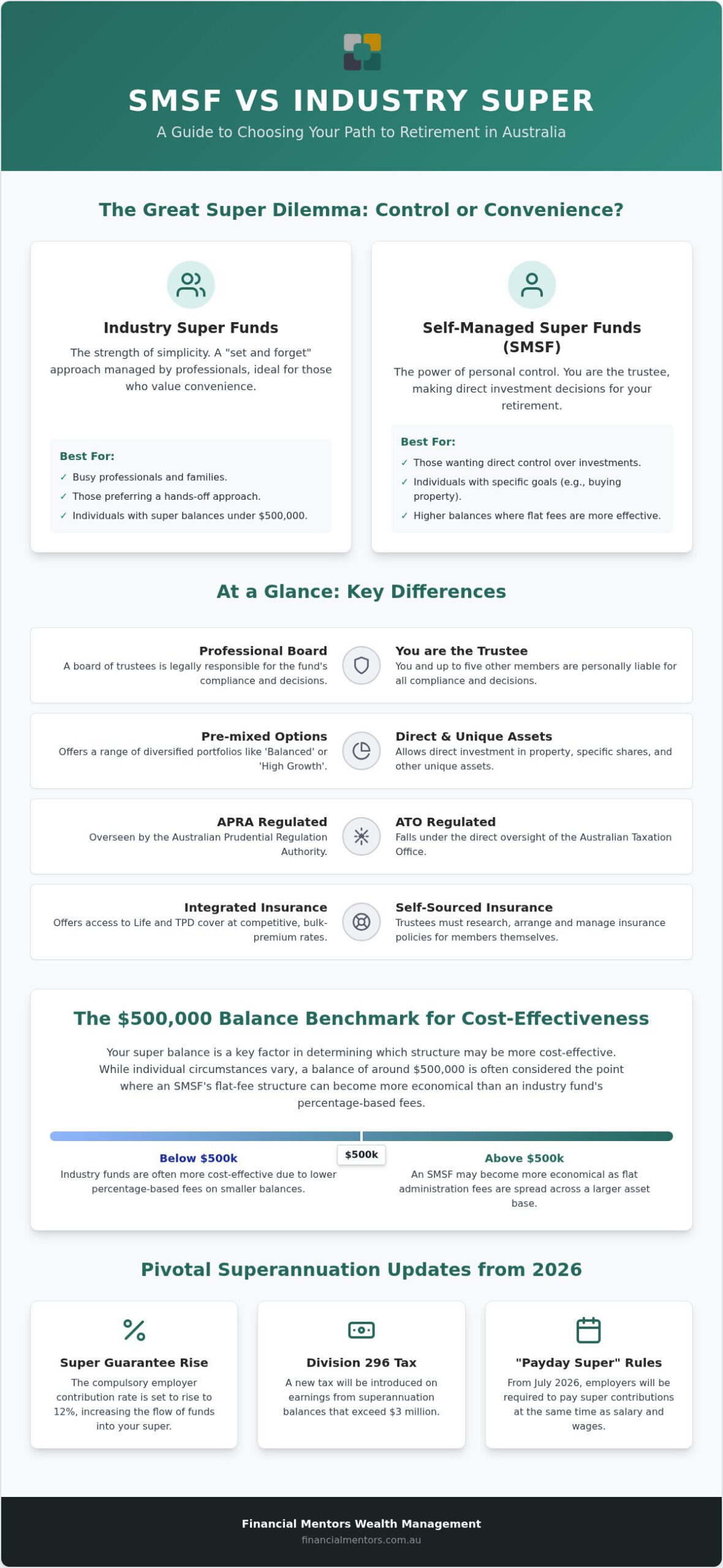
- Regulatory Oversight: Industry funds are regulated by APRA, while SMSFs fall under the watchful eye of the ATO.
- Trustee Responsibility: In an industry fund, a professional board carries the legal responsibility. In an SMSF, you (and up to five other members) are the trustees, meaning you’re personally liable for the fund’s compliance.
- Investment Flexibility: Industry funds typically offer “pre-mixed” options like Balanced or High Growth. An SMSF allows you to hold direct property, specific share portfolios, or even unique assets like collectables, provided they meet the “sole purpose” test.
If you value simplicity and professional distance, the industry path is often the most reassuring. However, if you’ve always wanted to own your business premises through your super or have a very specific vision for your portfolio, the SMSF route offers a level of tailoring that industry funds simply cannot match.
Industry Superannuation: The Strength of Simplicity
For many Australians, the greatest luxury in financial planning is simplicity. Industry super funds provide a “set and forget” approach that allows busy professionals and growing families to focus on their daily lives while their retirement savings grow in the background. By pooling the resources of millions of members, these funds leverage massive economies of scale to keep costs down. A typical balanced MySuper option in 2026 carries an ongoing fee of around 0.85% of the account balance per year, with highly competitive funds dipping below 0.7%. This collective power gives you access to institutional-grade investments, such as major infrastructure projects and private equity, that would be nearly impossible to reach as an individual.
Don’t let the term “default” mislead you into thinking these funds are one-size-fits-all. Modern industry funds have evolved significantly, offering a wide array of “Choice” options. These allow you to tilt your portfolio toward sustainable investments, international shares, or high-growth assets without needing to manage the individual trades yourself. You’re essentially hiring a team of professional investment managers to do the heavy lifting for you.
Cost-Effectiveness and Pooled Resources
If you’re in the early to mid-stages of retirement planning, the low-fee structure of an industry fund is often your greatest ally. One of the most significant, yet overlooked, benefits is the access to integrated insurance, including Life and Total and Permanent Disability (TPD) cover. Because the fund buys these policies in bulk, the premiums are generally much lower than what you’d pay for a standalone policy. For many, choosing “simple” is actually the most strategic path for long-term peace of mind, especially when you consider the steep learning curve of ATO regulations for SMSFs that trustees must navigate.
The Limitations of the Collective Approach
However, the collective model does have its boundaries. When comparing SMSF vs industry super for retirement, you’ll notice a lack of transparency regarding specific underlying holdings. While you know the broad asset classes, you can’t see every single company or bond the fund owns on a daily basis. Additionally, if your strategy involves purchasing a specific commercial warehouse for your business or investing in niche assets, an industry fund won’t accommodate that level of customisation.
There’s also the matter of unlisted assets. Major funds often hold significant allocations in unlisted property or infrastructure to manage volatility. While this provides stability, these assets aren’t valued daily like shares on the ASX. This can lead to a “valuation lag” during market shifts, which might mean your balance doesn’t always reflect live market conditions instantly. If you’re wondering how these factors might influence your personal timeline, a tailored review of your retirement planning can help ensure your current fund still fits your broader life goals.
Self-Managed Super Funds: The Power of Personal Control
While the simplicity of a managed fund is reassuring for some, others feel a growing desire to be more than just a passenger in their financial journey. When you look at the choice between SMSF vs industry super for retirement, the quest for transparency is often a primary motivator. You gain the ability to see exactly which assets are supporting your future, rather than relying on a broad asset class summary. If you’ve ever felt like you have no control over where your money is actually invested, an SMSF might be the answer you’re looking for.
This path opens doors to direct investment opportunities that industry funds simply cannot provide. Whether it’s a commercial warehouse for your business, a specific portfolio of Australian shares, or even carefully selected collectables, the choices are yours to make. An SMSF also serves as a powerful family wealth vehicle, as you can now include up to six members in a single fund. This allows families to pool their balances, potentially reducing overall costs and simplifying the management of a collective legacy. However, it’s vital to remember that the role of a Trustee is a serious legal commitment to compliance that requires your diligent attention.
Strategic Tax and Estate Planning Advantages
One of the most compelling reasons to choose an SMSF is the level of flexibility it offers for tax management. You have greater control over when you trigger capital gains tax (CGT) events, allowing you to time asset sales more strategically. For business owners, the ability to transfer business real property into the fund can be a cornerstone of a long-term wealth strategy. Because these structures are so customisable, tailored estate planning advice integrates much more deeply with an SMSF than a standard fund, giving you more certainty about how your assets are eventually distributed.
The Compliance and Administrative Burden
Before making the leap, you’ll need to weigh the “time cost” involved. Managing your own fund is a strategy, not a hobby, and it requires you to stay on top of annual audits and ATO reporting requirements. When comparing SMSF vs industry super for retirement, the extra administrative work is often the main trade-off for that increased control. To stay on the right side of the law, professional tax return preparation is non-negotiable. For a balanced view of the responsibilities involved, the Moneysmart guide to SMSFs provides an excellent starting point for any prospective trustee.
Choosing Your Path: A Framework for Retirement Readiness
Finding the right path requires more than just looking at a spreadsheet. It’s about asking yourself how you want to spend your time and what kind of relationship you want to have with your money. To help you find clarity in the SMSF vs industry super for retirement debate, we suggest using this four-step framework to evaluate your personal circumstances.
- Step 1: Assess your Investment Appetite. Do you have a genuine interest in picking individual stocks or monitoring market shifts? If you enjoy the research and want a seat at the table, an SMSF provides the canvas you need. If the thought of checking share prices makes you feel uneasy, the professional management of an industry fund is likely a better fit.
- Step 2: The $500,000 Rule. While there’s no hard law, an SMSF generally becomes cost-competitive when your balance is between $250,000 and $500,000. Below this level, the flat-dollar costs of audits and compliance can eat into your returns faster than the percentage-based fees of an industry fund.
- Step 3: Evaluate Asset Specificity. Do you need to hold your own business premises within your super? If direct commercial property or niche assets are a priority for your strategy, the SMSF path is the only way to achieve that level of integration.
- Step 4: Consider Your Legacy. Think about the next generation. SMSFs offer unique flexibility for estate planning, allowing you to keep wealth within the family unit across multiple generations more easily than a standard fund.
Calculating the True Cost of Control
Industry funds usually charge a percentage of your balance, which means your fees grow as your wealth does. In contrast, SMSF costs are often flat-dollar amounts for administration and auditing, which can be more economical for very large balances. However, you must also account for “hidden” costs like potentially higher insurance premiums and brokerage fees. Consulting a wealth management office is a practical way to get an objective cost analysis before you make any permanent changes to your structure.
Aligning Super with Your Lifestyle Vision
Does your fund truly support your planned retirement income needs? Financial planning isn’t just about the numbers; it’s about the “sleep-at-night” factor that comes from knowing you’re prepared. A mentor helps you filter the noise of market trends and focus on what actually matters to your family. If you’re ready to build a strategy that fits your life, reach out to our team to start a conversation about your future.
Beyond the Fund: Integrating Super into Your Wealth Strategy
It’s easy to get caught up in the technicalities of SMSF vs industry super for retirement, but remember that the fund itself is simply a “bucket”. Whether you choose a large-scale industry fund or a personalised SMSF, the real impact comes from the strategy you pour into that bucket. Your super shouldn’t exist in a vacuum. It works best when it’s tightly integrated with your broader wealth creation strategies. When your outside investments, tax structures, and superannuation are all pulling in the same direction, you create a powerful synergy that speeds up your progress toward financial independence. This holistic view ensures that every dollar is working toward a common purpose, rather than being scattered across disconnected accounts.
The Role of Professional Mentorship
Moving from basic “compliance”, which is simply ticking the boxes the ATO requires, to true “optimisation” is where expert guidance proves its value. Murray Frean and the team at Financial Mentors don’t just look at numbers on a screen; they look at the people behind them. We provide a supportive, human-centric approach that acknowledges the emotional weight of planning for the future. As you move through different life stages, having a partner who understands the nuances of aging and the desire for legacy provides a level of peace of mind that a call centre simply cannot match. We act as the steady hand, helping you stay the course through market cycles and regulatory shifts. This partnership isn’t just about financial returns; it’s about the confidence that comes from being prepared for whatever life brings.
Your Next Steps Toward Security
If you’re feeling a bit uncertain about your current direction, the best thing you can do is take a small, proactive step today. Start by reviewing your latest statement with a critical eye. Are the fees what you expected? Is the performance aligning with your goals? From there, booking a strategy session allows us to model different retirement scenarios based on your actual lifestyle aspirations. This ensures your super, tax, and estate plans are all “singing from the same songbook”, giving you a clear, cohesive roadmap.
We invite you to start a dialogue with us today to discover how we can help secure your unique future. By aligning your fund structure with a well-thought-out plan, you can stop worrying about the “what-ifs” and start looking forward to the years ahead. Whether you need a simple review or a complete structural overhaul, we’re here to guide you through every transition with quiet confidence and practical wisdom.
Building Your Personal Roadmap to Retirement
Choosing between an SMSF vs industry super for retirement isn’t a decision you have to make in isolation. Whether you find comfort in the streamlined efficiency of an industry fund or prefer the bespoke control of a self-managed structure, the most important factor is that your choice aligns with your lifestyle. Your super is just one part of a larger plan that should include tax efficiency and a clear legacy for your family.
At Financial Mentors, we’ve been providing professional advice under our own AFSL since 2003. As specialists in retirement and estate planning, we take an empathetic, mentor-led approach to ensure your wealth management feels like a partnership rather than a transaction. If you’re ready to move forward with quiet confidence, we’re here to help you navigate these complex choices with ease.
Secure your retirement peace of mind with a personalised strategy session from Financial Mentors.
You’ve worked hard to build your savings; now let’s ensure they work just as hard for you. We look forward to helping you create a future that feels both stable and rewarding.
Frequently Asked Questions
Can I have both an industry super fund and an SMSF at the same time?
You can certainly maintain both an industry fund and an SMSF simultaneously. This strategy is often used by members who wish to keep the cost-effective life insurance provided by their industry fund while using an SMSF for direct property or share investments. It’s a practical way to balance the simplicity of institutional management with the control of a self-managed structure, provided you’re comfortable managing multiple sets of fees and reporting.
How much money do I really need to make an SMSF worthwhile in 2026?
While there’s no legal minimum, most professionals suggest a combined balance of $250,000 to $500,000 to ensure the fund is cost-effective. When weighing up SMSF vs industry super for retirement, you must account for flat-dollar costs like annual audits and the ATO supervisory levy. If your balance is lower, these fixed expenses can eat into your returns significantly more than the percentage-based fees found in a standard industry fund.
Is it difficult to close an SMSF if I decide it is not for me later?
Closing an SMSF is a methodical process that requires careful planning rather than a quick exit. You’ll need to sell or transfer all assets, pay any outstanding taxes, and arrange for a final audit before the fund can be formally wound up with the ATO. While it takes time to ensure everything is handled correctly, a mentor can help you navigate this transition to ensure no compliance boxes are missed.
Can I buy a residential investment property through my SMSF to live in later?
You can purchase a residential investment property, but you cannot live in it or rent it to a family member while it’s held by the fund. The “sole purpose test” requires the investment to be purely for providing retirement benefits. If you wish to live in the property later, you would typically need to transfer it out of the fund as a lump sum benefit once you’ve reached your preservation age and retired.
How do industry fund fees compare to the cost of running an SMSF?
Industry funds typically charge a percentage-based fee, which averages around 0.85% for a balanced option in 2026. Conversely, an SMSF has fixed administration costs that don’t necessarily increase as your balance grows. This means that for larger balances, an SMSF can actually be the more economical choice. However, you should always consider the “hidden” costs like the time you’ll spend on compliance and reporting as part of the true expense.
What happens to my SMSF if I become incapacitated or lose mental capacity?
If you lose mental capacity, your SMSF could become non-compliant unless you have an Enduring Power of Attorney (EPOA) in place. This legal document allows your chosen attorney to step into your role as a trustee. Without a clear succession plan, the fund may be forced to wind up or appoint a corporate trustee, which can add significant stress to your family during an already difficult and emotional transition.
Are SMSFs safer than industry funds during a stock market crash?
The safety of your super during a market downturn depends on your specific investment strategy rather than the fund type itself. An SMSF gives you the power to pivot quickly into cash or defensive assets, but it also places the burden of those decisions on your shoulders. In contrast, industry funds use professional managers to diversify across unlisted assets, which can sometimes provide a smoother ride during periods of high equity market volatility.
Can I use an SMSF to reduce the tax my beneficiaries pay on my death?
Yes, an SMSF offers significant flexibility when it comes to estate planning and tax minimisation for your loved ones. You can use non-lapsing binding death benefit nominations to provide more certainty about how your wealth is distributed. When comparing SMSF vs industry super for retirement, the ability to pay out benefits in a way that minimises the tax burden on non-dependants is often a key reason why families choose the self-managed path.