

What if the most significant birthday of your life isn’t your 21st or your 50th, but the day you blow out 65 candles? It’s a milestone that represents more than just another year; it’s the point where your financial dedication finally meets the freedom you’ve earned. You are likely wondering, what happens to my super when I turn 65, especially if you aren’t quite ready to hang up the work boots just yet.
It’s natural to feel a mix of excitement and hesitation as you approach this transition. You’ve worked hard to build your nest egg, and the fear of making a wrong move with complex rules or paying unnecessary tax is a common concern. We agree that you deserve to feel secure about your savings lasting as long as you do while providing for the people you love. Finding a clear path through the technical jargon is the best way to protect your financial legacy.
This article shows how turning 65 unlocks your superannuation as a full “condition of release,” giving you total access regardless of your working status. We’ll preview how to structure tax-free income, navigate the $2.1 million transfer balance cap, and coordinate your savings with the Age Pension. Our goal is to provide the clarity you need to move forward with quiet confidence and a secure plan for your future.
Key Takeaways
- Reaching 65 marks a full “condition of release,” granting you unrestricted access to your savings whether you choose to keep working or retire.
- Learn how to choose between leaving your funds in an accumulation account or starting an account-based pension for a steady, tax-free income stream.
- Clarify the relationship between your superannuation and the Age Pension to ensure you’re maximising your entitlements while staying within the $2.1 million transfer balance cap.
- Gain peace of mind by understanding what happens to my super when I turn 65 and how to update your estate planning to reflect your current wishes.
- Move from wealth accumulation to strategic stewardship with a tailored plan that focuses on tax efficiency and long-term financial stability.
Reaching the Milestone: Why Age 65 is a Game-Changer for Your Super
Reaching 65 feels different from any other birthday. It’s the age where the Australian government steps back and gives you the keys to your savings. For decades, you’ve been a diligent saver, watching your balance grow through employer contributions and market gains. Now, the focus shifts toward stewardship. This is the moment you transition from building a nest egg to managing a legacy that supports your lifestyle and your family. It’s a time for quiet confidence, knowing you’ve reached a significant milestone in your financial journey. You’ve earned the right to decide how your future looks.
Many people feel a sudden pressure to make big decisions the moment they turn 65. If you aren’t ready to change anything, you don’t have to. Your super can stay exactly where it is, continuing to be invested in the accumulation phase. Taking the time to validate your current financial health with a professional wealth management office before moving any funds is a wise first step. It’s about making sure your next move aligns with your personal goals rather than just following a calendar date. Understanding what happens to my super when I turn 65 starts with knowing that you are in the driver’s seat.
The Definition of a Condition of Release
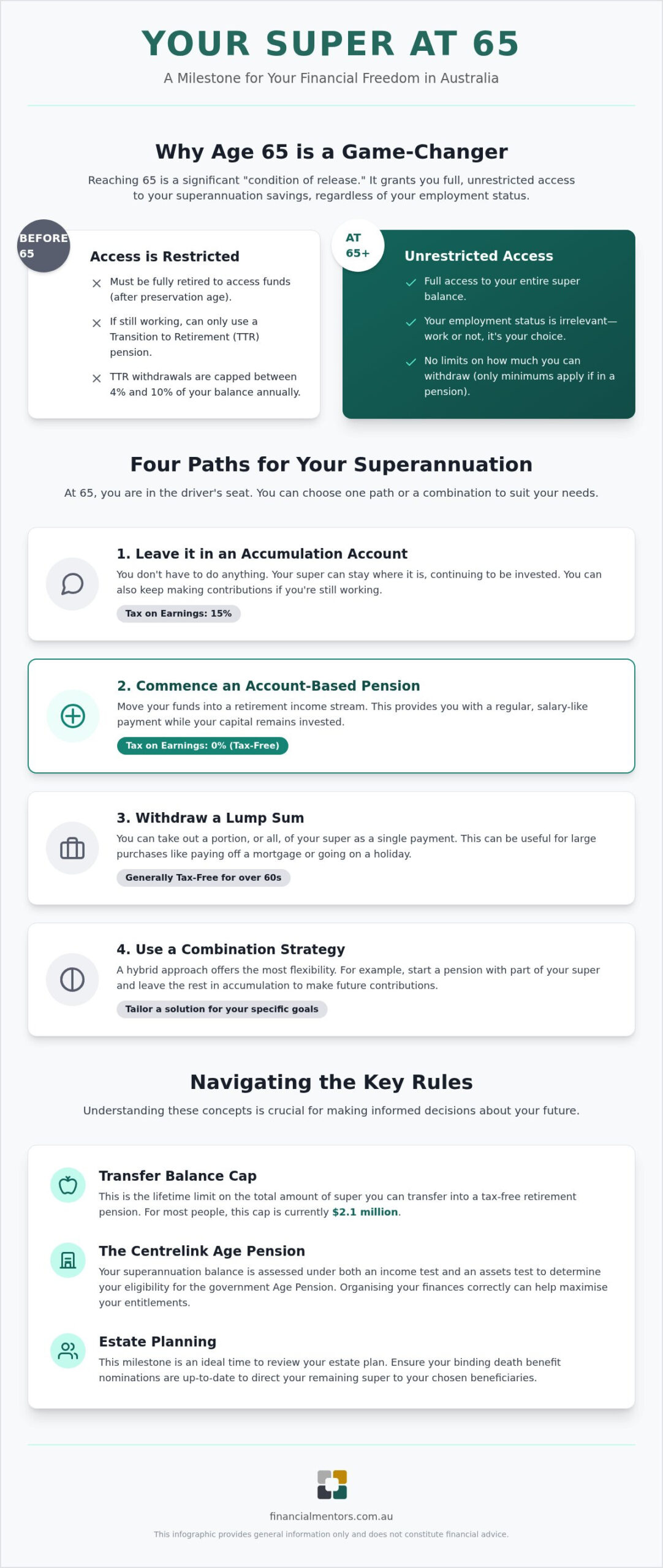
The rules governing Superannuation in Australia are built around “conditions of release.” While your preservation age is 60, reaching that age usually requires you to retire or start a transition to retirement income stream to access your funds. Age 65 is different because it is an “unrestricted” condition. Once you hit this milestone, your entire balance becomes what the ATO calls “unrestricted non-preserved benefits.” By definition, these are funds you can withdraw at any time without further restriction once this condition of release is met. You no longer need to prove you’ve retired to access your hard-earned money.
Still Working? You Can Still Access Your Super
Are you planning to keep working part-time or perhaps consult while you travel? One of the most liberating aspects of what happens to my super when I turn 65 is that your employment status becomes irrelevant. Unlike the Transition to Retirement (TTR) rules that apply between ages 60 and 64, which limit withdrawals to between 4% and 10% of your balance, age 65 removes those caps entirely. Whether you’re joining the “grey nomads” on the road or staying in the office, you can draw down as much or as little as you like. This flexibility allows you to supplement your income on your own terms, providing a safety net as you transition into the next chapter of your life.
Your Options for Accessing Superannuation at 65
Turning 65 brings a sense of relief, but it also brings a series of choices. You have reached the point where you can finally decide how to use the funds you’ve spent decades building. There are four main paths you might consider when looking at what happens to my super when I turn 65. You can leave your money exactly where it is in the accumulation phase, commence a regular income stream, withdraw a lump sum, or use a combination of these strategies. Each choice has different implications for your tax position and how long your savings will last.
It’s helpful to remember that you don’t have to pick just one path. Many people find that a hybrid approach offers the most flexibility. For example, you might choose to keep a portion of your funds in accumulation while starting a pension with the rest. This allows you to continue making contributions if you’re still working, while also enjoying the benefits of a steady income. Having a clear plan helps reduce the stress of these big decisions.
Commencing an Account-Based Pension
For many, the most reassuring option is moving your balance into a retirement phase income stream. This is often called an account-based pension. It works by keeping your money invested while paying you a regular income, much like a salary. One of the greatest benefits is that the investment earnings within this pension account are generally tax-free. You just need to meet the government’s minimum drawdown requirements. For someone aged 65 to 74, this is typically 5% of your account balance each year. It’s a methodical way to ensure your money lasts while providing the lifestyle you’ve planned for.
The Lump Sum Strategy
There are times when taking a larger amount at once makes practical sense. You might want to clear the remaining balance on your mortgage or fund a significant life goal, like a long-awaited trip around the country. While the freedom of accessing your super as a lump sum is appealing, it’s worth being cautious. Taking out too much too soon can reduce your tax-sheltered investment base. If you move large sums into a standard bank account, you may lose the tax advantages and growth potential that the super system provides. Stewardship is about balance; it’s often about taking what you need while keeping the rest working for you.
Choosing between these options doesn’t have to be a solo journey. Often, a combination of a regular pension and a smaller lump sum for emergencies provides the best peace of mind. If you’re feeling uncertain about which path fits your unique circumstances, seeking professional Retirement Planning can help clarify your next steps as you consider what happens to my super when I turn 65.
Comparing Income Streams, Lump Sums, and Staying Put
Have you considered how much of your hard-earned growth is actually staying in your pocket? When clients ask what happens to my super when I turn 65, they are often looking for the most tax-effective way to transition into their next chapter. The decision isn’t just about the rules; it’s about aligning your choice with your planned retirement goals. Choosing between staying in the accumulation phase, moving to a pension, or taking a lump sum requires a careful look at your long-term liquidity and lifestyle needs.
If you decide to leave your money where it is, you maintain full investment flexibility, but you continue to pay tax on the earnings within the fund. If you choose to move into the pension phase, you could significantly increase the longevity of your savings by reducing your tax burden. It’s a shift from growth at all costs to the wise stewardship of what you’ve already built.
The Tax Advantage of the Pension Phase
The most compelling reason to consider an account-based pension is the tax treatment of investment earnings. While your money is in the accumulation phase, earnings are taxed at a rate of up to 15%. Once you move those funds into a retirement phase pension, that tax rate drops to 0%. This difference might seem small in a single year, but over a decade or two, it can represent a substantial amount of money that stays in your account rather than going to the ATO.
As of July 1, 2026, the general transfer balance cap is $2.1 million, which is the lifetime limit on the total amount you can move into the tax-free retirement phase. If your balance exceeds this limit, the excess must remain in the accumulation phase or be taken out of the super system. This cap makes it essential to plan your entry into the pension phase carefully to ensure you optimise your tax position without breaching government limits.
Flexibility and Control
One of the common myths about starting a pension is that your money becomes “locked away” or “used up.” In reality, an account-based pension offers remarkable flexibility. You can choose to increase your payments if you have an unexpected expense, or you can even stop the pension and move the money back into the accumulation phase if your circumstances change. This level of control is why a wealth creation strategy remains relevant even after you turn 65.
Managing your portfolio at this stage is less about aggressive gains and more about ensuring your capital lasts as long as you do. By keeping your money working in the market while drawing a tax-free income, you maintain the potential for growth that can help offset inflation. It’s about creating a steady, predictable flow of funds that gives you the peace of mind to enjoy your retirement without constantly checking the balance of your bank account.
Tax, the Age Pension, and Estate Planning Considerations
While reaching 65 is a major milestone for your super, it’s also a time to look at the bigger picture. You’ve spent years focused on growth, but now stewardship becomes the priority. This involves understanding how your savings interact with government support and ensuring your hard-earned wealth eventually reaches your loved ones. Many people feel a sense of unease when considering what happens to my super when I turn 65 in the context of the Age Pension and taxes. We’re here to help simplify those complexities so you can move forward with a clear mind.
A common misconception is that accessing your super automatically triggers other retirement benefits. In reality, your superannuation is just one piece of a larger puzzle. Integrating your savings with other financial pillars requires a methodical approach. It’s about being prepared for the transitions ahead so you can maintain the lifestyle you’ve envisioned without unnecessary stress.
Super and the Age Pension
It’s a common point of confusion, but the age you can access your super is currently different from the age you can claim the Age Pension. While you can access your super at 65, the eligibility age for the Age Pension is 67. Once you reach 67, your superannuation is counted under both the Assets Test and the Income Test. If you’re part of a couple where one person is younger than the Age Pension age, there may be strategic ways to hold super in the younger partner’s name to improve your overall pension outcome. This is a nuanced area where professional retirement planning becomes invaluable. Balancing your drawdowns with your pension entitlements ensures you aren’t leaving money on the table.
The Legacy Factor: Estate Planning
Turning 65 is a natural prompt to think about the legacy you’ll leave behind. One of the most important tasks is reviewing your death benefit nominations. Do you have a binding nomination in place, or is it non-binding? A binding nomination gives you the peace of mind that the trustee must follow your instructions. Without this, the distribution of your super could be left to the discretion of the fund trustee, which might not align with your wishes. Integrating professional estate planning advice into your roadmap ensures your family is protected from unnecessary legal hurdles.
There is also a significant tax trap that many Australians overlook. If your super goes to a non-dependant, such as an adult child, they could be forced to pay 15% tax plus the Medicare levy on the taxable component of your balance. This is often referred to as the “death tax” on super. Knowing how to avoid death tax on superannuation can save your beneficiaries tens of thousands of dollars. It’s about being practical and forward-looking to ensure your children receive the maximum benefit of your life’s work. If you’re ready to secure your family’s future, our team can help you navigate these Estate Planning Advice strategies today.
Strategic Steps: Organising Your Finances for the Next Chapter
Turning 65 is more than an administrative tick-box; it’s the start of a new chapter that deserves an organised foundation. If you’ve been wondering what happens to my super when I turn 65, the answer lies in how you choose to coordinate your next moves. Engaging a professional wealth management office ensures that your super, tax, and estate plans work in harmony rather than in isolation. It’s about moving from a phase of constant activity to one of deliberate stewardship.
To set yourself up for success, we recommend following three practical steps:
- Step 1: Conduct a full review. Take the time to look at all your super accounts. Many Australians still have multiple funds from different stages of their career. Consolidating these can help reduce unnecessary fees and make your reporting much simpler as you move into the pension phase.
- Step 2: Model your long-term needs. A 65-year-old today might easily need their savings to last another 20 or 30 years. Seeing a projection of how your balance might behave over three decades provides the clarity needed to enjoy your lifestyle today without worrying about tomorrow.
- Step 3: Lock in your strategies. Seek professional advice to ensure your tax and estate plans are robust. As we’ve explored, the transition to a pension phase and the avoidance of “death taxes” are complex areas where small errors can have large consequences for your beneficiaries.
The Role of a Mentor in Your Financial Journey
Attempting DIY retirement planning can often lead to missed opportunities or costly oversights. The Australian superannuation system is one of the most sophisticated in the world, but its complexity can be overwhelming. A trusted guide doesn’t just manage the numbers; they provide the “quiet confidence” that comes from knowing every detail has been considered. Moving from a state of anxiety about the future to one of preparation requires a documented roadmap that reflects your unique aspirations and life challenges.
Taking the First Step
A great place to start is by integrating your tax return preparation into a broader wealth strategy. This ensures your annual compliance is working toward your long-term goals rather than being a standalone task. We invite you to have a conversation about your journey so far and where you’d like to go next. Retirement isn’t an end to your financial story, but a new, rewarding way of living that rewards those who are prepared. With the right plan in place, you can focus on the things that truly matter, knowing your financial future is secure.
Embracing Your Retirement with Confidence
Unlocking your life’s savings at 65 isn’t just about accessing cash; it’s about shifting your mindset toward long-term stewardship. You now have the freedom to choose between tax-free pension income, strategic lump sums, or keeping your funds invested for future growth. Understanding exactly what happens to my super when I turn 65 allows you to move from a place of uncertainty to one of quiet confidence. By balancing your immediate needs with your legacy goals, you ensure that your hard work continues to support you and your family for decades to come.
Navigating these choices doesn’t have to be a solo effort. Our team provides strategic advice tailored to your unique life outcomes, ensuring every move is backed by professional tax and estate planning integration. Under the expert guidance of Murray Frean, we help you coordinate your super with the Age Pension and family legacy goals. If you’re ready to turn your preparation into a clear, documented plan, we invite you to secure your retirement future with Financial Mentors Wealth Management. Your next chapter is a significant milestone, and we’re here to help you make the most of every moment.
Frequently Asked Questions
Do I have to withdraw my super as soon as I turn 65?
No, you aren’t under any obligation to withdraw your superannuation just because you’ve reached this milestone. While turning 65 is a full condition of release, you can choose to leave your savings in the accumulation phase where they continue to be invested. This is often a wise move if you’re still working or don’t need the income yet. It allows your balance to remain in a tax-effective environment while you decide on your next steps.
Is all superannuation tax-free after age 65?
For most Australians, withdrawals from a taxed super fund are tax-free once you turn 60. However, the tax treatment of the earnings within your fund depends on the “phase” your account is in. In the accumulation phase, earnings are taxed at up to 15%. If you move your funds into a retirement phase pension, those investment earnings generally become tax-free. Understanding what happens to my super when I turn 65 involves distinguishing between these two phases.
Can I still make contributions to my super after I turn 65?
Yes, you can generally continue to make both concessional and non-concessional contributions until you turn 75. The “work test” was abolished for most contribution types in recent years, meaning you don’t necessarily need to be employed to add to your nest egg. However, you must stay within the annual contribution caps. For the 2026-2027 financial year, the concessional cap is $32,500 and the non-concessional cap is $130,000, provided your total balance allows it.
How much super can I transfer into a tax-free pension account in 2026?
As of July 1, 2026, the general transfer balance cap is $2.1 million. This is the lifetime limit on the total amount of super you can move into a tax-free retirement phase income stream. If your total super balance is higher than this amount, the excess must remain in an accumulation account or be withdrawn from the super system. It’s a key figure to keep in mind when planning a tax-effective transition into retirement.
Will my super balance affect my eligibility for the Commonwealth Seniors Health Card?
Yes, your superannuation can impact your eligibility through the income test. While the Commonwealth Seniors Health Card isn’t assets-tested, the income generated by your account-based pension is “deemed” by Centrelink. This means a set rate of income is assumed based on your balance, regardless of what you actually withdraw. If your total adjusted taxable income, including this deemed amount, exceeds the current thresholds, you may not qualify for the card’s benefits.
What happens if I turn 65 and I am still working full-time?
Turning 65 is a game-changer because it grants you full access to your savings regardless of your employment status. Even if you’re working full-time, your super becomes “unrestricted non-preserved.” You can choose to start an account-based pension to supplement your salary or take a lump sum for a specific goal. Many people use this flexibility to pay down debt or boost their lifestyle while they’re still earning a regular wage from an employer.
Do I need to tell Centrelink when I turn 65 if I have super?
You don’t usually need to report your super to Centrelink at 65 unless you are already receiving a government payment. Super is usually exempt from the means test until you reach the Age Pension age, which is currently 67. However, if you’re applying for the Commonwealth Seniors Health Card or other support, you’ll need to disclose your financial position. Clarifying what happens to my super when I turn 65 helps you prepare for the reporting rules at 67.
Can I give my super to my children as a lump sum when I turn 65?
Once you reach 65, you can withdraw your super as a tax-free lump sum and gift that cash to your children. This is often a strategic way to help them with a mortgage or education. If you leave the money in your super and it’s paid to adult children after you pass away, they may face a tax of 15% plus the Medicare levy. Gifting the money while you’re alive can avoid this potential tax trap.