

What if turning 60 didn’t mean you had to choose between your career and your retirement savings? Many Australians reaching this milestone find themselves asking, can I access my super at 60 and still work, only to be met with a wall of complex jargon and conflicting advice. It’s completely natural to feel a bit overwhelmed by the various conditions of release or to worry that a single mistake might lead to an unexpected tax bill. You’ve worked hard to build your nest egg, and wanting to enjoy some of those benefits while you’re still active in the workforce is a sensible, forward-looking goal.
This guide will show you exactly how to unlock your superannuation safely. Our aim is to ensure you have the financial peace of mind to transition into retirement on your own terms, without the fear of making an irreversible error. We’ll explore the specific rules around Transition to Retirement strategies, how to avoid common tax traps, and the steps you can take to reduce your hours without sacrificing your current lifestyle. By the end, you’ll have a clear path toward a retirement that feels both secure and rewarding.
Key Takeaways
- Understand the specific legal triggers that answer the question, can I access my super at 60 and still work, allowing you to plan your career transition with confidence.
- Learn how ending a single employment arrangement after you turn 60 can unlock your entire super balance, even if you choose to return to work later.
- Discover how a Transition to Retirement strategy allows you to supplement your income by drawing up to 10% of your super while staying in your current role.
- Recognise the powerful tax benefits of reaching age 60, which typically makes your superannuation withdrawals and income streams completely tax-free.
- Find out how professional retirement planning can help you avoid costly tax traps and ensure your savings are structured to support your lifestyle goals.
Understanding the Rules: Can I Access My Super at 60 and Still Work?
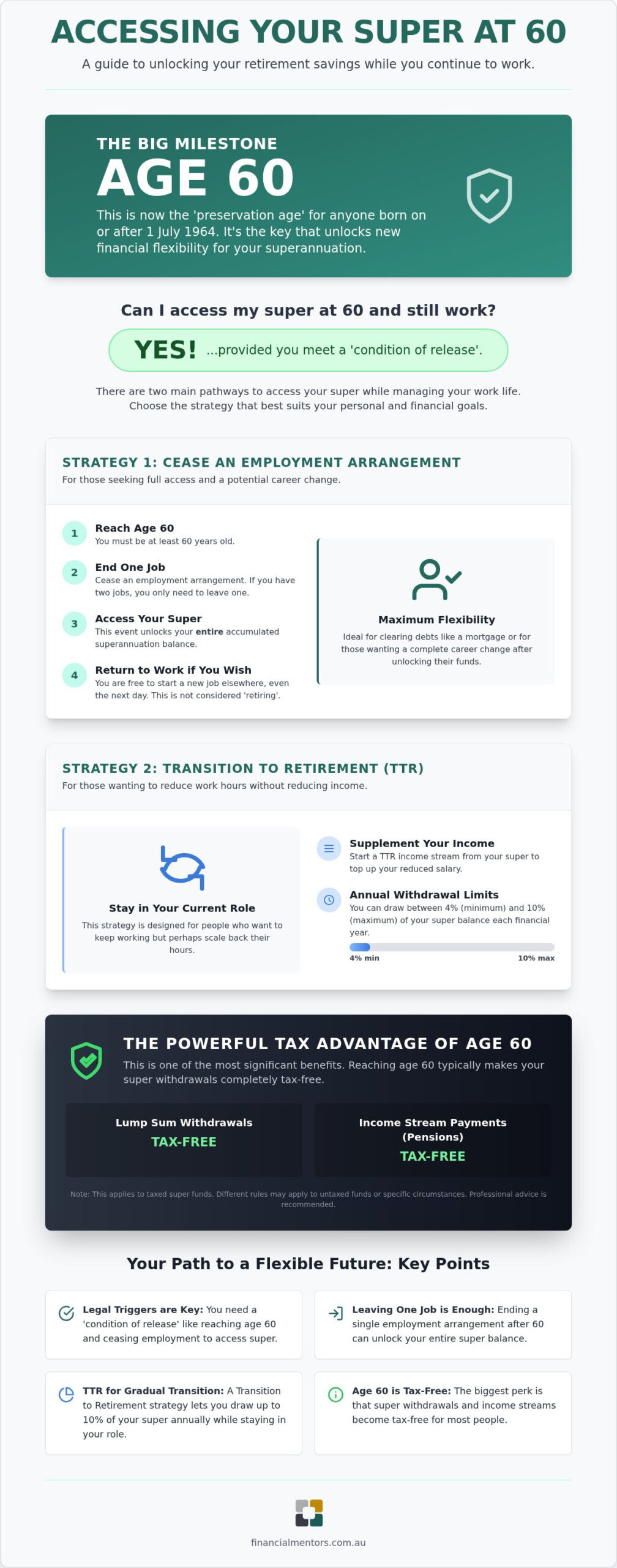
Reaching age 60 is a significant milestone for many Australians. It’s the age where the rules around Superannuation in Australia shift in your favour. If you’ve been wondering, can I access my super at 60 and still work, the answer is a heartening yes, provided you meet certain legal triggers known as a “condition of release.” These rules act as the keys to your savings, ensuring that while your money is protected for your future, it becomes available when you reach specific life stages.
For many, 2026 is a pivotal year. This is because the preservation age has now reached 60 for everyone born on or after 1 July 1964. It marks the moment your super moves from being “preserved” (locked away) to “restricted non-preserved” or even fully “unrestricted,” depending on your work status. Understanding these distinctions is the first step toward gaining financial peace of mind.
What is the Preservation Age?
Think of your preservation age as the government’s “start date” for your retirement planning. Until you hit this age, your super is generally off-limits. Because the preservation age for most Australians is now 60, reaching this birthday often brings a profound sense of emotional relief. You’ve spent decades contributing to your fund; knowing that those hard-earned savings are finally within reach provides a level of security that’s hard to match. It’s no longer just a number on a statement; it’s a practical tool you can use to shape your daily life.
The Two Main Pathways to Access
There are two primary ways to approach this transition. The first is the traditional route: retiring with the intention to never work again. This unlocks your entire balance. The second, more flexible route allows you to keep your career while accessing a portion of your funds. This is particularly useful if you want to scale back your hours without seeing a drop in your take-home pay.
It’s vital to understand the subtle distinction between “retiring” and “ceasing an employment arrangement.” If you finish a job after you turn 60, even if you don’t intend to stop working forever, that specific event can count as a condition of release for the super you’ve accumulated up to that point. This flexibility means your choice today doesn’t have to be your choice forever. You can access your savings, take a breath, and decide your next move with a clear head and a stable bank balance.
The ‘Cease Employment’ Loophole: Returning to Work After 60
Many Australians feel a sense of hesitation when considering their future. They worry that accessing their savings means they must leave the workforce forever. However, a specific rule allows for a much more flexible approach. If you’ve reached age 60, simply ending an employment arrangement can act as a valid condition of release. This provides a definitive answer for those asking, can I access my super at 60 and still work, because it separates your past contributions from your future earnings.
The Australian Taxation Office (ATO) looks closely at your intention. When you “retire” in the traditional sense, you’re making a declaration that you don’t intend to work more than 40 hours a month again. But if you simply cease a specific job after your 60th birthday, that event itself satisfies the rules. You could technically start a new role the very next week. This strategy is particularly helpful for those who want to use a lump sum to clear a mortgage or settle debts while continuing to earn a salary in a new or different capacity.
The ‘Any Employer’ Rule Explained
You don’t need to say goodbye to your entire career to find financial flexibility. For Australians aged 60 to 64, ceasing an employment arrangement is a valid condition of release that allows access to all superannuation benefits accumulated up to that date. If you’re working two part-time jobs and decide to leave one, that single resignation can trigger the ability to access your super. It’s a subtle distinction that many miss, yet it offers incredible freedom for those who aren’t quite ready to stop working entirely. It allows you to draw on your accumulated wealth while still maintaining an active income stream from your remaining role.
Starting a New Chapter: Working Again
Choosing to start a new job after unlocking your super can feel like a fresh start. Whether you’re pursuing a passion project or moving into a less stressful role, the rules support your journey. It’s helpful to remember that any new super guarantee contributions your new employer pays will be “preserved.” This means they’ll be locked away until you meet a future condition of release, such as turning 65. You can find more details on these triggers in MoneySmart’s guide to getting your super.
This approach ensures your planned retirement feels like a choice rather than a necessity. By navigating these rules carefully, you can enjoy the fruits of your labour while your career continues to grow. If you’re feeling unsure about the timing, speaking with a specialist in retirement planning can help you make these moves with total confidence.
Transition to Retirement (TTR): The Strategy for Those Staying Put
If you enjoy your current role but want to start enjoying the benefits of your savings, a Transition to Retirement Income Stream (TRIS) could be the perfect middle ground. While the “cease employment” rule we discussed earlier requires you to finish a job, a TTR strategy is designed for those who want to stay exactly where they are. Can I access my super at 60 and still work in my current position? With a TTR strategy, the answer is a resounding yes. It allows you to convert a portion of your super into a regular income stream while your employer continues to pay your Superannuation Guarantee contributions into your account.
One of the most popular ways to use this is to facilitate a phased retirement. You might choose to drop from five days a week to three, using your super income to bridge the gap in your take-home pay. Alternatively, many Australians use a “recycling” strategy. This involves staying in full-time work and salary sacrificing a larger portion of your income into super to reduce your taxable salary. You then draw a tax-free income from your TTR account to maintain your lifestyle. It’s a highly tax-effective way to boost your final balance in those last few years of your career.
Is a TTR Strategy Right for You?
A TTR strategy is often ideal for someone who wants to “test drive” retirement or significantly lower their taxable income. It’s about finding a balance that honours your current financial needs without compromising your future security. Before making the switch, it’s wise to look at how this fits into your broader goals. Using a retirement planning checklist australia can help you visualise where a TTR income stream sits alongside your other assets and lifestyle aspirations. It’s a chance to step back and ensure every move you make is purposeful and steady.
Managing the 4% to 10% Drawdown Limits
The government sets specific boundaries on how much you can withdraw through a TTR strategy. For the 2026-27 financial year, you must draw a minimum of 4% of your account balance each year, but you’re capped at a maximum of 10%. These Australian government rules on accessing super are in place to ensure your savings aren’t depleted too quickly while you’re still working. Because these limits are calculated annually, professional guidance is essential to ensure you don’t accidentally over-draw or miss out on the strategy’s full potential. Getting the balance right means you can enjoy more of your life today while staying confident that your retirement remains secure.
The Financial Perks of Waiting Until 60: Tax and Super Guarantee
Waiting until you blow out those sixty candles brings more than just a sense of achievement; it unlocks a powerful tax environment that can significantly boost your financial position. While the question of can I access my super at 60 and still work often focuses on the “how”, the “why” is frequently found in the tax savings. If you were to access your super at age 58, you might face tax on the taxable component once you exceed the low rate cap, which sits at $260,000 for the 2026-27 financial year. By waiting until 60, that same withdrawal typically becomes entirely tax-free, potentially saving you tens of thousands of dollars that stay in your pocket rather than going to the ATO.
This milestone creates a sense of quiet confidence. You’ve been diligent with your savings for decades, and now the system begins to work harder for you. This period is an excellent time to review your overall position, especially if you have multiple income sources from part-time work and super. Ensuring everything is structured correctly can prevent simple errors from becoming costly problems during your annual tax obligations.
Tax-Free Income Streams vs. Lump Sums
Choosing between a lump sum and a regular income stream is a deeply personal decision that depends on your immediate goals. A lump sum might offer the emotional relief of finally being mortgage-free, while an account-based pension provides a steady, sustainable rhythm for your daily life. For most Australians, superannuation benefits paid after age 60 are entirely tax-free. This clarity allows you to plan your future with a level of certainty that simply isn’t available earlier in life. Whether you need a one-off payment for a major life event or a reliable fortnightly “paycheck”, the tax-free status at 60 makes your money go much further.
New Contributions and the Super Guarantee
Even as you begin to enjoy your savings, your current or new employer must continue to pay the Superannuation Guarantee (SG) into your account. For the 2026-27 financial year, this rate is 12%, ensuring your nest egg continues to grow even while you draw from it. You essentially manage two “buckets”: your tax-free pension account for withdrawals and your accumulation account for new contributions. This period is often the most productive for wealth creation strategies australia, as you’re both spending and saving in a highly tax-effective way. Managing these dual accounts requires a bit of organisation, making professional tax return preparation a vital tool to ensure you remain compliant while maximising your benefits.
Deciding how to step into this new phase of life is about more than just checking boxes on a government form. While we’ve established that the answer to can I access my super at 60 and still work is a resounding yes, the more important consideration is whether doing so right now aligns with your long-term vision. A DIY approach often focuses only on the immediate cash flow, but it can inadvertently trigger tax traps or complicate your future Centrelink entitlements. Having a mentor by your side ensures that every decision is part of a deliberate, well-considered plan rather than a reaction to a single birthday milestone.
At Financial Mentors Wealth Management, we see ourselves as your partner in this journey. We’ve been AFSL licensed since 2003, and our role is to act as a trusted guide through the maze of Australian superannuation. We focus on the “should I” just as much as the “can I”, helping you weigh the pros and cons of accessing your savings while you’re still earning a salary. It’s about stewardship—making sure your hard-earned wealth is protected, organised, and ready to support you for the next thirty years, not just the next three.
Beyond Compliance: Strategic Wealth Management
True financial security involves looking at the whole picture rather than focusing on a single account balance. This means integrating your super access with professional estate planning advice to ensure your family is protected from unnecessary “death taxes” on your superannuation. Additionally, strategic tax return preparation ensures that your various income streams—from part-time work and your pension—are handled with absolute precision. Having a professional second set of eyes on your life’s savings provides a level of peace of mind that a simple online calculator or a generic fund statement just can’t offer.
Your Invitation to Dialogue
Starting this conversation early—perhaps when you’re 55 or 58—gives you the gift of time to structure your assets effectively before you hit the “magic” age of 60. When you sit down for a retirement planning consultation with us, there’s no pressure and no clinical, cold atmosphere. We focus on listening to your aspirations and then building a strategic roadmap that fits your life. We’ll help you navigate the subtle rules around ceasing employment and TTR strategies with quiet confidence. If you’re ready to explore your options, let’s have a coffee and a chat about your future.
Your Path to a Flexible Future
Reaching age 60 is a milestone that offers genuine flexibility, allowing you to blend your career with the benefits of your retirement savings. We’ve explored how the “cease employment” rule can unlock your balance and how Transition to Retirement strategies let you scale back your hours without losing income. If you’ve been asking, can I access my super at 60 and still work, you now know the legal triggers that make this possible. The system is designed to reward your years of hard work with tax-free benefits and options that suit your unique lifestyle.
Since 2003, our AFSL-licensed team has provided expert strategic advice tailored to the personal goals of Australians. We believe in a human-centric approach that prioritises your peace of mind, acting as a trusted guide through every life transition. Secure your retirement peace of mind—book a consultation with Financial Mentors today. You’ve spent decades building your nest egg; now it’s time to ensure your future is exactly how you imagined it would be.
Frequently Asked Questions
Can I access my super at 60 and still work full-time?
Yes, you can access a portion of your super while working full-time by starting a Transition to Retirement income stream. If you’re wondering, can I access my super at 60 and still work without changing employers, this strategy is your primary option. It’s specifically designed for those who have reached their preservation age but aren’t ready to stop. While you stay in your role, you can draw between 4% and 10% of your balance annually.
Do I pay tax on my super if I withdraw it at age 60 while working?
For most Australians, superannuation withdrawals made after the age of 60 are entirely tax-free. This applies whether you take the money as a lump sum or as a regular income stream. Because you’ve reached this milestone, the taxable component of your super is no longer subject to tax. This is a significant benefit compared to accessing funds earlier, where you might have faced taxes once you exceeded the low rate cap of $260,000.
What happens if I quit my job at 60, take my super, and then find a new job?
If you cease an employment arrangement after turning 60, you satisfy a condition of release that unlocks your entire accumulated super balance. You are then free to start a new job whenever you like. While your existing super becomes unrestricted non-preserved, any new contributions made by your next employer will be preserved until you reach a future trigger, such as turning 65 or retiring again. It’s a flexible way to reset your career.
How much of my super can I withdraw if I use a Transition to Retirement strategy?
Under a Transition to Retirement strategy, the government limits your annual withdrawals to between 4% and 10% of your account balance. These limits ensure that your savings aren’t depleted too quickly while you’re still earning a salary. If you’re asking, can I access my super at 60 and still work, this specific percentage range is the key to balancing your current lifestyle needs with your long-term financial security during your final working years.
Is it better to take my super as a lump sum or a fortnightly pension at 60?
The best choice depends entirely on your personal goals and current financial position. A lump sum is often ideal for clear, one-off objectives like paying off a mortgage or clearing debt to reduce monthly expenses. Conversely, an account-based pension provides a steady, reliable rhythm for your daily life, much like a regular paycheque. Many Australians choose a combination of both to ensure they have immediate relief and long-term stability as they transition.
Will accessing my super at 60 affect my future eligibility for the Age Pension?
Accessing your super at 60 won’t immediately affect Age Pension eligibility because the qualifying age is currently 67. However, the way you structure your super now can impact future assessments. Both the balance of your super and the income you draw from it are subject to Centrelink’s income and assets tests. It’s wise to plan your withdrawals carefully to ensure you don’t inadvertently reduce your future entitlements when you eventually reach the Age Pension age.
Can I still make voluntary contributions to my super after I have started an income stream?
Yes, you can continue to make voluntary contributions even after you’ve started drawing an income stream. These new contributions will simply sit in a separate accumulation account. This is a common strategy for those using a Transition to Retirement approach to lower their taxable income through salary sacrifice. You can draw tax-free money from your pension account while simultaneously building up new savings in your accumulation account, effectively recycling your wealth for better tax outcomes.
What is the ‘condition of release’ for someone who has reached age 65?
Turning 65 is an automatic condition of release in the Australian superannuation system. Once you reach this age, your entire superannuation balance becomes unrestricted non-preserved, meaning you can access it all regardless of your work status. You don’t need to retire or change employers to unlock your funds. This age threshold removes the complexity of the cease employment or TTR rules, giving you total freedom over how and when you use your hard-earned savings.