

Imagine you’ve just sold an investment property or received an inheritance, and you’re eager to bolster your retirement nest egg. You know superannuation is the most tax-effective home for your wealth, but the fear of receiving a heavy tax penalty for overstepping the mark often creates unnecessary stress. It’s a common worry, especially as the non-concessional contributions cap bring forward rule involves navigating strict thresholds that seem to change every year. You shouldn’t have to feel like you’re walking a tightrope just to secure the lifestyle you’ve worked so hard to build.
We understand that keeping track of Total Super Balance limits and indexation changes can feel overwhelming. It’s natural to feel a sense of urgency about making the most of these rules before you reach 75. This guide will show you how to contribute up to three years of after-tax super in one go while staying safely within the law. We’ll explore the 2026 thresholds, provide a clear roadmap for your next three financial years, and help you find the confidence that your retirement savings are truly optimised.
Key Takeaways
- Distinguish between before-tax and after-tax contributions to help you decide the most effective way to grow your retirement wealth.
- Master the mechanics of the non-concessional contributions cap bring forward rule to potentially contribute up to $390,000 in one go.
- Check your eligibility based on the 2026 Total Super Balance thresholds and the important ‘under 75’ age requirement.
- Learn how to time your contributions strategically when dealing with large life events like receiving an inheritance or selling an investment property.
- Understand how a tailored roadmap can help you avoid costly tax penalties while ensuring your nest egg is fully protected.
Understanding the Non-Concessional Contributions Cap and Why It Matters
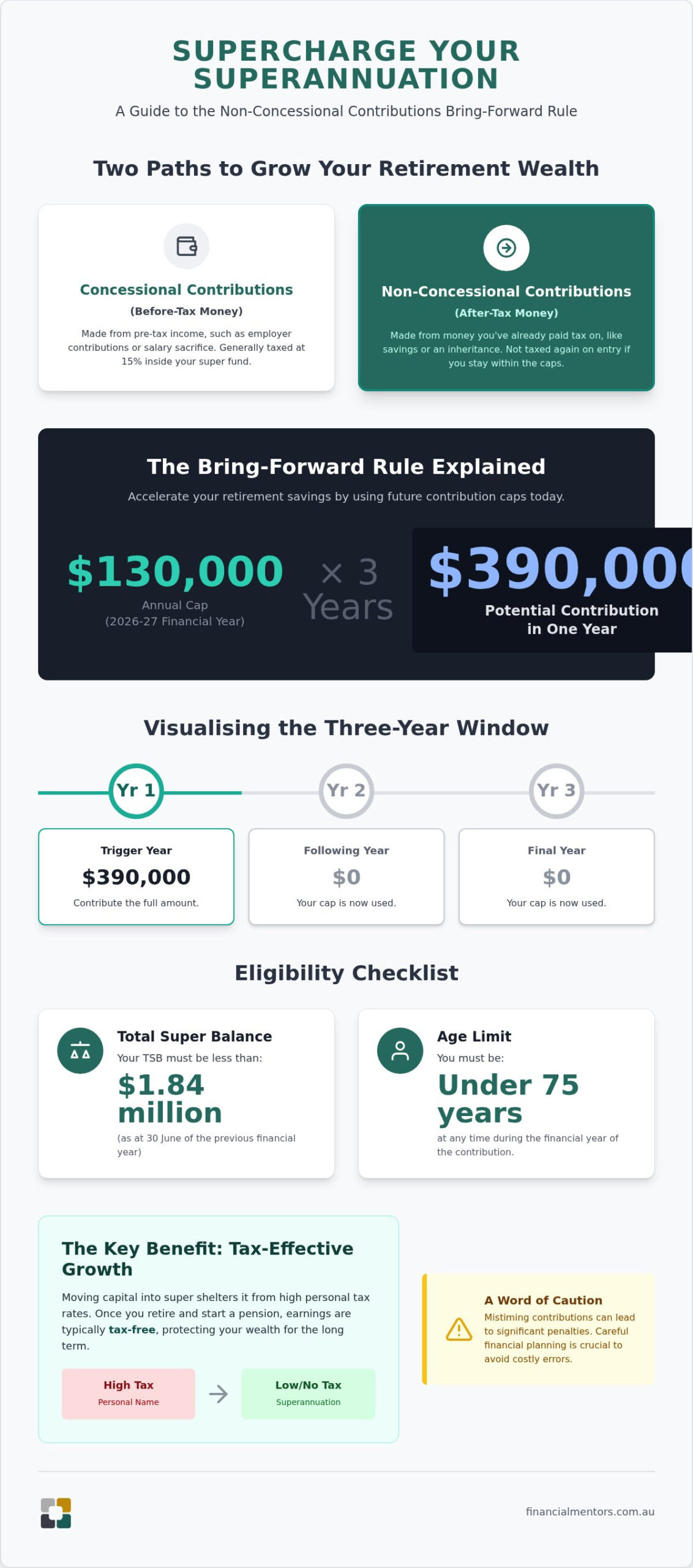
Building a secure future often begins with a single, thoughtful decision about where to place your hard-earned savings. If you’ve ever wondered how to effectively move personal wealth into a more protected environment, you’ve likely encountered the term “non-concessional contributions.” Simply put, these are payments you make into your superannuation fund using money you’ve already paid tax on, such as your take-home salary, personal savings, or proceeds from an asset sale. Because you’ve already met your tax obligations on these funds, they aren’t taxed again when they enter your super fund, provided you stay within the government’s set limits.
Distinguishing between contribution types is a vital first step in Understanding the Australian Superannuation System. While concessional contributions are made from before-tax income and generally attract a 15% tax within the fund, non-concessional contributions offer a different path. They allow you to shift larger sums of capital into a low-tax environment without needing a tax deduction upfront. The real magic happens once you reach retirement. When these funds eventually support a retirement pension, the earnings generated by that capital are typically tax-free. This shift can significantly increase the longevity of your nest egg, ensuring your lifestyle remains comfortable for decades to come.
The Annual Cap vs. The Bring-Forward Rule
For the 2026-27 financial year, the standard annual limit for after-tax contributions is $130,000. But what if you have a larger sum ready to invest right now? This is where the non-concessional contributions cap bring forward rule becomes an essential tool. It essentially allows you to “reach into the future” by accessing up to two additional years of caps in advance. By triggering this arrangement, you could potentially contribute up to $390,000 in a single financial year. It’s a powerful way to accelerate your savings, though it requires careful timing to ensure you don’t accidentally trigger a tax penalty by exceeding your Total Super Balance thresholds.
Why High-Net-Worth Australians Prioritise This Strategy
Many successful individuals find themselves in a position where their wealth is held in personal names or high-tax structures, leading to significant “tax leakage” over time. By utilising the non-concessional contributions cap bring forward rule, you can move substantial capital into the superannuation system where it’s sheltered from high personal marginal tax rates. This isn’t just about following rules; it’s a sophisticated wealth creation strategy Australia investors use to focus on long-term stewardship. Protecting your assets from unnecessary erosion today means more freedom to enjoy your retirement milestones later. Are you making the most of the current caps to future-proof your family’s financial stability?
How the Bring Forward Rule Works: A Three-Year Strategy
Understanding the mechanics of the non-concessional contributions cap bring forward rule is less about filling out forms and more about the timing of your actions. It happens automatically. When you contribute even a single dollar over the annual limit, currently $130,000 for the 2026-27 financial year, you effectively tell the ATO that you’re starting a multi-year strategy. This “trigger” allows you to access future contribution space today, providing a significant boost to your superannuation balance when you have the capital available.
The arrangement operates within a fixed three-year window. This period includes the “trigger year” plus the next two financial years. If you choose to contribute the full three-year maximum of $390,000 in Year 1, your non-concessional cap for the following two years will be reduced to zero. It’s a powerful way to get more of your wealth into a tax-effective environment sooner, but it requires precise tracking. Mistiming a contribution by even a few days can lead to “excess contribution” penalties, which are often taxed at the highest marginal rate. If you’re unsure about your current standing, a quick chat with a specialist in retirement planning can provide the clarity you need.
Triggering Your Arrangement
- Step 1: Confirm your Total Super Balance (TSB) as of 30 June of the previous financial year. To access the full three-year rule in 2026, your balance must be below $1.84 million.
- Step 2: Make a non-concessional contribution that exceeds the standard $130,000 annual cap. According to the ATO guidelines on bring-forward arrangements, this action officially opens your three-year window.
- Step 3: Carefully manage any remaining “cap space” over the subsequent 24 months to ensure you don’t exceed the total $390,000 limit.
The Impact of Indexation on Your Bring-Forward Amount
Because the annual caps are indexed in line with average earnings, they tend to rise over time, just as we saw the increase from $120,000 to $130,000 in 2026. However, once you trigger a bring-forward arrangement, you’re essentially locking in the rules as they stand at that moment. Once a bring-forward arrangement is triggered, your total cap is usually fixed regardless of future indexation during that window. This means if the annual cap rises again in Year 2 or Year 3 of your window, you won’t be able to “top up” your contribution to match those new, higher limits. For those expecting a very large windfall, it’s sometimes worth waiting until a new financial year begins if indexation is expected to increase the total available cap significantly.
Eligibility Criteria: Total Super Balance and Age Limits
While the potential to boost your retirement savings is significant, the non-concessional contributions cap bring forward rule isn’t available to everyone at all times. Think of the eligibility rules as a set of gatekeepers designed to ensure the system remains fair. The two primary factors that determine your path are your Total Super Balance (TSB) and your age. Understanding where you stand today is the first step toward making a confident decision about your financial future.
Your TSB is a snapshot of your wealth across all your superannuation accounts, including any pensions you’ve already started. The ATO looks at this figure on 30 June of the previous financial year to decide which contribution rules apply to you for the year ahead. For the 2026-27 financial year, the thresholds have been adjusted due to indexation, making it even more important to check your specific numbers before making a deposit. Strategically using the bring-forward rule requires knowing exactly which of the following brackets you fall into.
The TSB Thresholds Explained
- TSB less than $1.84 million: You’re generally eligible for the full 3-year bring-forward period, allowing a total contribution of $390,000.
- TSB between $1.84 million and $1.97 million: You may only access a 2-year bring-forward period, with a maximum cap of $260,000.
- TSB between $1.97 million and $2.1 million: You cannot use the bring-forward rule but can still make a standard annual contribution of $130,000.
- TSB of $2.1 million or more: Your non-concessional cap is reduced to nil for the year.
The 75-Year-Old Deadline
Age is the second critical factor in your planning. Currently, you must be under 75 years of age at any time during the financial year to trigger a bring-forward arrangement. One of the most helpful changes in recent years is the removal of the “work test” for non-concessional contributions. This means that if you’re under 75, you don’t need to be gainfully employed to add to your super from your savings or an inheritance. It opens a vital window for retirees to consolidate their wealth before the rules tighten.
However, there is a strict “cliff” once you turn 75. Super funds can generally only accept personal contributions up until 28 days after the end of the month in which you celebrate your 75th birthday. If you’re approaching this milestone, the window to maximise your final contributions is closing. This is where professional retirement planning becomes essential. We can help you map out these final moves to ensure you don’t miss the opportunity to secure your legacy and provide peace of mind for the years ahead.
Strategic Timing: When Should You Trigger a Bring Forward Arrangement?
Deciding when to use the non-concessional contributions cap bring forward rule is often a matter of matching your financial strategy to significant life milestones. If you’ve recently sold an investment property or received a meaningful inheritance, you may find yourself with a surplus of capital that feels “exposed” in a high-tax personal environment. In these moments, the rule acts as a bridge, allowing you to shift up to $390,000 into the tax-sheltered world of superannuation in a single year. However, it’s vital to look ahead. If you expect an even larger windfall in the next financial year, triggering the rule now could lock you into the current $130,000 annual cap, preventing you from benefiting if indexation raises that limit in the future.
Another powerful opportunity arises when you choose to downsize your family home. While the government allows a “Downsizer Contribution” of up to $300,000 per person that doesn’t count towards your caps, you can actually combine this with a bring-forward arrangement. This creates a rare window where a couple could potentially move nearly $1.4 million into super in a very short period. It’s a transformative move for your retirement income, but it requires a methodical approach to ensure every dollar is accounted for. Have you considered how the sale of your home could be the final piece in your retirement puzzle?
The Re-contribution Strategy for Couples
If you’re part of a couple, you have a unique opportunity to balance your wealth. This is a cornerstone of sophisticated estate planning advice. By withdrawing funds from the partner with a higher balance and re-contributing them to the partner with a lower balance using the non-concessional contributions cap bring forward rule, you can help both individuals stay under the $1.84 million threshold for longer. This doesn’t just maximise your combined contribution space; it also converts “taxable” components of your super into “tax-free” components, which can save your adult children thousands in tax when they eventually inherit your remaining balance.
Super vs. Mortgage: Where Does the Extra Cash Go?
We often see clients torn between the emotional peace of mind that comes from a debt-free home and the long-term mathematical gain of a maximised super balance. While paying off a mortgage is a wonderful achievement, the after-tax returns within a super fund can sometimes outpace the interest savings on a mortgage, especially when you factor in the tax-free earnings phase of retirement. How a wealth management office models these paths for you is essential. We help you see the “if-then” scenarios clearly, so you can choose the path that feels right for both your bank account and your sleep at night. If you’re ready to see how these numbers look for your specific situation, reach out to our team for a personalised strategy session.
Navigating Complexity with Professional Retirement Planning
While the mechanics of the non-concessional contributions cap bring forward rule might seem straightforward on paper, applying them to your unique life requires a delicate touch. An “off-the-shelf” approach often overlooks the nuances of your history across multiple super funds. If you’ve unknowingly triggered a bring-forward period in a previous year, making a large contribution now could inadvertently lead to a costly ATO audit and significant tax penalties. It’s about moving beyond simple compliance and towards true optimisation; ensuring every dollar you contribute is positioned to grow as effectively as possible for your future.
A specialist advisor does more than just watch the clock. We monitor your Total Super Balance and contribution history with meticulous care, acting as a safeguard against the complexities of the system. This is where integrated tax return preparation becomes a vital part of the process. By ensuring your contributions are correctly categorised and reported to the ATO from the start, we remove the anxiety of future “please explain” letters. This partnership allows you to focus on what retirement actually looks like for you, rather than the complex maths happening behind the scenes.
The Value of a Wise Mentor
Legislation in Australia rarely stands still. The thresholds and rules we see in 2026 may shift again, and having a trusted guide helps you avoid the “analysis paralysis” that often stalls progress. We help you create a roadmap that isn’t just a static document; it’s a living strategy designed to survive legislative changes and keep your goals within reach. Does your current plan account for how a sudden change in indexation might affect your remaining cap space? Having someone in your corner to interpret these shifts provides a level of peace of mind that a spreadsheet simply can’t offer.
Your Next Steps for a Secure Future
Taking control of your retirement doesn’t have to be a daunting task. You can start today by gathering your latest super statements and checking your TSB data through the MyGov portal. If you’re anticipating a property sale or a windfall in the coming months, now is the time to start the conversation. We invite you to book a consultation to review our retirement planning checklist Australia. Together, we’ll ensure you’re making the most of the non-concessional contributions cap bring forward rule to build a legacy that reflects your hard work and aspirations.
Taking the Next Step Toward a Secure Future
The path to a comfortable retirement is rarely found by accident; it’s built through steady progress and informed decisions. By understanding how the non-concessional contributions cap bring forward rule applies to your specific Total Super Balance, you can effectively move significant wealth into a tax-free environment. Whether you’re managing a large inheritance or downsizing the family home, the right timing ensures you don’t miss the vital window before age 75.
Navigating these rules alone can feel daunting, but you don’t have to carry that weight. Since 2003, we’ve provided AFSL registered wisdom and specialist retirement and estate planning advice to help Australians find clarity. Our integrated tax return preparation ensures your contributions remain compliant with the ATO, giving you the freedom to focus on your lifestyle goals rather than complex maths. It’s about having a partner who is deeply invested in your long-term well-being.
Ready to optimise your super? Book a consultation with Financial Mentors today. We’re here to be your trusted guide through every life transition, helping you achieve the peace of mind you deserve for the years ahead.
Frequently Asked Questions
What is the non-concessional contributions cap for the 2026/27 financial year?
The standard annual cap for the 2026/27 financial year is $130,000. If you meet the eligibility criteria, you can use the non-concessional contributions cap bring forward rule to contribute up to $390,000 by accessing two future years of caps. This increased limit reflects the latest indexation, providing a significant opportunity to move more of your personal savings into the tax-effective superannuation environment to support your future retirement lifestyle.
Can I use the bring-forward rule if I am over 75 years old?
Generally, you cannot. To trigger a bring-forward arrangement, you must be under 75 years of age at some point during the financial year. Once you turn 75, superannuation funds are restricted in the personal contributions they can accept, usually only allowing them up to 28 days after the end of the month you turn 75. It’s wise to plan these larger contributions well in advance of this important birthday milestone.
How many years can I bring forward in one go?
You can bring forward up to two future years, allowing you to use a total of three years’ worth of caps in one go. For the 2026/27 year, this creates a total limit of $390,000. Whether you can access the full three-year window or a reduced two-year period depends on your Total Superannuation Balance. This strategy is perfect if you have a large sum from an inheritance you’d like to invest today.
What happens if I accidentally exceed my non-concessional contributions cap?
If you accidentally exceed your cap, the ATO will send you a determination with your options. You can usually choose to withdraw the excess amount plus 85% of the associated earnings, which are then taxed at your marginal rate. If you decide to leave the money in your fund, the excess could be taxed at the highest marginal rate of 47%. It’s an avoidable stress that careful tracking and professional guidance can help prevent.
Does the bring-forward rule apply to my employer’s 11.5% super guarantee contributions?
No, the non-concessional contributions cap bring forward rule only applies to after-tax money you contribute yourself. Employer contributions, including the 11.5% super guarantee, are “concessional” contributions made from before-tax income. These have their own separate annual cap, which is $32,500 for the 2026/27 financial year. It’s important to keep these two buckets separate in your planning to ensure you don’t accidentally over-contribute and face unexpected tax penalties from the ATO.
How is my Total Superannuation Balance calculated for the bring-forward rule?
Your Total Superannuation Balance is the sum of all your super interests, including accumulation and pension accounts, as of 30 June of the previous financial year. To use the full three-year bring-forward in 2026/27, your balance must have been below $1.84 million on 30 June 2026. If your balance is higher, your ability to bring forward future caps may be reduced. It’s a vital figure to confirm before you make any large deposits.
Can I trigger a bring-forward arrangement with an SMSF?
Yes, you can certainly trigger the rule within a Self-Managed Super Fund. The same eligibility criteria regarding age and your Total Superannuation Balance apply to SMSF members just as they do to those in industry funds. However, as an SMSF trustee, you carry the direct responsibility for accurately tracking these contributions and reporting them correctly. Many trustees find that professional support provides the confidence that their fund remains compliant while they focus on their goals.
Is there a tax deduction for non-concessional contributions?
No, there is no tax deduction available for non-concessional contributions. These are made from money you’ve already paid tax on, such as your take-home pay or savings. While you don’t get a deduction today, the long-term benefit is significant. The earnings on this capital are taxed at a maximum of 15% within your fund and are generally tax-free once you move into the retirement pension phase, providing a stable foundation for your future income.