

What if facing redundancy in your fifties isn’t an abrupt end to your working life, but an accelerated transition toward the future you actually want? Receiving a redundancy notice after decades of dedicated service can feel confronting. Between concerns about funding living expenses before reaching Age Pension age at 67 and confusion over employment termination tax rules, managing finances after redundancy over 50 often brings immediate uncertainty. It is completely natural to wonder whether you should seek another role or begin stepping toward retirement.
With careful planning, you can turn this unexpected pause into an opportunity to protect your financial position. You will discover how to protect your payout, assess retirement readiness, and make confident choices for the years ahead. This guide walks you through practical ways to minimise tax liabilities on severance pay, establish an immediate cash flow cushion to reduce household stress, and evaluate whether your superannuation balance can comfortably support an early transition.
Key Takeaways
- Pause before making major commitments to give yourself time to assess your genuine severance documents and immediate household budget.
- Understand how tax-free thresholds and Employment Termination Payment rules apply so you keep more of your hard-earned payout.
- Gain clarity on managing finances after redundancy over 50 by weighing up the reality of corporate re-entry against a planned transition into retirement.
- Discover the rules surrounding your superannuation preservation age, debt reduction priorities, and potential waiting periods for Centrelink entitlements.
- Learn why structuring a tailored financial plan provides the steady direction needed to protect your wealth and achieve peace of mind.
What to Do First: Steps Following Involuntary Redundancy
When you receive a redundancy payout, the natural instinct is often to act quickly. You might feel tempted to clear your home loan immediately or allocate capital straight into investment markets. However, the most protective first step is simply hitting pause. Give yourself space to absorb the transition before locking funds away. Successfully managing finances after redundancy over 50 starts with establishing immediate financial breathing space and ensuring every cent from your employer has been accurately paid.
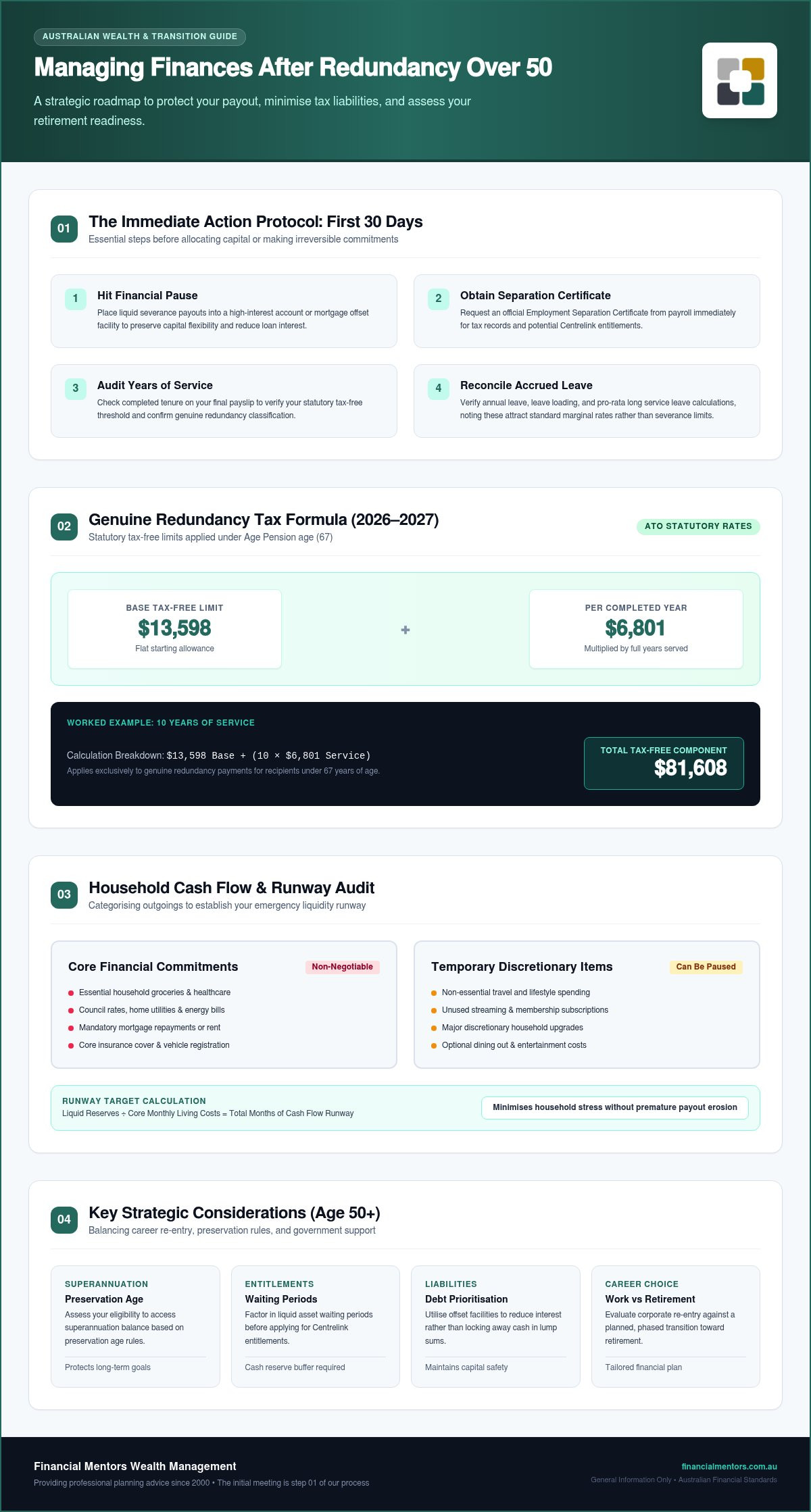
Before committing your severance package to long-term structures, place the liquid payout into a high-interest cash account or an existing mortgage offset facility. This keeps your capital safe, reduces loan interest, and preserves total flexibility while you plan your next move. Resist hasty lump-sum debt settlements until you fully understand your end-of-year tax position, as tax liabilities on termination amounts can differ substantially from regular earnings.
Securing Your Paperwork and Employment Records
Thorough payroll reconciliation gives you clarity on your starting numbers. Review your formal termination documents against the minimum redundancy terms provided under Australia’s National Employment Standards, ensuring you receive everything you are legally owed:
- Employment Separation Certificate: Request this document immediately from payroll, as you will need it for tax records and any government claims.
- Years of service: Check that your completed years of service are recorded correctly, since this directly determines your tax-free threshold.
- Leave entitlements: Verify accrued annual leave, leave loading, and pro-rata long service leave calculations on your final payslip.
- Redundancy classification: Confirm your employer classifies the departure explicitly as a genuine redundancy rather than an ordinary termination.
Establishing an Immediate Cash Flow Breathing Space
Maintaining financial stability requires an honest audit of your household cash flow. Divide your regular outgoings into non-negotiable living costs (such as utilities, rates, and groceries) and temporary discretionary items that can be paused. Measuring these core financial commitments lets you calculate your true monthly burn rate.
Next, calculate your realistic runway. How many months of essential living expenses can your liquid emergency reserves cover without touching your primary severance payout? If existing liabilities create pressure, contact your lenders to discuss short-term interest-only options or temporary payment freezes. Taking these practical steps gives you complete confidence while managing finances after redundancy over 50, providing the calm foundation needed to make sound, forward-looking decisions.
Understanding Redundancy Tax Rules and Employment Termination Payments
Taxation on a redundancy payout rarely mirrors ordinary salary withholding. A portion of your severance may arrive completely tax-free, while remaining sums are treated under specialized rules that directly impact what lands in your bank account. If you are managing finances after redundancy over 50, grasping how Australian Taxation Office (ATO) thresholds apply to your payout ensures you do not hand over more tax than necessary.
When you leave your employer, your package separates into distinct parts. Payouts of accrued annual leave and long service leave generally do not qualify as redundancy payments. Instead, they attract standard marginal tax rates according to when the leave accrued. Meanwhile, the genuine severance portion receives generous statutory concessions before any tax applies.
The Mechanics of Genuine Redundancy Limits
For your dismissal to qualify as a genuine redundancy, your employer must confirm your job was abolished, and you must be under the Age Pension age of 67. The ATO applies an indexed statutory formula to determine the tax-free component for the 2026-2027 financial year:
- Base amount: A tax-free allowance of $13,598.
- Completed years of service: An additional $6,801 tax-free for every full year of service completed with that employer.
For example, if you worked 10 full years with your company, your tax-free redundancy limit equals $13,598 plus (10 × $6,801), yielding $81,608 completely free from income tax. Pairing this allowance with professional tax return preparation helps you structure final deductions accurately and claim every eligible concession.
Employment Termination Payment Caps and Concessions
Any genuine severance payment exceeding your tax-free threshold is classed as an Employment Termination Payment (ETP). For the 2026-2027 financial year, the ETP cap stands at $270,000, alongside an unindexed whole-of-income cap of $180,000.
Your age dictates how that taxable ETP gets treated up to the cap:
- At or above preservation age (60): The taxable component within the cap is taxed at a maximum rate of 17% including the Medicare levy.
- Under preservation age (ages 50 to 59): The taxable portion is taxed at a capped rate of 32% including the Medicare levy.
- Amounts above the cap: Any sum exceeding the applicable ETP or whole-of-income cap is taxed at the top marginal rate of 45%.
Following practical steps to manage your money allows you to keep more of your funds intact. If you want reassurance that your tax calculations align with your broader transition, speaking with a dedicated adviser at financialmentors.com.au can give you clarity on the road ahead.
Career Re-Entry Versus Early Retirement: Evaluating Your Options
Redundancy in your fifties inevitably brings a major fork in the road. Should you dust off your resume to secure another full-time position, or is this the moment to step permanently into retirement? For many Australians aged 55 to 64, workforce participation sits at 69%, showing that remaining economically engaged is common. However, with the national average retirement age sitting under 60, redundancy often acts as an unexpected catalyst to examine whether full-time work is still necessary. Successfully managing finances after redundancy over 50 means honestly evaluating both your balance sheet and your lifestyle preferences.
Securing an equivalent senior executive or specialist role often takes longer than anticipated. Age bias, shifting corporate structures, and evolving industry requirements can turn a three-month job search into twelve months or more. Factoring this potential timeline into your personal plans allows you to make measured choices without feeling pressured to take the first role that appears.
Testing Your Retirement Preparedness
Before deciding to exit the workforce entirely, you need to stress-test whether your wealth can comfortably fund decades of living expenses. For a typical 54-year-old Australian, average superannuation balances sit around $289,900 for men and $191,400 for women. While these figures represent solid foundations, leaving employment early means your capital must last longer while compounding contributions stop earlier than planned.
You can evaluate your readiness by working through this retirement planning checklist to see how your assets measure against standard benchmarks. Professional cash flow modeling can then illustrate whether your superannuation, combined with outside savings, can support your target lifestyle all the way to age 90 without prematurely exhausting your reserves.
Bridging Strategies with Phased Employment
Stepping away from a 40-year career does not have to be an all-or-nothing choice. A phased retirement strategy can offer the perfect middle ground, blending income generation with greater personal freedom:
- Consulting and contracting: Package your decades of industry knowledge into advisory roles or project contracts that let you set your own hours.
- Part-time or fractional work: Earning enough to cover basic household financial commitments allows your investment balances to remain untouched and compound.
- Preserving social connection: Maintaining a regular professional routine supports emotional wellbeing, self-identity, and mental clarity during a major life transition.
By blending earned income with your severance reserves, managing finances after redundancy over 50 becomes far more sustainable. You gain full control over your time while protecting your long-term wealth.
Managing Superannuation, Centrelink Entitlements, and Debt
Redundancy in your fifties sits right at the intersection of superannuation rules, debt management, and social security. At this age, a single misstep can carry lasting consequences. Withdrawing funds improperly triggers steep tax penalties, while relying on immediate government support without preparation can leave your household exposed. Successfully managing finances after redundancy over 50 means aligning these moving pieces so your capital stays protected while maintaining personal cash flow.
Before considering any fund transfers, look closely at your existing superannuation policy. Employer default funds frequently bundle life insurance, total and permanent disability cover, and income protection. Ending your employment can terminate or alter group life cover within 30 to 60 days. Check these policies before consolidating balances to make sure valuable cover does not quietly lapse.
Superannuation Preservation and Contribution Tactics
Access to accumulated superannuation depends strictly on meeting a condition of release. In Australia, the preservation age is 60 for everyone. If you are aged 50 to 59, your super remains preserved until you reach 60 and meet retirement or employment cessation conditions. Reaching age 65 unlocks complete access with zero work restrictions. Review our guide on a secure planned retirement before making any withdrawal decisions.
If you have surplus severance funds, using carry-forward concessional contribution caps can prove highly tax-effective. This strategy allows you to contribute unused caps from up to five prior years, offsetting taxable income generated by your severance package while boosting your nest egg.
Centrelink Entitlements and Liquid Asset Waiting Times
If you intend to claim JobSeeker payments, be prepared for mandatory waiting periods administered by Services Australia:
- Liquid Assets Waiting Period: Readily available cash reserves can delay your payment starts by up to 13 weeks.
- Income Maintenance Period: Severance payouts, leave settlements, and termination sums are treated as income, postponing payment eligibility for a timeframe equal to the weeks the payout represents.
Around 2.5 million Australians receive the full or part Age Pension, but qualification begins strictly at age 67. Navigating the gap between your payout and Age Pension age requires disciplined cash preservation rather than expecting immediate safety nets.
Balancing Mortgage Commitments with Liquidity
Extinguishing your mortgage completely with a lump-sum payout may bring emotional relief, yet wiping out liquid reserves creates vulnerability. If you suddenly need capital for living expenses while between jobs, securing a new loan without employment proof can prove difficult.
A mortgage offset account provides an ideal balance. Parking funds in an offset reduces your loan balance and monthly interest obligations immediately, while keeping your capital fully accessible for emergencies. To establish a balanced debt and investment plan tailored to your needs, book an appointment with Financial Mentors today.
Structuring a Long-Term Financial Plan: Why Professional Advice Matters
Redundancy after 50 involves multiple moving parts that must work in harmony. You have to balance final tax obligations, superannuation preservation restrictions, and investment horizons while safeguarding your household lifestyle. A formal financial plan brings structure to these overlapping priorities. Instead of wondering how long your severance will last, you gain a documented roadmap that transforms sudden change into steady, forward momentum.
Sound financial advice looks well past your immediate payout. It weaves together taxation strategies, investment structures, and tailored estate planning advice to protect your family wealth. Through a commitment to ongoing periodic review, your strategy adapts as market dynamics shift, personal priorities evolve, or new career opportunities emerge.
The Value of Strategic Advice During Transitions
A sudden career pause requires balancing current cash requirements against your future goals. Working alongside a financial planner allows you to allocate your severance payout intentionally, ensuring your capital serves both immediate living needs and future security:
- Targeted goal mapping: Align your liquid funds with medium-term goals, like funding a transition period, alongside long-term goals for retirement.
- Sustainable momentum: Incorporate proven wealth creation strategies to keep your capital growing without taking unmeasured risks.
- Risk mitigation: Identify potential financial risks, such as inflation or poor sequencing of investment returns, before they erode family assets.
This structured coordination ensures you do not draw down investments during a market dip or face unforeseen tax shortfalls at year’s end.
What to Expect from Your Advice Partnership
Partnering with a trusted adviser should feel like a reassuring conversation rather than a high-pressure corporate process. Financial Mentors Wealth Management has been providing professional planning advice across Australia since 2000. Operating under the licence of Financial Mentors AFSL Pty Ltd, registered in 2003, the practice delivers guidance focused solely on your personal objectives.
Step 01 of the process begins with an initial meeting. This calm first conversation gives you the space to unpack your circumstances, examine your current financial position, and clarify your lifestyle hopes. Redundancy may have arrived uninvited, but the next chapter remains firmly in your hands. To take control of managing finances after redundancy over 50, book your complementary initial consultation and step forward with absolute clarity.
Stepping Confidently into Your Next Chapter
Redundancy in your fifties marks a significant crossroads, but it doesn’t have to compromise your long-term security. Taking time to establish an immediate cash flow breathing space, optimising the tax rules surrounding your severance package, and clarifying your retirement readiness puts you firmly back in control. Successfully managing finances after redundancy over 50 comes down to making measured choices that protect your wealth and preserve your lifestyle.
You don’t have to map out this journey on your own. Financial Mentors Wealth Management has been providing professional planning advice across Australia since 2000, operating under the AFSL of Financial Mentors AFSL Pty Ltd registered in 2003. Step 01 is an initial meeting to understand your goals without pressure. To build an orderly roadmap for the years ahead, book your complementary initial consultation today. With a sound strategy in place, this unexpected career change can become the doorway to a secure, rewarding future.
Frequently Asked Questions
How is my redundancy payout taxed if I am over 50 in Australia?
Your payout splits into tax-free and taxable portions. For genuine redundancies in 2026-2027, the base amount of $13,598 plus $6,801 per completed year of service is completely tax-free. Any remaining severance becomes an Employment Termination Payment (ETP). If you are under 60, this taxable sum is capped at 32% tax including Medicare; once you turn 60, it drops to 17% up to the ETP limit.
Can I access my superannuation early if I am made redundant after age 50?
No, you generally cannot access superannuation immediately because Australia’s preservation age is 60 for everyone. If you are aged 50 to 59, your super remains locked until you turn 60 and meet a statutory condition of release, like ceasing employment. Until reaching that threshold, you must fund your living expenses entirely from outside savings, severance funds, or alternative income streams.
Will a redundancy payout prevent me from receiving Centrelink payments immediately?
Yes, severance funds routinely trigger waiting periods that delay government income support. Centrelink applies an Income Maintenance Period based on the total weeks of salary your termination and leave payments represent. Additionally, liquid funds exceeding statutory thresholds invoke a Liquid Assets Waiting Period of up to 13 weeks, meaning you cannot rely on immediate social security safety nets.
Should I use my redundancy money to pay off my mortgage completely?
Resist wiping out your home loan entirely if it drains your liquid cash reserves. Without ongoing employment income, securing credit or emergency funding from banks becomes exceptionally difficult. Using a mortgage offset account offers a smarter balance when managing finances after redundancy over 50. It saves identical mortgage interest every month while ensuring your cash remains completely accessible for day-to-day needs.
What happens to the insurance policies inside my super fund after redundancy?
Group life, total disability, and income protection cover often depend on continuous employer super contributions. Once those contributions cease, your cover can automatically lapse within 30 to 60 days depending on the fund’s rules. Always contact your superannuation trustee immediately to confirm whether you can maintain cover through direct premium debits or convert the policy to individual retail cover.
How do I know if I can afford to retire after redundancy over 50?
You can determine retirement viability by comparing your total net worth against your projected annual expenses to age 90. Because Age Pension entitlements do not start until age 67, your super and personal assets must bridge at least seven to seventeen years unsupported. A formal financial plan stress-tests these withdrawal rates, confirming whether full retirement works or if phased consulting is wiser.
Can I contribute some of my redundancy payout into super to save tax?
Yes, contributing severance money into superannuation can reduce your overall income tax burden substantially. By making personal concessional contributions, you claim a tax deduction against taxable ETP earnings. If your super balance is under $500,000, you can even use carry-forward provisions to contribute unused concessional caps from the previous five years, protecting capital while managing finances after redundancy over 50.