

What if the financial legacy left behind by a loved one could secure your lifestyle and bring your retirement plans forward by years? Working out what to do with an inheritance before retirement often arrives at an emotionally demanding moment. You are likely balancing personal grief with urgent, confusing questions about property rules, capital gains tax, and how an influx of capital might influence future Centrelink entitlements.
Feeling uncertain about your next move is completely natural. When managing a sudden windfall, the fear of making a costly misstep can easily stall your momentum, especially when your working years are drawing to a close. Discover how to strategically manage an inheritance before retirement to clear debts, boost superannuation, and protect your future lifestyle. Ahead, you will explore a clear, step-by-step strategy to allocate your funds across investments, remove lingering financial commitments, and transition into retirement with total peace of mind.
Key Takeaways
- Deciding what to do with an inheritance before retirement starts with an intentional pause, giving you space to park funds safely while separating emotional grief from permanent financial commitments.
- Comparing the guaranteed savings of eliminating mortgage debt against long-term investment yields helps determine the most balanced allocation for your financial position.
- Directing lump sums into superannuation using non-concessional contribution caps or the bring-forward rule can enhance your balance inside a tax-effective environment.
- Knowing how Capital Gains Tax applies to inherited property and tracking Centrelink reporting rules prevents unexpected tax bills and protects future Age Pension eligibility.
- Bringing these moving parts together into a structured financial plan ensures your windfall directly supports your retirement lifestyle goals.
What to Do First When You Receive an Inheritance
Receiving a bequest often brings conflicting emotions. You might feel deep sorrow over losing someone special, alongside relief or anxiety about managing new funds. Deciding what to do with an inheritance before retirement requires patience, clarity, and steady sequencing. Rushing into binding arrangements or major property purchases during bereavement can cause avoidable tax headaches or disrupt your transition into retirement. Taking practical, measured steps right away creates stability while protecting your options.
Create an Intentional Cooling-Off Period
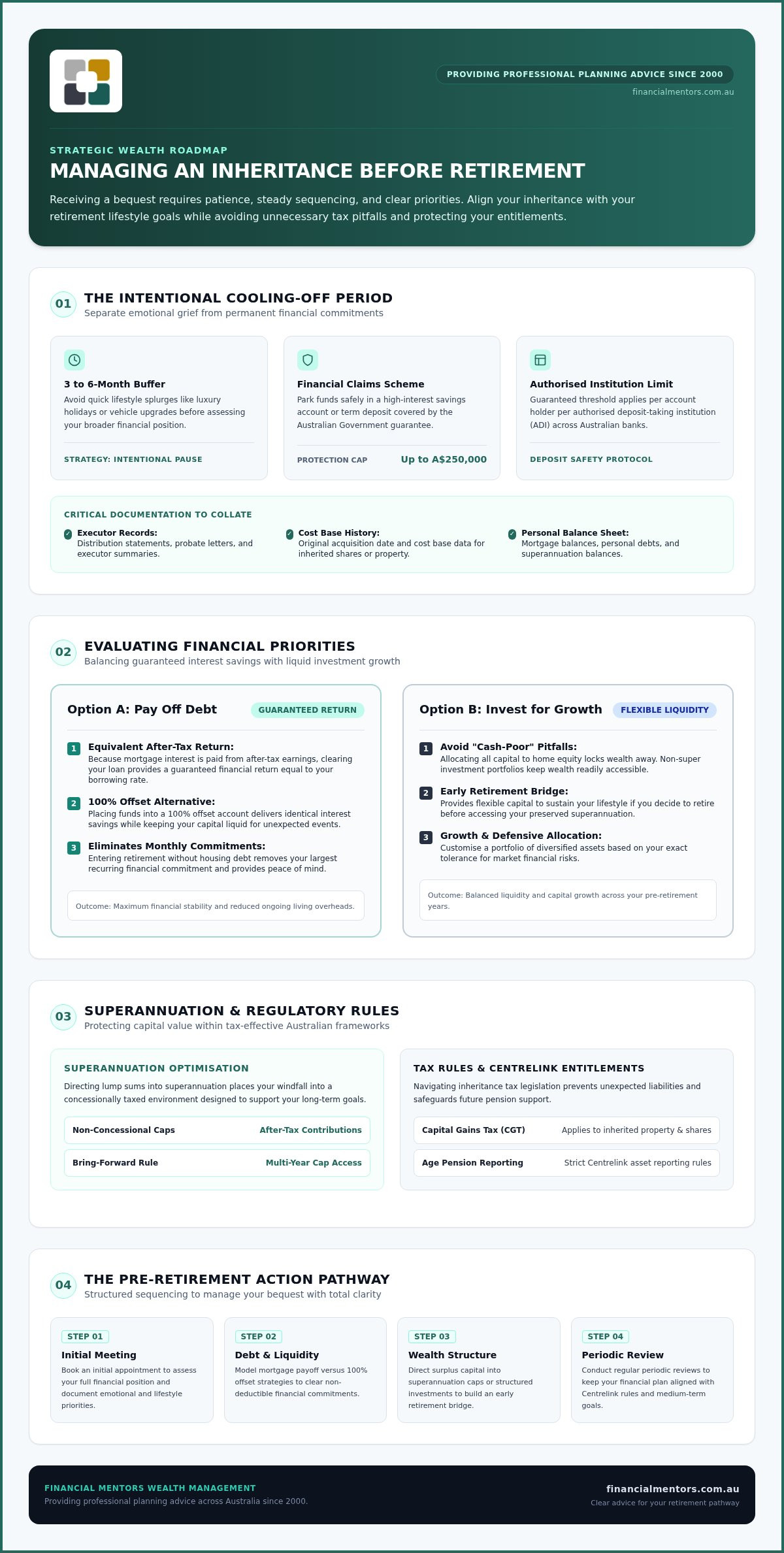
Give yourself permission to pause. Establishing a three to six-month buffer lets you process personal grief without the added weight of major financial pressures. During this window, avoid the common trap of making immediate lifestyle splurges, such as luxury holidays or upgrading vehicles, before you understand your broader financial position.
If you receive cash proceeds, park the funds in a high-interest savings account or term deposit covered by the Australian Government Financial Claims Scheme. This guarantee protects balances up to A$250,000 per account holder per authorised deposit-taking institution. Giving yourself breathing room ensures you make clear-headed choices that protect your long-term goals.
Gather Essential Documentation and Records
Once you feel ready to assess the estate, collecting the right paperwork is the next vital task. Having organized records ensures any future calculations around taxes or asset restructuring run smoothly.
- Executor documentation: Secure the formal estate distribution statement, probate letters, and executor financial summaries detailing exactly what assets are transferring to you.
- Cost base history: For inherited shares or real estate, track down the original acquisition date and cost base documentation from the executor to prepare for future capital gains calculations.
- Current personal finances: Collate your outstanding mortgage statements, personal debt details, and balances across your super funds. Looking at these alongside the broader framework of Superannuation in Australia will help identify whether eliminating liabilities or boosting retirement savings delivers the best outcome.
Working out what to do with an inheritance before retirement does not mean solving everything in one week. Clearing this initial administrative path provides the foundation you need to evaluate upcoming priorities with total confidence.
Evaluating Your Financial Priorities: Paying Off Debt vs Investing
Deciding how to allocate capital between debt reduction and asset growth marks a major turning point in your working life. When weighing what to do with an inheritance before retirement, the key lies in separating your accumulation habits from future preservation needs. Eliminating non-deductible personal debt provides an immediate, guaranteed return. Meanwhile, investing surplus funds builds liquid wealth to support your lifestyle before pension age. Coordinating these choices inside a structured planned retirement framework ensures every dollar serves a clear purpose.
The Case for Eliminating the Family Home Mortgage
Wiping out a home loan removes your largest ongoing monthly expense. Because you pay mortgage interest using after-tax earnings, clearing this balance delivers a guaranteed financial return equal to your loan rate. Entering your final working years without housing debt also delivers immense psychological relief. If you want ongoing liquidity, placing funds into a 100% offset account achieves identical interest savings while keeping capital accessible for unexpected maintenance or sudden life transitions.
Building Wealth Outside Your Home
Funneling every dollar into property equity can leave you cash-poor during retirement. Holding liquid investments outside superannuation creates a flexible financial bridge if you choose to retire earlier than planned. Reviewing the relevant Australian tax rules for beneficiaries allows you to manage any income distributions effectively. You can then assemble a portfolio of growth and defensive assets that reflects your exact tolerance for market risk.
Debt Elimination vs Growth Investment Comparison
Choosing between debt elimination and wealth creation rarely requires an all-or-nothing commitment. A balanced allocation often yields the best outcome for pre-retirees.
- Guaranteed savings vs market exposure: Paying off debt guarantees savings with zero risk, whereas growth investments aim for capital growth and income streams that outpace inflation over five to ten years.
- Tax efficiency: Non-deductible home loan interest offers no tax breaks, making its removal highly efficient. Managed share portfolios generate franking credits and dividends, which carry tax considerations.
- Strategic allocation: Adopting proven wealth creation strategies australia allows you to eliminate expensive liabilities first, then deploy surplus inheritance funds into compounding investments.
If you feel unsure how to divide your windfall between property debt and wealth creation, a tailored consultation with the team at financialmentors.com.au can help map out your optimal path.
Maximising Your Superannuation Contributions Before Retirement
Channeling inherited capital into superannuation stands out as one of the most effective paths for Australians approaching the end of their working lives. Moving funds into this concessionally taxed structure shields earnings from higher personal income tax brackets. When considering what to do with an inheritance before retirement, taking advantage of contribution caps lets you expand your wealth while establishing strong tax-free income streams for later years.
Non-Concessional Contributions and the Bring-Forward Arrangement
Non-concessional contributions allow you to deposit personal after-tax funds directly into your account without paying extra tax on entry. For the 2026-2027 financial year, the standard annual non-concessional cap sits at A$130,000. To qualify, your total super balance must remain below the general transfer balance cap of A$2.1 million as assessed on 30 June 2026.
Eligible individuals under age 75 can activate the bring-forward rule. This mechanism allows you to contribute up to three years of limits in a single year, enabling an immediate injection of up to A$390,000. If you have a spouse with a lower balance, sharing funds through spouse contributions helps level out total holdings and maximises household transfers before retirement phase thresholds apply.
Carry-Forward Concessional Contributions for Tax Efficiency
You can also turn inherited cash into significant personal tax savings by using carry-forward concessional contributions. The standard concessional cap is A$32,500 per year, which covers employer super guarantee payments and voluntary salary sacrifices. However, if your total super balance sat below A$500,000 on 30 June of the prior year, you can access unused caps accumulated over the past five financial years.
Claiming a personal tax deduction on these catch-up contributions directly lowers your assessable income during your peak earning years. This strategy proves especially rewarding if your salary places you in the 37% or 45% tax brackets, because contributions inside the fund are taxed at just 15%.
Self-Managed Super Fund and Structuring Considerations
Managing an influx of capital may prompt you to assess whether an industry fund, retail platform, or a self-managed super fund best serves your estate planning and investment preferences. Structuring mistakes, however, carry expensive excess contribution penalties from the ATO. Following a detailed retirement planning checklist australia will help you align payment cut-off dates, monitor lifetime limits, and decide what to do with an inheritance before retirement to achieve lasting security.
Navigating Australian Tax Rules and Centrelink Entitlements
Australia does not impose inheritance tax or death duties on estates. The lump sum or physical assets you receive arrive tax-free at the moment of distribution. However, secondary tax triggers can quickly alter what you retain. Deciding what to do with an inheritance before retirement requires a clear grasp of Capital Gains Tax (CGT) rules and an understanding of how new wealth alters future support from Services Australia.
Capital Gains Tax on Inherited Property and Shares
Acquiring real estate or share parcels does not immediately trigger CGT, but disposing of them later often does. For inherited dwellings, the main residence exemption allows you to sell the home completely tax-free if you settle the sale within two years of the person’s death. Missing this 24-month window can expose you to substantial capital gains based on the market value at death or the deceased’s original acquisition cost.
Inherited share portfolios carry their original cost base if purchased on or after 20 September 1985. While holding assets for over 12 months grants an individual a 50% CGT discount, legislated reforms taking effect from 1 July 2027 replace this discount with cost base indexation alongside a minimum 30% tax on net capital gains. Factoring in these timelines helps prevent unexpected tax bills when liquidating assets.
Tax on Inherited Superannuation Benefits
Superannuation balances do not automatically form part of an estate. When paid to a non-dependant for tax purposes, such as a financially independent adult child, the taxable component of the superannuation benefit faces a 17% tax (15% plus the 2% Medicare levy). Aligning these variables through professional estate planning advice ensures wealth passes between generations without needless tax leakage.
Protecting Future Centrelink Entitlements
An inheritance affects government support even if you receive it years before claiming the Age Pension. Around 65% of Australian retirees rely on Centrelink payments, making early planning essential. Consider these critical compliance rules:
- The 14-day rule: You must report any new assets or windfall payments to Centrelink within 14 days of receiving them.
- Asset test inclusion: Cash sitting in private bank accounts is assessed immediately under the assets test, and earnings are calculated using standard deeming rates under the income test.
- Pre-pension super exemption: Money held inside a superannuation accumulation account remains completely exempt from Centrelink assets and income tests until you reach the Age Pension age.
- Gifting constraints: Transferring money to children is subject to strict deprivation rules. Centrelink permits gifting of only A$10,000 per financial year, capped at A$30,000 across a rolling five-year period. Exceeding this limit means the excess continues to count against your assets test for five years.
To establish how your bequest impacts your future pension thresholds and tax position, book an obligation-free initial meeting with Financial Mentors Wealth Management to protect your entitlements.
How to Build Your Pre-Retirement Inheritance Action Plan
Translating an estate distribution into lifelong financial security requires a structured process. Rather than treating each financial choice in isolation, bringing your debts, investments, and super contributions under a unified strategy gives every dollar purpose. Knowing what to do with an inheritance before retirement means matching your newfound resources to your exact lifestyle goals, whether that involves stepping away from work sooner or building a lasting family legacy.
Step-by-Step Strategic Roadmap
A practical sequence prevents decision fatigue and protects your capital at each phase:
- Step 1: Quantify estate proceeds: Confirm final asset valuations, estate distribution statements, and actual payout timelines with the executor.
- Step 2: Protect against financial adversity: Reserve three to six months of living expenses in an accessible account before locking capital into illiquid investments.
- Step 3: Fund core priorities: Clear lingering personal financial commitments and direct lump sums into superannuation up to your available caps.
- Step 4: Generate retirement cash flow: Channel remaining funds into diversified growth and defensive investments designed to fund medium-term goals.
Partnering with an Authorised Financial Planner
Working alongside an experienced advisor allows you to model different future scenarios before making irreversible choices. Professional modelling can show whether retiring two years early is feasible, or how distinct investment pathways influence your future tax return preparation. Providing professional planning advice across Australia since 2000, Financial Mentors structures this journey clearly. Step 01 of the process is an obligation-free initial meeting, giving you a collaborative space to review your financial position and prepare a clear financial plan.
Maintaining Long-Term Governance and Reviews
A successful transition into retirement is not a one-time transaction. Committing to an annual periodic review ensures your investments stay aligned with changing personal goals, shifting economic conditions, and updates to federal superannuation legislation. This routine also provides a checkpoint to review your own estate planning, ensuring updated wills and binding death benefit nominations accurately reflect your financial position.
By putting a methodical plan in place, working out what to do with an inheritance before retirement shifts from an overwhelming burden into a confident, empowering transition into your next chapter.
Taking the Next Step Towards Your Ideal Retirement
Managing a significant windfall while preparing for life after work does not have to feel daunting. By eliminating personal debts, making intentional super contributions, and planning around capital gains tax rules, you turn an emotional transition into lasting stability. Deciding what to do with an inheritance before retirement gives you the power to protect your future pension rights while ensuring your loved one’s legacy supports your lifestyle for decades to come.
Delivering strategic financial advice across Australia since 2000, Financial Mentors brings clarity and structure to your transition into retirement. As an AFSL-licensed firm offering integrated wealth creation and tax strategies, the practice is dedicated to helping you make confident, well-informed choices. Book your Step 01 initial appointment with Financial Mentors today to map out a clear pathway towards a secure, fulfilling future.
Frequently Asked Questions
Do you pay tax on an inheritance received in Australia?
No, Australia does not levy inheritance tax, death duties, or estate taxes on transferred assets. You receive the cash, shares, or property tax-free at distribution. Tax obligations only emerge later if inherited funds generate investment returns, or if you dispose of inherited capital assets like shares or real estate, potentially triggering Capital Gains Tax.
Can you put an entire cash inheritance directly into your superannuation?
No, you cannot deposit an unlimited cash amount into super due to annual statutory limits. Non-concessional contributions cap deposits at A$130,000 per financial year, or up to A$390,000 using the three-year bring-forward rule. Working out what to do with an inheritance before retirement requires checking your total super balance to ensure eligibility before transferring funds.
How does an inheritance affect your future Centrelink Age Pension?
An inheritance increases your assessable assets and affects future deeming calculations under the income test. Even though the initial windfall is not classified as income, holding it in private accounts can reduce or eliminate future pension payments. However, retaining funds inside a superannuation accumulation structure remains completely exempt from Centrelink tests until you reach Age Pension age.
What happens if you inherit a house before retirement?
Inheriting a residential property does not incur an instant tax bill, but future disposals might. If the home served as the deceased’s main residence and wasn’t generating rent, you can generally sell it tax-free within two years of their passing. Retaining the property past this timeframe or renting it out can trigger Capital Gains Tax liabilities.
Should you pay off your mortgage before putting money into super?
Paying off a mortgage provides a guaranteed, tax-free return by wiping out ongoing interest costs and removing monthly financial commitments. Conversely, contributing surplus capital into super allows funds to compound in a low-tax environment. Many pre-retirees choose a blended strategy, clearing non-deductible home debt first while using unused contribution caps to build super balances.
What is the bring-forward rule for super contributions?
The bring-forward rule allows eligible Australians under 75 to contribute up to three years’ worth of non-concessional caps in a single financial year. This lets you inject up to A$390,000 into superannuation at once, provided your total balance was below A$2.1 million on 30 June of the previous financial year.
How does inheriting superannuation differ from inheriting cash or property?
Inherited superannuation bypasses the estate if paid directly to nominated beneficiaries through binding death benefit nominations. If an adult, financially independent child receives the payment, the taxable component faces a 17% tax rate, including Medicare. In contrast, ordinary cash distributions from a bank account pass to beneficiaries entirely free of tax.
Why is an initial financial planning consultation important after receiving a windfall?
An initial meeting prevents costly mistakes around non-refundable tax events, excess super contribution penalties, and lost Centrelink entitlements. Deciding what to do with an inheritance before retirement requires holistic modelling across debt reduction, tax return preparation, and wealth creation. Financial Mentors provides an obligation-free first meeting as Step 01 to build a cohesive financial plan.