

Should you take on the expense of establishing a trust today, or is it wiser to create one through your will for the future? Deciding between a family trust vs testamentary trust represents an essential crossroad as your wealth grows. It is completely natural to feel uncertain about ongoing accounting costs right now, especially when balancing everyday commitments. At the same time, you want confidence that your hard-earned assets will remain protected from litigation, divorce, or sudden financial adversity.
The core distinction is straightforward: living family trusts manage wealth during your lifetime, while testamentary trusts safeguard a future inheritance. Understanding how each vehicle operates ensures you choose a path that fits your circumstances without paying unnecessary fees or leaving your beneficiaries vulnerable.
This guide explains the key tax, asset protection, and estate planning differences between family trusts and testamentary trusts in Australia. You will discover how minor beneficiaries can access valuable tax concessions, how each option treats investment income, and which structure best aligns with your current financial position and long-term goals.
Key Takeaways
- Explore how a family trust vs testamentary trust differs in timing, control, and lifetime administrative requirements.
- Discover the significant tax concessions available to minor beneficiaries through excepted trust income under a testamentary structure.
- Learn practical methods to shield your wealth from creditor claims, marriage breakdowns, and unexpected financial adversity.
- Follow a step-by-step decision framework to align your trust strategy with your current financial position and long-term goals.
- Understand how collaborating with an adviser to set your strategic roadmap provides clarity before formal legal wills and deeds are drafted.
Family Trust vs Testamentary Trust: Core Differences and How They Work
Choosing between a family trust vs testamentary trust comes down to a fundamental timing question: do you need an active vehicle right now, or are you arranging protection for the future? While both options separate legal ownership of wealth from its beneficial enjoyment, their operational timelines, ongoing commitments, and establishment triggers are entirely different.
A living family trust helps manage investments, build capital, and direct income distributions during your working life. By contrast, a testamentary trust remains inactive until your death, springing into existence only through explicit terms outlined in your will.
What Is an Inter Vivos Family Discretionary Trust?
Often referred to as a living trust, an inter vivos discretionary trust is established while you are alive. A formal trust deed is drawn up by a solicitor, a nominal settlement sum is paid, and an appointed trustee takes control of the assets. You retain tremendous flexibility to acquire properties, manage share portfolios, and steer yearly investment earnings across various eligible family members based on their personal financial position.
What Is a Testamentary Discretionary Trust?
Rather than functioning today, a testamentary trust structure is embedded into the terms of your will. It incurs zero running costs or accounting overheads while you are alive because it does not exist yet. Once probate is granted following your passing, designated estate assets transfer into the trust, offering your beneficiaries an enduring shield against unexpected financial adversity.
Side-by-Side Comparison
To help determine which arrangement matches your current priorities, consider how their core operational features compare:
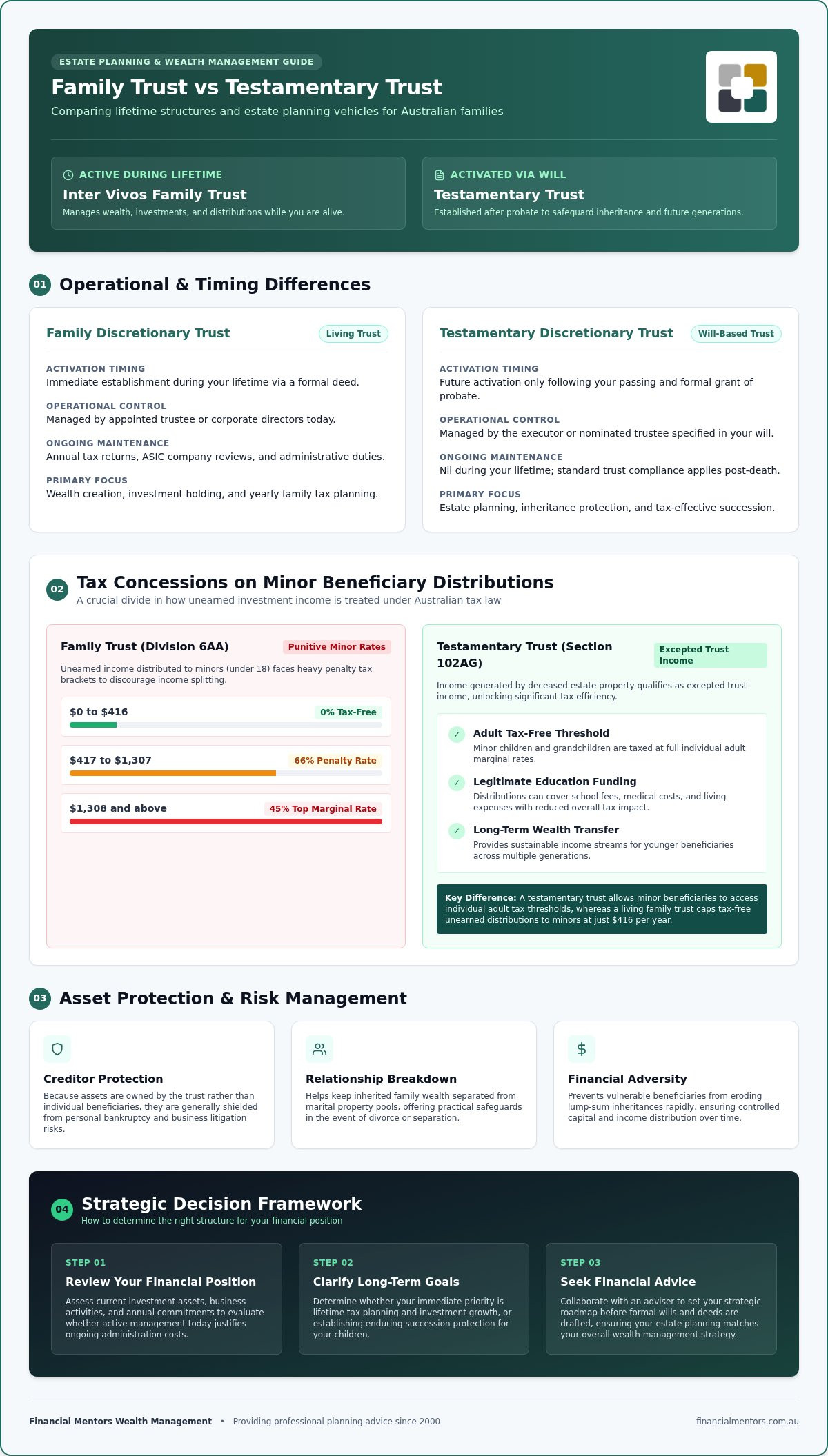
| Feature | Family Discretionary Trust | Testamentary Discretionary Trust |
|---|---|---|
| Activation Timing | Immediate, created during your lifetime. | Future, activates only upon your passing after probate. |
| Operational Control | Managed by your appointed trustee or company directors today. | Managed by the executor or nominated trustee named in your will. |
| Ongoing Maintenance | Annual tax returns, ASIC reviews, and administrative duties. | Nil during your lifetime; standard trust compliance post-death. |
| Primary Purpose | Lifetime wealth creation, asset holding, and annual tax planning. | Estate planning, inheritance protection, and tax-effective succession. |
Evaluating this balance between immediate flexibility and future protection clarifies the role each structure plays in reaching your long-term goals.
Tax Advantages and Beneficiary Distributions: A Strategic Comparison
How investment income flows to your beneficiaries often dictates the real-world value of any structure. When weighing up a family trust vs testamentary trust, tax efficiency stands out as a defining difference, especially if you have young children or grandchildren. While both entities allow trustees to distribute annual earnings to beneficiaries on lower tax rates, it’s the treatment of minor beneficiaries under Australian tax law that creates a significant divide.
Tax Treatment of Minor Beneficiaries and Excepted Trust Income
Under a standard family trust, distributing unearned investment income to children under 18 triggers punitive penalty tax rates under Division 6AA of the Income Tax Assessment Act 1936. Minors can only receive up to $416 per financial year tax-free. Any distributed income between $417 and $1,307 is taxed at 66%, and amounts above $1,308 face the top marginal tax bracket of 45%.
Testamentary trusts operate under entirely different provisions. Under Section 102AG, income generated by deceased estate property qualifies as excepted trust income. This means minor beneficiaries receive the benefit of adult marginal tax rates, including the full $18,200 annual tax-free threshold. If you want an inheritance to cover private school fees or living expenses for dependent children, this concession prevents substantial tax erosion.
Streaming Capital Gains, Franking Credits, and Investment Earnings
Both arrangements grant trustees the discretionary power to stream distinct income categories to chosen beneficiaries. Grounded in established legal principles of trusts, this separation of legal title from beneficial enjoyment allows you to direct returns where they produce the cleanest tax outcome.
- Franked dividends: Trustees can stream dividend earnings alongside franking credits to adult family members with low taxable incomes, often generating cash tax refunds.
- Capital gains: When the trust sells an asset held for more than 12 months, the trustee can distribute net capital gains to resident individuals, preserving the 50% capital gains tax discount under Subdivision 115-A.
Making annual trust distribution determinations before 30 June ensures you don’t face default taxation at the top personal tax bracket. Integrating these tax rules into your financial plan helps your family build wealth smoothly without running into avoidable compliance traps. Seeking tailored estate planning advice gives you clarity on how these distribution powers can protect your family’s future.
Asset Protection: Safeguarding Wealth from Legal and Financial Risks
Shielding your hard-earned wealth from personal liability, commercial disputes, and divorce requires careful planning. Assets held inside a trust do not form part of your personal balance sheet. Because legal ownership sits with the trustee, personal creditors cannot automatically seize trust property to satisfy an individual debt. However, the protective strength of a family trust vs testamentary trust depends heavily on how and when the assets enter the structure.
Neither structure offers an absolute shield against every dispute, particularly in the Family Court. Understanding the limits of each vehicle ensures you build genuine resilience against unexpected financial adversity.
Shielding Capital from Business Insolvency and Creditor Claims
Operating a business or working in a profession exposed to litigation carries inherent financial risks. A living family trust lets you hold appreciating assets, like shares or commercial property, entirely separate from your trading entities. If your trading business faces severe trading difficulties, assets held securely within your family trust are generally insulated from business creditors.
Timing remains critical. Under sections 120 and 121 of the Bankruptcy Act 1966, a bankruptcy trustee can claw back assets transferred into a family trust within a four to five-year statutory window, or indefinitely if the transfer intended to defeat creditors. A testamentary trust avoids this clawback challenge. Because an inheritance flows directly from the deceased estate into the trust without touching the beneficiary’s personal estate, creditors cannot claim ownership of the capital.
Preserving Inheritances Across Generations and Relationship Breakdowns
Protecting an inheritance across generations often involves guarding against relationship breakdowns. In the Federal Circuit and Family Court of Australia, trust assets receive close scrutiny. If a beneficiary has sole control over the trust as sole appointer and trustee, the court will likely treat the trust assets as ordinary matrimonial property available for division.
You can significantly strengthen asset protection by establishing thoughtful governance:
- Independent trustees: Appointing an independent co-trustee prevents any single beneficiary from treating trust capital as personal pocket money.
- Generational succession: Clear lineage clauses ensure wealth remains within your family bloodline rather than drifting to former partners.
- Safeguarding vulnerable beneficiaries: Discretionary controls protect family members struggling with addiction, poor money management, or undue third-party influence.
When properly structured, both vehicles defend your wealth, giving your family confidence as you pursue your long-term goals.
How to Decide Between a Family Trust and a Testamentary Trust
Deciding between a family trust vs testamentary trust does not mean selecting one structure and abandoning the other entirely. Many Australian wealth creators successfully run both vehicles in tandem. While a living trust secures current investment ventures, a testamentary trust captures personal estate wealth down the track. Following a logical framework helps determine how to stage these entities to protect your household balance sheet.
Step 1: Evaluate Your Current Wealth Accumulation Needs
Start by auditing your present assets. Do you hold a growing portfolio of shares or residential property that generates substantial income today? If you are paying tax at top marginal rates, moving active investments into a discretionary trust can be sensible. However, you must weigh those potential tax savings against operational costs, including state stamp duty on deeds, ASIC fees, and yearly tax return preparation.
Step 2: Plan Your Intergenerational Legacy and Future Beneficiaries
Next, look ahead at who will ultimately inherit your estate. If your children are young, or if you want to support grandchildren through university, building a testamentary structure into your will offers unique advantages. Because your beneficiaries access adult tax-free thresholds on estate income, you avoid the heavy penalty rates associated with ordinary trusts. Incorporating this mechanism directly into your strategic estate planning advice shields your legacy from sudden financial adversity or unexpected relationship disputes.
Step 3: Align Trust Strategy with Long-Term Goals
Finally, confirm that your trust architecture coordinates smoothly with your wider financial arrangements:
- Harmonise your broader strategy: Ensure your structure complements your long-term wealth creation strategies and ongoing retirement goals.
- Superannuation alignment: Direct your self-managed super fund death benefit nominations so payouts flow seamlessly into testamentary trusts via your estate.
- Pension eligibility: Factor in how potential distributions could alter future Centrelink entitlements as your family members enter retirement.
Getting these settings right requires an objective look at where your finances stand today and where you want them to go. You can clarify your roadmap by arranging an initial financial planning consultation to review your structures.
Putting Your Structure into Action: Strategic Advice and Next Steps
Implementing an effective wealth strategy requires clear collaboration between your financial planner and your legal specialist. While comparing a family trust vs testamentary trust clarifies your architectural choices, moving from concept to reality takes methodical coordination. Financial planners build the overarching strategic roadmap, test tax modelling, and clarify your priorities before formal documentation begins. Once that financial strategy is confirmed, qualified solicitors handle the legal document drafting for trust deeds and wills to ensure compliance with Australian succession legislation.
Step 01: Booking Your Initial Consultation and Portfolio Discovery
Every successful wealth management journey starts with an initial discovery meeting, representing step 01 of the process. Providing professional planning advice across Australia since 2000, Financial Mentors Wealth Management focuses first on understanding your personal milestones. During this first session, you will review your full financial position, assess existing income streams, and outline your medium-term goals.
This discussion helps pinpoint blind spots in your current setup. It gives you a clear forum to evaluate financial risks, assess debt exposure, and establish whether your family requires immediate lifetime structuring or future inheritance safeguards.
Conducting Periodic Reviews to Adapt to Life Transitions
Establishing your structure is not a set-and-forget exercise. Significant life transitions naturally alter your financial landscape, requiring proactive oversight through an ongoing periodic review. Your trust governance should evolve whenever meaningful milestones take place:
- Family transitions: Welcoming children, celebrating marriages, or navigating relationship separations require updating named beneficiaries and lineage clauses.
- Commercial changes: Selling a family enterprise, acquiring significant property, or transitioning into retirement alters your annual cash flow and tax profile.
- Succession updates: Appointor roles and trustee designations must be updated as your adult children develop the financial experience needed to manage family wealth.
Remaining proactive gives you confidence that your assets stay secure through every chapter of life. You can take control of your future today by scheduling a strategic appointment with an experienced financial advisor.
Taking the Next Step Towards Lasting Wealth Protection
Choosing between a family trust vs testamentary trust is ultimately about aligning the right vehicle with your life stage. A living family trust provides immediate flexibility to manage investment assets and stream earnings today. In contrast, establishing a testamentary trust through your will safeguards a future inheritance, shielding capital from litigation while providing generous tax concessions for young beneficiaries. Many families find that pairing both structures provides genuine security against unexpected financial adversity.
Building that security starts with clear strategic direction before formal legal deeds and wills are prepared. Providing professional planning advice across Australia since 2000, Financial Mentors Wealth Management creates tailored wealth management roadmaps designed around your personal values. Everything starts with step 01: an initial discovery discussion focused on your unique circumstances and long-term goals. Book your initial consultation today and gain quiet confidence in your family’s tomorrow.
Frequently Asked Questions
Can you transfer assets from a family trust into a testamentary trust?
Transferring assets between these structures is legally complex and can trigger capital gains tax and state stamp duty, as they represent distinct legal entities. Under section 102AG(2AA) of the tax act, assets injected into a testamentary trust from external sources do not qualify for minor tax concessions. Because the law requires property to derive directly from the deceased estate, coordinating your entities through tailored financial advice prevents unnecessary tax penalties.
How much does it cost to maintain a testamentary trust before death?
Maintaining a testamentary trust costs nothing during your lifetime. The structure exists purely as conditional instructions inside your will, remaining dormant until your death. Because no separate tax file number, bank accounts, or asset transfers exist while you are alive, you avoid the ongoing accounting and compliance expenses that come with running an active vehicle, saving you money until the vehicle is genuinely needed.
Can a family trust protect assets during a family law divorce?
When assessing a family trust vs testamentary trust, neither structure grants total immunity in matrimonial proceedings. Under Australian family law, the court examines who exercises effective control over the assets. If you or your former partner serve as trustee and principal beneficiary, the court can treat the trust assets as ordinary property of the marriage, rather than a mere financial resource, when determining a final property settlement.
What are the tax rates for children receiving income from testamentary trusts?
Minor beneficiaries receiving income from a testamentary trust are taxed at adult resident marginal rates under Section 102AG of the tax act. They qualify for the standard $18,200 annual tax-free threshold, with excess income taxed at ordinary adult rates starting at 16%. This contrasts sharply with standard discretionary trusts, where unearned income over $416 paid to minors faces penalty tax rates reaching 45%.
Who controls the assets inside a testamentary trust after you pass away?
Control rests with the trustee you nominate in your will. You can appoint an adult beneficiary, a trusted family member, or a corporate trustee with designated directors. For added peace of mind, you can also designate an appointor who holds the legal power to hire or replace the trustee. This governance setup prevents any individual beneficiary from making unilateral decisions that could compromise the trust capital.
Can a testamentary trust receive life insurance and superannuation proceeds?
Yes, your testamentary trust can receive life insurance payouts and superannuation death benefits, provided you complete a binding death benefit nomination directing funds to your legal personal representative. Money flows into your estate first and then transfers into the testamentary trust. Coordinating this pathway carefully ensures you avoid unexpected tax consequences on taxable super components distributed to non-tax dependants.
Do you need a separate testamentary trust for each child in your will?
You do not legally require separate structures, but creating individual testamentary trusts for each child is often sensible. When comparing a family trust vs testamentary trust strategy, establishing separate trusts within your will grants each adult child independent control over their own inheritance. It isolates each child’s share from the other’s commercial risks, protects against shared decision-making conflicts, and simplifies long-term investments.