

What if the “million-dollar retirement” is actually a myth that does more harm than good? If you have spent late nights worrying that your superannuation balance isn’t high enough, you are certainly not alone. Many Australians feel a deep sense of unease about outliving their savings or getting lost in the maze of Centrelink asset tests. It is understandable to feel overwhelmed when the goalposts seem to shift constantly, but we are here to help you find a path toward a don’t panic retirement.
We believe that your current savings are likely a much better start than you’ve been led to believe. This article will show you exactly how to integrate your super with the Age Pension to create a reliable income stream. We will explore the latest 2026 ASFA standards, explain how the $333,000 asset threshold for single homeowners works, and provide a clear roadmap to replace financial anxiety with quiet confidence. You will learn how the system is designed to support you, allowing you to focus on the lifestyle you’ve worked so hard to build.
Key Takeaways
- Discover why the “million-dollar myth” often leads to unnecessary stress and how a don’t panic retirement starts with shifting your focus from accumulation to strategic distribution.
- Learn how the Australian Age Pension and your superannuation work together as a partnership to provide a stable, long-term income.
- Understand the 2026 ASFA benchmarks to see how you can maintain a lifestyle that includes travel and dining without needing an enormous lump sum.
- Identify the practical steps to organise your finances, including how to conduct a thorough asset audit and maximise your super contributions.
- Explore how a financial mentor helps you avoid emotional decision-making while ensuring your tax preparation and wealth strategy are perfectly aligned.
Understanding the ‘Don’t Panic’ Retirement Philosophy
How often do you find yourself staring at your super balance, wondering if it will ever be enough? For many Australians, the transition from work to life after work is clouded by a persistent sense of dread. The “Don’t Panic” mindset is about shifting your focus from the fear of accumulation to the confidence of distribution. It is a fundamental change in how you view your wealth. Instead of seeing your savings as a score you need to keep increasing, you begin to see them as a tool for living. It is about moving away from the “more is always better” trap and toward a place of calm, informed stewardship.
Why the ‘Million Dollar Myth’ is Harmful
We see it in the media constantly; the idea that you need a million dollars to retire comfortably. This arbitrary target creates immense stress for hard-working people who have done everything right but haven’t hit that magic number. If you chase a figure that isn’t based on your actual needs, you risk “frugality fatigue,” where you sacrifice your current happiness for a future you might never fully enjoy. The “don’t panic retirement” philosophy is a strategy-first approach that prioritises your personal lifestyle goals over generic bank balance targets. It’s about knowing that Superannuation in Australia is designed to work alongside other supports, like the Age Pension, not carry the entire burden alone. Why should you be forced to live a restricted life now because of a number that might not even apply to your circumstances?
The Shift from Saving to Spending
Have you thought about what it will actually feel like to stop depositing money and start drawing it down? This is often the biggest psychological hurdle. After forty years of being told to save, the first time you see your balance decrease can feel like a failure. It isn’t. It is the system working exactly as intended. Having a clear roadmap is the best cure for this financial anxiety. By 2026, we have seen inflation and interest rates create a more complex environment, but also one where strategic planning pays off. Your unique life goals, whether that’s regular trips to see the grandkids or a quiet life in a coastal town, deserve more than a “rule of thumb” approach. A financial mentor helps you filter out the market noise, ensuring you stay focused on your journey rather than the daily headlines. They act as a steady hand, helping you understand that while the market fluctuates, your plan remains solid. This partnership allows you to enjoy your retirement without the constant urge to check the news.
The Superannuation and Age Pension ‘Sweet Spot’
Have you ever considered that having a slightly smaller super balance might actually lead to a more stable lifestyle? It sounds counterintuitive, but the Australian retirement system is built on a “hand-in-glove” relationship between your private savings and the government Age Pension. Achieving a don’t panic retirement often comes down to finding the “sweet spot” where these two income sources complement each other perfectly. When you understand how they interact, you can stop worrying about a single “magic number” and start focusing on your total spendable income.
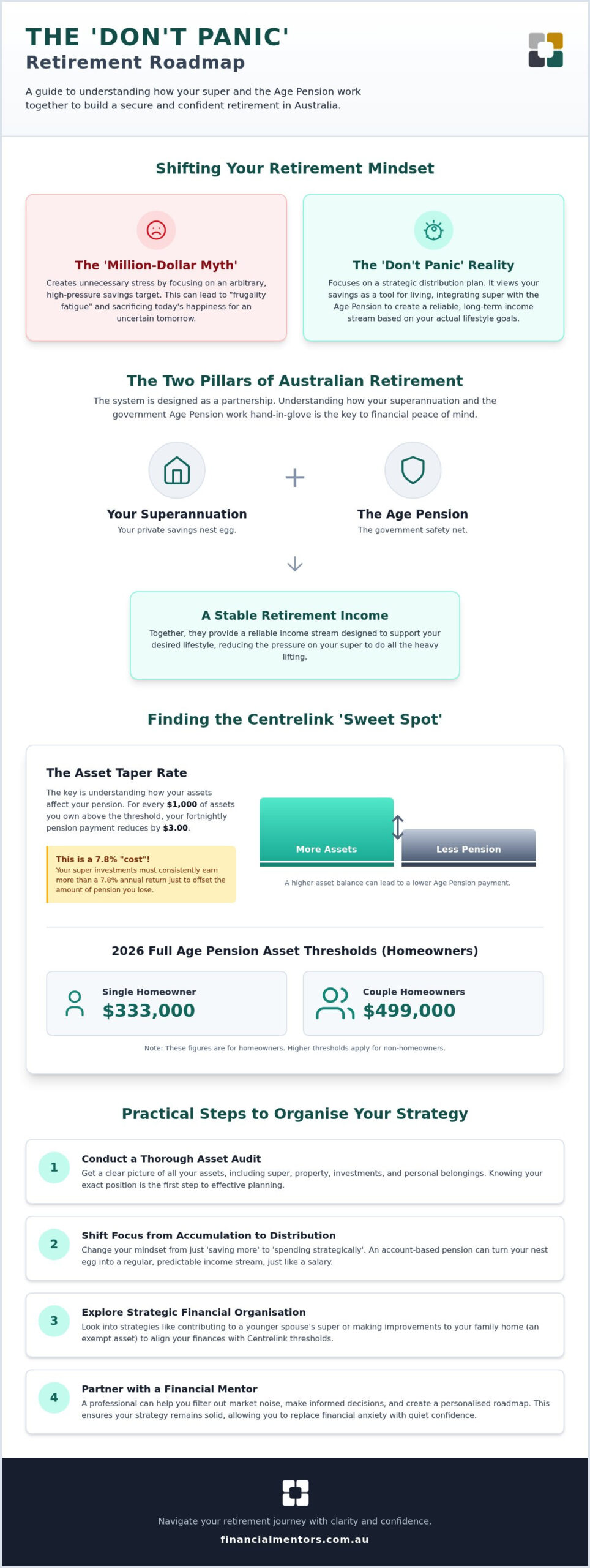
The key to this strategy lies in the Centrelink taper rate. For every $1,000 of assets you own above the full pension threshold, your pension payment reduces by $3 per fortnight. This equates to a $78 reduction every year. If your superannuation investments are not consistently earning more than that 7.8% “cost” in lost pension, you might find that having a lower balance actually leaves you with more cash in your pocket. This is why a strategy focused on total income, rather than just the size of your super account, is so vital for your peace of mind.
Mastering the Centrelink Asset Test
As of 2026, the asset test thresholds have been indexed to help retirees keep more of their hard-earned money. For a single homeowner, the threshold to receive a full pension is now $333,000. For couples who own their home, that figure sits at $499,000. If you are a non-homeowner, your thresholds are considerably higher to help offset the costs of the rental market. Strategic ways to organise your assets, such as making allowable contributions to a younger spouse’s super or renovating your exempt family home, can help you stay under these thresholds. If you are unsure where your assets sit, seeking professional retirement planning can help clarify your position and reduce your reporting stress.
Account-Based Pensions Explained
Once you reach preservation age and retire, you have the option to convert your super into an account-based pension. This effectively turns your nest egg into a regular “paycheque” that lands in your bank account just like your old salary did. To maintain the tax-free benefits of this phase, you must meet minimum drawdown requirements set by the government, which vary based on your age. The goal for most Australians is to align these drawdowns with the ASFA Retirement Standard, which currently suggests a couple needs approximately $77,375 per year for a comfortable lifestyle. A well-constructed plan ensures your super drawdowns work in harmony with the Age Pension, providing a steady income that lasts as long as you do.
Defining a ‘Comfortable’ Lifestyle in 2026
What does your ideal Tuesday morning look like once you have finished your working life? For some, it is a slow coffee at a local café; for others, it is preparing for a trip across the Nullarbor. To achieve a don’t panic retirement, you need to move past vague fears and look at what a “comfortable” life actually costs. According to the June 2026 ASFA Retirement Standard, a single person needs approximately $54,837 per year, while a couple requires about $77,375 to maintain a comfortable lifestyle. These figures assume you own your home outright, which remains the cornerstone of Australian retirement security.
A comfortable lifestyle in 2026 is designed to provide more than just the bare essentials. It allows for a sense of freedom and participation in the community. Specifically, these budgets typically cover:
- Regular domestic holidays and an occasional overseas trip.
- Dining out at local restaurants and catching up with friends for lunch.
- Maintaining a good quality car and keeping up with household repairs.
- Replacing household appliances and updating your wardrobe as needed.
- Private health insurance and access to a range of leisure activities.
If those figures feel out of reach, it is worth remembering that a “modest” lifestyle is still a dignified and viable path. A modest retirement covers all the basics and still allows for some social activities and local travel. It is about matching your spending to your values rather than trying to keep up with an imaginary standard. Calculating your own “comfort number” starts with a simple audit of your current spending. If you remove your work-related costs and mortgage payments, what is left? That figure is your true baseline.
Beyond the Basics: Travel and Healthcare
Most retirees experience an “active” phase, often called the “Go-Go” years, where travel and social spending are at their peak. It’s important that your strategy accounts for this early surge in spending while also looking ahead. As we age, healthcare costs and private health insurance premiums tend to take up a larger slice of the budget. When we provide estate planning advice, we ensure that your roadmap accounts for these transitions, including potential future aged care needs. This foresight prevents the stress of unexpected costs later in life.
Inflation-Proofing Your Income
One of the most reassuring aspects of the Australian system is that the Age Pension acts as a natural hedge against inflation. Because the pension is indexed twice a year, your base level of support rises as the cost of living increases. However, your private superannuation also needs to do some heavy lifting. Organising your investment portfolio to provide growth, even while you are drawing an income, is essential for maintaining your purchasing power over twenty or thirty years. Is your planned retirement secure? Building a foundation that balances immediate cash flow with long-term growth is the key to lasting peace of mind.
Practical Steps to Organise Your Retirement Strategy
Ready to move from understanding the theory to seeing the results in your own bank account? Transitioning into a don’t panic retirement requires more than just good intentions; it demands a methodical approach to your paperwork and your portfolio. By taking small, deliberate steps today, you can replace that lingering sense of uncertainty with a clear, documented path forward. If you are looking for a comprehensive guide to get started, our Retirement planning checklist Australia provides a detailed breakdown of the milestones you should be hitting.
The first step is always a full audit of your current assets and liabilities. This isn’t just about your super balance. It involves looking at your bank accounts, shares, and any outstanding debts, while also acknowledging the value of your family home, which remains exempt from the Centrelink asset test. Once you have a clear picture, you can focus on maximising your super contributions before the 30 June deadline. For the 2026-27 financial year, the concessional contributions cap has risen to $32,500. Utilising these caps effectively is one of the simplest ways to boost your nest egg while managing your current tax position.
The Role of Tax in Retirement
Many Australians assume that once they stop working, they can say goodbye to the tax office. However, professional tax return preparation remains vital for managing your retirement income streams effectively. You need to understand the difference between the tax-free and taxable components of your superannuation, especially if you are under age 60. Through strategic tax planning, you can minimise unnecessary leakage and significantly extend the lifespan of your retirement savings. Aligning your tax returns with your broader wealth strategy ensures that every dollar is working as hard as possible for your lifestyle.
Estate Planning: The Final Piece of the Puzzle
True peace of mind comes from knowing that your family is protected no matter what the future holds. This is why comprehensive estate planning advice is about much more than just writing a will. In Australia, your superannuation does not automatically form part of your estate. You must ensure your death benefit nominations are current and legally binding to avoid unnecessary delays or disputes for your loved ones. We often recommend consulting a wealth management office to stress-test your plan against various life scenarios, ensuring your legacy is handled with the same care you used to build it. If you’re ready to see how these steps fit your specific situation, you can speak with a retirement planning specialist to begin your journey.
Why a Financial Mentor is the Key to Peace of Mind
Have you ever felt like just another number when dealing with a large bank or super fund? There is a profound difference between a product seller and a financial mentor. While a product seller focuses on where your money is held, a mentor focuses on where your life is going. This distinction is the foundation of a don’t panic retirement. A mentor acts as a steady partner, helping you look past the frightening headlines and focus on the long-term roadmap we’ve built together. It’s about having someone who knows your story, not just your account balance.
One of the greatest benefits of professional advice is the emotional buffer it provides. When markets become volatile, it’s natural to feel a surge of anxiety. Without a guide, that anxiety often leads to impulsive decisions that can damage your long-term security. A mentor brings quiet confidence to the table, reminding you of the “if-then” logic in your plan. If the market dips, then our cash reserves are there to see us through. This structured approach replaces panic with a sense of order and ensures you don’t make permanent mistakes based on temporary emotions.
Beyond the numbers, a mentor serves as your authorised representative in the often-confusing Centrelink maze. Dealing with asset tests, income reporting, and the ever-changing rules of Services Australia can be a full-time job. Having an expert who understands the system and can speak on your behalf reduces the administrative burden. This allows you to actually enjoy the retirement you’ve worked so hard to fund, rather than spending your time on hold or filling out endless forms.
Finding the Right Wealth Management Office
Choosing who to trust with your future is a significant decision. In 2026, you should look for more than just a license. While being AFSL licensed since 2003 is a vital proof of stability, you also need a partner who demonstrates genuine empathy for your unique aspirations. Selecting the right wealth management office means finding a team with a national perspective on Australian retirement laws. You deserve a guide who is patient, observant, and deeply invested in your long-term well-being.
Your Invitation to a Calmer Future
We’ve explored why the “million-dollar myth” is often misleading and how the Age Pension and superannuation work as a team. The journey from financial anxiety to peace of mind is rarely a straight line, but it’s always easier with a trusted guide by your side. At Financial Mentors Wealth Management, we are here to help you navigate every transition, from your final paycheque to your first overseas trip in retirement. A simple conversation is often the best cure for uncertainty. Let’s start your retirement conversation today and build the secure future you deserve.
Your Path to a Confident Future
You now have the tools to see past the media noise and understand that a secure lifestyle is well within your reach. By moving away from arbitrary savings targets and focusing on the synergy between your superannuation and the Age Pension, you can find your own financial “sweet spot.” Achieving a don’t panic retirement is not about having the largest balance in the room; it is about having a clear, documented plan that respects your unique goals and provides for your most active years.
We provide strategic advice tailored to Australian retirement laws, ensuring your tax and estate planning are fully integrated for maximum efficiency. Our experienced authorised representatives offer empathetic guidance to help you navigate the complexities of Centrelink and market fluctuations with quiet confidence. If you are ready to replace uncertainty with a structured roadmap, we are here to walk beside you as your trusted guide. Book a consultation with a Financial Mentor today and take the first step toward the peaceful lifestyle you have earned. You have worked hard for your future; now it’s time to let your future work for you.
Frequently Asked Questions
Do I really need $1 million to retire in Australia?
No, the million-dollar figure is often a distraction rather than a requirement. Most Australians can enjoy a comfortable lifestyle with significantly less by using a don’t panic retirement strategy. The 2026 ASFA standards suggest a lump sum of $630,000 for singles and $730,000 for couples is sufficient for a comfortable life. This assumes you own your home and receive some government support, proving that a seven-figure balance isn’t a prerequisite for peace of mind.
How much can I have in assets and still get the Age Pension in 2026?
Your eligibility depends on whether you own your home and your relationship status. For homeowner couples in 2026, you can hold up to $499,000 in assessable assets and still receive the full Age Pension. If your assets are between this amount and the $1,102,500 cut-off, you may still qualify for a part pension. For single homeowners, the full pension threshold is $333,000 with a cut-off of $733,500.
What is the ‘sweet spot’ for superannuation balances for couples?
The “sweet spot” for many homeowner couples is often a super balance between $450,000 and $550,000. At this level, the combination of your account-based pension and the government Age Pension often provides a higher total income than if you had a much larger super balance. This happens because the taper rate reduces your pension as your assets grow, meaning more super doesn’t always equal more spendable cash in your pocket.
Can I still work part-time while receiving the Age Pension?
Yes, you can certainly work part-time while receiving the Age Pension. The Work Bonus scheme allows you to earn a certain amount from working without it affecting your pension payments. As of July 2026, the income test allows singles to earn up to $226 per fortnight and couples up to $396 per fortnight combined before their full pension begins to reduce. This is an excellent way to stay active and boost your retirement lifestyle.
How does the ‘Don’t Panic’ philosophy apply to single retirees?
For single retirees, this philosophy is about validating that a dignified lifestyle is achievable even without a partner’s combined super. The ASFA comfortable standard for a single person is approximately $54,837 per year. By strategically organising your assets to stay under the $333,000 full pension threshold, you can maximise your government support. It’s about moving from the fear of being alone in your finances to having a clear, mentored roadmap.
What happens if I run out of superannuation money?
If your superannuation runs out, the Australian Age Pension serves as a robust safety net. Because the pension is means-tested, your government payments will typically increase as your private assets decrease. While your lifestyle might need to adjust, you won’t be left without an income. This structural support is why we encourage a don’t panic retirement mindset; the system is designed to provide a floor that protects you for life.
Is my family home included in the Centrelink asset test?
No, your principal place of residence is generally exempt from the Centrelink asset test. This is one of the most significant advantages for Australian retirees. Regardless of whether your home is worth $500,000 or $2 million, its value won’t reduce your Age Pension payments. This exemption allows you to remain in your family home while still accessing government support to help cover your daily living expenses and maintenance costs.
How often should I review my retirement plan with a financial mentor?
We generally recommend reviewing your retirement plan at least once a year. The Australian financial landscape changes frequently, with pension indexation occurring every March and September and superannuation caps adjusting every July. A regular check-in with a financial mentor ensures your strategy remains aligned with these changes. If you experience a major life event, such as a health change or an inheritance, an immediate review is wise to protect your peace of mind.