

What if the strict boundaries of superannuation contribution limits were actually the keys to your most tax-effective wealth playground? It’s completely natural to feel a sense of hesitation when the rules shift, especially when the fear of an accidental ATO penalty looms over your retirement dreams. Most of us find the labels of concessional and non-concessional a bit like a foreign language; it’s easy to wonder if you’re doing enough to secure the lifestyle you’ve worked so hard for.
We understand that you want more than just numbers; you want the peace of mind that comes from being prepared. By mastering the new 2026 caps, you can turn that uncertainty into a clear strategy that optimises your tax position and builds a stable future. This guide provides a methodical look at the updated $32,500 and $130,000 thresholds, explains how to use carry-forward rules if your balance is under $500,000, and ensures you feel like a confident steward of your own financial journey.
Key Takeaways
- Understand the distinction between concessional and non-concessional “buckets” to ensure your retirement savings are growing in the most tax-efficient way possible.
- Discover how to utilise the updated $32,500 concessional cap to reduce your taxable income while building a more robust financial future.
- Master the 2026 superannuation contribution limits, including the $130,000 non-concessional cap, to confidently boost your balance with after-tax funds.
- Identify if you are eligible for “carry-forward” rules, which allow those with balances under $500,000 to catch up on missed contributions from the last five years.
- Learn how an integrated approach to tax and retirement planning provides a safety net against accidental ATO penalties and helps you stay focused on your life goals.
Understanding the Superannuation Contribution Landscape in 2026
Think of your superannuation as more than just a mandatory line item on your payslip. It is actually a sophisticated, low-tax environment designed specifically to support your future self. The system of Superannuation in Australia is built on the foundation of stewardship; you are looking after your tomorrow by making wise choices today. While the complexity of the rules can occasionally feel overwhelming, these boundaries are there to provide a stable framework for your long-term growth.
The Australian Government sets superannuation contribution limits to strike a careful balance. They want to encourage us to save for a comfortable retirement, but they also need to prevent the system from being used as an excessive tax shelter. If you have ever felt frustrated by these caps, it helps to view them as the rules of a fair game. Understanding where these lines are drawn is the first step toward finding financial peace and ensuring you do not accidentally step into penalty territory.
Concessional vs Non-Concessional: What is the Difference?
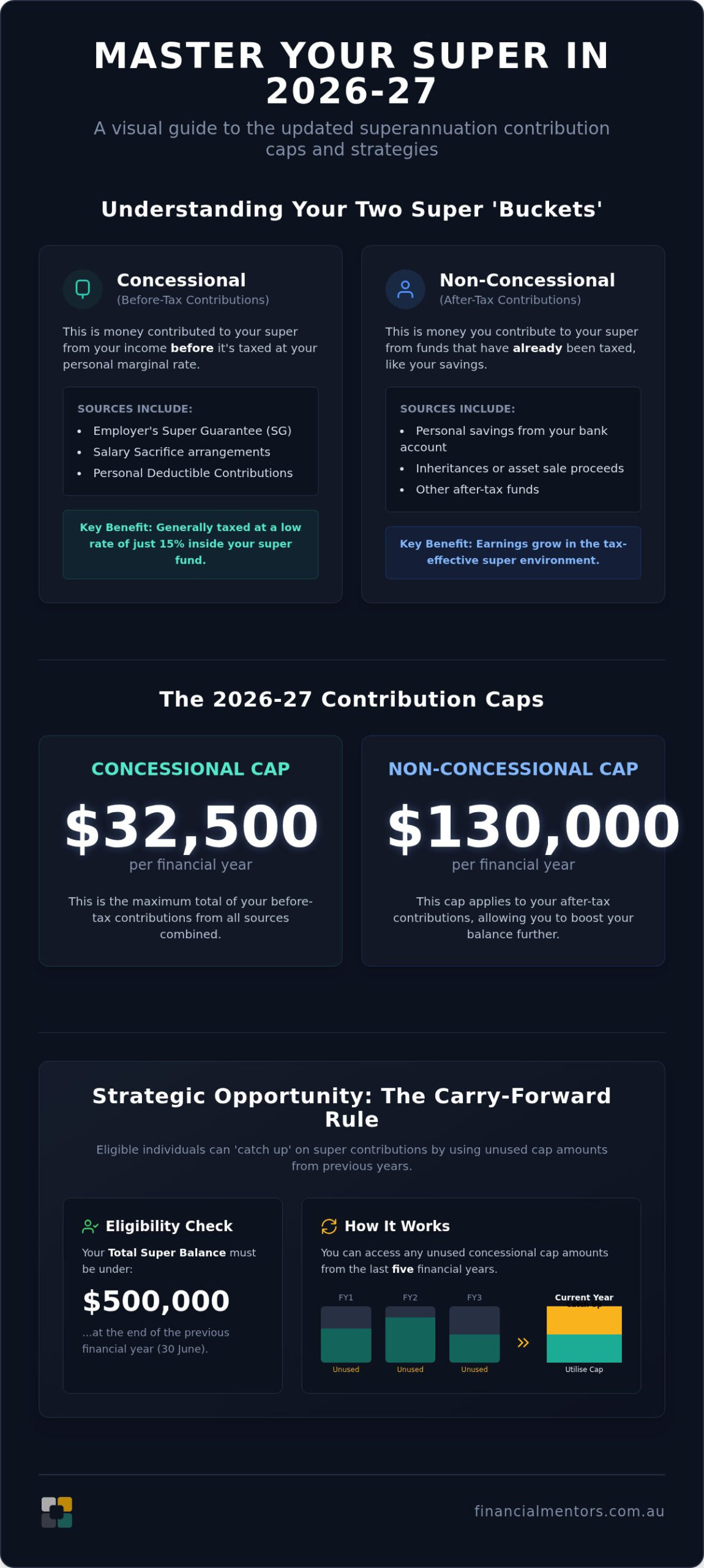
To make sense of the system, it helps to imagine your super fund as a vehicle with two distinct fuel tanks. The Concessional tank is filled with money that has not been taxed at your normal marginal rate yet; it is generally taxed at just 15% inside the fund. This includes your employer’s regular payments and any salary sacrifice you have arranged. On the other hand, the Non-Concessional tank is for after-tax money you choose to invest, such as savings from your bank account. While you do not get a tax deduction for these, the earnings they generate remain in a tax-effective environment. This dual-tank approach allows you to fuel your retirement from different sources depending on your current cash flow and tax needs.
Why 2026 is a Pivotal Year for Your Super
Why does 2026 feel like such a significant milestone? This year is particularly important because indexation has pushed the caps higher, providing more room for your savings to flourish. If you are currently refining your wealth creation strategies Australia, these updated limits offer a fresh opportunity to review your contribution levels. Have you checked if your current payment plan still aligns with the updated superannuation contribution limits? By seeing these rules as a roadmap rather than a roadblock, you can move forward with the quiet confidence that your retirement is being built on a very solid foundation.
Maximising Your Concessional (Before-Tax) Contributions
How much of your hard-earned income can you actually keep? For the 2026-2027 financial year, the concessional contributions cap is $32,500. This figure represents the total amount you can contribute to your super from your pre-tax pay. It includes the 12% Superannuation Guarantee (SG) paid by your employer, any salary sacrifice arrangements you have in place, and personal contributions for which you intend to claim a tax deduction. Understanding these superannuation contribution limits is vital because it allows you to plan your cash flow with precision and purpose.
The primary appeal of concessional contributions lies in the significant tax savings. While your personal marginal tax rate could be as high as 45% plus the Medicare levy, money entering your super fund as a concessional contribution is generally taxed at a flat rate of just 15%. This creates an immediate “tax alpha” that stays within your fund to grow over time. Beyond the numbers, there is a profound sense of peace that comes from automating this process. By setting up a salary sacrifice arrangement, you are essentially paying your future self first. It removes the stress of manual transfers and ensures your wealth builds steadily in the background while you focus on your daily life.
The Power of Personal Deductible Contributions
If you have extra savings sitting in a bank account, you might consider making a personal contribution and claiming it as a deduction. This is a flexible way to manage your tax position, especially if your income fluctuates. To ensure the ATO recognises this, you must lodge a “Notice of Intent” with your super fund and receive an acknowledgement before you file your paperwork. When this is integrated with professional tax return preparation, you can be sure that your strategy is both compliant and highly effective. It is a practical way to turn spare cash into a tax-saving tool for your future.
High Earners and Division 293 Tax
For those with a combined income and super contributions exceeding $250,000, Division 293 tax may apply. This effectively adds an extra 15% tax to your concessional contributions. It is important not to view this as a penalty, but rather as a specific rule to manage within a broader strategy. Even with this additional tax, the total rate of 30% is often still much lower than your top marginal tax rate. Navigating these layers of legislation is a core part of what we do at a wealth management office. If you are concerned about how these limits impact your specific goals, reaching out for a professional consultation can provide the clarity you need to move forward with confidence.
Navigating Non-Concessional (After-Tax) Contribution Limits
While concessional contributions help you save on tax today, non-concessional contributions are about protecting your wealth for tomorrow. For the 2026-2027 financial year, the annual limit for these after-tax contributions is $130,000. These are payments you make from your own savings; money that has already had tax paid on it at your marginal rate. You might wonder why you would put already-taxed money into a “locked” environment. The answer lies in the future. Once you eventually move these funds into a retirement pension, the earnings they generate become tax-free. It is a powerful way to ensure your nest egg isn’t slowly eroded by taxes during your golden years.
We understand that moving significant sums into super can feel like a heavy emotional decision. It represents a shift from having immediate access to your capital to committing it to your long-term stewardship. It is a transition that requires both practical planning and a bit of courage. By staying within the superannuation contribution limits, you are creating a tax-effective sanctuary for your wealth that few other investment vehicles can match. It provides a level of future-proofing that brings a real sense of quiet confidence.
Total Superannuation Balance (TSB) Restrictions
The ability to make these contributions isn’t open to everyone. If your total superannuation balance was $2.1 million or more on 30 June 2026, you are generally not eligible to make further non-concessional contributions for the 2026-2027 year. This threshold is indexed periodically to reflect the changing economic landscape. You can easily track your TSB through your MyGov account or by having a quick chat with your financial mentor. If you find you have reached this limit, don’t worry. There are always other wealth strategies we can explore together to keep your financial momentum going.
The Bring-Forward Rule: A Strategic Leap
If you have recently received an inheritance or sold an asset, you might want to make a larger contribution all at once. The “bring-forward” rule allows you to tap into future years’ caps, potentially contributing up to $390,000 in a single financial year. To use this, you generally need to be under the age of 75 at the start of the year and meet specific TSB requirements. This strategy is a cornerstone of a planned retirement, as it allows you to move capital into a tax-protected space very quickly. Checking the official ATO contribution caps before you act ensures you stay on the right side of the rules while making the most of your superannuation contribution limits.
Strategic Opportunities: Carry-Forward and Catch-Up Rules
Life rarely moves in a straight line. Many Australians find their career paths interrupted by the beautiful, often demanding responsibilities of raising children or caring for elderly parents. If your work pattern has been broken, you might feel a sense of anxiety about your retirement savings. The “Carry-Forward” rule is designed specifically for these moments. It allows you to access unused portions of your superannuation contribution limits from the previous five financial years. This isn’t just a technical loophole; it is an act of stewardship that acknowledges your unique life journey and gives you a chance to make up for lost time.
To take advantage of this opportunity, your Total Superannuation Balance (TSB) must have been less than $500,000 on 30 June of the previous year. If you meet this criterion, you can “catch up” by contributing more than the standard annual cap. It is a powerful way to reduce your taxable income during a high-earning year while simultaneously future-proofing your lifestyle. It feels incredibly reassuring to know that the system has a built-in “reset” button for those who haven’t been able to contribute consistently in the past.
How to Calculate Your Unused Cap Space
Identifying exactly how much “space” you have left requires a methodical approach. You can find this information through your MyGov account, but it helps to have a professional eye review the data to avoid any accidental breaches. Following these steps will give you a clear starting point:
- Step 1: Log in to your ATO online services via MyGov and navigate to the ‘Super’ tab to view your reported history.
- Step 2: Review your concessional contribution history starting specifically from the 2021-22 financial year to see what remains unused.
- Step 3: Consult with your financial mentor to confirm your TSB and ensure you don’t inadvertently exceed your superannuation contribution limits.
Case Study: The “Catch-Up” in Action
Consider the scenario of a professional returning to a full-time role after a three-year hiatus. During her time away, she made no contributions. In 2026, she earns a significant salary and decides to make a $60,000 catch-up contribution using her carried-forward amounts. Because she has unused cap space from her years off, she can claim a deduction for the full amount. This strategy could potentially save her thousands in tax while providing the immense peace of mind that her retirement fund is back on track. If you want to see how these rules apply to your own history, book a strategic retirement planning session to organise your next steps.
Beyond the Caps: Creating a Personalised Retirement Roadmap
While mastering the specific figures of superannuation contribution limits is a vital part of your financial health, it is important to remember that these caps are just one piece of a much larger puzzle. Your super doesn’t exist in a vacuum; it is a pillar that supports your broader life goals and eventual legacy. This is why we often view contribution strategies as a natural extension of estate planning advice. By organising your contributions today, you aren’t just saving on tax; you are carefully structuring the wealth that will sustain you and your loved ones for decades to come.
As your mentors, we encourage you to look past the “tax-compliant” version of your future and start imagining your “ideal” retirement. What does a typical Tuesday look like for you in ten years? Once you have a clear vision of that lifestyle, the technical boundaries of the law become much easier to navigate. They stop being restrictive hurdles and start being the guardrails that keep your journey on track. Managing these transitions requires a high level of coordination, especially when you are balancing multiple income streams or family commitments. Having a partner who understands the emotional weight of these decisions makes all the difference.
The Risk of Excess Contribution Penalties
It is easy to make a simple administrative error that pushes you over the superannuation contribution limits, particularly if you have multiple employers or make a last-minute personal transfer. If you accidentally exceed the caps, the ATO may apply additional tax and interest charges, which can quickly erode the benefits of your strategy. We like to think of professional oversight as a form of insurance policy. It provides a “look before you leap” safety net, ensuring that every dollar you contribute is working for you rather than creating an unexpected headache during tax season.
Taking the Next Step with Financial Mentors
We invite you to start a conversation about your unique aspirations and the life milestones you still want to achieve. Integrated tax and financial planning is about more than just compliance; it is about reducing the daily stress that comes from uncertainty. When you have a clear roadmap and a trusted guide by your side, the complexity of the Australian super system feels much more manageable. You don’t have to navigate these limits alone. We are here to provide the quiet confidence and steady partnership you need to secure a comfortable, well-planned future.
Securing Your Financial Future with Quiet Confidence
Building a comfortable retirement is a journey of steady, thoughtful stewardship rather than a frantic sprint. By understanding the updated 2026 superannuation contribution limits, you have already taken a significant step toward future-proofing your lifestyle. Whether you are utilising the $32,500 concessional cap to lower your taxable income or exploring catch-up rules to make up for lost time, these boundaries are the tools you need to build a stable wealth playground. It’s about more than just compliance; it’s about the peace of mind that comes from being prepared.
We believe that financial planning is most effective when it is deeply human and tailored to your unique aspirations. Since 2003, we have been providing professional advice to Australian families, helping them navigate complex transitions with warmth and expertise. Our integrated approach to tax and wealth strategies ensures that every decision you make is coordinated and clear, leaving you free to focus on what truly matters. If you are feeling ready to turn these insights into a concrete plan, we are here to walk alongside you as your trusted guide.
Ready to optimise your super? Let’s create your roadmap together.
You don’t have to carry the weight of these complex decisions alone. With the right partnership, your retirement can be the rewarding new chapter you deserve.
Commonly Asked Questions
What are the superannuation concessional contribution limits for the 2025-26 financial year?
For the 2025-26 financial year, the concessional contribution cap was $30,000. As we have moved into the 2026-27 period, this limit has indexed upward to $32,500. Staying aware of these annual shifts is a vital part of your financial stewardship, as it ensures you are maximizing your tax-effective savings without accidentally crossing into penalty territory.
Can I still make super contributions if I am over 75 years old?
Generally, super funds can only accept voluntary contributions until you turn 75, plus 28 days into the following month. After this milestone, you can still receive mandated employer contributions or make “downsizer” contributions if you decide to sell your family home. It’s a natural transition phase where our focus often shifts from building the balance to the careful management of your existing retirement savings.
What happens if I accidentally exceed my non-concessional contribution cap?
If you go over your limit, the ATO will typically send you a determination letter offering a few different choices. Most people choose to withdraw the excess amount and 85% of any associated earnings to avoid paying the top marginal tax rate on those extra funds. Having a partner to review your planned transfers beforehand acts as a helpful safety net against these types of administrative hiccups.
How does the “bring-forward” rule work for non-concessional contributions?
The bring-forward rule allows you to access up to three years of non-concessional caps at once, which totals $390,000 for the 2026-27 year. This is an excellent tool if you’ve received an inheritance or sold an asset, provided you are under 75 and your total super balance meets the eligibility criteria. It helps you move larger sums into a tax-protected environment with quiet confidence.
Does my employer’s 12% super guarantee count towards my concessional cap?
Yes, your employer’s Superannuation Guarantee (SG) payments, which are 12% for the 2026-27 year, count directly toward your concessional cap. When you’re calculating your superannuation contribution limits, you must factor in these mandated payments alongside any salary sacrifice or personal deductible contributions. It’s all about looking at the total picture of your before-tax contributions to stay within the boundaries.
Can I carry forward unused non-concessional contribution caps?
No, you can’t carry forward unused non-concessional contribution caps; these are strictly “use it or lose it” each financial year. Only concessional (before-tax) caps offer the five-year carry-forward provision for those with a total super balance under $500,000. This is why the timing of your after-tax contributions is such a significant part of a well-organised wealth creation strategy.
Is there a limit on how much I can have in my total superannuation balance?
While there’s no hard limit on your total balance, there’s a $2.1 million cap on how much you can transfer into a tax-free retirement pension. Additionally, if your balance exceeds $2.1 million, you’re generally barred from making further non-concessional contributions. For balances over $3 million, a higher tax rate of 30% applies to earnings on the portion above that threshold, so careful planning is essential.
How do I claim a tax deduction for personal super contributions in 2026?
To claim a deduction, you must first lodge a “Notice of Intent to Claim” form with your super fund and receive their acknowledgement letter. Once you have that confirmation, you can include the deduction in your tax return. When we handle your superannuation contribution limits review and tax return preparation together, we ensure this process is seamless and that you’re receiving every tax advantage you’re entitled to.