

What if the institution you trust to keep your savings safe isn’t actually the best place to help those savings grow into a lasting legacy? It’s natural to feel a sense of loyalty to your local branch, yet many Australians find themselves feeling like just another account number in a large, impersonal system. You might be concerned about hidden fees or the subtle pressure of vertically integrated products that don’t quite fit your unique circumstances. If you’ve ever felt that your wealth strategy was more about the bank’s targets than your own dreams, you aren’t alone.
When weighing up the choice between a bank vs financial advisor for wealth management australia, the decision you make today will define your financial freedom for years to come. This guide will help you discover the critical differences between institutional banking and private advisory to ensure your strategy aligns with your long-term life goals. We’ll explore the legal protections of the Best Interests Duty and how an integrated tax and wealth strategy can provide the genuine peace of mind that comes from being truly prepared for retirement and beyond.
Key Takeaways
- Understand why the traditional banking model might not offer the personalised touch needed for your family’s unique financial journey.
- Explore how the Best Interests Duty protects you when comparing a bank vs financial advisor for wealth management australia.
- Learn to spot the difference between being sold a financial product and being guided by a strategy that puts your life goals first.
- See how combining your wealth strategy with professional tax return preparation can create a more seamless path toward your retirement goals.
- Use our decision framework to determine if your current path aligns with the legacy you wish to build for the next generation.
Understanding the Landscape: The Bank Model vs Private Wealth Advisory
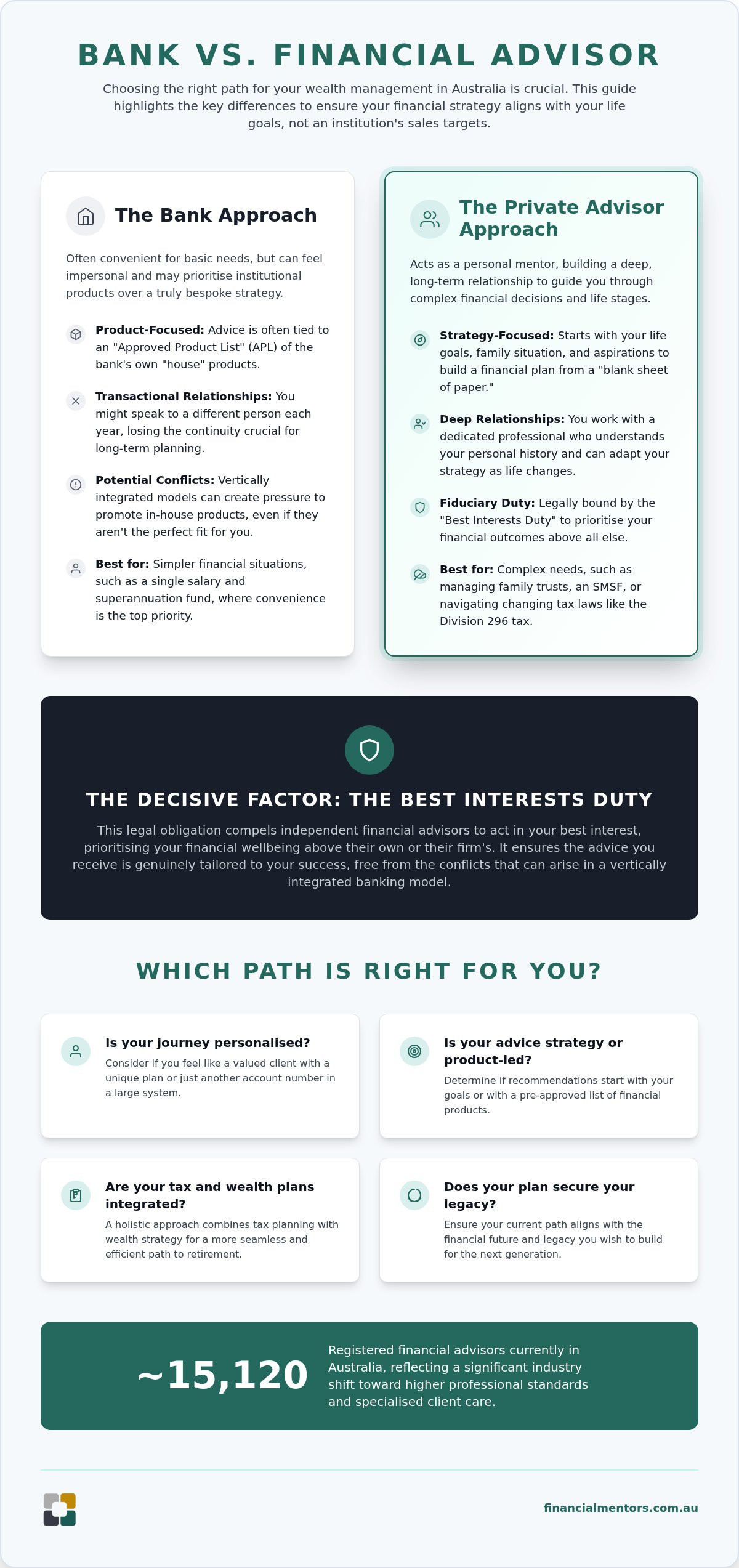
In the modern Australian context, wealth management is far more than a simple set of investment instructions. It’s a comprehensive approach to stewardship that looks at your entire life, from the family home to your retirement dreams and the legacy you’ll eventually leave behind. As of mid-2026, the landscape has shifted significantly. With approximately 15,120 registered financial advisers across the country, the industry has moved toward much higher professional standards, making the choice of who guides you more important than ever. When you’re deciding on a bank vs financial advisor for wealth management australia, you’re really choosing between two very different philosophies of care.
The choice doesn’t just depend on your account balance. It’s about the complexity of your life. If you have a straightforward salary and a single super fund, a bank’s general services might feel sufficient. However, if you’re managing a family trust, an SMSF, or navigating the new Division 296 tax on large super balances that commenced in July 2026, you likely need a level of nuance that a standard retail bank isn’t designed to provide. Understanding What is a Financial Planner? helps clarify that a true professional doesn’t just manage money; they manage your path through shifting legislation and personal milestones.
The Institutional Banking Approach
For many, the primary appeal of a bank is the sheer convenience. It’s the “one-stop-shop” feeling of having your mortgage, credit cards, and wealth strategy all visible within a single app. Banks leverage these existing relationships to offer wealth services that feel familiar and safe. However, the trade-off is often a lack of bespoke strategy. Since the major banks reduced their presence in personal advice following regulatory reforms, the service can sometimes feel more transactional. You might find yourself speaking to a different person each year, losing that vital sense of continuity and personal history that is so important when planning for the long term.
The Private Advisory Alternative
A private wealth advisor functions more like a mentor or a trusted guide sitting across the kitchen table from you. This model prioritises a deep, ongoing relationship with a specific professional who knows your children’s names and understands your specific fears about retirement. In an environment where superannuation contribution caps and tax brackets were updated in July 2026, having an agile partner is essential. A private advisor can pivot your strategy quickly as laws change, ensuring your wealth creation strategies remain effective. This path is built on personal accountability and a shared commitment to your life goals, rather than meeting corporate product targets.
Product Focus vs Strategy Focus: Where Does Your Interest Lie?
Have you ever walked into a bank feeling like a valued client, but left feeling like you’ve just been sold a product? This common experience highlights the fundamental difference between product-focused and strategy-focused advice. When navigating the choice of a bank vs financial advisor for wealth management australia, it’s essential to understand how these different models impact your net returns and your peace of mind. While banks often focus on “what” you should buy, a private advisor focuses on “why” you are investing in the first place.
The traditional bank model often relies on vertical integration. This means the institution owns the advice team, the investment platform, and the actual funds being recommended. This can create a “closed loop” where your choices are limited to an “Approved Product List” (APL) curated by the bank itself. In contrast, an independent advisory office with its own long-standing AFSL (Australian Financial Services Licence) can often access a much broader range of investment vehicles. This freedom allows your advisor to scour the market for the best fit for your specific risk profile and ethical preferences, rather than being restricted to “house” products.
The Hidden Risks of Product-Led Advice
The risk of product-led advice is that your unique goals can become secondary to the institution’s desire to keep your assets within their ecosystem. Even though commissions on investment products are now a thing of the past, the institutional culture of “product pushing” can be hard to shake. A strategist, however, starts with a blank sheet of paper. They look at your family trust, your business interests, and your personal aspirations before even mentioning a specific fund. ASIC offers helpful guidance on how to choose a financial adviser, which can help you distinguish between a professional strategist and a corporate representative.
Why Strategy-Led Advice Wins for Retirement
For those focusing on their planned retirement, a strategy-led approach is non-negotiable. Retirement isn’t just about a balance in an account; it’s about cash flow, tax efficiency, and the orderly transfer of wealth to the next generation. A mentor helps you navigate complex legislative changes, such as the 2026 updates to superannuation contribution caps, ensuring you’re making the most of every dollar. This level of care requires an integrated strategy that connects your wealth creation with estate planning advice and tax preparation. If your current financial plan feels like a generic template, it might be time to seek a more personal partnership that treats your legacy with the respect it deserves.
Comparing Fees, Transparency, and the Best Interests Duty
If you’ve ever felt confused by a complex fee disclosure statement, you’re not alone. Transparency is the bedrock of a healthy partnership, and it starts with understanding how you’re being charged and what that covers. In the debate of bank vs financial advisor for wealth management australia, the most significant difference often lies in where the loyalty of the professional truly sits. While every licensed professional in Australia is bound by the Best Interests Duty, the way this is applied can vary between a large institution and a private firm. It’s a legal requirement to act in your favour at all times, ensuring that any advice provided is specifically designed to improve your financial position.
The legal foundation of financial advice in Australia changed significantly in 2026 with higher education standards and stricter transparency rules. This means you should expect a clear breakdown of all costs before any work begins. A professional mentor will be happy to sit down and explain their fee structure, whether it’s a flat fee for a specific strategy or an ongoing service fee. This openness allows you to calculate the real value of the advice, looking beyond just the cost to the potential tax savings and long-term growth an integrated strategy can provide.
Institutional Fees vs Private Advisory Fees
Institutional advice often appears low-cost on the surface, but it’s important to ask what’s happening behind the scenes. In many cases, the “cost” of the advice is subsidised by the margins on the bank’s own products. This can make the advice feel cheaper, but it may limit your investment options to a narrow list. On the other hand, the private advisory model typically favours a transparent fee-for-service approach. You pay for the professional’s wisdom and time, not for the products they recommend. It’s a cleaner way to do business that removes the “product pushing” culture often found in larger systems.
The Legal Protection of the AFSL
Every professional offering financial advice must be authorised under an Australian Financial Services Licence (AFSL). This isn’t just a piece of paper; it’s a commitment to rigorous ethical standards and ongoing education. You can easily verify these details through ASIC’s Financial Advisers Register, which provides a clear history of an individual’s qualifications and professional standing. When a firm has held its own AFSL since 2003, it demonstrates a level of stability and experience that a revolving door of bank staff simply cannot match. It ensures your wealth is managed by someone who has navigated decades of regulatory change with a steady hand.
Ultimately, the right choice in the bank vs financial advisor for wealth management australia debate is the one that offers you the most clarity. When fees are transparent and the legal duty is clear, you can focus on what really matters: your life and the people you love. A wise mentor doesn’t just manage your money; they help you protect it through every stage of your journey.
Key Considerations for Your Wealth Journey: A Decision Framework
How do you know when your financial situation has outgrown the local branch? It’s a question many Australians face as their careers progress and their family structures become more intricate. While a bank offers a sense of reach, a private wealth office offers depth. When evaluating a bank vs financial advisor for wealth management australia, the right path often depends on the level of customisation your life requires. If you’re managing more than just a savings account, you need a framework that considers your business interests, family trusts, and the legacy you intend to leave behind.
Complexity and Customisation
There comes a point where a simple, bank-managed retail fund no longer serves your best interests. If you’re looking to protect intergenerational wealth or manage a Self-Managed Super Fund (SMSF), the generic approach of a large institution can feel restrictive. In a high-inflation environment, where the RBA cash rate sits at 4.35% as of August 2026, your strategy must be agile. Effective wealth creation strategies australia require a mentor who can pivot your portfolio to meet these economic shifts. It’s about moving beyond “set and forget” to a model of active stewardship that respects the hard work you’ve put into building your assets.
The Strategic Edge of Integrated Tax Preparation
Many people believe that keeping their banking and wealth in one place is the ultimate convenience. However, the true “one-stop-shop” is one that integrates your financial strategy with your annual tax return preparation. When your advisor and your tax preparer work in the same office, you eliminate the friction that often occurs when separate professionals don’t communicate. This integration ensures that every investment decision is made with its tax implications in mind, optimising your growth while maintaining strict compliance with the latest ATO requirements.
This holistic view is equally vital when considering the future. A bank may help you with a basic account, but they rarely provide the deep estate planning advice needed to ensure your assets are distributed exactly as you wish. Matching the personality and values of your advisory firm to your own is the final piece of the puzzle. You deserve a partner who values stability and long-term partnership over quarterly corporate targets. Choosing between a bank vs financial advisor for wealth management australia is ultimately about who you want standing beside you during life’s biggest transitions. If you’re ready to see how an integrated approach can simplify your life, reach out to a trusted mentor today to discuss a strategy tailored to your family’s future.
The Financial Mentors Approach: Integrated Strategy and Stewardship
Choosing between a bank vs financial advisor for wealth management australia isn’t just a financial decision; it’s a choice about who you want walking beside you through life’s most significant milestones. At Financial Mentors, we believe that wealth is more than a number on a screen. It’s the ability to provide for your family, the security of a well-earned retirement, and the legacy you leave behind. Our approach moves away from the cold, transactional nature of institutional banking and toward a relationship-based mentorship that prioritises your peace of mind above all else.
With our AFSL license held since 2003, we offer a level of stability that is rare in an ever-changing regulatory environment. This long-standing history means we’ve guided families through various economic cycles, always maintaining a steady hand and a clear focus on the individual. When you partner with us, you’re not just another client in a system; you’re a person with unique aspirations that deserve careful, personalised attention. We take the time to listen, ensuring that every recommendation we make is a direct reflection of your values and goals.
A Partnership Built on Trust
Our “Wise Mentor” philosophy is built on the idea that we are stewards of your future. We handle the heavy lifting of wealth management office operations, from compliance to complex strategy, so you don’t have to. We speak in plain, jargon-free Australian English because we believe that clarity is the first step toward confidence. If you’ve ever felt overwhelmed by financial terms or institutional paperwork, we’re here to translate that complexity into a practical, actionable roadmap. This partnership is designed to reduce the stress of decision-making, allowing you to focus on enjoying the life you’ve built.
Securing Your Legacy Today
The best time to refine your strategy is today. Waiting for “someday” often means missing out on the benefits of compounding growth or the latest tax-effective structures available in the current 2026 landscape. Whether you’re in a capital city or a regional area, our national reach ensures you have access to expert advice that integrates retirement planning, estate goals, and tax return preparation. We don’t just look at where your money is today; we look at where it needs to be for the next generation.
We invite you to start a dialogue with us. Let’s sit down, discuss where you are now, and plan exactly where you want to be. Your financial future is a journey, and we’d be honoured to be your guide. By choosing a partner who understands the nuances of the Australian landscape, you’re taking the first step toward a more secure and meaningful financial future.
Your Path to a Secure Financial Legacy
Determining the right fit between a bank vs financial advisor for wealth management australia is about more than just comparing fees or digital apps. It’s about deciding who you want to trust with your family’s future. While a bank offers the ease of a large system, a private advisor provides the bespoke strategy and personal continuity that complex wealth demands. A true partner doesn’t just manage your funds; they integrate your tax strategy and estate goals to ensure every piece of your financial life works in harmony.
At Financial Mentors, we’ve held our own AFSL licence since 2003, providing a stable foundation for families across the country. Our empathetic, mentor-led approach ensures you’re never just a number, but a valued individual with a unique story. We combine integrated strategic tax and wealth expertise to give you the confidence that your plan is robust and future-proof. If you’re ready to move from a transactional relationship to a lifelong partnership, we’re here to help you navigate the way forward.
Secure your financial future with a partner who cares—enquire with Financial Mentors today.
Take that first step with confidence, knowing that your legacy is in safe, experienced hands.
Common Questions About Australian Wealth Management
Is it safer to keep my wealth management with a big Australian bank?
Safety in wealth management is defined by regulatory oversight rather than the size of the institution. All financial advisors, whether they work for a “Big Four” bank or a private firm, must comply with strict ASIC regulations and the same professional standards. A private firm with a long-standing AFSL, held since 2003, offers the same legal protections as a bank while providing the added security of personal continuity and a deep understanding of your family’s history.
Do independent financial advisors charge more than banks?
The total cost of advice is often comparable, but the way you pay is usually more transparent with a private advisor. Banks may offer lower upfront fees because they often recover costs through the margins on their own investment products. Private advisors typically use a fee-for-service model. This clear structure ensures you’re paying for professional wisdom and strategy rather than just being placed into a bank-owned fund.
What is the “Best Interests Duty” in Australian financial planning?
The Best Interests Duty is a legal requirement that forces advisors to prioritise your needs above their own or their employer’s interests. When you’re deciding between a bank vs financial advisor for wealth management australia, this duty is your primary protection. It ensures that every piece of advice, from superannuation changes to investment choices, is specifically designed to improve your financial position and help you reach your life goals.
Can a financial advisor help with my tax returns as well?
Yes, some specialised firms provide integrated tax return preparation as part of their wealth strategy. This is a significant advantage because it allows your advisor to see the full picture of your finances. When your tax and wealth strategies are handled by the same mentor, you avoid the friction that occurs when separate professionals don’t communicate. This leads to better tax-effective growth and a simpler experience for you.
How do I know if my bank advisor is pushing their own products?
You can identify this by asking for their Approved Product List (APL) and seeing if it’s dominated by the bank’s own brands. If an advisor only recommends funds or platforms owned by their parent company, you’re likely in a “vertically integrated” system. A strategic mentor should be able to explain why a particular investment is the best fit for you from a broad range of options across the entire Australian market.
What should I look for when choosing a wealth management office?
Look for a firm that holds its own AFSL and demonstrates a commitment to long-term stewardship. It’s vital to check the ASIC Financial Advisers Register to verify that the individual advisor meets the high education standards required in 2026. You should also seek a partner who offers a holistic range of services, including retirement planning and estate advice, rather than just basic investment management.
How often should I review my wealth strategy with an advisor?
A formal review should take place at least once a year to ensure your plan stays on track. More frequent reviews are necessary when major life events happen or when the government introduces new laws, such as the 2026 updates to superannuation tax brackets. These regular check-ins allow your advisor to pivot your strategy as the economy shifts, keeping your future-proofing efforts effective and relevant.
Can I switch from a bank to a private financial advisor easily?
Switching is a standard process that a private advisor can manage on your behalf. They’ll handle the administrative tasks involved in transitioning your accounts and superannuation to a strategy that better aligns with your personal goals. This move is often the first step toward a more personalised partnership where you’re treated as a person with a legacy to build, rather than just another account number.