

What if your superannuation accounts, investment properties, and family legacy weren’t sources of stress, but instead felt like a perfectly tuned engine driving you toward the life you’ve always imagined? Many Australians find themselves feeling slightly disorganised as their wealth grows, perhaps wondering if multiple super funds and various assets are actually working in harmony. It’s completely normal to feel a sense of unease about whether your current trajectory will truly provide enough for a comfortable retirement, especially when local regulations seem to change every time you turn on the news.
Discovering how a structured financial planning process in Australia helps you organise your wealth is the key to reclaiming your confidence. If you can see exactly where you stand today, then you can make informed decisions about where you want to be tomorrow. This guide will walk you through the essential steps of building a financial roadmap. We’ll look at how a partnership with a wise mentor can simplify complex rules, streamline your tax obligations, and ultimately provide the peace of mind that comes from knowing your future legacy is secure. It’s time to move away from confusion and toward a steady, well-prepared journey.
Key Takeaways
- Understand how the financial planning process in Australia is designed to protect you by ensuring your advisor prioritises your personal goals above all else.
- Discover the structured six-step journey that turns your various assets and super accounts into a clear, manageable roadmap.
- Learn how to interpret your Statement of Advice (SOA) so you can move forward with a personalised blueprint you actually understand.
- Identify the essential documents and questions needed to ensure your first consultation is a productive step toward a trusted partnership.
- Gain insight into why a successful plan is an ongoing conversation that adapts to your changing life stages and legislative shifts.
What is the Financial Planning Process in Australia?
Think of the financial planning process australia as a living framework rather than a dusty folder on a shelf. It’s a methodical way to look at your entire life through a financial lens, ensuring that your daily habits align with your long-term dreams. Within the broader Australian financial system, this process acts as your personal navigation system. It takes the complexity of superannuation, tax laws, and investment markets and organises them into a single, cohesive strategy.
The modern landscape has shifted away from simply selling financial products toward providing deeply considered strategic advice. In Australia, this isn’t just a professional preference; it’s a legal requirement. Financial advisors must adhere to a “Best Interests Duty,” which means every recommendation they make must prioritise your well-being over their own interests. This shift recognises that your money is a tool for living, not just a collection of balances. It transforms the relationship from a one-off transaction into a journey of stewardship and steady progress.
Why a Structured Process Matters
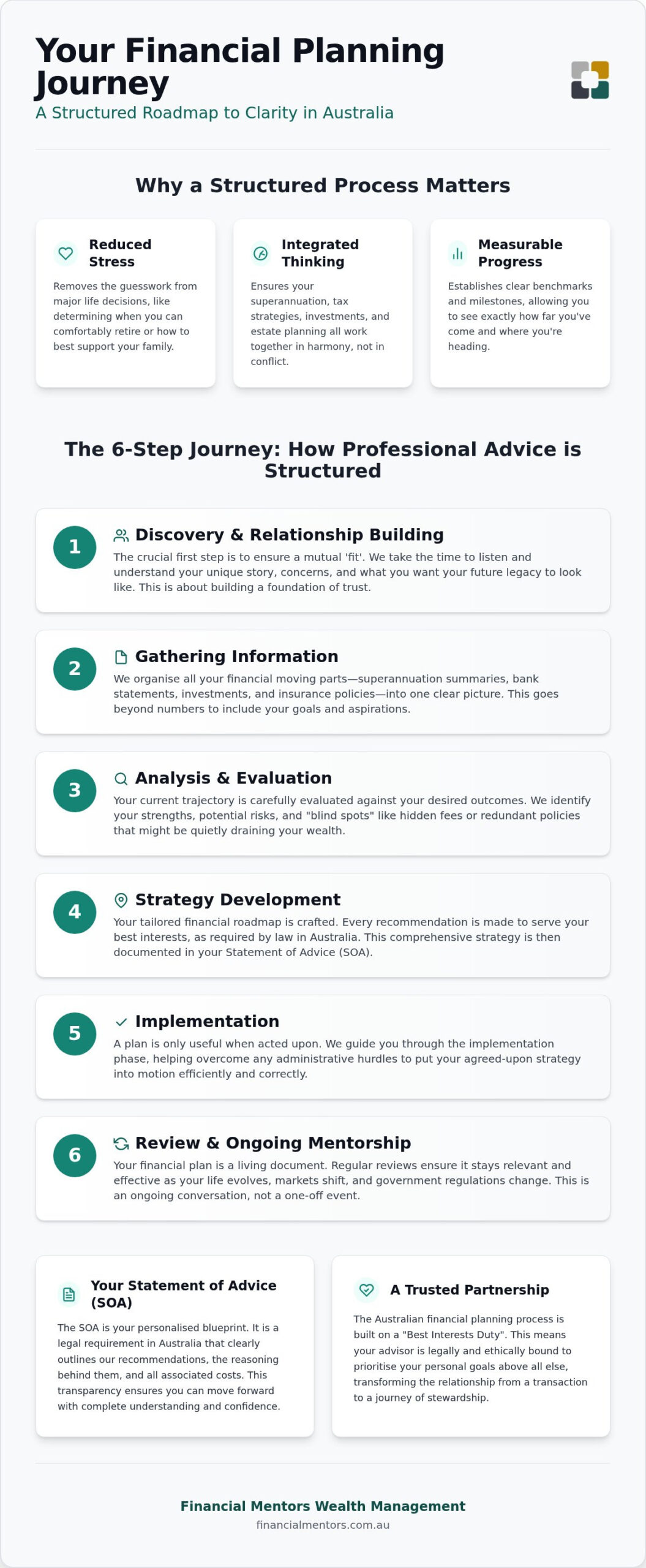
If you’ve ever felt overwhelmed by trying to manage your finances in isolation, you’ll understand why structure is so vital. A clear process provides several key benefits:
- Reduced stress: It removes the guesswork from major life decisions, such as when to retire or how to support your children.
- Integrated thinking: It ensures your super, tax strategies, and estate planning all work together instead of pulling in different directions.
- Measurable progress: It establishes clear benchmarks, allowing you to see exactly how far you’ve come and where you’re heading.
The Role of a Wise Mentor
There is a significant difference between a transactional broker and a true financial mentor. While a broker might focus on a single trade or product, a mentor focuses on your unique story. They take the time to validate your concerns and understand the “why” behind your goals. This human-centric approach is what builds real trust. A mentor doesn’t just provide data; they provide perspective. They offer a sense of quiet confidence, especially during periods of market volatility when it’s easy to feel anxious. By sitting across the table as a partner, they help you filter out the noise and stay focused on the milestones that truly matter to your family’s future.
The 6-Step Journey: How Professional Advice is Structured
The journey toward financial clarity isn’t a random series of meetings. It’s a methodical six-step sequence that ensures your strategy is robust, compliant, and deeply personal. If you’re considering getting financial advice, understanding these stages helps you feel more in control of the conversation. It removes the mystery of what happens behind the scenes and allows you to participate fully in your own progress.
The financial planning process australia begins with relationship building, where you and your advisor determine if there’s a mutual “fit.” This is followed by data collection, where we organise all your financial moving parts into one clear picture. Next comes the analysis phase, where we evaluate your current trajectory against your desired goals. The fourth step is strategy development, where your tailored roadmap is crafted. Once you’re comfortable with the path, we move to implementation, putting that plan into motion. Finally, the review stage ensures your plan stays relevant as your life evolves and regulations change.
Gathering Information: Telling Your Story
Many people assume this stage is just about handing over bank statements or superannuation summaries. While those numbers are important, they’re only half the story. To build a plan that truly resonates, a mentor needs to understand your aspirations, your fears about the future, and what you want your legacy to look like. We look for the “blind spots” in your current setup, such as hidden fees or redundant insurance policies that might be quietly draining your wealth. Ultimately, the data collection phase serves as the foundation of personalised advice, ensuring every recommendation is grounded in the reality of your unique circumstances.
Implementation and the Power of Action
A beautiful plan is useless if it stays in a drawer. The implementation phase is often where people get stuck because the administrative burden of moving funds or updating beneficiaries can feel overwhelming. This is where a trusted guide provides the most value. We help you overcome the inertia of complex paperwork and coordinate with other professionals, such as tax specialists, to ensure everything is aligned. This is particularly useful when integrating wealth creation strategies Australia into your daily life. By handling the heavy lifting of implementation, we ensure your strategy moves from theory to reality without the stress of doing it alone. If you’re ready to see how these steps could work for your family, speaking with a mentor is a gentle way to start the conversation.
Behind the Scenes: The Statement of Advice (SOA) and Compliance
Once the initial conversations are complete and your goals are clear, the work moves into a more formal phase. This is where the financial planning process australia produces its most significant document: the Statement of Advice (SOA). While it might look like a thick stack of paper, it’s actually your personalised financial blueprint. It’s designed to ensure that the strategy we’ve discussed is captured accurately, transparently, and with your best interests as the only priority.
Transparency is at the heart of this document. It clearly outlines every fee, cost, and potential conflict of interest, leaving no room for surprises. This level of detail is a legal requirement in Australia, meant to provide you with absolute clarity before you make any commitments. Professional bodies like the Financial Advice Association Australia advocate for these high standards to ensure that every Australian receives advice that is ethical and robust. Compliance shouldn’t feel like a scary legal hurdle; it’s a protective shield for your wealth and your future.
Understanding Your Financial Blueprint
Think of your SOA as a map that uses “if-then” logic to guide your choices. If your goal is a comfortable retirement by a specific age, then these investment and superannuation changes are the recommended path to get there. Because the document must cover your current situation, your future aspirations, and the reasoning behind every recommendation, it can be quite lengthy. It isn’t a static contract but a living document that sets the stage for your journey. A wise mentor will walk you through it page by page, encouraging you to ask questions until you feel completely comfortable with every detail.
Licensing and the Financial Advisers Register
Before you commit to any strategy, it’s vital to know who is standing behind the advice. Every professional advisor must operate under an Australian Financial Services Licence (AFSL). This licence is a mark of rigorous oversight, accountability, and professional standards. Working with an authorised representative gives you the peace of mind that your financial journey is being guided by someone who is deeply invested in the industry’s ethical framework. Financial Mentors Wealth Management takes this responsibility of stewardship seriously, having operated under our own AFSL registered since 2003. This long-standing commitment to the financial planning process australia ensures that your legacy is in experienced and steady hands.
How to Prepare for Your Initial Consultation
Walking into a financial planning office for the first time shouldn’t feel like an interrogation. It’s actually a chance to see if the chemistry is right between you and your potential mentor. In the financial planning process australia, this first step is often called the “discovery” phase. Before we dive into the numbers, you’ll receive a document called a Financial Services Guide (FSG). This is a helpful guide that explains our services, how we’re paid, and how we handle any concerns. It’s designed to build trust from the very first moment. Beyond the legalities, this meeting is about finding a partner who truly hears you. It’s about ensuring your unique aspirations are the foundation of everything that follows.
Defining Your Retirement Vision
Before you sit down, try to look beyond the dollar figures. What does a “good life” actually look like for you? Is it spending more time with grandkids, travelling the coast, or perhaps starting a small hobby business? Linking your vision to a planned retirement means knowing the difference between your basic needs and your heartfelt wants. If you can articulate what truly makes you happy, your mentor can build a strategy that protects those specific outcomes. Ask yourself: if money were no object, how would I spend my Tuesday morning? These small details help us understand the lifestyle we’re trying to fund.
The Practical Checklist
While the vision is the heart of the plan, the data is the engine. To get the most out of your time, it helps to have your basic information organised. This includes your latest superannuation statements, details of any debts like mortgages or car loans, and your current income. It’s also a great time to bring your latest tax return preparation details. Because we integrate tax strategy with wealth management, seeing your recent returns helps us identify immediate ways to improve your position.
Having this information ready is a vital part of the financial planning process australia as it allows for a much more accurate conversation about your starting point. Don’t forget to jot down those “what-if” scenarios that keep you awake at night. Whether it’s a market crash or a health scare, these are the very things a structured plan is designed to address. Having this list ready ensures we don’t miss the things that matter most to your peace of mind. Ready to take the first step toward clarity? Start your journey with Financial Mentors Wealth Management today and let’s start mapping out your future.
Beyond the Document: The Value of Ongoing Mentorship
Signing your Statement of Advice is a significant milestone, but it’s really just the beginning of your journey. Many people mistakenly believe that once the initial strategy is implemented, the work is done. However, the financial planning process australia is most effective when it’s treated as a living, breathing relationship rather than a one-off transaction. Life rarely stands still. Whether you’re navigating a sudden inheritance, welcoming a new grandchild, or managing a career transition, your financial strategy needs to evolve alongside you. A trusted mentor ensures that your plan remains a relevant tool for your life, not a static relic of the past.
One of the most practical benefits of this ongoing partnership is the seamless integration of your annual obligations with your long-term growth. By having your tax and wealth strategies managed under one roof, you ensure that every decision is tax-effective. For instance, as the Superannuation Guarantee reaches 12% for the 2026-2027 financial year, your mentor can help you decide if additional salary sacrifice is the right move for your specific tax bracket. This holistic view turns your wealth management office into a constant companion that watches the fine print so you don’t have to.
The Annual Review Cycle
The annual review is your opportunity to pause and check your progress against the original goals we set together. It’s a time to recalibrate. We look at whether the assumptions made in your SOA still hold true and adjust for any legislative shifts. For example, with the maximum fortnightly Age Pension rate for singles reaching $1,200.90 in late 2026, we might need to adjust your drawdown strategy to remain efficient. It’s also the perfect moment to ensure your estate planning advice is still aligned with your family’s needs. If your concessional contributions are approaching the $32,500 annual cap, we’ll discuss the most prudent ways to manage your surplus cash flow for the year ahead.
Stewardship and Peace of Mind
The true “return on investment” from ongoing mentorship is often emotional rather than just numerical. It’s the quiet confidence that comes from knowing a professional is constantly watching the horizon for you. When markets become volatile or news headlines turn negative, your mentor acts as a steadying hand, helping you stay disciplined and focused on your long-term milestones. This stewardship is about more than just balances; it’s about the freedom to enjoy your life today while knowing your future legacy is being carefully tended. If you’re ready to move from feeling disorganised to feeling truly prepared, we invite you to begin the dialogue. Your journey toward a secure and confident future starts with a single, meaningful conversation.
Your Path to a Confident Legacy
Taking the first step toward organising your wealth is often the hardest part, but as we’ve explored, the financial planning process australia is designed to replace anxiety with a sense of order. By moving through a structured journey, you transform a collection of scattered assets into a purposeful roadmap. Whether it’s demystifying the Statement of Advice or aligning your annual tax returns with your long-term wealth growth, the focus remains on your unique story and the people you care about most.
At Financial Mentors Wealth Management, we act as your trusted guide, offering specialised retirement and estate planning expertise under our own AFSL license. Because we integrate tax return preparation directly into our wealth strategies, you can enjoy the convenience of having every detail managed with quiet confidence. If you’re ready to move toward a future where you feel prepared for whatever comes next, we invite you to start your journey with a Financial Mentors Wealth Management consultation. Let’s work together to ensure your legacy is secure and your peace of mind is lasting.
Frequently Asked Questions
How long does the financial planning process usually take?
The journey from your initial discovery meeting to the final implementation of your strategy usually takes between four and eight weeks. This timeframe allows for a methodical approach to data collection, analysis, and the careful drafting of your Statement of Advice. It’s a deliberate pace that respects the gravity of your financial decisions, ensuring every recommendation is thoroughly researched and aligned with your unique life goals.
Do I need to be wealthy to start the financial planning process?
No, you don’t need to be wealthy to begin; you simply need a desire to manage your resources more effectively. Financial planning is about stewardship at every level of wealth. Whether you are in the early stages of wealth creation or preparing for retirement, a structured process helps you organise your current assets and build a clear, confident roadmap for your future growth.
What is a Statement of Advice (SOA) and why is it important?
A Statement of Advice is a legally required document that serves as your personalised financial blueprint. It’s important because it outlines the specific recommendations made by your advisor and explains the logic behind them. As part of the financial planning process australia, the SOA ensures absolute transparency regarding fees and costs, providing you with the peace of mind that the advice is in your best interests.
How much does the initial financial planning consultation cost?
The cost of an initial consultation can vary depending on the complexity of your financial situation and the specific services you require. This first meeting is primarily about determining if there is a mutual “fit” between you and your potential mentor. It’s an opportunity to discuss your aspirations and understand how professional guidance can help you achieve the life outcomes you desire before committing to a formal plan.
What is the difference between general and personal financial advice?
Personal financial advice is tailored specifically to your individual goals, needs, and financial circumstances, whereas general advice does not take these factors into account. Personal advice provides a concrete strategy for your unique situation, such as how to manage your specific super funds or debt. General advice is more educational, providing broad information about financial products or concepts without considering how they affect your personal journey.
How often should I review my financial plan with my advisor?
You should ideally review your financial plan at least once every twelve months to ensure it remains relevant. These annual reviews allow your strategy to adapt to significant life changes, such as a marriage or inheritance, as well as shifts in Australian regulations. Regular check-ins with your mentor provide a sense of order and help you stay disciplined, even when investment markets become volatile.
Will a financial planner help me with my tax returns too?
While many firms keep these services separate, we uniquely integrate tax return preparation into our broader wealth management service. This holistic approach means your tax obligations and wealth creation strategies are always working in harmony. Having both managed under one roof provides significant convenience, especially for entrepreneurs who require a business accountant perth to ensure that their corporate filings are consistent with their long-term goals for a secure family legacy.
Is the financial planning process different for retirement versus wealth creation?
The core six-step financial planning process australia remains consistent, but the strategic focus shifts depending on your current life stage. Wealth creation strategies typically focus on accumulation and tax-effective growth for those still in the workforce. Retirement planning prioritises capital preservation and creating sustainable income streams. Both pathways benefit from the same structured framework to ensure you move forward with quiet confidence and clarity.