

What if the “magic number” you’ve been chasing for your superannuation balance isn’t actually the most important part of your future? It’s a question that keeps many of us awake at night as we wonder how much do i need to retire in australia while the cost of living continues to climb. You’ve likely spent years working hard, yet the closer you get to 60, the more the rules seem to shift. It’s completely natural to feel a sense of unease when faced with complex tax laws and the fear that your hard-earned savings might not stretch quite far enough to support the lifestyle you’ve imagined.
We understand that you want more than just a bank balance; you’re looking for the peace of mind that comes from a genuine plan. If you’ve ever felt overwhelmed by the technical jargon of the financial world, you aren’t alone. This guide will show you how to move beyond guesswork by leveraging the strategic synergy between superannuation, tax efficiency, and estate planning. We’ll explore the latest 2026 standards for a comfortable lifestyle and provide a clear roadmap to help you minimise tax and protect your legacy. This is about turning your years of hard work into a secure, tax-effective, and stress-free retirement.
Key Takeaways
- Learn why the true “retirement advantage” is found in a strategic framework that prioritises income certainty and tax minimisation rather than just a single bank balance.
- Understand how to leverage the 2026 superannuation contribution caps to maximise your wealth within Australia’s low-tax environment.
- Identify your personal “Income Gap” to gain a clear, realistic answer to the question of how much do i need to retire in australia for the lifestyle you desire.
- Discover why relying solely on cash can be a tactical error and how to protect your purchasing power against the rising cost of living.
- Recognise the value of a wise mentor in navigating the emotional nuances and complex regulations of your long-term financial legacy.
Defining the Retirement Advantage: More Than Just an Account
You might have noticed advertisements for “retirement advantage” bank accounts offering tiered interest rates for those over 55. While these are useful tactical tools for managing daily spending, they aren’t a substitute for a genuine retirement strategy. The real advantage isn’t found in a single product; it’s found in a strategic financial position that aligns your assets with your personal values. If you’ve spent late nights wondering how much do i need to retire in australia, you’re likely looking for more than just a number. You’re looking for a sense of security that doesn’t disappear when the market fluctuates.
Australia’s financial landscape provides a world-class framework for building this security. The system of Superannuation in Australia allows you to build wealth in a low-tax environment that is difficult to replicate elsewhere. Validating your desire for a more sophisticated approach is the first step toward a stress-free future. It’s about choosing a path of stewardship where every dollar has a specific purpose, from funding your next holiday to providing for your grandchildren’s education.
The Three Pillars of Strategic Advantage
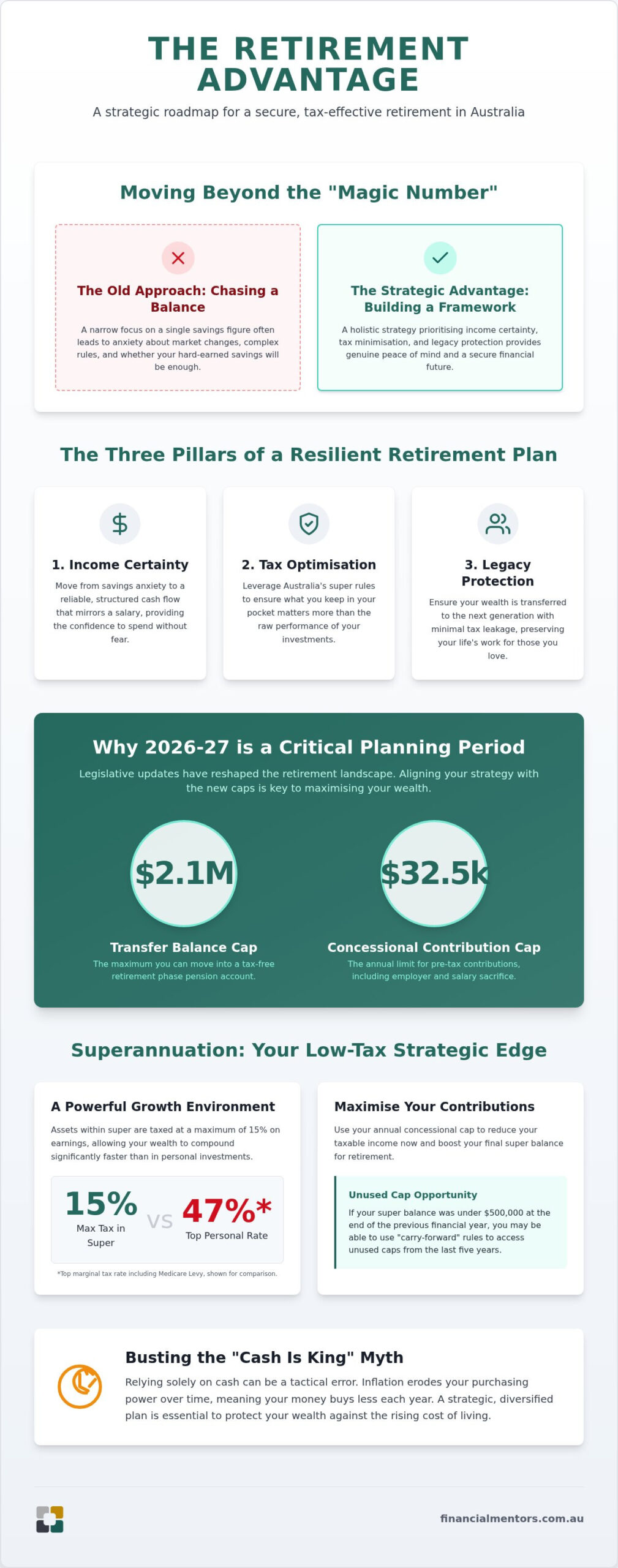
A resilient retirement plan is built on three essential pillars. First, income certainty involves moving away from the anxiety of simple savings toward a reliable, structured cash flow. This mirrors the regularity of a salary, providing the confidence to spend without fear. Second, tax optimisation is critical. Because Australia has specific rules around superannuation and pension phases, what you actually keep in your pocket matters far more than the raw performance of your investments. Finally, legacy protection ensures your wealth is transferred to the next generation with minimal tax leakage, preserving the fruits of your lifelong labour for those you love most.
Why 2026 is a Critical Year for Planning
Entering 2026, Australian retirees face a landscape that has been reshaped by both inflation and significant legislative updates. With the Transfer Balance Cap reaching $2.1 million for the 2026-2027 financial year, there are more opportunities than ever to move wealth into tax-free environments. However, these opportunities require careful timing and precise execution. When you ask how much do i need to retire in australia, you must consider how these caps and the increased concessional contribution limit of $32,500 impact your specific roadmap.
The global market continues to show volatility, which makes the concept of forward-looking stewardship even more relevant. It isn’t just about reacting to the news of the day; it’s about having a plan that accounts for the rising cost of healthcare and energy. If you can align your strategy with the current 2026 regulations, you’ll be better positioned to weather economic shifts while maintaining the lifestyle you’ve worked so hard to earn.
Leveraging Superannuation: Your Primary Strategic Edge
Your superannuation is more than a mandatory savings pot; it’s a sophisticated vehicle designed to protect your wealth from high taxes. In the 2026-2027 financial year, the rules have evolved to offer even more flexibility for those nearing the end of their career. By understanding the difference between concessional and after-tax contributions, you can potentially add tens of thousands of dollars to your final balance without changing your daily spending habits. Determining how much do i need to retire in australia often starts with a single number, but the real answer depends on how much of that money you actually get to keep after the tax office takes its share.
Assets held within the superannuation environment generally attract a maximum tax rate of 15%, which is significantly lower than most personal income tax brackets. This difference allows your investments to compound much faster than they would in a standard savings account or an external investment portfolio. You can explore how these variables interact by using the Moneysmart Retirement Planner, which helps visualise the long-term impact of small, strategic changes to your contribution levels.
Maximising Concessional Contributions
For the 2026-2027 year, the concessional contribution cap has increased to $32,500. This includes your employer’s contributions and any salary sacrifice arrangements you’ve set up. If your super balance was below $500,000 at the end of the previous financial year, you might also be able to use “carry-forward” rules to access unused caps from the last five years. Concessional contributions are the most effective tax-reduction tool for pre-retirees. By directing pre-tax income into your super, you reduce your taxable income today while building a more robust tomorrow.
The Transition to Retirement (TTR) Strategy
If you’ve reached your preservation age, which is 60 for most people in 2026, you don’t necessarily have to stop working to benefit from your savings. A TTR strategy allows you to access a portion of your super as a pension while you’re still employed. This can be a wise move if you want to reduce your working hours or if you want to use the pension income to replace salary that you’re now sacrificing into super for tax benefits. It’s a delicate balance of debt reduction and growth that requires careful stewardship to ensure your planned retirement remains secure.
Aligning your investment choices with your personal risk tolerance is the final piece of the puzzle. Whether you prefer a conservative approach or are looking for growth, your super should reflect your unique lifestyle goals. If you’re feeling unsure about which lever to pull first, reaching out for tailored retirement planning can provide the clarity you need to move forward with confidence.
Common Misconceptions: Busting the Cash-Only Myth
Many people feel a genuine sense of safety when they look at a healthy bank balance. It’s tangible, easy to access, and doesn’t fluctuate with the daily news cycle like the share market might. However, relying solely on cash is usually a tactical choice rather than a comprehensive retirement strategy. If you’ve been asking how much do i need to retire in australia, you might be surprised to learn that a large pile of cash sitting in a standard account can actually be a risk in itself. While it feels secure today, it lacks the structural growth needed to sustain a lifestyle that could easily span thirty years or more.
There is a fundamental difference between simply saving for your later years and actively planning for them. Saving is passive; it’s the act of putting money aside and hoping it will be enough. Planning is active stewardship. It involves looking at the Australian financial system as a whole and identifying how different assets can work together to provide a reliable, tax-effective income stream that lasts as long as you do.
Inflation: The Silent Retirement Killer
Imagine your bank account offers a 2.5% interest rate. While that sounds like steady progress, if the cost of essentials like healthcare, food, and energy is rising at a similar or faster rate, you’re effectively losing purchasing power every single year. This is the silent erosion of your future comfort. To maintain your standard of living, your wealth needs to grow at a rate that stays ahead of these rising costs. According to the ASFA Retirement Standard, a comfortable lifestyle for a couple in the March quarter of 2026 requires an annual income of $78,566. If your strategy doesn’t include diversified assets that can outpace inflation, you may find that the “comfortable” life you planned for becomes increasingly difficult to afford as the decades pass.
The Advice Gap and How to Close It
A common myth in our country is that professional financial planning is a luxury reserved for the ultra-wealthy. In reality, the people who often benefit most from strategic guidance are everyday Australians looking to make their superannuation work harder. Without a guide, many retirees miss out on government benefits or pay more tax than necessary because they don’t know how to navigate the complex interaction between super laws and the Age Pension. Closing this “advice gap” is about more than just numbers; it’s about reducing the anxiety that comes with managing complex finances alone.
The return on investment for strategic planning often comes from the tax you don’t pay and the mistakes you don’t make. Validating the stress of these life transitions is important, but you don’t have to carry that burden by yourself. When you calculate how much do i need to retire in australia, remember that a wise mentor can help you integrate your tax returns with a long-term roadmap. This ensures your hard-earned savings are protected from unnecessary leakage, giving you the freedom to focus on your family and your personal goals instead of worrying about your spreadsheets.
5 Steps to Securing Your Retirement Advantage
Moving from the workforce into retirement is one of life’s most significant transitions. It’s not just a change in how you spend your time, but a fundamental shift in how you view your security. To move forward with confidence, you need a plan that goes beyond a simple spreadsheet. By following a methodical, step-by-step approach, you can transform a complex financial puzzle into a clear roadmap for the future. This process allows you to stop worrying about the “what ifs” and start focusing on the possibilities of your next chapter.
Auditing and Goal Setting
The first step in answering how much do i need to retire in australia is to clearly define what “enough” looks like for you. Before you dive into the numbers, take a moment to visualise your ideal lifestyle. Do you plan to travel across the country, or is your heart set on spending more time with your grandchildren in a comfortable home? Once you have a vision, you can conduct a comprehensive audit of your current assets, liabilities, and superannuation balances. This is where you identify potential roadblocks, such as an outstanding mortgage or future healthcare costs that might impact your cash flow.
To help structure this process, we recommend consulting our retirement planning checklist australia. This tool ensures you don’t overlook critical details during your audit. After you’ve listed everything you own and owe, you can define your “Retirement Income Gap.” This is the difference between what you’ll receive from super or the Age Pension and what you actually need to fund your lifestyle. Identifying this gap early gives you the time to implement strategies to bridge it effectively.
Integration of Tax and Estate Planning
A common mistake is treating tax returns as a once-a-year chore rather than a strategic tool. In a truly integrated plan, your tax return preparation should inform your broader wealth management strategy. By looking at your tax position throughout the year, you can identify opportunities for salary sacrifice or personal deductible contributions that lower your tax bill while boosting your retirement savings. This proactive stewardship ensures that more of your money stays where it belongs: in your pocket.
Similarly, protecting what you’ve built is just as important as growing it. Seeking professional estate planning advice is essential for ensuring your family legacy is secure. This involves more than just writing a will; it includes making sure your binding death benefit nominations are current and legally valid. Without these protections, your wealth could be subject to unnecessary tax leakage or legal delays. When you consider how much do i need to retire in australia, remember that protecting your assets from these hidden costs is a vital part of the calculation.
The final step is establishing a long-term partnership with a mentor who can help you adjust your strategy as life changes. If you’re ready to start building your tailored roadmap, reach out to our team for strategic financial planning that puts your goals first.
Strategic Mentorship: Why a Trusted Guide is Your Greatest Asset
Finding a realistic answer to the question of how much do i need to retire in australia is a vital first step, but a number on a page is only the beginning of the journey. The real challenge lies in managing that plan through the inevitable shifts in the economy, changes in legislation, and the personal milestones that define your life. This is where the value of a wise mentor becomes clear. Rather than facing these complexities alone, having a partner to sit across the table from you provides a sense of order and clarity that a digital calculator simply cannot replicate.
Professional guidance isn’t just about spreadsheets and tax codes; it’s about the emotional security that comes from knowing you’re prepared. When the market becomes volatile or the government announces new superannuation rules, a trusted guide helps you stay focused on your long-term roadmap. This steady, step-by-step narrative ensures you don’t make impulsive decisions based on short-term headlines, protecting the financial legacy you’ve spent decades building.
The Financial Mentors Difference
At Financial Mentors Wealth Management, led by Murray Frean, our philosophy is grounded in the concept of stewardship. We believe that wealth management should be human-centric, focusing on your unique aspirations rather than just your account balance. Since our AFSL was registered in 2003, we’ve remained dedicated to supporting Australians through the major transitions of life with patience and observation. We understand that starting a family or entering retirement involves deep emotional nuances that deserve careful, personalised attention.
One of our core commitments is the use of plain English. We intentionally avoid intimidating technical terms or dense industry jargon that can make financial planning feel inaccessible. By using clear, conversational language, we ensure you’re a full participant in every decision. Our goal is to reduce the stress of complex decision-making, providing you with the quiet confidence that your future-proofing strategy is both practical and wise.
Your Next Steps Toward a Secure Future
If you’re feeling a sense of unease about whether your current strategy is enough, taking the next step doesn’t have to be overwhelming. We believe in an encouraging, low-pressure approach where the focus remains entirely on your journey. A professional consultation is simply a conversation designed to prompt reflection on your personal circumstances and identify the potential for improvement through strategic planning.
During our dialogue, we’ll help you refine your roadmap and address any lingering questions about how much do i need to retire in australia. You can expect a methodical and deliberate process that respects the gravity of your financial decisions. By integrating your tax returns with a long-term wealth strategy, we help you minimise leakage and maximise your lifestyle flexibility. We invite you to take control of your retirement advantage today by reaching out for a partnership that prioritises your peace of mind and long-term well-being.
Securing Your Peace of Mind for the Years Ahead
Your retirement should be a time of celebration and rest, not a period defined by financial anxiety. We’ve explored how a strategic approach to your superannuation and a proactive stance against inflation can turn your hard-earned savings into a reliable, tax-effective income stream. By integrating your tax returns with long-term estate planning, you ensure that your legacy is protected and your lifestyle remains flexible. Determining exactly how much do i need to retire in australia is a personal journey that requires more than just a calculator; it requires a roadmap built on your unique aspirations.
Since 2003, our team has operated under an AFSL to provide specialised retirement and estate planning expertise with a human-centric, mentor-led approach. We’re here to sit across the table from you and help navigate the complexities of the 2026 financial landscape with quiet confidence. If you’re ready to move from guesswork to a structured plan, we invite you to begin your journey toward a secure future with Financial Mentors Wealth Management. You’ve worked hard to reach this milestone, and you deserve the stability that comes from being prepared.
Frequently Asked Questions
What is the most effective way to gain a retirement advantage in Australia?
The most effective way to gain a retirement advantage is to integrate your superannuation, tax planning, and estate goals into a single, cohesive roadmap. Rather than viewing these as separate tasks, a strategic position allows you to maximise your income certainty while minimising unnecessary tax leakage. This holistic approach ensures that your wealth isn’t just sitting in an account but is actively working to support your lifestyle and protect your family legacy for the long term.
How much superannuation do I need for a comfortable retirement in 2026?
For a comfortable retirement in 2026, the ASFA Retirement Standard suggests a lump sum of approximately $630,000 for singles and $730,000 for couples. When asking how much do i need to retire in australia, remember these figures assume you own your home outright. If you’re renting or still have a mortgage, your required balance will likely be higher to cover those ongoing housing costs while maintaining your desired lifestyle standards throughout your later years.
Can I still get a retirement advantage if I am starting my planning after age 50?
You can certainly secure a significant advantage even if you begin your strategic planning after age 50. This stage of life often coincides with your peak earning years, providing a prime opportunity to use “catch-up” concessional contributions and Transition to Retirement (TTR) strategies. By focusing on tax-integrated wealth management now, you can still make substantial progress toward bridging your income gap before you reach the preservation age of 60 or the pension age of 67.
What are the Age Pension asset limits for 2026?
While specific asset thresholds are subject to regular indexation, the maximum Age Pension rate as of March 20, 2026, is $1,200.90 per fortnight for singles and $1,810.40 for couples. Your eligibility depends on both an income test and an assets test. Because these rules are complex, a professional roadmap helps you understand how your superannuation balance interacts with these limits to ensure you’re receiving your full entitlement from the Australian financial system.
How does estate planning advice differ from simply having a Will?
Estate planning advice goes far beyond the basic distribution of assets found in a simple Will. It involves creating a protective framework for your wealth, including binding death benefit nominations for your super and strategies to manage tax implications for your beneficiaries. A Will is a single document, but estate planning is a comprehensive strategy that ensures your legacy reaches the next generation without being eroded by unnecessary legal delays or avoidable tax burdens.
Is a high-interest retirement account enough for a secure future?
A high-interest account is a useful tactical tool for your daily spending, but it’s rarely enough to secure a thirty-year retirement on its own. The hidden cost of a cash-only strategy is inflation, which can erode your purchasing power over time. To maintain your lifestyle, your wealth needs the growth potential of diversified assets. Relying only on bank interest often means your “safe” money is actually losing value in real terms every year.
What are the tax benefits of professional tax return preparation for retirees?
Professional tax return preparation ensures that your annual compliance is perfectly aligned with your long-term retirement goals. For retirees, this integration is vital because it identifies opportunities to reduce tax on superannuation withdrawals and investment earnings. By having a mentor oversee your tax position, you can avoid the “leakage” that often occurs when tax returns are treated as an isolated chore rather than a core component of your broader wealth creation strategy.
How do I choose the right wealth management office for my needs?
You should look for a wealth management office that prioritises a mentor-led relationship over a cold, corporate transaction. Choosing a partner with a long history, such as an AFSL registered since 2003, provides confidence in their stability and expertise. It’s important to find a guide who uses plain English and takes the time to understand your unique aspirations. A wise mentor will focus on your personal journey, helping you feel organised and reassured.