

What if the legislative boundaries around your retirement savings weren’t just hurdles, but a clear map to a more secure future? It’s understandable if you feel a little overwhelmed by the latest changes to contribution caps, especially when the fear of an accidental tax penalty feels so real. If you’ve been considering how to best use salary sacrifice superannuation Australia wide to lower your taxable income, you aren’t alone in wanting to get the details exactly right. We believe that with the right stewardship, these rules become powerful tools for your long-term stability.
You deserve to feel certain that your hard work today is being preserved for your life tomorrow. In this 2026 guide, we’ll help you master the current superannuation caps so you can build your nest egg effectively without the stress of unexpected ATO complications. We’ll break down the specific differences between contribution types, clarify the new indexation limits, and provide a simple roadmap for your 2026 strategy. By the end of this article, you’ll have the clarity needed to maximise your tax position and the peace of mind that comes from being truly prepared.
Key Takeaways
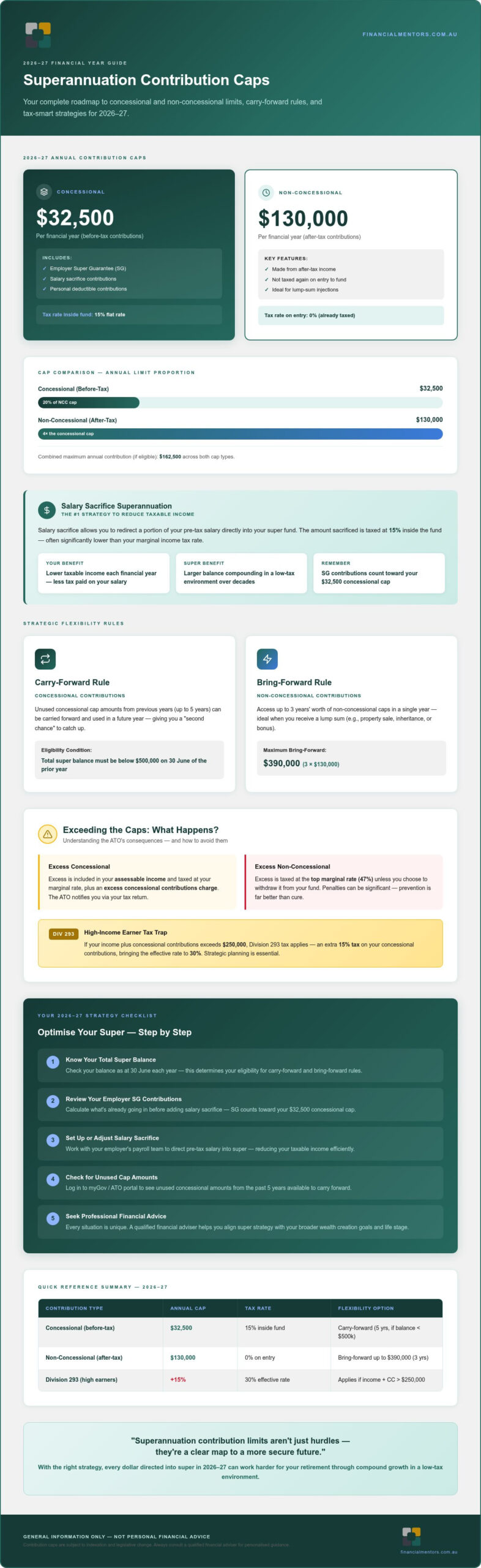
- Identify the updated 2026 contribution limits, including the $32,500 concessional cap and the $130,000 non-concessional cap.
- Learn how to strategically use salary sacrifice superannuation Australia wide to lower your taxable income while building long-term wealth.
- Discover how carry-forward and bring-forward rules can provide a valuable “second chance” to boost your retirement savings when you have extra capital.
- Understand the mechanisms the ATO uses to track excess contributions and how to avoid high-income tax traps like Division 293.
- Gain confidence in balancing your superannuation goals with other life priorities through professional stewardship and planning.
Understanding Superannuation Contribution Limits: Why Caps Matter for Your Future
Think of superannuation contribution limits as the government’s “speed limits” for tax-effective savings. They exist to keep the system fair, ensuring it isn’t exploited while still encouraging you to become self-sufficient for your retirement. While “limits” might sound restrictive, they actually provide a clear framework for your financial journey. Managing these caps isn’t just about crunching numbers; it’s an act of stewardship. By staying within these boundaries, you’re looking after your future self and protecting your hard-earned wealth from unnecessary tax drains.
There are two main tools in your wealth-building kit: concessional and non-concessional contributions. Concessional contributions, like salary sacrifice superannuation australia wide, are made before tax and are generally taxed at a lower rate within the fund. Non-concessional contributions are made from your after-tax income. Each serves a unique purpose, and understanding how they interact is the first step toward a more secure tomorrow. It’s about finding the right balance for your specific life stage and aspirations.
The Role of Super in Wealth Creation Strategies
Superannuation is a unique environment because of its low tax rate on investment earnings. When you invest within your super fund, your money has the chance to benefit from long-term compound growth in a way that’s often more efficient than investing in your own name. If you start hitting your contribution caps early in your career, the exponential benefits over several decades can be life-changing. Integrating these caps into broader wealth creation strategies australia provides a foundation for stability. Using salary sacrifice superannuation australia residents can significantly reduce their taxable income while simultaneously boosting their retirement balance. It’s a steady, methodical way to ensure every dollar works as hard as possible for you.
Why 2026 is a Critical Year for Your Super
Why is 2026 such a pivotal time for your financial planning? This year brings specific indexation changes that affect how much you can contribute to your fund. For the 2026-27 financial year, the concessional cap has increased to $32,500. Staying informed about these shifts is vital because an evolving legislative landscape can often feel like a moving target. If you don’t adjust your contributions to match these new limits, you might miss out on valuable tax benefits or, conversely, accidentally exceed a cap and face penalties. We’re here to help you navigate these figures with confidence, moving from the broad concepts of stewardship to the specific dollar values that will shape your year ahead.
Concessional vs. Non-Concessional Contributions: Navigating the 2026 Caps
If you’ve ever felt confused by the terms “concessional” and “non-concessional,” it helps to think of them simply as two different paths toward the same goal. We often use the word “concessional” to mean “tax-advantaged” for your benefit. For the 2026 financial year, the limit for these contributions is $32,500. This figure isn’t just for your own extra payments; it includes the compulsory Super Guarantee (SG) contributions your employer makes on your behalf, along with any salary sacrifice superannuation australia residents decide to arrange. These contributions are generally taxed at a flat rate of 15% within your fund, which is often significantly lower than your personal marginal tax rate.
On the other hand, non-concessional contributions are made using your after-tax income. For 2026, the annual limit for these is $130,000. Since you’ve already paid income tax on this money, the government doesn’t tax it again when it enters your super fund. It’s a clean way to inject personal capital into a low-tax environment where it can grow over time. Choosing between these two pillars depends entirely on your current cash flow and long-term goals. If you’re looking for a steady way to reduce your tax bill today, concessional paths are often the first choice. If you’ve come into a lump sum, the non-concessional route might be more appropriate.
Concessional Contributions: Before-Tax Benefits
Setting up salary sacrifice superannuation australia wide is one of the most effective ways to lower your taxable income. When you tell your employer to send a portion of your pre-tax salary into your super, you’re only taxed on the remaining amount. This is particularly useful for those in higher tax brackets who want to keep more of what they earn. If you’re self-employed or have extra savings sitting in a bank account, you can also make personal deductible contributions to reach that $32,500 target. It’s a proactive way to manage your tax return while ensuring your retirement savings stay on track.
Non-Concessional Contributions: After-Tax Growth
The $130,000 non-concessional limit is a powerful tool for those looking to make a significant impact on their balance in a short time. You might consider this option if you’ve recently received an inheritance, sold a large asset, or reached a stage in life where your mortgage is paid off and you have surplus cash. However, your ability to use this cap depends on your Total Superannuation Balance (TSB). If your balance is approaching certain thresholds, your limit could be reduced or even set to zero. Staying mindful of these rules is a key part of professional retirement planning, ensuring you don’t accidentally trigger a tax penalty while trying to do the right thing for your future.
Strategic Flexibility: Carry-Forward and Bring-Forward Rules Explained
Life doesn’t always move in a straight line. There may be years where your focus is on paying down a mortgage or supporting a growing family, leaving little room for extra contributions. Conversely, you might find yourself with a sudden surplus after receiving a performance bonus or selling an investment property. This is where the Australian superannuation system offers a level of kindness through strategic flexibility. Rather than losing your chance to save tax-effectively, these rules act as a pressure valve, allowing you to adjust your contributions based on your current circumstances.
If you’ve been consistent with salary sacrifice superannuation australia wide, you’re already ahead. However, if life got in the way, these “catch-up” rules ensure you aren’t permanently behind. Understanding how to use these mechanisms is a vital part of professional stewardship, helping you turn a one-off financial gain into a permanent pillar of stability. It’s about having the confidence to act when the time is right for you, rather than feeling pressured by a “use it or lose it” annual deadline.
The Carry-Forward Rule: Catching Up on Your Goals
The carry-forward rule is essentially a “second chance” for those who haven’t fully utilised their concessional caps in previous years. Carry-forward is a mechanism for those with balances under $500,000 to utilise past unused caps. By looking back over a rolling five-year window, you can identify unused portions of your $32,500 annual limit and apply them to the current year. This is a powerful tool if you are facing a high-tax year and want to make a larger contribution to offset your income. It’s also incredibly helpful for parents returning to the workforce after a career break who want to make up for lost time. By tracking your 5-year rolling window, you can strategically time your salary sacrifice superannuation australia payments to maximise your tax position when it matters most.
The Bring-Forward Rule: Accelerating Your Retirement
While carry-forward rules focus on pre-tax money, the bring-forward rule applies to non-concessional, after-tax contributions. If you are under the age of 75, you may be eligible to “bring forward” up to two future years of caps, allowing you to contribute up to $390,000 in a single financial year. This total represents three times the standard $130,000 annual limit for 2026. This strategy is often triggered when someone receives a significant inheritance or sells a large asset and wants to move that wealth into the protected super environment quickly. Your eligibility depends heavily on your Total Superannuation Balance, as there are strict thresholds that determine whether you can access the full three years or a reduced amount. Using this rule correctly is a fundamental step in building a secure foundation for your planned retirement, ensuring your capital is working efficiently for your future peace of mind.
Avoiding the Tax Trap: What Happens if You Exceed the Limits?
We understand that the fear of a tax bill can be a heavy burden to carry. While you might be diligent with your salary sacrifice superannuation australia strategy, the Australian Taxation Office (ATO) has a very methodical way of tracking every dollar that enters your fund. They match the data reported by your super fund against your annual tax return to identify any contributions that have nudged past the legal caps. If this happens, you’ll receive a notice detailing the excess and the tax adjustments required. It’s a common worry, but please remember that mistakes can often be rectified if they’re caught early and managed with professional care.
For those in a higher income bracket, there’s also the Division 293 tax to consider. If your combined income and concessional contributions exceed $250,000, the ATO applies an additional 15% tax on those contributions. This brings the total tax rate on your super savings to 30%, which, while higher than the standard 15%, is still generally lower than the top marginal tax rate. By integrating your strategy with professional tax return preparation, you can ensure your data is accurate before the ATO even looks at it. If you’re unsure where you stand, reach out to us today for a clear perspective on your position.
Common Pitfalls and How to Organise Your Tracking
One of the most frequent traps is having multiple super funds. If you’ve changed jobs and have different employers contributing to separate accounts, it’s easy for the combined total to exceed the $32,500 concessional cap without you realising it. Timing is another critical factor. For a contribution to count toward the 2026 financial year, it must be “cleared funds” in your super account by June 30. If your employer sends a salary sacrifice superannuation australia payment on June 29 but it doesn’t land in your fund until July 2, it will count toward the following year’s cap instead. To stay organised, consider this simple mental checklist:
- Review all active super accounts to consolidate your data.
- Confirm the exact Super Guarantee (SG) percentage your employer is paying.
- Total your year-to-date salary sacrifice amounts each quarter.
- Check your “MyGov” portal for any carry-forward amounts you might have available.
The Cost of Getting it Wrong
If you do exceed the concessional cap, the excess amount is added back to your assessable income and taxed at your marginal rate. You’ll receive a 15% tax offset to account for the tax the fund has already paid, but you may still face an interest charge for the delay in payment. Non-concessional errors can be more expensive; if you exceed the $130,000 limit and don’t elect to withdraw the excess, it could be taxed at the top marginal rate of 47%. This is why having a dedicated wealth management office is so valuable. We provide the proactive oversight needed to catch these timing issues and cap overlaps before they turn into a letter from the ATO, giving you the peace of mind that your stewardship is on the right path.
Optimising Your Super Strategy: How Professional Advice Makes the Difference
While understanding the technical limits is the first step, the real value lies in how you weave these rules into your broader life. Superannuation shouldn’t exist in a vacuum; it’s a single, powerful piece of a much larger puzzle. When you’re deciding whether to increase your salary sacrifice superannuation australia payments or put that extra cash toward your mortgage, you’re making a choice about your current lifestyle and your future freedom. A professional advisor helps you find that delicate balance, ensuring you aren’t just saving tax, but building a life that feels secure and intentional at every stage.
You deserve to feel certain that your hard work today is being preserved for the right reasons. This sense of peace comes from knowing that your strategy accounts for more than just the next financial year. It’s about future-proofing your stability so you can focus on what truly matters, whether that’s starting a family, supporting your children through school, or preparing for a graceful transition into retirement. Professional stewardship isn’t just about avoiding penalties; it’s about having a partner who tracks the complexities so you don’t have to.
Integrating Super with Estate Planning Advice
One of the most overlooked aspects of superannuation is how your contribution choices today will affect your loved ones later. Every dollar in your fund is classified as either a “tax-free” or “taxable” component, and the way you contribute can shift this balance significantly. This is where seeking estate planning advice becomes essential. By strategically managing your inputs, you can influence the eventual tax position for your beneficiaries, ensuring your legacy is passed on as efficiently as possible.
The “death tax” on super refers to the tax applied to the taxable component of your superannuation death benefit when it is paid to non-dependants, such as adult children. Without a clear plan, a significant portion of your hard-earned savings could be diverted to the ATO rather than your family. We work with you to structure your salary sacrifice superannuation australia and other contributions to mitigate these impacts, providing a methodical roadmap that protects the people you care about most.
Your Journey Starts with a Conversation
If you’re ready to move from uncertainty to confidence, we invite you to take a proactive step toward your goals. You can start by downloading our retirement planning checklist australia to see how your current strategy measures up against the 2026 standards. At Financial Mentors, we act as your trusted guide through the ever-changing landscape of Australian financial law. We don’t just provide numbers; we provide a partnership built on empathy and a deep commitment to your long-term well-being. Let’s sit down and discuss how we can turn these contribution limits into a framework for your lasting wealth.
Taking the Next Step Toward Your Secure Future
Managing your superannuation is a journey of stewardship that rewards consistency and foresight. By understanding the 2026 limits, such as the $32,500 concessional cap, you can use salary sacrifice superannuation australia residents rely on to build wealth while reducing your taxable income. Remember that flexibility exists through carry-forward and bring-forward rules, allowing you to adapt your strategy as your life circumstances change. These tools are designed to support your stability, provided they are managed with care and precision.
You deserve the peace of mind that comes from having a professional partner who tracks these complex regulations for you. Since 2003, our AFSL licensed experts have provided tailored advice that integrates tax return preparation with long-term wealth creation strategies. We’re committed to helping you protect your legacy and achieve the milestones that matter most to your family. If you’re ready to refine your approach, you can secure your retirement future with a personalised strategy session at Financial Mentors. Your future is worth the careful attention of a trusted guide.
Frequently Asked Questions
What is the concessional super contribution cap for the 2026-27 financial year?
The concessional super contribution cap for the 2026-27 financial year is $32,500. This indexed amount represents the total before-tax contributions you can make, which includes the Super Guarantee payments from your employer and any salary sacrifice superannuation australia arrangements you’ve set up. Staying within this limit is vital for maintaining your tax-effective position, as these contributions are generally taxed at just 15% within your fund rather than your personal marginal rate.
Can I still use the bring-forward rule if I am over 67 years old in 2026?
Yes, you can still access the bring-forward rule if you are over 67, provided you are under the age of 75 at the start of the financial year. Recent legislative changes have simplified the rules for non-concessional contributions, making it much easier for retirees to inject personal capital into their funds. If your Total Superannuation Balance allows it, you could potentially contribute up to $390,000 in a single year to boost your retirement savings and future stability.
What happens if my employer pays super that takes me over the limit?
If your employer’s contributions take you over the cap, the excess amount is added to your assessable income for that year. You’ll be taxed at your personal marginal rate on the excess, but you’ll receive a 15% tax offset to compensate for the tax your super fund has already paid. This process is handled through your annual tax return, and you’ll usually have the option to withdraw the excess funds from your super account without further penalty.
How does the $500,000 balance limit work for carry-forward contributions?
To use the carry-forward rule, your Total Superannuation Balance (TSB) must be less than $500,000 on 30 June of the previous financial year. If your balance is below this threshold, you can “catch up” by using any unused portions of your concessional caps from the past five years. This is an excellent way to manage a high-income year or make up for career breaks while keeping your tax obligations as low as possible through professional stewardship.
Is salary sacrifice included in the $32,500 concessional cap?
Yes, salary sacrifice is included within the $32,500 concessional cap for the 2026-27 year. It’s important to remember that this cap is a combined limit for all before-tax contributions. This includes your employer’s compulsory Super Guarantee payments, any additional salary sacrifice superannuation australia agreements, and any personal contributions for which you intend to claim a tax deduction. Monitoring this total throughout the year helps prevent accidental breaches and ensures your wealth creation strategy remains on track.
How can I check my current total superannuation balance?
The most reliable way to check your Total Superannuation Balance is through the ATO section of your MyGov account. This portal provides a consolidated view of all your super interests as reported by your various funds at the end of the last financial year. You can also find this information on your most recent annual member statement. Knowing your TSB is a key part of planning when deciding which contribution rules apply to your specific circumstances.
What is Division 293 tax and will it affect my contributions in 2026?
Division 293 is an additional 15% tax that applies to concessional contributions if your combined income and contributions exceed $250,000. It’s designed to reduce the tax concessions received by high-income earners, bringing the total tax on their super savings to 30%. If your income is approaching this level in 2026, it’s wise to factor this extra cost into your wealth strategy to ensure there are no surprises when your tax return is processed by the ATO.
Can I withdraw excess contributions from my super fund to avoid penalties?
Yes, you can generally withdraw excess contributions, but you must follow the specific process set out by the ATO. When the ATO identifies an excess, they’ll issue a determination giving you the choice to release the funds or leave them in the fund. If you choose to leave excess non-concessional contributions in the fund, they may be taxed at the highest marginal rate of 47%, so acting on the ATO’s notice promptly is essential for your peace of mind.