

What if the secret to stepping away from the workforce isn’t chasing an impossible savings target, but simply understanding how to enjoy retirement without financial stress? If you feel uneasy about rising living costs, outliving your superannuation, or sorting through complex Centrelink entitlements, your concerns are completely valid. Most Australians spend decades accumulating wealth, yet stepping into the drawdown phase often brings genuine uncertainty about how long those savings will actually last.
You can transition into your post-work years with clarity and confidence by building a clear financial roadmap tailored to your lifestyle goals. This guide explores how to evaluate your current financial position, protect against unexpected financial risks, and coordinate your income sources effectively. Along the way, you’ll see how steady planning creates the freedom to focus on your family, your favourite hobbies, and the peaceful future you’ve earned.
Key Takeaways
- Learn how to enjoy retirement without financial stress by assessing your current financial position and aligning daily spending with your personal values.
- Discover how balancing your superannuation, private savings, and Centrelink entitlements creates dependable cash flow across every stage of later life.
- Safeguard your savings against inflation and rising living costs through thoughtful asset allocation and suitable insurance cover advisory.
- Build a personalised financial plan designed to support your family priorities, cherished hobbies, and evolving medium-term goals.
- Gain lasting confidence by collaborating with a trusted mentor, beginning with a structured review of your options during a complementary initial appointment.
Understanding the Link Between Your Financial Position and Peace of Mind
Discussions about retirement often split into two extremes: purely emotional coaching about finding purpose, or technical analyses of investment yields. In reality, your mental wellbeing and your balance sheet are inextricably linked. A secure financial position acts as the bedrock for personal freedom, giving you the breathing room to actually appreciate your spare time. When you lack visibility over your capital, common pressures such as market swings and the fear of the unknown can quickly generate chronic anxiety. Facing your ongoing financial commitments early prevents small lifestyle expenses from compounding into major stress later in life. Being prepared for potential financial adversity cushions the emotional impact of sudden life events, ensuring you stay resilient no matter what comes your way. Gaining this sense of control is the essential first step in understanding how to enjoy retirement without financial stress.
The Emotional Impact of Transitioning from Work
Stepping away from the workforce represents a profound psychological change. Leaving behind a predictable monthly salary to draw from savings can feel unsettling, even if you have prepared for decades. Through the system of Superannuation in Australia, your accumulated capital must now generate your day-to-day cash flow, which requires a significant adjustment in mindset. A structured financial plan gives you clear permission to spend money on your favourite hobbies, dining out, and travel without lingering guilt. It also validates your natural desire to support your family, giving you confidence that your personal lifestyle choices will not compromise the legacy you want to leave behind.
Why a Strategic Approach Beats Simple Saving
Relying on good fortune or an arbitrary savings figure often falls short when real-world costs fluctuate. Wealth management is not merely about accumulating a large balance; it is about converting assets into reliable, long-term lifestyle outcomes. Moving from vague hopes to a defined strategy gives you a clear picture of how to enjoy retirement without financial stress across every economic cycle. Coordinating your investments alongside professional estate planning advice establishes an organised framework for the future, providing total certainty that your wealth will support both your retirement and the people who matter most to you.
Structuring Your Retirement Income for Long-Term Stability
Australian retirement rests on three distinct pillars: superannuation, the Age Pension, and private savings or investments. Coordinating these elements into a single strategy ensures your living expenses remain funded regardless of short-term economic turbulence. To understand how to enjoy retirement without financial stress, you need an income structure that separates immediate spending needs from growth assets. Converting accumulated super into an account-based pension provides regular distributions, while annual tax return preparation ensures you claim available offsets and minimise liabilities. Aligning these moving parts through qualified financial planning advice creates lasting clarity and steady cash flow.
Maximising Your Superannuation and Self-Managed Super
Different fund structures suit different stages of life. While standard funds offer simplicity, establishing a self-managed super fund gives you direct oversight of property or specific market holdings. The key lies in segmenting your portfolio based on timelines. Holding defensive assets to meet your medium-term goals over the next two to five years protects everyday living costs, while growth assets fund your long-term goals beyond a decade. Superannuation acts as a tax-effective vehicle designed to nurture and protect your retirement wealth through concessional earnings and tax-free pension drawdowns. Exploring verified options for retirement income streams allows you to turn that accumulated capital into dependable fortnightly income.
Navigating Centrelink Entitlements and Asset Limits
The Age Pension serves as an essential partner to private savings, supporting roughly two-thirds of eligible Australians over the age of 67 with either full or partial payments. For a couple, the maximum combined Age Pension provides around $1,866.00 per fortnight, creating a dependable baseline that takes pressure off your super investments. Navigating the asset and income tests is crucial for your planned retirement, because even modest adjustments to your assessable assets can make you eligible for valuable Centrelink entitlements and concession cards.
Strategic structuring helps you stay within allowable thresholds while funding your desired standard of living. Knowing how to integrate government support with personal drawdowns is central to learning how to enjoy retirement without financial stress for decades ahead.
Mitigating Financial Risks to Protect Your Lifestyle
A successful retirement plan must do more than simply generate income; it must also defend against unseen disruptions. Australian retirees face real financial risks that can quietly undermine long-term stability. The most persistent among these are longevity risk and inflation. According to Australian Government Life Tables, a 65-year-old Australian man lives on average to 85, while a woman lives to 88. That means your nest egg could easily need to support you for 25 years or longer. Professional insurance cover advisory helps you manage personal risks during your transition from work, particularly when reviewing existing policies such as income protection before you fully exit the workforce. Establishing a dedicated cash buffer of one to two years of living expenses prevents you from having to sell growth investments during market downturns. Partnering with a supportive mentor removes the anxiety of managing these complex decisions alone, showing you clearly how to enjoy retirement without financial stress.
Managing Inflation and Rising Costs
Inflation silently erodes purchasing power over time. A modest annual inflation rate of 3% can cut the value of your dollar roughly in half over a 25-year period. Relying exclusively on cash savings exposes your capital to real decay. To counter this, your portfolio requires assets that outpace living costs while respecting your personal comfort with risk. A sensible annual habit involves conducting a periodic review of your recurring financial commitments. Eliminating outdated expenses, comparing utility plans, and realigning discretionary spending preserves cash for things you truly value.
Planning for Health and Aged Care Needs
Healthcare demands naturally shift as you grow older. Out-of-pocket medical procedures, specialist consultations, and in-home support often introduce unexpected expenses into your budget. Factoring a dedicated healthcare reserve into your wider wealth management strategy gives you peace of mind that care needs will not strain everyday household cash flow. Meeting the qualifying criteria under Services Australia Age Pension guidelines can also grant you access to concession cards that dramatically reduce prescription costs. Coordinating these precautions alongside timely estate planning ensures that your medical and lifestyle wishes are honoured if your health changes. Knowing these measures are in place helps you enjoy retirement without financial stress, freeing you to focus fully on personal wellbeing.
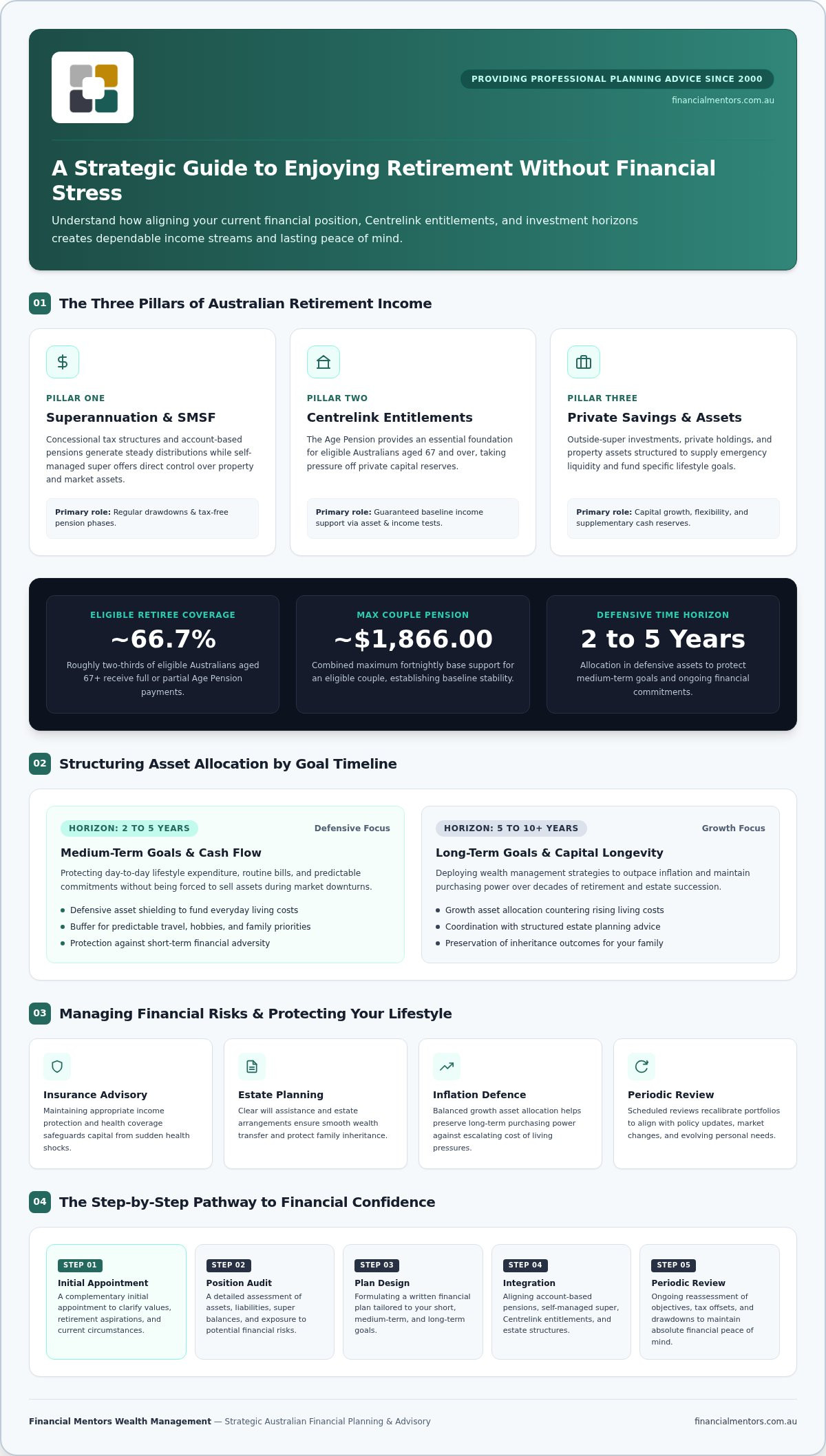
Your Five-Step Roadmap to Enjoying a Stress-Free Retirement
Moving toward a predictable post-work lifestyle does not happen by accident. Rather than treating retirement as a single date on the calendar, approaching it as an evolving journey gives you steady control over your decisions. Understanding how to enjoy retirement without financial stress comes down to following a practical, step-by-step sequence:
- Step 1: Assess your financial position: Review all current assets, bank balances, and liabilities to obtain an honest snapshot of where you stand today.
- Step 2: Clarify your personal goals: Determine what gives your life meaning, whether that involves regular travel, taking up new creative hobbies, or assisting your family.
- Step 3: Construct a tailored financial plan: Integrate superannuation streams, private savings, and tax strategies to fund each phase of your lifestyle.
- Step 4: Organise your estate arrangements: Seek professional estate planning advice to document your wishes and safeguard the inheritance you leave behind.
- Step 5: Commit to an ongoing periodic review: Revisit your portfolio annually to respond calmly to legislative updates, cost changes, or personal milestones.
Setting Realistic Long-Term Goals
What does your ideal Tuesday morning look like when work is no longer an obligation? Taking time to visualise your daily routine helps convert vague dreams into tangible targets. Framing your lifestyle aspirations around an intentional wealth creation strategy ensures your money works directly toward fulfilling your long-term goals. Starting this reflective process early gives you valuable room to adapt, allowing you to fine-tune your asset base before you make your final exit from the workforce.
The Importance of a Written Financial Plan
Holding financial thoughts in your head creates unnecessary worry. A written strategy serves as an objective reference point, replacing guesswork with measurable direction. It maps out your asset allocation, coordinates required tax return preparation, and dictates reliable cash withdrawals across every season of later life. Working through a practical retirement planning checklist helps confirm that no technical detail or entitlement is overlooked. If you want to turn these steps into an organised strategy, you can schedule an appointment with a planner to begin bringing your future into focus.
Partnering with a Mentor for a Secure Future
Managing retirement on your own using generic online calculators often overlooks the emotional nuances of major life changes. Providing professional planning advice since 2000 has shown that lasting security comes from genuine partnership. Having an experienced mentor beside you transforms complex rules into practical, reassuring choices. An objective guide understands how personal shifts in your health, household, and interests affect your finances over time. Wealth management is ultimately about peace of mind and the freedom to spend time on what matters most. Discovering how to enjoy retirement without financial stress becomes much simpler when you have a trusted adviser walking alongside you.
What to Expect in Your Initial Appointment
Taking the first step should never feel intimidating or high-pressure. Step 01 of the process is a complementary initial appointment designed to explore your circumstances in an open, relaxed environment. This meeting is an exploratory conversation about your life goals, not a sales pitch. You can freely bring your questions regarding superannuation balances, tax return preparation, and estate planning, knowing your situation will be met with empathy and practical insight. That initial conversation helps clarify your current position and outlines realistic options for the road ahead.
The Role of Ongoing Periodic Reviews
Retirement is not static, and circumstances naturally evolve over time. Government rules shift, economic conditions fluctuate, and unexpected family priorities arise. Scheduling a regular periodic review keeps your financial roadmap aligned with your personal needs through every stage of life. Partnering with a dedicated wealth management office gives you steady confidence that your affairs are supervised with care. When financial adversity or temporary market volatility occurs, a wise mentor helps you stay focused on your long-term goals rather than reacting to short-term headlines. Maintaining that continuous oversight is fundamental to knowing how to enjoy retirement without financial stress for decades to come.
Taking Your Next Step Toward a Confident Retirement
Stepping into your post-work years should feel liberating, not daunting. When you align your superannuation, private assets, and government entitlements within a structured framework, learning how to enjoy retirement without financial stress becomes an achievable reality. Putting protective buffers in place against rising living costs and future health needs removes lingering worry, leaving you free to focus on your family, personal passions, and everyday contentment.
Financial Mentors Wealth Management has been providing professional planning advice since 2000. As specialists in Australian retirement and estate planning advice, the firm seamlessly integrates tax return preparation into a broader wealth management strategy to keep your long-term goals on track. You don’t have to navigate these complex decisions on your own. Take control of your future and book your complementary Step 01 appointment with Financial Mentors today to start shaping the peaceful, rewarding lifestyle you deserve.
Frequently Asked Questions
How much money do I need to retire comfortably in Australia?
According to the ASFA Retirement Standard benchmarks, a couple seeking a comfortable lifestyle requires an annual budget of roughly $78,998, while a single homeowner needs about $56,166. Reaching this standard generally targets a combined superannuation balance of $730,000 for couples and $630,000 for singles, assuming partial Age Pension support. Your specific living costs, travel plans, and overall financial position will determine the exact capital you need.
Can I still get the Age Pension if I have a large superannuation balance?
Yes, you can qualify for a partial Age Pension provided your assets and income remain under the thresholds set by Services Australia. Once you reach the qualifying age of 67, your superannuation income streams are assessed under the assets and income tests. Strategic allocation between your primary residence, superannuation, and cash reserves helps preserve your Centrelink entitlements, creating regular income alongside your private investments.
What is the best way to avoid financial stress during the first year of retirement?
The most effective approach is establishing a dedicated cash buffer holding one to two years of basic living expenses before ceasing work. Having accessible liquidity prevents you from selling investments during market downturns, giving growth assets time to recover. This reserve delivers immediate peace of mind, demonstrating how to enjoy retirement without financial stress right from your first day away from work.
How often should I review my financial plan once I have retired?
You should commit to a formal periodic review at least once every twelve months. Regular reassessments confirm that your drawdowns match your actual living expenses, assess portfolio returns, and capture updates to Centrelink rules or tax thresholds. If you experience unexpected financial adversity or changing medical needs, arranging an interim appointment with your planner keeps your long-term goals protected.
What are the most common financial risks for Australian retirees in 2026?
Inflation, market volatility, and longevity risk represent the primary financial risks facing retirees today. Because Australians retiring at 65 often live into their late eighties, funding a 20 to 25-year post-work life requires capital that actively outpaces living costs. Balancing defensive holdings with growth investments protects your living standards against rising energy, healthcare, and household expenses over time.
Is it too late to start retirement planning if I am already 60?
It is never too late to take control of your financial position. Australians reach their super preservation age at 60, unlocking strategies such as transition-to-retirement pensions to build balances while adjusting working hours. Starting now gives you valuable years before reaching the Age Pension age of 67 to reduce remaining financial commitments and discover how to enjoy retirement without financial stress.
How does estate planning advice help reduce stress for my family?
Professional estate planning advice ensures that your assets, superannuation death benefits, and personal wishes are structured properly. This proactive guidance prevents family disputes, clarifies tax outcomes on your inheritance, and sets up trusted decision-makers through enduring powers of attorney. Removing administrative confusion gives your family clarity, knowing your affairs are organised with precision and care.
What is the difference between wealth management and simple investment advice?
Simple investment advice concentrates narrowly on selecting specific assets or investment funds. In contrast, wealth management delivers a coordinated strategy connecting your investments, self-managed super, estate planning, and tax return preparation. It assesses your entire household situation, helping you manage ongoing financial commitments, protect against unexpected hazards, and construct dependable income streams tailored to your lifestyle goals.