

Could your professional success actually be making your retirement planning more difficult? It is a frustrating reality that as your income grows, so does the complexity of managing your wealth. You might find that bracket creep and the Division 293 tax threshold of $250,000 are quietly eroding your superannuation benefits. When you are focused on a demanding career, finding the time to coordinate multiple investment structures can feel like a second job. This is why retirement planning for high income earners australia requires a more nuanced perspective than standard advice.
You likely agree that your current lifestyle is a hard-earned reward for your dedication, and you deserve a future that reflects that effort. You will learn how to navigate restrictive contribution caps and tax hurdles to build a secure foundation for your next chapter. This guide provides a roadmap to transition from a high salary to high passive wealth through legitimate, tax-effective structures. The following sections explore how a tailored financial plan can protect your family legacy and provide the quiet confidence you have earned through your professional achievements.
Key Takeaways
- Understand why standard superannuation contributions alone may not sustain your current lifestyle and how to bridge the gap through strategic planning.
- Discover how to manage the impact of Division 293 and other tax hurdles to ensure your retirement planning for high income earners australia is structured for maximum efficiency.
- Evaluate how specific wealth management structures, such as a self-managed super fund or family trust, can offer the control you need to protect your family legacy.
- Learn how to define clear medium-term goals and why a periodic review of your insurance cover is essential for safeguarding your financial position.
- Find out how to begin your transition with a complementary initial appointment to develop a financial plan that reflects your professional success.
The High-Income Paradox: Why Earnings Don’t Always Equal Retirement Security
High professional success often creates a unique set of financial pressures that are not always visible from the outside. While your peers might focus on basic savings, your situation involves maintaining a high standard of living that your current active income supports. Transitioning away from a demanding career means you need to replace a substantial salary with passive wealth. This shift requires a mindset of stewardship. It is not just about how much you earn today, but how well you protect your family and future-proof your lifestyle for the decades ahead.
Effective retirement planning for high income earners australia validates these concerns. You have worked hard to reach this level of success, and the fear that your wealth might not sustain your current standard of living is a valid emotional weight. Moving from active income to structured wealth management is the key to ensuring that your professional achievements translate into long-term peace of mind. It is about creating a bridge between your current success and a retirement that feels just as rewarding.
The Gap Between Capped Contributions and Lifestyle Needs
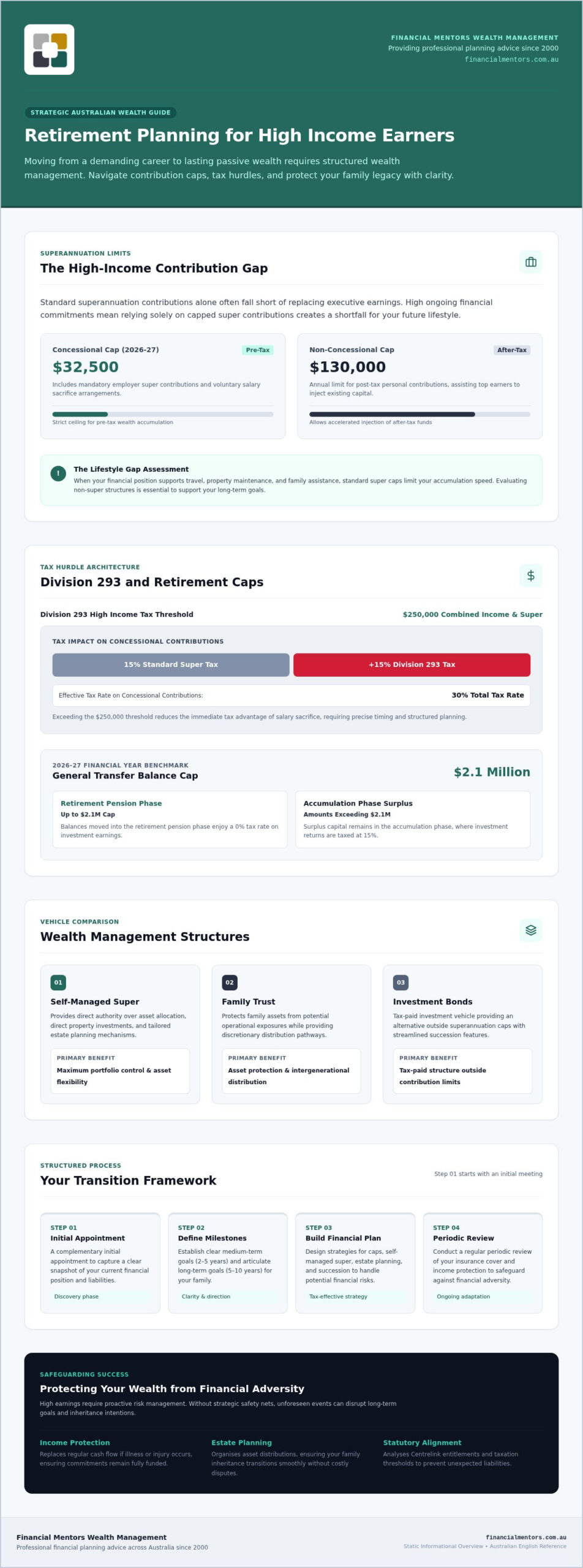
The framework of superannuation in Australia provides a strong starting point, but it often falls short for those in the highest tax brackets. For the 2026-27 financial year, the concessional contribution cap is set at $32,500. If you are earning a high salary, this limit can feel restrictive. It makes catching up later in your career difficult if you have not planned ahead from the start. Lifestyle creep is another factor to consider. Your current financial commitments, from premium insurance to property maintenance, require a larger nest egg than the average person. Have you stopped to reflect on what your ideal post-work day actually looks like? If it involves travel, supporting your children, or specific hobbies, standard super contributions may not be enough to cover the costs.
Understanding Your Current Financial Position
Gaining a clear snapshot of your assets and liabilities is the first step toward a successful financial plan. You might have multiple investment properties, share portfolios, and various super accounts. Bringing these into a single view helps you understand which financial commitments will persist into retirement. It is common for high earners to feel a sense of complexity that leads to stress. By identifying your exact financial position, you take back control. This clarity allows you to see where your retirement planning for high income earners australia needs adjustment to match your long-term goals. Framing this initial assessment as a discovery phase helps reduce the weight of complex decision-making.
Navigating the Tax Maze: Division 293 and Beyond
Tax is often the single largest expense for successful professionals in Australia. While your income reflects your hard work, it also places you in a bracket where tax concessions begin to taper off. If your combined taxable income and concessional super contributions exceed $250,000, you will likely encounter Division 293 tax on concessional contributions. This additional 15% tax effectively brings your contribution tax rate to 30%, which reduces the immediate benefit of salary sacrificing. Retirement planning for high income earners australia involves managing these thresholds to ensure your wealth continues to grow efficiently despite these hurdles.
Another significant factor is the General Transfer Balance Cap, which is $2.1 million for the 2026-27 financial year. This cap limits the total amount you can transfer into a tax-free retirement pension phase. If your balance exceeds this, the surplus remains in the accumulation phase, where earnings are taxed at 15%. Managing these financial risks requires a steady, forward-looking approach. By identifying these challenges early, you can adjust your strategy to protect your long-term goals and ensure your family legacy remains secure.
Contribution Strategies for Top Earners
Understanding the difference between contribution types is essential for staying within the law while maximising benefits. Concessional contributions are pre-tax amounts, such as employer payments and salary sacrifice, capped at $32,500 for the 2026-27 year. Non-concessional contributions are made from your after-tax income and have a much higher cap of $130,000 per year. If your income has fluctuated or you have had years with lower contributions, you might be eligible for “carry-forward” rules. These allow you to use unused concessional cap space from the past five years, provided your total super balance is under $500,000. Timing your contributions to align with your highest earning periods can significantly influence your final tax outcome and boost your retirement savings.
The Synergy of Tax and Wealth Strategy
A common mistake is treating your annual tax obligations as a task separate from your long-term wealth strategy. When you integrate tax return preparation with your broader financial plan, you create a much clearer roadmap for the future. This combined approach helps reduce “tax drag”, which is the portion of your investment returns lost to tax each year. By aligning your investment structures with your tax position, you can accelerate the growth of your portfolio. If you feel like your current structures are becoming too complex, it may be time to book a periodic review of your financial position to ensure everything is working in harmony.
Comparing Wealth Structures: SMSF, Trusts, and Investment Bonds
Choosing the right vehicle for your wealth is one of the most critical decisions in retirement planning for high income earners australia. While your superannuation is a cornerstone, it is often just one part of a broader strategy. Depending on your goals, you might consider a mix of structures to balance tax efficiency with accessibility. Family trusts, for instance, are excellent for asset protection and can allow for income splitting among family members. Alternatively, investment bonds act as a tax-paid structure where earnings are taxed internally at 30%. If held for ten years, the proceeds can often be withdrawn tax-free. Ultimately, the best choice depends on your personal aspirations and how much control you wish to maintain.
Every professional journey is different, and your wealth structure should reflect that. You might find that a combination of structures provides the best balance of growth and protection. A family trust can be particularly useful if you have a spouse or adult children in lower tax brackets. It allows you to distribute income in a way that minimises the overall tax burden for your household. On the other hand, investment bonds offer a “set and forget” approach for long-term goals outside of super. Because the tax is handled within the bond, you don’t need to report the earnings on your personal tax return each year. This simplicity can be a relief when you are already managing a complex professional life.
Is a Self-Managed Super Fund Right for You?
One popular option for those seeking maximum control is self-managed super funds (SMSFs). These funds allow you to invest in a wider range of assets, including business real property or specific share portfolios. However, being a trustee comes with significant legal responsibilities. You must ensure the fund meets the “sole purpose test” of providing retirement benefits. It is also important to consider the maturity of your fund. Generally, the balance needs to be large enough to justify the ongoing audit, insurance, and compliance costs. Professional guidance is vital here to ensure you stay on the right side of regulatory requirements and that the fund remains a benefit rather than a burden.
Wealth Creation Outside the Super Environment
High earners often find that their lifestyle goals require capital before they reach their preservation age. This is why building a “third bucket” of wealth outside the super environment is so important. It provides the flexibility to fund medium-term goals, such as children’s education or early semi-retirement. One effective method is debt recycling. This involves using the equity in your home to invest, gradually turning non-deductible personal debt into tax-deductible investment debt. For more detailed tactics on this, you can explore our guide on wealth creation strategies australia. Balancing these different structures ensures that your wealth is not just growing, but is also available when you actually need it.
Actionable Steps to Organise Your High-Income Transition
Transitioning away from a high-earning career requires more than just a healthy bank balance. It involves a deliberate process of organising your life to ensure your wealth matches your aspirations. Start by defining your medium-term goals and long-term goals. These should reflect your true lifestyle desires, whether that involves travel, supporting your family, or pursuing new passions. When you have a clear vision, you can align your financial commitments to ensure your cash flow remains fluid. This level of organisation is a core part of retirement planning for high income earners australia, as it reduces the stress often associated with major life changes.
Fluidity is essential during this stage. You may have ongoing obligations, such as mortgage repayments or education costs, that need to be managed as your income structure changes. A periodic review of your financial position helps identify where adjustments are needed. Retirement planning for high income earners australia is most effective when it is proactive rather than reactive. By taking these practical steps now, you create a stable foundation that allows you to move into retirement with quiet confidence. It’s about moving from a state of busy professional activity to one of purposeful stewardship over your hard-earned wealth.
Protecting Your Journey with Income Protection
During your peak earning years, your ability to generate an income is your most significant asset. This is why income protection is a vital component of any robust financial plan. It provides a safety net that secures your strategy against financial adversity, such as an unexpected illness or injury. A periodic review of your insurance cover ensures that your protection remains relevant as your wealth grows. We can help you determine if your cover is best structured tax-effectively inside or outside of super. This layer of security provides the peace of mind that your journey toward retirement won’t be derailed by unforeseen events.
The Legacy Component: Estate Planning Advice
A successful transition also involves looking beyond your own needs to consider the future of your loved ones. Moving beyond a simple will to a detailed estate planning advice strategy is essential for high earners. This process involves managing potential inheritance for the next generation in a way that minimises their tax burden. By seeking professional estate planning advice, you ensure that your assets are distributed according to your wishes while protecting your family legacy. This strategy helps avoid complications that can arise from financial risks during asset transfers. If you’re ready to secure your future, you can book an appointment to discuss your estate strategy and take the next step in your journey.
Partnering with a Wise Mentor: The Financial Mentors Approach
Retirement planning for high income earners australia is rarely a solo endeavour. While you have spent years honing your professional expertise, managing the complexities of a high-wealth transition requires a different set of tools. You deserve a partner who understands that your wealth is a means to an end, not the end itself. A professional wealth management office should feel like a trusted guide sitting across the table, not a distant corporate entity. This partnership is built on quiet confidence and a shared commitment to your long-term goals.
The process begins with a financial plan that acts as a living document. It is not a static report to be filed away, but a roadmap that adapts as your life changes. If you are looking for clarity in a sea of tax thresholds and contribution caps, having a mentor to simplify these concepts is invaluable. Effective retirement planning for high income earners australia focuses on stewardship, ensuring that the legacy you have built is preserved for your family. This collaborative approach helps reduce the stress of complex decision-making, allowing you to focus on the milestones that matter most.
What to Expect in Your Initial Appointment
Step 01 of the process is always a complementary initial appointment. The focus here is on listening to your story and understanding your “why” before any discussion of the “how”. This is a no-pressure environment designed for validation and clarity. You will have the space to voice your aspirations and concerns without feeling rushed. To get the most out of this meeting, providing a snapshot of your current financial position is helpful. This allows a mentor to see the full picture and provide the encouragement you need to take the next step toward your future.
The Power of a Periodic Review
The regulatory landscape in Australia is constantly shifting, with changes to super caps and tax rules occurring frequently. This is why a periodic review is essential. It ensures your strategy remains effective even as external conditions change. Regular catch-ups allow you to adjust your medium-term goals and ensure your financial commitments remain sustainable. If you are wondering how to find the right partner for this journey, you can read these tips on selecting the right wealth management office. Taking the first step is often the most important, as it moves you closer to the retirement you have worked so hard to achieve.
Securing the Future You Have Earned
Achieving significant professional success is a milestone that deserves a retirement to match. You’ve seen how retirement planning for high income earners australia involves more than just saving; it requires navigating complex tax thresholds and selecting the right wealth structures to protect your hard-earned assets. Whether you decide on a self-managed super fund or a family trust, the goal is to move from active income to steady, passive stewardship. By organising your financial commitments and reviewing your estate planning advice, you ensure that your family legacy remains secure.
Providing professional planning advice since 2000, authorised representatives bring decades of combined experience to help you reach your unique life milestones. The focus is on creating tailored strategies that offer quiet confidence and long-term stability. If you’re ready to gain clarity on your future and reduce the stress of complex decision-making, book your complementary initial appointment with Financial Mentors today. It’s a simple step that brings you much closer to the peace of mind you deserve.
Frequently Asked Questions
How much superannuation does a high income earner need to retire comfortably in Australia?
You typically need enough capital to generate a passive income that replaces approximately 60% to 70% of your pre-retirement salary. While industry benchmarks for a comfortable retirement exist, they often do not account for the higher financial commitments of successful professionals. A tailored financial plan will help you determine your specific number based on your long-term goals and desired lifestyle. This ensures your wealth sustains you without compromising your current standard of living.
What is Division 293 tax and how does it affect my retirement planning?
Division 293 tax is an additional 15% tax applied to the concessional super contributions of individuals whose combined income and contributions exceed $250,000. It effectively reduces the tax concession you receive on super, bringing the total tax rate on contributions to 30%. When you are looking at retirement planning for high income earners australia, you must factor this into your cash flow. Managing this tax efficiently is a key part of modern wealth management strategies.
Can I still contribute to super if I have already reached the Transfer Balance Cap?
You can still make contributions to the accumulation phase of your super even if you have reached the $2.1 million General Transfer Balance Cap. The cap specifically limits the amount you can move into the tax-free retirement pension phase. Any surplus remains in accumulation, where earnings are taxed at 15%. Understanding how to balance these accounts is vital for your financial position. It allows you to continue building wealth while staying within regulatory limits.
Is an SMSF better than a retail fund for high-net-worth individuals?
A self-managed super fund offers greater control and investment flexibility, but it is not necessarily better for everyone. It is often preferred by high-net-worth individuals who wish to hold specific assets like business real property or have a family-run fund with up to six members. However, the responsibilities of being a trustee are significant. You should weigh the increased control against the ongoing compliance costs and time required to manage the fund effectively.
How can I reduce the tax on my investment earnings outside of super?
You can manage tax on non-super investments by using structures like discretionary family trusts or investment bonds. A trust allows you to distribute income to beneficiaries in lower tax brackets, while investment bonds are taxed internally at 30% and can become tax-free after ten years. Debt recycling is another strategy to consider for your medium-term goals. These methods help reduce the tax drag on your portfolio and accelerate your progress toward high passive wealth.
What happens to my superannuation if I pass away, and is there a death tax?
Australia does not have a formal inheritance tax, but superannuation death benefits can be taxed if they are paid to non-tax dependants like adult children. The taxable component of your super may attract a tax rate of 15% plus the Medicare levy. This is why estate planning is so important for protecting your legacy. By structuring your death benefit nominations correctly, you can ensure your inheritance reaches your loved ones in the most tax-effective way possible.
How often should I review my retirement plan as a high earner?
You should ideally conduct a periodic review of your financial plan at least once a year. High earners face frequent changes in legislation, such as the new Division 296 tax on balances over $3 million starting July 2026. Regular catch-ups ensure your strategy remains aligned with your long-term goals and current financial position. These reviews are essential for identifying new financial risks and adjusting your approach as you move closer to your retirement date.
Should I pay off my mortgage or put more into super before I retire?
The choice between debt reduction and super contributions depends on your specific financial commitments and the current interest rate environment. Retirement planning for high income earners australia often involves balancing the tax-effective growth of super with the psychological and financial freedom of being debt-free. If your mortgage interest rate is lower than your expected after-tax investment returns, prioritising super might be more beneficial. However, entering retirement without a mortgage significantly reduces your required monthly cash flow.