
Did you know that for many Australian public servants, the most critical financial decision of your career might happen exactly one month before you turn 55? While your PSS or CSS defined benefit scheme is a significant reward for your years of service, the rules governing these funds are often remarkably complex. If you’ve felt overwhelmed by the intricacies of retirement planning for government employees australia, you aren’t alone. It’s a common concern to worry about how your pension might affect your Age Pension eligibility or whether you’re paying more tax than necessary on your super withdrawals.
We believe you deserve a retirement that feels as stable and secure as the career you’ve built. In this article, we’ll show you how to navigate the complexities of government superannuation and maximise your post-work income with a strategy tailored to your unique goals. You’ll discover how to coordinate your defined benefits with private investments, understand the impact of the latest 2026 contribution caps, and gain the peace of mind that comes from a truly integrated financial roadmap. Let’s look at how you can turn your years of hard work into a lasting, tax-effective legacy.
Key Takeaways
- Understand the critical differences between formula-based defined benefit schemes and market-dependent accumulation funds to accurately forecast your retirement lifestyle.
- Learn how to navigate the Centrelink taper rate and income tests to ensure your government pension and Age Pension work together seamlessly.
- Discover how to use transition-to-retirement strategies to boost your superannuation balance while you are still working within the public service.
- See why retirement planning for government employees australia requires a specialised strategy to manage the unique tax implications of schemes like the CSS or PSS.
- Gain clarity on how a tailored financial roadmap can simplify complex decision-making and provide lasting peace of mind for you and your family.
Navigating the Unique Retirement Landscape for Australian Government Employees
Stepping away from a career in the public service is a significant life milestone. It marks the end of a chapter defined by service and the beginning of one focused on your personal aspirations. For many, this transition feels complex because government superannuation schemes aren’t like standard private sector funds. They have more moving parts, unique tax rules, and specific exit requirements. Effective retirement planning for government employees australia requires you to move beyond simple compliance and embrace a mindset of stewardship over your hard-earned benefits.
You’ve spent years contributing to the community through your work. It’s only right that the rewards of that dedication are managed with care. This isn’t just about balance sheets; it’s about the emotional shift from a regular salary to a self-funded lifestyle. By adopting a forward-looking strategy now, you can reduce the stress of complex decision-making and focus on the peace of mind that comes from being prepared.
The Evolution of Public Sector Superannuation
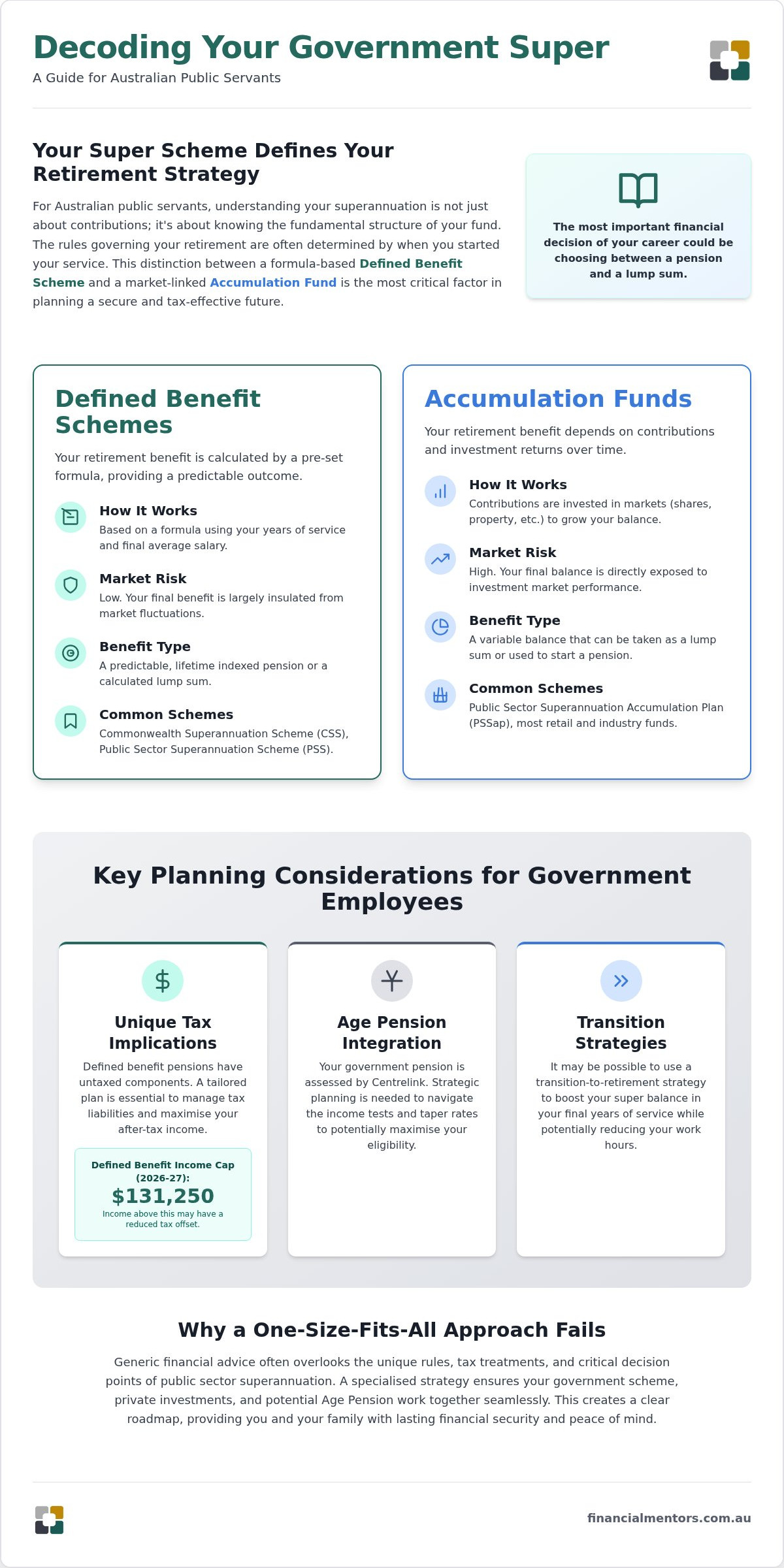
The rules governing your retirement are often determined by the day you first walked into your government role. This history matters. Older defined benefit schemes, such as the CSS and PSS, operate on formulas based on your salary and years of service. Newer members likely have accumulation funds like the PSSap, which behave more like market-linked accounts. To understand the broader context, an Overview of Australian Superannuation highlights how these systems have evolved over time. Because government schemes are often taxed differently, particularly when dealing with untaxed components, a reactive approach won’t suffice. You need a strategy that anticipates these nuances well before you hand in your resignation.
Why a One-Size-Fits-All Approach Fails Government Employees
A generic financial plan rarely works for public servants because it ignores the specific “if-then” logic of government pensions. High-balance accounts in these schemes can trigger tax liabilities that aren’t present in retail funds. For instance, for the 2026-27 financial year, the defined benefit income cap is $131,250. If your income from an untaxed source exceeds this amount, your 10% tax offset may be restricted on the excess. Without a tailored roadmap, you risk paying more tax than necessary or failing to maximise your income stream. Professional retirement planning for government employees australia ensures your strategy accounts for these specific public sector rules, providing clarity and confidence as you plan your exit.
Decoding Your Superannuation: Defined Benefits vs. Accumulation Funds
Understanding your super starts with identifying which system you’re in. For many in the public sector, this means distinguishing between a Defined Benefit Scheme and an Accumulation Fund. This distinction is the cornerstone of effective retirement planning for government employees australia. A Defined Benefit Scheme, like the CSS or PSS, is essentially a formula. Your final benefit isn’t dictated by the stock market, but by your years of service and your final average salary. In contrast, Accumulation Funds like the PSSap are investment-market-dependent accounts where your balance grows based on contributions and investment returns.
Because the CSS and PSS are closed schemes, it’s common to feel a sense of being ‘locked in.’ You might worry that leaving the public service early could jeopardise a life-changing pension. This feeling is valid, as these schemes often offer benefits that are difficult to replicate elsewhere. However, managing this transition requires understanding ‘notional’ contributions. In a defined benefit environment, your contributions aren’t always dollar-for-dollar; instead, they’re calculated based on the value of the benefit you’re accruing. This can complicate your caps, making professional retirement advice essential for staying on the right side of tax limits.
The Mechanics of the PSS and CSS
The most critical decision you’ll face is the ‘pension versus lump sum’ election. While a lump sum offers immediate flexibility, an indexed pension provides a guaranteed income stream for life. This choice is often influenced by the ’10-year rule’ or specific timing constraints that are unique to Australian Government Superannuation Schemes. As we often say, a defined benefit scheme is a promise of future income, but its value is only realised through precise timing and strategic election.
Managing Modern Government Accumulation Funds
If you’re in a fund like PSSap or GESB, your focus shifts toward investment choice and risk management. Are you taking too much risk as you approach your finish line, or perhaps too little? For those on higher public sector salaries, maximising concessional contributions up to the $32,500 annual cap for the 2026/27 financial year is a powerful way to reduce taxable income while building wealth. By integrating these choices into your planned retirement, you create a foundation that can withstand market fluctuations. Effective retirement planning for government employees australia involves balancing these technical details with your personal aspirations for the future.
Strategic Integration: Government Super, the Age Pension, and Private Wealth
How do you ensure your various income streams don’t work against each other? For many public servants, the challenge isn’t just about the size of the super balance, but how that balance interacts with the broader Australian retirement system. Effective retirement planning for government employees australia requires a holistic view that treats your PSS or CSS pension, the Age Pension, and your private investments as a single, harmonised engine. Without this integration, you might find yourself caught by the “taper rate,” where every extra dollar of assets could reduce your pension eligibility more than you’d expect.
As of 20 September 2026, the maximum full Age Pension for a single person is $1,237.70 per fortnight, while couples can receive up to $1,866.00. However, reaching age 67 doesn’t automatically guarantee these amounts. If your government super provides a high income stream or your assets exceed certain thresholds, your pension may be reduced or eliminated. A retirement financial advisor acts as a wise mentor here, helping you arrange your affairs so you don’t miss out on entitlements through simple structural oversights.
Navigating the Centrelink Assets and Income Test
Centrelink values defined benefit income streams differently than standard accumulation accounts. They often use a “deductible amount” calculation that can be quite favourable if handled correctly. If you have a non-working partner, there are often opportunities to optimise your total household eligibility by shifting the ownership of certain assets. It’s vital to maintain accurate reporting, as the complexity of government pensions can sometimes lead to unintentional overpayment debts that are stressful to resolve later.
Balancing Your Portfolio with Non-Super Investments
While superannuation is a powerful tool, being “super-heavy” can limit your flexibility, especially if you wish to retire before your preservation age. By exploring wealth creation strategies australia, you can build a bridge of liquidity through investment bonds or shares. This allows you to access funds for milestones like travel or home renovations without needing to trigger a complex super withdrawal. Consider this quick checklist to see if your portfolio needs more balance:
- Do you have enough “ready cash” to cover six months of expenses without touching your super?
- If you retired tomorrow, could you fund your lifestyle until you reach age 67?
- Are your non-super investments structured to be tax-effective alongside your government pension?
When these elements are aligned, the result is a steady, predictable income that supports your aspirations. This level of coordination is what transforms a collection of accounts into a true legacy. If you feel uncertain about how your pieces fit together, seeking professional retirement planning for government employees australia can provide the clarity you need to move forward with confidence.
The Road to Retirement: Transition Strategies and Timing Your Exit
Timing your departure from the public service is a delicate balance between personal readiness and financial logic. Your journey toward a self-funded lifestyle follows a specific sequence of steps that ensure you don’t leave money on the table. First, you must determine your preservation age, which is 60 for anyone born after 30 June 1964. Aligning this milestone with your public service exit goals is the foundation of effective retirement planning for government employees australia. Once you know your date, you can begin the practical work of auditing your super components, distinguishing between taxed and untaxed elements that will attract different treatment when you finally stop work.
Protecting your legacy is the final, vital piece of the puzzle. This involves formalising your intentions through professional estate planning advice to ensure your government pension and accumulated wealth reach the right people. By treating these steps as a methodical roadmap, you replace uncertainty with a clear sense of progress and peace of mind.
Utilising Transition to Retirement (TTR) Effectively
A TTR strategy is a powerful way to bridge the gap between full-time work and your post-career life. It allows you to access a portion of your super as an income stream while you continue to work in the public service. This creates a “salary sacrifice” loop. You can direct more of your pre-tax salary into super to reduce your tax bill while using the TTR pension to maintain your take-home pay. TTR is not just a lifestyle choice; it is a powerful tax-arbitrage tool for the savvy government employee. It allows you to build your final balance aggressively in those high-earning years just before you retire.
Tax Implications of Lump Sums vs. Income Streams
Understanding how the Australian Tax Office views your super is essential for minimising liabilities. If you access your super before age 60, you may be subject to the “Low Rate Cap,” which limits the amount of the taxable component you can receive tax-free. However, for most Australians over age 60, super withdrawals and income streams are entirely tax-free. The complexity often arises with the “Death Tax” on super, where certain components paid to non-dependants can be taxed at 15% plus levies. Integrating your strategy with professional tax return preparation ensures these details are managed proactively, protecting more of your wealth for your family.
If you’re ready to move from general concepts to a concrete plan, we invite you to speak with a specialist in retirement planning for government employees australia. Having a trusted guide to manage the “if-then” logic of your exit can make all the difference in your long-term security.
Securing Your Future: Why Professional Mentoring Clarifies the Path
Why do so many public servants feel a sense of hesitation as they approach their retirement date? Often, it isn’t a lack of savings, but rather the sheer weight of the technical “if-then” logic required to get the transition right. When you’ve spent decades within the structured environment of the public service, the shift to managing your own complex income stream can feel daunting. This is where a financial mentor becomes an invaluable partner. Instead of navigating the maze alone, you have a guide who understands the nuances of your specific scheme and can reduce the stress of high-stakes decision-making.
Professional retirement planning for government employees australia is about more than just compliance; it’s about stewardship. It’s the peace of mind that comes from knowing every tax offset has been claimed and every Centrelink interaction has been optimised. Because your situation is unique, selecting the right wealth management office is a critical choice. You need a team that doesn’t just see a spreadsheet, but understands the prestige and specific rules of the PSS, CSS, and PSSap. Starting today, even with a single conversation, can fundamentally change the trajectory of your future.
The Value of Personalised Strategic Advice
A wise mentor doesn’t just give you a static plan; they model different “what-if” scenarios to help you see the possibilities. If you decide to retire six months earlier than planned, how does that affect your indexed pension? If you receive a redundancy, how can it be structured to minimise your tax liability? These are the questions that personalised strategic advice answers. Beyond the initial setup, ongoing reviews are essential. Legislation changes, market conditions shift, and your own life goals may evolve. Having a partner to adjust your roadmap ensures your strategy remains as dynamic as your life, keeping your goals within reach regardless of external changes.
Taking the Next Step Toward Your Ideal Lifestyle
What do you want your “day one” of retirement to look like? Perhaps it’s the quiet satisfaction of a morning walk without a commute, or the excitement of finally booking that long-delayed trip. Whatever your aspirations, they deserve a solid financial foundation. We invite you to begin a dialogue to explore how your unique public sector circumstances can be harmonised into a clear, actionable strategy. For those ready to take immediate action, our retirement planning checklist australia provides a methodical way to assess your current readiness. Your career has been defined by service to others; now is the time to focus on the future you’ve worked so hard to build.
Embracing Your Future with Confidence and Clarity
Your transition from a dedicated career in the public service to a self-funded lifestyle is a milestone that deserves careful stewardship. We’ve explored how decoding the mechanics of your defined benefit scheme and harmonising it with the Age Pension and your private wealth can create a stable, predictable income stream. By choosing a strategy that accounts for the unique tax rules of government funds, you ensure your hard work translates into a lasting legacy for your family.
The complexity of these rules shouldn’t be a barrier to your peace of mind. Effective retirement planning for government employees australia is most successful when you have a trusted guide to manage the technical details and model your “what-if” scenarios. Since 2003, we’ve provided AFSL licensed professional advice with a specialist focus on the public sector. Our integrated approach to tax and wealth management ensures every part of your financial life works together seamlessly.
If you would like to explore your options, contact Financial Mentors for a tailored retirement roadmap. We’re here to help you step into your next chapter with the quiet confidence you’ve earned.
Frequently Asked Questions
Is my government defined benefit pension taxed in Australia?
Yes, your pension is taxable, but the tax you pay depends on your age and the specific components of your fund. If you’re over 60, the employer-financed indexed pension from the CSS is taxable but usually attracts a 10% tax offset. However, for the 2026-27 financial year, a defined benefit income cap of $131,250 applies. Any income from untaxed sources above this cap won’t receive that 10% offset, which is why integrated tax planning is so essential.
Can I still get the Age Pension if I have a large PSS or CSS balance?
You can certainly still qualify for a part Age Pension, provided your income and assets fall within Centrelink thresholds. Government defined benefit pensions are valued using specific formulas that often differ from standard accumulation accounts. As of September 2026, the maximum full Age Pension for a single person is $1,237.70 per fortnight. If your super income is high, the “taper rate” may reduce your eligibility, making a coordinated strategy vital for your total household income.
How much super does a government employee need to retire comfortably?
There is no single magic number because your indexed pension provides a level of security many private sector workers don’t have. While industry benchmarks suggest a couple needs roughly $72,000 per year for a comfortable lifestyle, your requirement depends on your personal goals and debt levels. Effective retirement planning for government employees australia involves modelling your specific PSS or CSS benefits alongside your other assets to see if your desired lifestyle is sustainable over the long term.
What happens to my government super if I retire before age 60?
Retiring before age 60 triggers specific preservation rules and different tax treatments. For CSS members, the “54/11” strategy is a well-known path that involves resigning just before your 55th birthday to potentially secure a more favourable benefit. If you access super before 60, you may be subject to the Low Rate Cap on the taxable component. It’s a complex transition where the right timing can significantly impact your net income for decades to come.
Can I roll my government super into a private retail fund?
If you have an accumulation account like the PSSap, you can generally roll these funds into a private retail or industry fund. However, defined benefit components in the PSS or CSS are fundamentally different and usually cannot be rolled out once you’ve started receiving a pension. These schemes are promises of future income rather than a simple pot of cash. If you’re considering a move, it’s vital to weigh the guaranteed indexation against the flexibility of a private fund.
Is there a “death tax” on government superannuation benefits?
While Australia doesn’t have a formal inheritance tax, a tax can apply to the taxable components of your super if they’re paid to non-dependants, such as adult children. This tax is typically 15% plus the Medicare levy. For public servants with high-value defined benefits, this can represent a significant portion of your legacy. Have you considered how your estate planning might protect your beneficiaries from unnecessary tax liabilities? Professional advice can help clarify these risks and protect your stewardship.
How do I calculate my final pension if I am in the PSS or CSS?
Your final pension is calculated using specific formulas that depend on your scheme. For PSS members, it’s based on your Accrued Benefit Multiple and your Final Average Salary at retirement. CSS members have a more complex calculation involving member contributions, interest, and employer-financed components. Because these formulas are sensitive to your final years of service and salary levels, getting an accurate projection is the first step in successful retirement planning for government employees australia.
What is the best age for a government employee to retire for tax purposes?
For many, age 60 is the sweet spot because superannuation benefits generally become tax-free at this milestone. However, the best age for you depends on your specific scheme’s rules and your preservation age. If you’re in the CSS, the 54 and 11 months strategy might be more effective than waiting until 60. Have you looked at how your income changes if you work one extra year? Modelling these if-then scenarios helps you choose the most tax-effective exit point.