

Your public sector super might be worth far more than you think, and far less than it could be. For the thousands of Australians still navigating the Commonwealth Superannuation Scheme (CSS), the Public Sector Superannuation Scheme (PSS), or the newer PSSap, the rules governing your retirement savings are genuinely unlike anything in the private sector. Seeking clear, personalised public sector superannuation advice in Australia isn’t a luxury; it’s often the difference between a comfortable retirement and one spent second-guessing every decision.
If you’ve ever felt a quiet unease about how your defined benefit pension actually works, whether your family will face an unexpected tax burden when you’re gone, or how your super fits alongside the Age Pension, you’re not alone. These are the questions that keep long-serving public servants up at night, and they deserve honest, straightforward answers.
This guide is here to help. We’ll walk you through the key differences between CSS, PSS, and PSSap, explore how to protect your family through thoughtful estate planning, and show you how a coordinated strategy can improve your tax outcomes and retirement income, so you can step into this next chapter with genuine confidence.
Key Takeaways
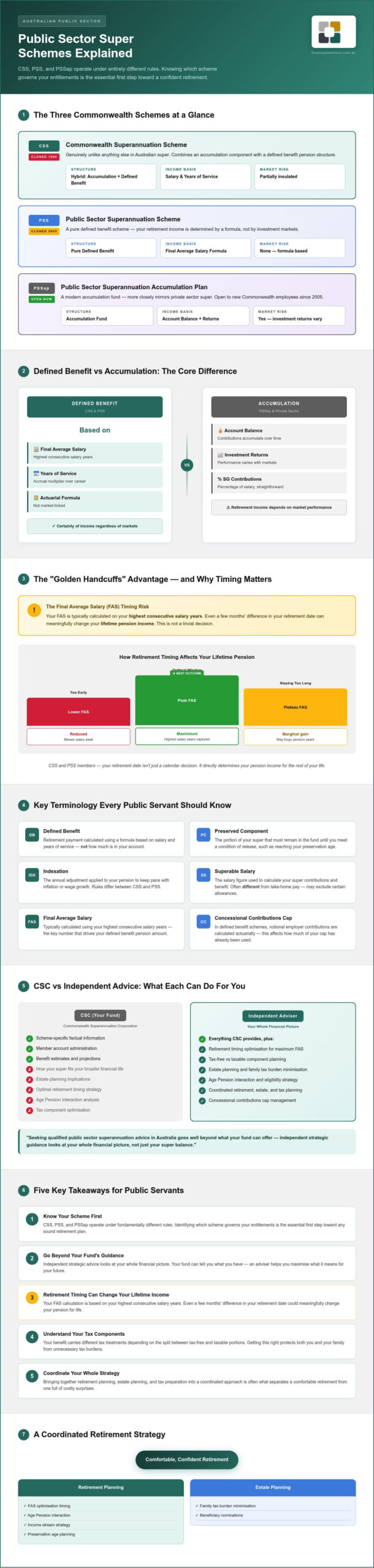
- CSS, PSS, and PSSap operate under fundamentally different rules, and understanding which scheme governs your entitlements is the essential first step toward a confident retirement.
- Seeking qualified public sector superannuation advice in Australia goes well beyond what your fund can offer — independent strategic guidance looks at your whole financial picture, not just your super balance.
- The timing of your retirement can significantly affect your Final Average Salary calculation, meaning even a few months’ difference could meaningfully change your lifetime pension income.
- Your benefit components carry different tax treatments, and knowing the split between tax-free and taxable portions can help you and your family avoid unnecessary tax burdens down the track.
- A coordinated approach — one that brings together retirement planning, estate planning, and tax preparation — is often what separates a comfortable retirement from one full of costly surprises.
Understanding the Unique Landscape of Public Sector Superannuation
For many long-serving government employees, superannuation isn’t simply a savings account sitting quietly in the background. It’s a carefully structured legacy asset, built up over decades of public service, and governed by rules that bear very little resemblance to the standard retail or industry funds most Australians are familiar with. Understanding how your entitlements actually work is the foundation of every sound retirement decision you’ll make from here.
Australia’s public sector super landscape has shifted considerably over the past few decades. The Commonwealth moved away from defined benefit schemes for new employees in the 1990s, introducing accumulation-style arrangements that more closely mirror the private sector. Today, three distinct schemes coexist: the CSS (closed since 1990), the PSS (closed to new members since 2005), and the PSSap, which operates as a modern accumulation fund. If you’re a long-serving public servant, there’s a reasonable chance you’re sitting in one of the older schemes, and that changes almost everything about how you should plan your retirement.
The Commonwealth Superannuation Corporation (CSC) administers all three schemes and provides members with factual, scheme-specific information. What CSC doesn’t do is help you understand how your super fits into your broader financial life, how it interacts with your estate, or how to time your retirement for the best possible outcome. That’s precisely where qualified public sector superannuation advice in Australia becomes genuinely valuable.
Why Public Sector Schemes Require a Different Approach
There’s a reason people sometimes refer to CSS and PSS membership as “golden handcuffs.” The defined benefit structure offers something no accumulation fund can replicate: a level of certainty about your retirement income that’s tied to your salary and years of service, rather than market performance. That certainty has real value, but only if you understand how to protect it. Timing matters enormously here. Your Final Average Salary (FAS) calculation is typically based on your highest consecutive salary years, which means the months leading up to your retirement date can have a meaningful impact on your lifetime pension income. A few months’ difference isn’t trivial.
Key Terminology You Need to Know
A few plain-English definitions go a long way when you’re working through your options:
- Defined Benefit: A retirement payment calculated using a formula, typically based on your salary and years of service, rather than how much is in your account.
- Preserved Component: The portion of your super benefit that must remain in the fund until you meet a condition of release, such as reaching your preservation age.
- Indexation: The annual adjustment applied to your pension to help it keep pace with inflation or wage growth, depending on the scheme rules.
- Superable Salary: The salary figure used to calculate your super contributions and, ultimately, your benefit. It’s often different from your actual take-home pay and may exclude certain allowances.
Concessional contributions also look different in the public sector. In defined benefit schemes, the notional employer contribution is calculated using an actuarial formula rather than a straightforward percentage, and this affects how much of your contributions cap has already been used. Seeking proper public sector superannuation advice in Australia means having someone who genuinely understands these distinctions sitting across the table from you.
CSS, PSS, and PSSap: Navigating Your Specific Scheme Rules
Three schemes, three entirely different sets of rules. If you’ve spent any time trying to compare notes with a colleague about your super entitlements, you’ve probably discovered that what applies to one person can be almost irrelevant to another. Understanding exactly which scheme governs your benefits isn’t just helpful background knowledge; it’s the starting point for every meaningful retirement decision you’ll make.
The Commonwealth Superannuation Scheme (CSS)
The CSS is genuinely unlike anything else in the Australian super landscape. It combines an accumulation component, built from your personal contributions, with a defined benefit pension funded by the Commonwealth. That hybrid structure is both its greatest strength and its most misunderstood feature.
One rule that catches many CSS members off guard is the so-called 54/11 rule. If you leave the public service after age 54 years and 11 months but before age 55, you can access your CSS benefit under specific conditions that differ from standard preservation rules. The timing here is precise, and getting it wrong can have lasting consequences for your retirement income. Your CSS pension, once in payment, is also largely non-commutable, meaning you generally can’t convert it to a lump sum after the fact. That certainty has real value, but it requires you to think carefully about your income needs before you retire, not after.
The Public Sector Superannuation Scheme (PSS)
In the PSS, your retirement benefit is expressed as a multiple of your Final Average Salary, determined by the benefit points you’ve accumulated over your career. At the point of retirement, you face one of the most consequential decisions of your financial life: take a lifetime indexed pension, or convert some or all of your benefit to a lump sum.
The indexed pension is compelling precisely because it keeps pace over time, providing reliable income regardless of how long you live. The lump sum offers flexibility but places the investment and longevity risk squarely on your shoulders. There’s no universally right answer; the best choice depends on your health, your other assets, your partner’s circumstances, and how the benefit interacts with the Age Pension. What’s often overlooked is the contribution rate decision. PSS members can contribute between 0% and 10% of their superable salary, and that choice directly shapes the size of your final benefit. Reviewing your rate well before retirement is one of the most practical levers available to you.
PSS Accumulation Plan (PSSap)
For public servants who joined the Commonwealth after 2005, the PSSap operates much like a modern industry fund, with employer contributions flowing into an account that grows with investment returns. The key government-specific benefit is a Commonwealth employer contribution of 15.4% of superable salary, which sits above the standard Superannuation Guarantee rate. Members can choose from a range of investment options and should consider gradually shifting toward more conservative allocations as retirement approaches, a process sometimes called a “lifecycle” approach. The PSSap also includes default life insurance and income protection cover, though the appropriateness of those default levels deserves a proper review as your circumstances evolve.
Across all three schemes, the 2026 tax environment adds another layer of complexity, particularly for members with high account balances. The Australian Government’s proposed changes to tax treatment on balances above $3 million mean that some long-serving public servants, especially those with significant accumulation components alongside defined benefit entitlements, may face higher effective tax rates on their super earnings. Reviewing your position against the Australian Taxation Office superannuation guidance is a sensible first step, though translating those rules into a personalised strategy is where qualified public sector superannuation advice in Australia becomes genuinely indispensable.
If you’re unsure how your scheme’s rules interact with your broader financial picture, speaking with a retirement planning specialist who understands the nuances of Commonwealth schemes can bring real clarity to what can otherwise feel like an overwhelming set of decisions.
Fund-Based Guidance vs Independent Strategic Advice
When you’re standing at the threshold of retirement, it’s natural to look for a helping hand to make sense of the numbers. The Commonwealth Superannuation Corporation (CSC) provides helpful, fund-specific information that is often quite accessible. For many public servants, this is a sensible starting point to understand the basic mechanics of their scheme. But as your financial life grows more complex, you might find yourself wondering if looking at your super balance in isolation is enough to give you the genuine peace of mind you’re looking for.
The Scope of Fund-Provided Advice
Fund-based planners are specialists in the specific rules of the CSS, PSS, or PSSap. They can explain your benefit points or how your Final Average Salary is calculated with great precision. However, their scope is naturally limited to the assets held within the scheme itself. They generally don’t provide guidance on your investment property, your spouse’s superannuation, or how your retirement income will interact with your annual tax return. While they may point you toward Australian Taxation Office superannuation guidance, they aren’t positioned to build a strategy that spans your entire household. If your life involves more than just a single super account, a siloed approach might leave gaps in your plan that only become apparent after you’ve already retired.
The Value of an Independent Wise Mentor
This is where seeking independent public sector superannuation advice australia changes the conversation. Rather than just looking at a balance, a wise mentor looks at your whole life. How does your super coordinate with your planned retirement goals? If you have assets outside of super, such as a family home or a share portfolio, how can these be managed together to provide the most tax-effective income stream possible?
An independent partner acts as a trusted guide, helping you see the connections between your super, your estate planning, and your tax obligations. They aren’t tied to a single product or fund, which means their focus remains entirely on your long-term well-being. People often ask if the fee for independent advice is worth the investment. When you consider the potential for optimised tax outcomes and the certainty that your family is protected via estate planning, the return on that investment is measured in more than just dollars. It’s measured in the quiet confidence that comes from being truly prepared for the milestones ahead.
Strategic Steps to Optimise Your Retirement Income
Knowing your scheme’s rules is only half the work. The other half is translating that knowledge into a clear, coordinated strategy that actually improves your retirement outcome. For most public servants, that means working through five practical steps, ideally with a qualified guide alongside you, before you hand in your notice.
Step 1: Audit your benefit components. Your super benefit isn’t a single, uniform pool of money. It’s made up of distinct components, each taxed differently. Understanding the split between your tax-free and taxable portions is essential before you make any decisions about lump sums, pension payments, or estate distributions.
Step 2: Model different retirement dates. Even a short delay, or an earlier exit, can shift your Final Average Salary calculation in ways that ripple through your lifetime pension income. Running the numbers across several scenarios, rather than assuming one date is as good as another, gives you real leverage over your outcome.
Step 3: Integrate your super with professional tax return preparation. Your retirement income doesn’t exist in a vacuum. How your pension or lump sum is treated at tax time depends on factors including your age, the components involved, and your other income sources. A coordinated approach ensures your tax position is optimised year after year, not just in the first year you retire.
Step 4: Review your beneficiary nominations. This one is urgent. Outdated or informal nominations can expose your family to a significant, and entirely avoidable, tax bill.
Step 5: Stress-test your income against Age Pension thresholds. Defined benefit pensions are assessed differently under the assets test and the income test, and the interaction can be counterintuitive. Modelling your position against current thresholds helps you plan proactively rather than react after the fact.
Managing the Tax Implications
Public sector funds carry something many members don’t anticipate: an “untaxed element.” Unlike most retail and industry funds, where contributions have already been taxed at 15% on the way in, CSS and PSS benefits include amounts that have never been subject to tax inside the fund. When you receive that benefit, either as a pension or a lump sum, the untaxed element is taxed at your marginal rate, up to a cap. That can come as a genuine shock if you haven’t planned for it. One practical response is a recontribution strategy, where eligible members withdraw super and recontribute it as a non-concessional contribution to shift the taxable component into a tax-free one. This approach isn’t suitable for everyone, but it’s a legitimate tool for reducing the tax burden your beneficiaries might otherwise inherit.
Super and Your Estate Plan
Here’s something that surprises many long-serving public servants: your superannuation doesn’t automatically form part of your Will. It sits outside your estate unless you specifically direct it there through a valid binding death benefit nomination. Without one, the trustee retains discretion over where your benefit goes, and that discretion doesn’t always align with your intentions.
For public servants with a CSS or PSS pension, the stakes are even higher. Reversionary pension rules determine whether your spouse continues to receive income after your death, and at what rate. Dependent children may also be eligible for a benefit, but the conditions and tax treatment differ significantly from what applies to adult non-dependants. Seeking proper estate planning advice that accounts for the specific rules of your scheme is one of the most meaningful gifts you can give your family.
This is exactly the kind of holistic, joined-up thinking that separates genuinely useful public sector superannuation advice Australia from a simple fund fact sheet. If you’d like to work through these steps with someone who understands both the Commonwealth schemes and the broader tax and estate landscape, speak with the team at Financial Mentors about building a strategy that’s tailored to your circumstances.
Partnering with a Wise Mentor for Your Superannuation Journey
Decades of public service deserve more than a generic retirement plan pulled from a template. If the sections above have clarified anything, it’s that CSS, PSS, and PSSap each carry a level of complexity that rewards careful, personalised attention. The question isn’t whether you need a guide for this transition. It’s whether the guide you choose can see the whole picture, not just the super balance on the screen in front of them.
The Financial Mentors Difference
Financial Mentors Wealth Management has been helping Australians navigate complex financial transitions since receiving its AFSL registration in 2003. That history matters, not as a credential to display on a wall, but because it represents more than two decades of sitting with real people at genuinely consequential moments in their lives. Retirement is one of those moments, and it deserves to be treated as such.
What sets the team apart is the integration of services under one roof. Rather than coordinating between a separate financial planner, tax accountant, and estate planning adviser, clients benefit from having their retirement planning, tax return preparation, and wealth management handled cohesively by people who talk to each other. That joined-up approach isn’t a luxury. For public servants navigating untaxed elements, reversionary pension decisions, and binding death benefit nominations simultaneously, it’s genuinely practical. Your wealth management office should be a place where all of those threads come together, not a place that hands you a referral and wishes you luck.
The focus here is never just on spreadsheets. It’s on understanding what retirement actually means to you, what you want your days to look like, what you want to leave behind, and what would keep you up at night if it went wrong. That kind of listening shapes better strategy.
Your Next Steps Toward Clarity
If you’re ready to take the first step, a little preparation goes a long way. When you come to an initial consultation, it helps to bring:
- Your most recent CSS, PSS, or PSSap member statement
- Details of any assets or income sources outside of super
- Your current beneficiary nomination documents
- A rough sense of your intended retirement date, even if it’s not yet firm
From there, the team can help you build a retirement planning checklist tailored specifically to your scheme and your circumstances. That checklist becomes the foundation of a strategy, not a one-size-fits-all plan, but a clear, considered roadmap that reflects your life.
Seeking quality public sector superannuation advice Australia is ultimately an act of respect for everything you’ve built. You’ve spent your career in service to others. This next chapter is yours. Speak with the Financial Mentors team today, and let’s make sure it unfolds the way you’ve worked so hard to deserve.
Your Retirement Deserves More Than a Best Guess
Public sector superannuation is genuinely complex, and the decisions you make in the years surrounding retirement can shape your financial life for decades. Whether you’re weighing a PSS pension against a lump sum, navigating the untaxed element in your CSS benefit, or simply wondering whether your family is protected if something happens to you, these aren’t questions to leave to chance.
The clearest takeaways from everything we’ve covered are straightforward: your scheme’s specific rules matter enormously, timing your retirement strategically can meaningfully improve your lifetime income, and a coordinated approach across super, tax, and estate planning is far more powerful than addressing each in isolation.
Quality public sector superannuation advice Australia isn’t about adding complexity to an already busy life. It’s about replacing uncertainty with clarity, so you can move forward with genuine confidence.
The team at Financial Mentors has been guiding Australians through exactly these decisions since receiving their AFSL registration in 2003, with deep expertise in complex government defined benefit schemes and a genuinely empathetic, mentor-led approach. Book a consultation with a Financial Mentors adviser today and take the first step toward a retirement you’ve truly earned.
Frequently Asked Questions About Public Sector Superannuation
Can I stay in the PSS or CSS if I leave the public service before age 55?
Yes, in most cases your benefit is preserved within the scheme rather than forfeited. If you leave the public service before meeting a condition of release, your entitlement remains in the CSS or PSS as a preserved benefit, accessible once you reach your preservation age (currently 60 for most people born after 1 July 1964). You won’t continue accruing benefit points after you leave, but what you’ve built remains protected.
The important nuance is that your options at the point of departure, whether to take a deferred benefit, a transfer value, or a preserved pension, can have lasting consequences. Each path carries different tax and income implications, so seeking qualified public sector superannuation advice Australia before you finalise your exit is genuinely worthwhile rather than something to sort out afterwards.
What is the ‘death tax’ on superannuation and how do I avoid it?
The so-called death tax isn’t a formal tax name, but it refers to the tax applied to the taxable component of a super death benefit paid to a non-dependant, such as an adult child. That component can be taxed at up to 17% (including Medicare levy), which can represent a significant reduction in what your family actually receives. For CSS and PSS members, the untaxed element within their benefit can push that tax rate even higher.
Practical strategies to reduce this burden include recontribution arrangements (where eligible) to convert taxable components into tax-free ones, and ensuring your binding death benefit nominations direct benefits to tax-dependants where possible. A coordinated approach across your estate plan and super nominations is the most effective way to protect your family from an avoidable tax bill.
How does my public sector pension affect my eligibility for the Age Pension?
A defined benefit pension from the CSS or PSS is assessed under Centrelink’s income test using a special rules framework, not the standard deeming approach applied to account-based pensions. Centrelink applies a deductible amount to your pension income, which reduces the assessed figure, but the remaining amount still counts toward the income test threshold and can reduce or eliminate your Age Pension entitlement.
The assets test treatment also differs. Because a defined benefit pension is generally non-commutable, Centrelink uses a specific conversion factor to calculate a notional asset value. These interactions are genuinely counterintuitive, and many public servants are surprised by how their pension affects their Centrelink position. Modelling your specific numbers well before retirement gives you the opportunity to plan proactively rather than react after the fact.
Is it better to take my PSS benefit as a lump sum or a lifetime pension?
There’s no universal right answer, and anyone who tells you otherwise isn’t looking at your full picture. The indexed lifetime pension offers certainty and longevity protection; it keeps paying regardless of how long you live and adjusts over time to help preserve purchasing power. The lump sum offers flexibility and may suit those with significant other assets, a shorter life expectancy, or specific estate planning goals.
The decision also hinges on your partner’s circumstances, how the benefit interacts with the Age Pension, and your broader tax position. Many PSS members are eligible to take a partial commutation, converting only a portion to a lump sum, which can offer a middle path. This is one of the most consequential financial decisions you’ll make, and it deserves careful, personalised analysis rather than a general rule of thumb.
What happens to my super if I go from full-time to part-time work in the APS?
Reducing your hours in the Australian Public Service can affect your super in ways that aren’t immediately obvious. In the PSS, your superable salary and the rate at which you accrue benefit points are both linked to your employment conditions, so moving to part-time work can slow the growth of your final benefit. Your Final Average Salary calculation may also be affected if your salary drops in the years immediately before retirement.
For PSSap members, the employer contribution of 15.4% continues to be calculated on your superable salary, so a reduction in hours generally means a proportional reduction in employer contributions flowing into your account. If you’re considering a transition to part-time work in the years approaching retirement, it’s worth modelling the impact on your projected benefit before you make the change rather than after.
Can I make extra contributions to my defined benefit fund in 2026?
In defined benefit schemes like the CSS and PSS, the scope for additional voluntary contributions is quite limited compared to accumulation funds. PSS members can adjust their personal contribution rate between 0% and 10% of superable salary, and this choice directly influences the size of their final benefit. CSS members have less flexibility, as the structure of that scheme is more rigid. Neither scheme accepts additional non-concessional contributions in the way a standard super fund does.
What some members do instead is hold a linked PSSap account or a separate accumulation fund alongside their defined benefit scheme, directing additional savings there. The concessional contributions cap applies across all your super interests, so it’s important to understand how your notional defined benefit contributions are counted before making extra contributions elsewhere. A qualified adviser can help you work through the numbers without inadvertently exceeding your cap.
Do I need a new estate plan if I change my superannuation nominations?
Changing your superannuation nominations and updating your Will are related but separate actions, and doing one doesn’t automatically address the other. Your super sits outside your estate unless you specifically nominate your legal personal representative as the beneficiary, so a new Will won’t redirect your super benefit on its own. Equally, updating your super nomination doesn’t update the provisions in your Will that govern your other assets.
A change in circumstances, such as a marriage, separation, the birth of a grandchild, or the death of a nominated beneficiary, is a prompt to review both your nominations and your broader estate plan together. Treating them as a coordinated whole, rather than separate administrative tasks, is what ensures your intentions are actually carried out. This is an area where integrated estate planning advice adds real, practical value.
What is the 54/11 rule and does it still apply in 2026?
The 54/11 rule is a CSS-specific provision that allows members who leave the public service after reaching age 54 years and 11 months, but before turning 55, to access their CSS benefit under conditions that differ from standard preservation rules. It’s a narrow window, and the timing is precise to the month. Members who qualify can generally access their benefit without waiting until their standard preservation age, which makes the exit date genuinely significant for those approaching this threshold.
As of 2026, the 54/11 rule remains a feature of the CSS, though its application depends on your individual circumstances and when you first became a CSS member. It’s the kind of provision that rewards careful planning; knowing whether it applies to you and how to position your exit accordingly is exactly the sort of nuanced guidance that specialist public sector superannuation advice Australia is designed to provide.