

Did you know that 53% of Australians have experienced family conflict over an inheritance? It’s a sobering thought that the legacy you’ve worked a lifetime to build could become a source of division rather than a gift of support. You likely want to ensure your children and grandchildren are looked after without the shadow of legal battles or emotional fallout. It’s completely natural to feel a little confused by the Australian system, especially when trying to understand how to minimise inheritance disputes while managing assets like superannuation that don’t always follow a traditional will.
Peace of mind for those you leave behind is a primary goal. This guide shows you how to protect your family harmony through proactive estate planning and clear financial strategies. You’ll learn how to create a plan that reduces financial risks and ensures your assets are distributed exactly as you intended. This article covers the practical steps of structuring your wealth, from binding nominations to transparent communication, so you can feel confident about the future of your estate.
Key Takeaways
- Understand the common triggers for family conflict, such as outdated Wills and complex family structures, so you can address them early.
- Learn to distinguish between estate and non-estate assets to ensure your superannuation and property are structured correctly for your beneficiaries.
- Discover how to minimise inheritance disputes by practicing radical transparency with your family to manage expectations while you are still alive.
- Future-proof your legacy by ensuring your Will, superannuation binding nominations, and trust deeds are all aligned with your current financial position.
- Recognise how professional estate planning advice acts as a bridge between your legal documents and your long-term goals for family harmony.
Why Inheritance Disputes Occur in Australian Families
An inheritance dispute is essentially a legal or personal challenge to how an estate is shared out. It often arises when the reality of a last will and testament doesn’t match the expectations of the family members left behind. These conflicts aren’t always about greed; they usually stem from a breakdown in communication or a sense of being overlooked. Common triggers include a lack of transparency during the parent’s lifetime, outdated documents that don’t reflect current relationships, or the inherent friction of complex family structures.
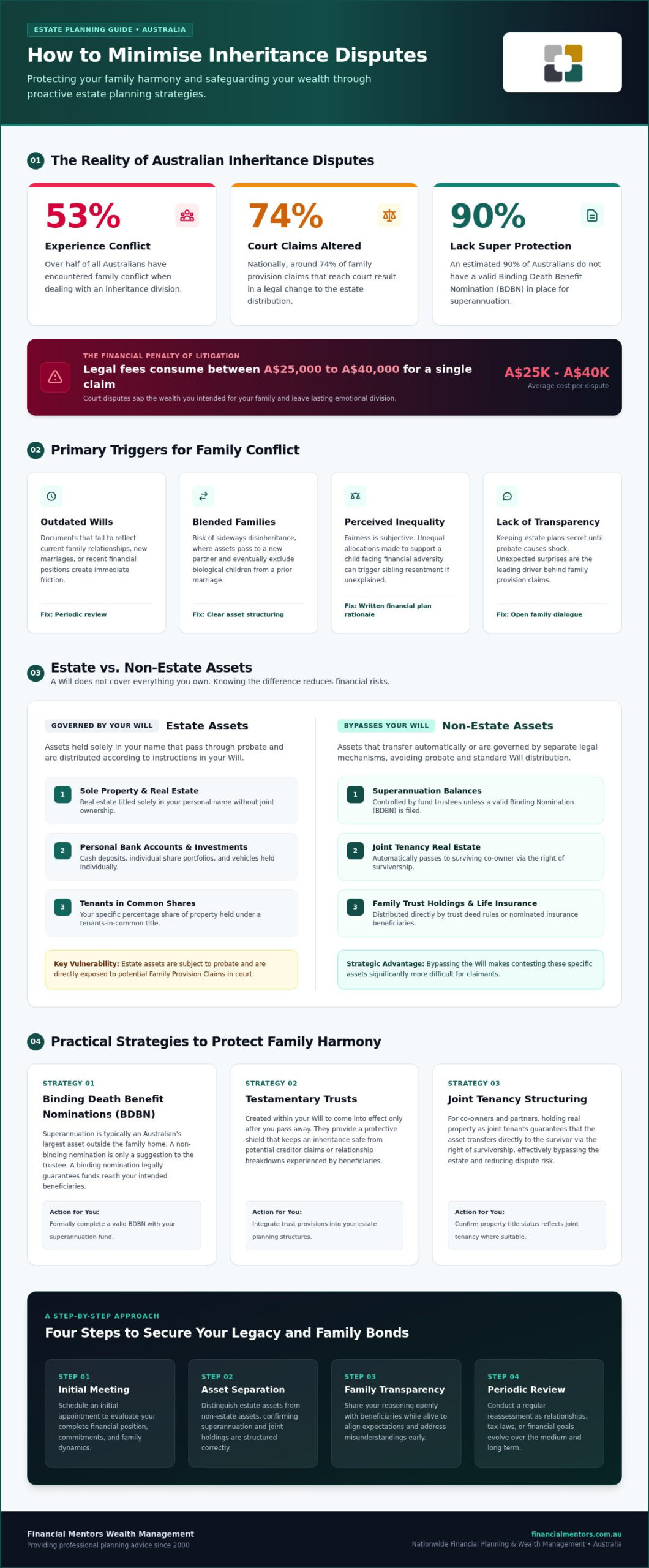
In the Australian context, these disputes often take the form of a Family Provision Claim. This allows eligible people, such as spouses, children, or sometimes former partners, to ask the court for a larger share of the estate if they feel they haven’t been left enough for their proper maintenance. While these laws exist to protect the vulnerable, they can lead to significant financial risks. Research shows that nationally, around 74% of family provision claims that go to court result in a change to the distribution. Litigation is also incredibly expensive. A single claim can easily sap A$25,000 to A$40,000 from the inheritance, meaning the wealth you intended for your family is consumed by legal fees. Beyond the money, the emotional toll on family harmony is often irreparable, creating rifts that last for generations. This is why learning how to minimise inheritance disputes is such a vital part of your financial journey.
The Impact of Blended Families
Second marriages and de facto relationships are now common in Australia, but they introduce unique challenges for your long-term goals. You might worry about sideways disinheritance. This occurs when assets pass to a new partner and eventually to their own children, leaving your children from a first marriage with nothing. Clear estate planning advice is vital here. It helps you balance the needs of a current partner with your desire to protect your biological children, ensuring everyone is treated with respect.
Perceived Inequality vs. Actual Need
Fairness is subjective, and an equal distribution isn’t always perceived as fair by beneficiaries. If one child has faced significant financial adversity, such as a health crisis or business failure, you might feel they need more support than a sibling who is financially stable. Conversely, a child who has already received substantial help to buy a home might be expected to receive less later. A professional financial plan allows you to articulate the reasoning behind these choices. By explaining your “why” now, you take a proactive step in how to minimise inheritance disputes and preserve the bonds between your loved ones.
Structuring Your Assets to Minimise Financial Risks
Structuring your wealth isn’t just about deciding who gets what; it’s about how those assets are held. To understand how to minimise inheritance disputes, you first need to distinguish between estate and non-estate assets. It’s a common misconception that a Will covers everything you own. In reality, assets like superannuation, life insurance, and property held in a family trust often sit outside the estate. By clearly identifying these categories, you can create a plan that leaves less room for confusion or legal challenges later.
Joint tenancy is a practical tool for partners. When you own a home as joint tenants, the property passes automatically to the surviving owner through the right of survivorship. This process bypasses the Will entirely, which makes contesting a will much more difficult regarding that specific property. For other assets, you might consider testamentary trusts. These are trusts created within your Will that only come into effect after you pass away. They offer a protective shield, keeping an inheritance safe from a beneficiary’s potential creditors or relationship breakdowns. Because family dynamics and tax laws change, a periodic review of these structures is essential to ensure they still align with your long-term goals.
Superannuation and Binding Death Benefit Nominations
Superannuation is often an Australian’s largest asset outside the family home, yet it doesn’t automatically form part of your estate. The trustee of your super fund generally decides who receives your balance unless you’ve made a valid Binding Death Benefit Nomination (BDBN). An estimated 90% of Australians don’t have a BDBN in place, which can lead to significant uncertainty. A non-binding nomination is merely a suggestion, while a binding one gives you the confidence that your funds will go exactly where you intend. You can find more details on how to avoid death tax on superannuation to help your beneficiaries keep more of their inheritance.
The Use of Family Trusts
Wealth management strategies often involve discretionary family trusts to manage and protect capital across generations. These trusts allow you to provide for your family while keeping the principal assets intact. A major benefit is continuity; the trust continues to operate even after you’re gone, with management passing to a successor you’ve already chosen. This prevents a “freeze” on assets and ensures your family’s financial commitments are met without delay. If you’re ready to see how your current structure stacks up, a professional financial position assessment is a wise first step in learning how to minimise inheritance disputes.
The Power of Family Communication and Transparency
While the technical structures discussed earlier provide a legal foundation, the emotional integrity of your plan depends on one thing: communication. Radical transparency is the most effective way to manage expectations while you’re still here to lead the conversation. Secrecy is often the spark that ignites suspicion. If your children only discover your intentions after you’ve passed, they might wonder if you were pressured or if they were unfairly judged. By opening the books now, you take control of the narrative. This is a core part of how to minimise inheritance disputes; it transforms a potentially cold legal outcome into a shared family vision.
Think of your inheritance as a baton being passed in a relay race. If you focus on stewardship rather than just the dollar value, you encourage your beneficiaries to see themselves as caretakers of a legacy. A financial advisor can act as a neutral third-party moderator in these discussions. They bring a calm, objective perspective that helps keep the focus on the future rather than past grievances. This partnership ensures that the transition of wealth is handled with the same care you used to build it.
Organising a Family Meeting
How do you start such a sensitive talk? It’s often best to frame the conversation around your family values and long-term goals. You might invite your adult children to a dedicated meeting to discuss your current financial position. This isn’t about giving them a bank statement; it’s about explaining what you hope the wealth will achieve for the next generation. If you feel nervous about managing the room, scheduling an appointment with a professional to facilitate the discussion can provide a safe, structured environment for everyone to be heard.
Explaining the “Why” Behind Your Decisions
Sometimes, an equal split isn’t the most practical choice. If you’ve decided on an unequal distribution, explaining your logic is essential to reduce the emotional sting. A “Letter of Wishes” is a powerful, non-legal document that sits alongside your Will to provide context. It’s the perfect place to address sensitive topics, such as loans you’ve already provided to one child for a house deposit or business venture. If you clearly state that these prior gifts were an early inheritance, you remove the guesswork. Taking this proactive step in how to minimise inheritance disputes helps preserve family harmony across generations.
Practical Steps to Future-Proof Your Legacy
Taking action is the only way to turn your good intentions into a stable reality. A professional assessment of your current financial position is the essential first step in this journey. This process isn’t just about counting your assets; it’s about ensuring every piece of your financial puzzle fits together perfectly. You’ve already seen how superannuation and trusts operate separately, but they must be aligned with your Will to be truly effective. If your Will says one thing and your trust deed or super nomination says another, you’re creating a gap for legal conflict. Establishing a schedule for a periodic review ensures your plan stays relevant as laws and family circumstances change. This proactive approach is exactly how to minimise inheritance disputes before they even begin.
Identifying Potential Financial Risks Early
Early detection of red flags can save your family years of heartache. If a beneficiary is currently struggling with significant debt or relationship instability, a direct inheritance might be at risk of being diverted to creditors or ex-partners. You can use estate planning advice to structure their share more safely, perhaps through a trust. Reviewing your life insurance cover is also crucial at this stage. It provides the liquidity needed to settle estate debts or pay out specific beneficiaries without forcing the sale of the family home. If you want to see how these steps fit into your broader life stage, our ultimate retirement planning checklist offers a helpful roadmap for your long-term goals.
Simplifying the Executor’s Task
Your executor has a significant responsibility, and you can make their job much easier with simple organisation. Start by creating a digital and physical folder that lists all your financial commitments, bank accounts, and property titles. Choosing a neutral and capable executor reduces the chance of friction among siblings who might already be grieving. Good record-keeping also streamlines tax return preparation for the estate, ensuring more of the inheritance stays with your family rather than being lost to administrative delays. By clearing the path now, you show your loved ones that you’ve considered their well-being at every step, which is a key component of how to minimise inheritance disputes. If you’re ready to secure your family’s future, you can book your initial financial position assessment today.
How Professional Advice Secures Your Family Harmony
A lawyer ensures your Will is legally sound, but a financial advisor bridges the gap between those legal documents and your actual life goals. While the legal paperwork provides the “what,” professional planning addresses the “why” and the “how.” If you truly want to understand how to minimise inheritance disputes, you need to look at the total picture of your wealth. This includes how your assets will support your loved ones emotionally and financially long after you are gone. Our “wise mentor” approach is designed to help you navigate these sensitive family transitions with quiet confidence, ensuring your legacy is one of support rather than conflict.
A validated, professional financial plan provides a level of peace of mind that a simple document cannot offer on its own. It allows you to look at liquidity, potential tax implications, and the long-term well-being of each beneficiary in a holistic way. If you take the time to structure your affairs today, then you remove the ambiguity that often leads to family friction. The best time to take action is now, as the most effective way to minimise a dispute is to address the risks years before they could ever happen. By acting early, you transform estate planning from a daunting task into a meaningful act of stewardship.
The Financial Mentors Wealth Management Approach
Our process begins with a thorough audit of your current estate readiness. We call this our “Step 01” initial meeting. During this session, we identify any potential gaps in your current strategy, such as misaligned superannuation nominations or unprotected assets. We don’t provide legal document drafting, but we coordinate closely with your other professionals to ensure a unified strategy. You might be surprised by how professional financial advice changes your life by replacing confusion with a clear, actionable roadmap for your family’s future.
Your Next Step: The Step 01 Appointment
Taking the first step toward a secure legacy is easier than you might think. For your initial estate planning advice session, it’s helpful to bring a snapshot of your current financial position, including your assets, liabilities, and any existing nominations you’ve made. This initial appointment is a complementary part of our process, acting as a foundation for our partnership. We invite you to book an appointment today to begin your stewardship journey. By addressing these topics now, you gain the confidence that your assets will be distributed exactly as you intended, preserving your family harmony across generations. It is a proactive choice that protects both your wealth and your most important relationships.
Secure Your Family’s Future Today
Protecting your family harmony is about more than just signing a document; it’s about combining clear asset structures with radical transparency. You’ve seen that learning how to minimise inheritance disputes involves looking at your total financial position, from binding super nominations to open family meetings. Since 2000, we’ve acted as a trusted guide for Australians navigating these sensitive transitions. As specialists in estate and retirement planning advice, we use an empathetic, mentor-led approach to help you achieve long-term stability. It’s about ensuring your hard-earned wealth remains a gift rather than a source of division.
If you’re ready to protect your legacy, the first step is simple. You don’t have to navigate these complexities alone. Book your complementary Step 01 appointment today to identify any potential risks and start your stewardship journey with confidence. Your future peace of mind starts with a single, proactive conversation, and we’re here to help you take that step closer to your goals. Let’s work together to ensure your assets are distributed exactly as you intended, preserving your family bonds for generations to come.
Frequently Asked Questions
Can a Will be contested even if it is professionally drafted?
Yes, a professionally drafted Will can still be contested by eligible persons under Family Provision laws. While a lawyer ensures the document is legally valid, they can’t prevent a family member from claiming they weren’t adequately provided for. This is where strategic wealth management comes in. By aligning your assets and communicating your reasons clearly, you can significantly reduce the likelihood of a successful challenge and protect your family harmony.
How does superannuation affect my estate plan in Australia?
Superannuation is technically not an estate asset and sits outside your Will. To ensure your super reaches the right people, you must have a valid Binding Death Benefit Nomination in place. Without this, the super fund trustee decides who receives your balance, which often triggers confusion and tension. Understanding this distinction is a vital step in how to minimise inheritance disputes and ensures your largest assets are distributed as you intended.
What is the role of an executor in minimising family conflict?
An executor is responsible for carrying out the instructions in your Will and managing the estate’s financial commitments. By choosing a neutral and capable person, you reduce the risk of beneficiaries feeling that the process is biased or unfair. A well-organised executor who keeps transparent records can prevent the delays and misunderstandings that often lead to legal challenges. Their role is to provide a steady hand during a difficult emotional time.
How often should I review my estate planning strategy?
You should ideally conduct a periodic review of your strategy every two to three years. Life milestones such as a new grandchild, a marriage, or a change in your financial position can all impact the effectiveness of your existing plan. Regular assessments ensure your nominations and trust structures remain aligned with current Australian laws. Staying proactive helps you identify new financial risks before they grow into significant family conflicts.
What happens if I die without a valid Will (intestacy)?
If you die without a valid Will, your estate is distributed according to the rigid intestacy laws of your state. This formula often fails to account for modern family structures like de facto partners or stepchildren, which can leave loved ones in financial adversity. Intestacy takes the control out of your hands and often leaves your family with the stress of a complex legal process, significantly increasing the chance of an inheritance dispute.
Is a family trust a better option than a Will for avoiding disputes?
A family trust is a powerful addition to a Will rather than a replacement. Because trust assets are non-estate assets, they generally pass outside the Will, making them harder to contest in a traditional sense. Trusts provide for the continuity of management and protect the principal capital for future generations. When used alongside a clear financial plan, they offer a robust way to safeguard your legacy from external claims and relationship breakdowns.
How much does it cost to get professional estate planning advice?
The cost of professional advice depends entirely on the complexity of your family structure and your long-term goals. While simple estate planning advice might be relatively straightforward, complex wealth management involving multiple trusts or businesses requires a more detailed approach. We believe in providing value from the start, which is why our initial Step 01 appointment is a complementary consultation designed to audit your current readiness and identify any immediate financial risks.
Can I include conditions in my Will to prevent beneficiaries from fighting?
You can include specific conditions, but they aren’t a guaranteed shield against legal challenges. In Australia, “no-contest” clauses are often difficult to enforce if a beneficiary has a legitimate claim for proper maintenance. A more effective strategy is to use a Letter of Wishes to explain your logic. By addressing the emotional reasons behind your choices, you can manage expectations and reduce the sting of perceived inequality among your loved ones.