
What if the secret to a comfortable retirement isn’t just the final balance of your nest egg, but the way you structure your income once the work stops? For many Australians, the transition from a steady salary to a life funded by Super and the Age Pension feels like stepping into the unknown. It’s completely natural to feel a sense of unease about whether your savings can keep pace with the rising cost of living, or if you’ll have enough to sustain the lifestyle you’ve worked so hard to build.
We understand these concerns, and we believe that clarity is the best antidote to stress. This guide will show you that determining retirement income is a practical, step-by-step process of stewardship. We’ll help you accurately forecast your post-work cash flow and build a sustainable roadmap for the years ahead. By the end of this article, you’ll have a clearer understanding of the 2026 ASFA benchmarks, how to coordinate your assets with government support, and how to implement a tax-effective strategy that protects your long-term stability and your family’s legacy.
Key Takeaways
- Learn why shifting your focus from a total lump sum to a reliable, ongoing income stream is the foundation of a stress-free retirement.
- Discover a methodical approach to determining retirement income by coordinating your Superannuation, the Age Pension, and personal savings to work in harmony.
- Use the latest 2026 ASFA Retirement Standards to define exactly what a ‘modest’ or ‘comfortable’ lifestyle looks like for your specific circumstances.
- Understand how strategic income layering and professional tax preparation can help minimise your tax liability and maximise the longevity of your funds.
- Transition from DIY uncertainty to professional confidence by using a structured roadmap and retirement planning checklist to secure your future.
What Does Determining Retirement Income Actually Mean for You?
For decades, you’ve likely focused on a single goal: growth. You’ve watched your super balance rise and your investments mature. This is the accumulation phase. But as you approach your final day of work, the focus shifts entirely. You move into ‘decumulation’, which is the art of spending what you’ve saved while ensuring it lasts. It’s a significant psychological transition. We often hear from clients who feel a knot of anxiety when they think about their salary stopping. “How does the money keep flowing?” they ask. Validating this fear is the first step toward overcoming it. It isn’t just about a number on a screen; it’s about the stewardship of your hard-earned wealth.
For many, this stewardship is best managed through expert retirement planning Sydney, ensuring that every financial decision aligns with your long-term vision.
Many people get caught up in reaching a magic “lump sum” figure. While having a healthy balance is vital, determining retirement income is more about the reliability of the cash flow than the size of the pot. A million dollars sounds impressive, but if it’s not structured to provide a regular income stream that accounts for inflation and market volatility, it can lead to sleepless nights. You need to know that the money will be there, month after month, regardless of what the headlines say.
The Difference Between a Nest Egg and a Roadmap
Your nest egg is simply the total capital you have available at a point in time. It’s the raw material for your future. A roadmap, however, is the strategic plan you use to draw down that capital over twenty or thirty years. Retirement planning involves more than just picking investments; it requires a clear-eyed look at how those assets will support you every fortnight. A mentor helps you see the forest for the trees, ensuring your roadmap accounts for the unexpected while you enjoy the journey. Without a roadmap, a nest egg is just a pile of potential with no direction.
Why ‘Enough’ is a Personal Rather Than a Statistical Question
You’ve probably seen generic headlines claiming you need a specific amount to retire. These figures are often based on averages that don’t know your story. Do you want to travel through Europe every year? Do you want to support your grandchildren’s education? Your ‘enough’ is entirely unique to your aspirations. Retirement income is a personalised cash-flow strategy tailored to your life goals. By focusing on your specific needs, we can move away from the trap of generic statistics and toward true financial peace of mind. After all, determining retirement income is about funding your life, not meeting a stranger’s benchmark.
The Three Pillars of Your Australian Retirement Income
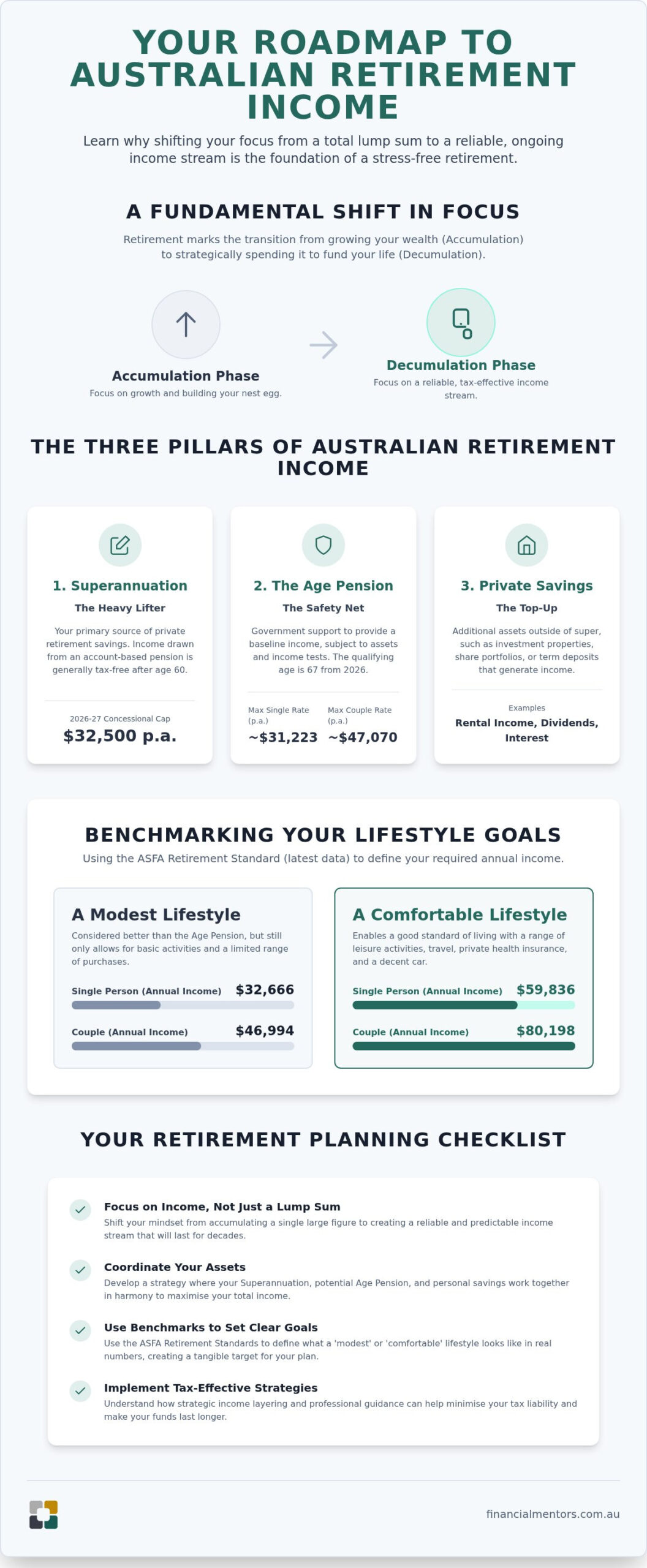
How do you ensure your financial security is more than just a hopeful guess? In Australia, the process of determining retirement income typically relies on three distinct pillars: superannuation, the Age Pension, and your private savings or investments. Think of these as layers that build upon one another. While some people are fully self-funded, about 70% of Australian retirees receive at least a partial Age Pension. Understanding how these sources interact is the key to creating a reliable, long-term cash flow.
Maximising Your Superannuation Income
For most of us, super is the heavy lifter. If you are over age 60 and have met a condition of release, the income you draw from an account-based pension is generally tax-free. This is a powerful advantage that helps your savings stretch much further. Some choose a Transition to Retirement (TTR) strategy to access their super while still working, while others wait for a full account-based pension. Building a planned retirement foundation early allows you to make strategic concessional contributions, currently capped at $32,500 for the 2026-2027 year, to boost your final balance. Would you feel more confident knowing your super was working as hard as possible for you?
The Role of the Age Pension
The Age Pension acts as a vital safety net. As of 2026, the qualifying age is 67 for everyone. For a single person, the maximum rate is approximately $31,223 per year, while couples can receive around $47,070 combined. However, eligibility depends on the assets and income tests. It’s a good idea to check the age pension asset limits for 2026 to see if you qualify for a part pension. Even a small amount of government support can provide extra stability against the rising cost of living. You can use tools like the Moneysmart retirement planner to see how a part pension might supplement your private funds.
The final pillar involves private wealth, such as rental income from an investment property or dividends from a share portfolio held outside of super. When these three pillars are coordinated, they form a unified strategy. Because the interaction between these sources is so specific to your assets, determining retirement income often requires looking at your whole financial picture at once. If you’d like to explore how these layers fit together for your specific situation, speaking with a trusted guide can help clarify your options and reduce the stress of complex rules.
Benchmarking Your Lifestyle: Modest vs. Comfortable
Imagine your ideal Tuesday morning three years after you’ve finished work. Are you enjoying a quiet coffee at home before a walk in the local park, or are you preparing for a lunch out with friends followed by a planning session for next year’s overseas trip? When you are determining retirement income, the Association of Superannuation Funds of Australia (ASFA) provides a helpful framework to help you visualise these different paths. For the March 2026 quarter, a ‘comfortable’ lifestyle requires an annual income of $52,383 for a single person or $73,875 for a couple. This level of funding allows for private health insurance, a good car, regular dining out, and the occasional international holiday.
If your goals are more scaled back, a ‘modest’ retirement sits at $32,665 for singles and $46,994 for couples. This benchmark covers the basics, such as essential health costs and local leisure activities, but it typically means driving an older car and limiting travel to domestic destinations. It’s quite close to the maximum Age Pension rate, which acts as a foundational layer but offers little room for extras. Seeing these figures in black and white helps move the conversation from abstract numbers to real-world choices. You can use an official retirement income planner to see how your current savings align with these specific lifestyle tiers.
Accounting for Inflation and Longevity Risk
One of the biggest challenges in determining retirement income is ensuring your purchasing power doesn’t erode over time. Recent cost-of-living increases have pushed ASFA benchmarks higher, adding several thousand dollars to annual budgets compared to just a few years ago. If you retire at 67, you may need your income to last for 30 years or more. This ‘longevity risk’ means your roadmap must include a buffer. We often suggest planning for a three-decade journey rather than a fifteen-year sprint. Building in a safety margin helps protect you against the rising price of groceries, electricity, and the general inflation that can quietly eat away at a fixed budget.
Customising the Benchmarks to Your Reality
While these standards are excellent guides, they assume you own your home outright. If you are still paying off a mortgage or are renting in retirement, your income needs will be significantly higher. Similarly, as we age, healthcare considerations often become a larger part of the budget, even with private cover. If you have specific health needs or family commitments, your personal ‘comfortable’ figure might look quite different from the national average. ASFA standards are a starting point, not a final destination for your planning. By tailoring these benchmarks to your specific debt levels and health goals, you can create a strategy that feels both practical and deeply personal.
Navigating these costs is a global challenge; for instance, those with international connections might look to specialised providers like Medicare Mentors to understand how retirement health planning is structured in other regions. Regardless of where you reside, the principle remains the same: expert advice is the key to managing health-related financial risks.
Strategic Income Layering and the Tax Advantage
Once you’ve identified your various sources of funds, the next step in determining retirement income is deciding how to layer them. It isn’t just about the total amount you withdraw; it’s about which “bucket” that money comes from first. By coordinating your drawdowns, you can significantly reduce your tax liability and make your savings last years longer. For many Australian retirees, franking credits from share portfolios act as a vital cash flow boost, often resulting in tax refunds that supplement your annual budget. This is where professional tax return preparation becomes a strategic tool rather than just a compliance task. Are you currently maximising the tax offsets available to you?
Managing capital gains tax (CGT) is another critical piece of the puzzle. If you need to sell an investment property or a parcel of shares outside of super to fund your lifestyle, the timing of that sale can have a massive impact on your net income. A wise mentor looks at your whole financial picture to ensure you aren’t unnecessarily giving away a large portion of your wealth to the tax office. By spreading sales over multiple financial years or offsetting gains against losses, you keep more of your capital working for you.
Tax-Effective Withdrawal Strategies
Deciding the order of your withdrawals is a core part of stewardship. Generally, it’s wise to spend from your most heavily taxed accounts first, allowing your tax-advantaged superannuation to continue growing for as long as possible. You also need to consider the potential “death tax” on superannuation. If your super is eventually paid to non-tax-dependants, such as adult children, they could face a tax rate of up to 17% on the taxable component. Strategic planning now can help re-contribute funds to change their tax status, protecting your legacy. For more details on protecting what you’ve built, exploring professional estate planning advice is a practical next step.
The Role of Investment Structures
In some cases, using structures like family trusts or investment bonds can provide greater control over how your income is distributed and taxed. These structures can be particularly useful if you are trying to manage your “assessable income” to stay within the thresholds for the Age Pension or the Commonwealth Seniors Health Card. However, the rules are complex. A family trust might be seen as an asset under the social security tests, which could impact your eligibility. Coordinating these moving parts is a primary function of a wealth management office. They ensure that your structures, tax returns, and pension applications all point in the same direction. If you feel overwhelmed by the technicalities, contact us today for a professional consultation to see how we can simplify your income strategy.
How a Financial Mentor Secures Your Income Roadmap
While online tools and calculators can provide a rough estimate, determining retirement income with accuracy requires more than just a digital projection. A DIY approach often misses the subtle nuances of Australian regulations or the emotional weight of your personal goals. Have you ever wondered if an algorithm truly understands your desire to help your grandchildren buy their first home? This is where the value of a professional guide becomes clear. By moving from isolated calculations to a structured retirement planning checklist australia, you can ensure that every aspect of your future is accounted for, from tax efficiency to Age Pension eligibility.
Murray Frean and the team at Financial Mentors Wealth Management act as your trusted partners in this transition. We don’t just look at the numbers; we look at the life those numbers need to support. Our role is to provide steady, methodical guidance that reduces the stress of complex decision-making. We’ve been helping Australians build wealth and secure their legacies since 2003, and we understand that the most reliable roadmaps are built on a foundation of collaboration and mutual respect. It’s about moving from a place of “what if” to a place of “I’m ready.”
Personalised Roadmaps vs. Generic Projections
A generic projection is like a suit bought off the rack; it might fit roughly, but it rarely feels right. A bespoke plan, however, considers your unique health needs, family dynamics, and the legacy you wish to leave behind. We stress-test your strategy against various scenarios, such as market downturns or unexpected health costs, to give you genuine peace of mind. Even if you are in the final years of your career, we can still integrate effective wealth creation strategies australia to bolster your position before you make the leap into full-time leisure. It’s about making sure your plan is as resilient as it is rewarding.
Starting the Conversation Today
The process of determining retirement income is a dynamic one. Whether you are five years away or already standing at the threshold, it’s never too early or too late to refine your approach. The first step in our partnership is an open, reflective dialogue about where you are and where you want to be. We take the time to listen, observe, and organise your finances into a clear, step-by-step narrative. If you’re ready to move from uncertainty to professional certainty, Contact Financial Mentors Wealth Management to begin your journey. We look forward to sitting across the table and helping you build the roadmap you deserve.
Securing Your Path to a Confident Future
Determining retirement income doesn’t have to be a source of stress or confusion. By moving your focus from a simple lump sum to a strategic, layered income stream, you can build a future that respects both your financial needs and your personal aspirations. We’ve explored how coordinating your Super, the Age Pension, and private wealth creates a roadmap that stands up to inflation and longevity. This methodical approach ensures that your lifestyle remains sustainable for decades to come.
At Financial Mentors, we believe in a holistic approach that integrates tax preparation, superannuation, and estate planning into one clear narrative. With over two decades of experience and expert strategic advice provided under our AFSL since 2003, we act as a steady guide through life’s most significant transitions. You’ve worked hard to build your wealth; now it’s time to ensure it works just as hard for you. If you’re ready to move from uncertainty to professional clarity, we invite you to book a consultation with Financial Mentors to secure your retirement income. Your future is waiting, and we’re here to help you step into it with confidence.
Frequently Asked Questions
How much super do I need for a comfortable retirement in Australia in 2026?
According to 2026 ASFA standards, a single person needs approximately $595,000, while a couple needs $690,000 to support a comfortable lifestyle. These figures assume you own your home outright and will receive a part Age Pension. If you don’t own your home or wish to be fully self-funded, your required balance will be higher. It’s a useful benchmark, but your personal goals will ultimately define your specific target.
Can I still get the Age Pension if I have a large super balance?
Yes, you can still receive a part Age Pension even with a significant super balance, provided you fall under the 2026 asset and income test thresholds. For many Australians, determining retirement income involves finding the sweet spot where their super provides a steady draw-down while the government provides a supplementary safety net. The rules are complex, so it’s wise to review how your assets are assessed by Centrelink.
What is the best way to determine my retirement income needs?
The most effective way is to start with your current annual expenses and subtract costs that will disappear, such as your mortgage or work-related travel. Then, add in your new lifestyle aspirations like travel or hobbies. This gives you a clear figure to aim for. By building a personalised roadmap rather than relying on generic averages, you gain a much more accurate forecast of your future cash flow.
How does inflation affect my retirement income over 20 or 30 years?
Inflation quietly reduces what your money can buy, which means a fixed income will feel smaller every year. Over 30 years, even a modest inflation rate can double the price of basic goods and services. To protect your stability, your income strategy needs to include assets that have the potential for growth. We help you build a buffer into your projections to ensure your lifestyle remains comfortable for the long haul.
Is income from my superannuation fund taxable after I turn 60?
For the vast majority of Australians over age 60, income drawn from an account-based super pension is completely tax-free. This includes both the pension payments you receive and the investment earnings within the fund itself. This tax-exempt status is a major advantage when you are determining retirement income, as it allows more of your savings to stay in your pocket rather than going to the tax office.
What happens to my retirement income if the share market drops?
A well-structured plan includes a cash bucket to fund your immediate needs, which means you don’t have to sell investments when markets are low. While market volatility is natural, your roadmap should be stress-tested to survive these periods without compromising your lifestyle. By keeping one to three years of living expenses in liquid assets, you can wait for the market to recover before drawing from your growth investments again.
How often should I review my retirement income plan with an advisor?
We generally recommend a formal review at least once a year to ensure your strategy remains on track. Life rarely stands still, and changes to government legislation, your health, or your family circumstances can all require adjustments to your plan. Regular check-ins with a mentor provide the opportunity to fine-tune your investments and confirm that your income stream is still meeting your evolving needs as they change.
Can I work part-time and still receive retirement income from my super?
Yes, you can certainly combine part-time work with your retirement savings. If you’ve reached your preservation age, you might use a Transition to Retirement (TTR) pension to supplement your wages while you continue to work. Additionally, the government’s Work Bonus scheme allows Age Pensioners to earn a certain amount of employment income before their pension payments are affected. This flexibility allows for a gentle, phased approach to leaving the workforce.