

If you’ve just received a significant windfall, your first instinct might be to search for the “perfect” share or property, yet the real secret to a secure future isn’t what you buy, but where you put it. Determining the best way to invest a lump sum for retirement in Australia in 2026 requires looking beyond simple returns and focusing on the structures that shield your hard-earned wealth from unnecessary tax. It’s completely natural to feel a sense of weight when managing a large sum. Between the fear of the “death tax” on super and the anxiety that a market dip could erode your nest egg, the pressure to get it right the first time is immense.
This guide will show you how to turn that windfall into a reliable monthly income stream while keeping the ATO’s share to an absolute minimum. We’ll explore how to navigate the 2026 contribution caps, use “bucket” strategies to weather volatility, and ensure your legacy remains protected for your family. By the end, you’ll have a clear path to transform a one-off payment into a lasting, worry-free lifestyle that lasts as long as you do.
Key Takeaways
- Understand why “parking” your cash in a standard savings account might quietly erode your future lifestyle and how to avoid this common trap.
- Identify how to use superannuation as a powerful tax-effective “wrapper” to maximise your income while staying within the 2026 contribution limits.
- Discover the best way to invest a lump sum for retirement in Australia by strategically diversifying across asset classes to protect against market volatility.
- Learn a step-by-step sequencing framework that prioritises debt elimination to build a more resilient and flexible financial foundation.
- Recognise how professional partnership can help you navigate complex regulatory changes while ensuring your estate planning goals are fully realised.
The Lump Sum Dilemma: Why “Park and Wait” is a Risky Strategy
Receiving a significant windfall often brings a mix of relief and sudden, unexpected pressure. Whether it’s from the sale of a family home, an inheritance, or a business exit, you’re suddenly responsible for a sum that must last the rest of your life. This is the “Lump Sum Dilemma”: a paralysis of choice where the fear of making a mistake feels greater than the potential for growth. Many Australians find themselves “parking” their funds in a standard savings account, telling themselves they’ll decide what to do “once the market settles.” However, this delay can be more expensive than you realise.
It’s vital to distinguish between saving and investing. While saving focuses on protecting your capital in the short term, the best way to invest a lump sum for retirement in Australia involves creating a sustainable income engine. A planned retirement requires a fundamental shift in your mindset from accumulation to preservation. You’re no longer just trying to grow a pile of money; you’re trying to ensure that pile can withstand decades of withdrawals without running dry.
The Impact of Inflation on Your Retirement Lifestyle
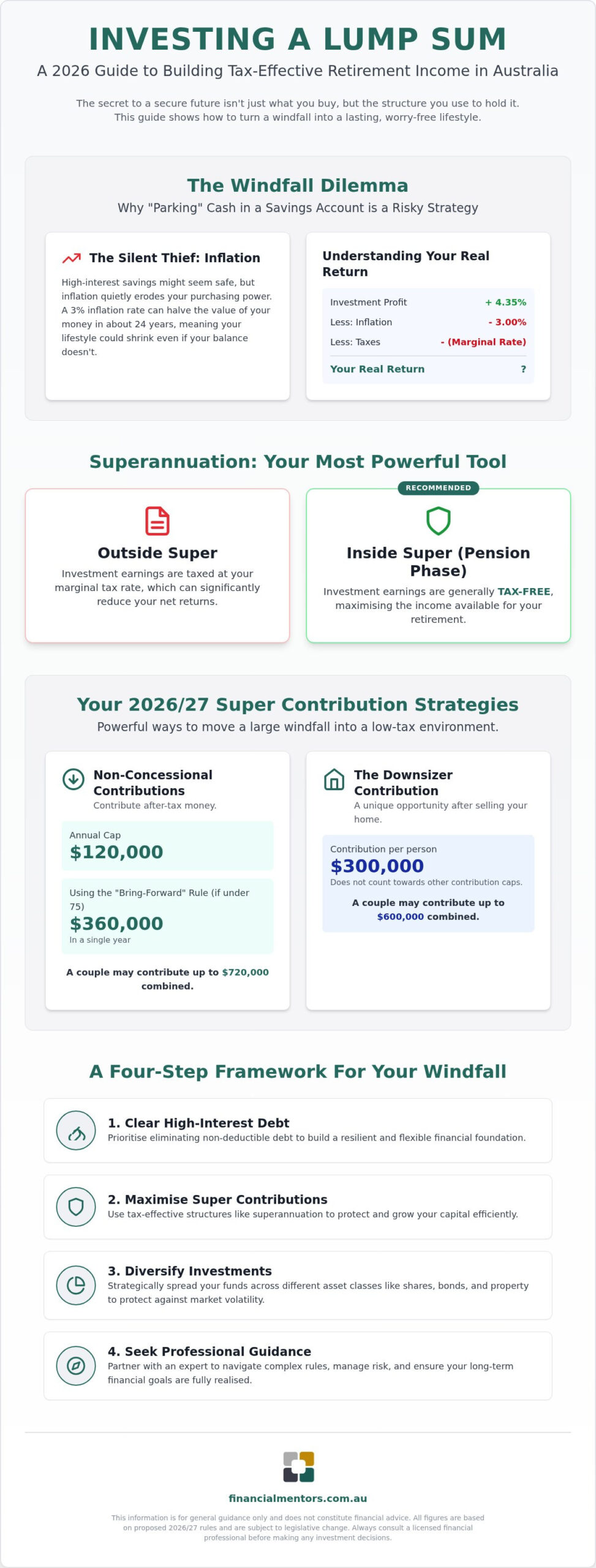
In 2026, with the RBA cash rate sitting at 4.35%, high-interest savings accounts might look attractive at first glance. However, inflation is a silent thief. If inflation averages just 3%, the purchasing power of your money halves in roughly 24 years. This is particularly dangerous for retirees because the costs of healthcare and travel often rise faster than the general consumer price index. “Safe” bank interest often fails to keep pace with these rising costs, meaning your lifestyle could slowly shrink even if your bank balance stays the same. Real return is defined as the actual profit remaining after you have subtracted both the inflation rate and any applicable taxes.
Psychological Barriers to Investing Large Sums
The “fear of the peak” is perhaps the greatest hurdle for anyone with a windfall. It’s the nagging worry that the day after you invest, the share market will experience a significant downturn. To manage this anxiety, some choose dollar-cost averaging, where you invest portions of your lump sum over several months to smooth out the entry price. Others prefer a total lump-sum entry to put the money to work immediately. This is where a mentor becomes invaluable; they provide the emotional distance needed to separate temporary market noise from long-term financial logic. Understanding the history of Superannuation in Australia and its resilience through various cycles can also offer peace of mind as you begin your investment journey.
Strategic Superannuation: Maximising Contributions and Tax Efficiency
Superannuation is more than just a savings account; it’s a tax-advantaged “wrapper” that can significantly amplify your wealth. In 2026, moving your lump sum into this environment is often the best way to invest a lump sum for retirement in Australia. While your investments might be taxed at your marginal rate outside super, earnings inside the pension phase are generally tax-free. However, this transition requires careful timing. Following a retirement planning checklist australia ensures you don’t fall foul of the Transfer Balance Cap, which limits the total amount you can move into the tax-free retirement phase.
Non-Concessional Contributions and the “Bring-Forward” Rule
For the 2026/27 financial year, the non-concessional (after-tax) contribution cap is $120,000. If you’re under age 75, the “bring-forward” rule allows you to contribute up to $360,000 in a single year by using your future caps. This is a powerful way to shift a large windfall into a low-tax environment quickly. Your eligibility depends on your Total Super Balance, so it’s wise to check your current standing before making a large transfer. If you’re part of a couple, you may be able to double this amount by contributing to both accounts.
The Downsizer Contribution: A Unique Opportunity
If you’ve recently sold your primary residence, you may have a unique window. The downsizer contribution allows you to put up to $300,000 per person into super without it counting towards your standard contribution caps. It’s a rare chance to boost your nest egg regardless of your age or total balance. Just remember, the contribution must be made within 90 days of settlement to qualify. This strategy is particularly effective for those who have already reached their standard contribution limits but still have excess cash from a property sale.
Concessional Contributions and Tax Offsets
You can also use the concessional contributions cap, which is $30,000 for the 2026/27 financial year. If you haven’t used your caps from the previous five years, “catch-up” rules might let you contribute even more. This is particularly useful if you’ve had a high-income year or a capital gains event. To get this right, strategic tax return preparation is essential to ensure you claim the correct deductions. Balancing these various entry points is complex, but a professional mentor can help you sequence these moves to keep more of your money working for you.
Beyond Super: Comparing Shares, Bonds, and Property for Retirement Income
While superannuation provides the tax-effective “wrapper” for your wealth, the underlying assets you choose are what actually drive your lifestyle. Diversification isn’t just a defensive cliché; it’s your primary shield against the specific economic shifts of 2026. With the ASX 200 showing a total return of 5.90% in the last financial year, it’s clear that growth is available, but it often comes with volatility. The best way to invest a lump sum for retirement in Australia involves balancing that growth with assets that provide a steady, predictable “paycheque” regardless of market headlines.
Australian Shares and the Power of Franking Credits
Australian equities remain a cornerstone for many retirees because of our unique dividend imputation system. When a company pays you a dividend, they’ve often already paid tax on those profits at the 30% corporate rate. For a retiree in the tax-free pension phase, these franking credits can often be claimed back from the ATO as a cash refund. Franking credits are effectively a “bonus” from the ATO for Australian investors, significantly boosting your actual spendable income. However, be cautious of over-concentration in just a few big banks or mining giants. A wise mentor would suggest looking for a broader mix to ensure your income doesn’t drop if one specific sector faces a downturn.
Fixed Interest and Bonds: The Portfolio Shock Absorbers
If shares are the engine of your portfolio, fixed interest and bonds are the shock absorbers. They provide the capital preservation you need when you’re drawing a regular pension. With the RBA cash rate held at 4.35% as of August 2026, fixed interest assets are finally offering meaningful yields again. Government bonds provide the highest level of security, while corporate credit can offer slightly higher returns. Having a portion of your lump sum in these liquid, stable assets ensures you don’t have to sell shares during a market dip just to fund your daily expenses.
In addition to traditional bonds, some retirees choose to diversify further by including precious metals as a non-correlated asset class. Partnering with a specialist like VIP Vaults & Bullion Exchange Perth allows you to integrate investment-grade bullion into your portfolio, providing a tangible store of value that can act as a hedge against broader market volatility.
Investment Property vs. REITs for Retirement
Many Australians love the tangible nature of physical property, but it comes with challenges in retirement. Rental income is steady, but maintenance costs, rates, and the risk of vacancies can eat into your cash flow. Perhaps more importantly, property is illiquid; you can’t sell a single bedroom if you need extra cash for a holiday. Real Estate Investment Trusts (REITs) offer a more flexible alternative. They provide exposure to large-scale commercial or industrial property but can be sold as easily as shares. Before deciding, it’s helpful to review the rules for accessing your super as a lump sum to see how these choices fit into your broader plan. Ultimately, your wealth creation strategies australia must now shift focus from aggressive growth to sustainable, long-term stewardship.
The Sequencing Framework: How to Allocate Your Funds Step-by-Step
The order in which you deploy your windfall is often more critical than the specific assets you choose. If you invest without a clear sequence, you risk leaving yourself vulnerable to high interest costs or forced asset sales during a market dip. The best way to invest a lump sum for retirement in Australia starts with a methodical approach that prioritises security and tax efficiency. By following a logical flow, you can create a resilient financial structure that supports your lifestyle without the constant need to monitor market headlines.
- Step 1: Eliminate non-deductible debt. Paying off a mortgage or high-interest credit cards provides a guaranteed “return” by removing interest costs that would otherwise drain your retirement income.
- Step 2: Establish a “Cash Bucket”. Before moving funds into long-term investments, set aside enough cash to cover your immediate living expenses for the next 2 to 3 years.
- Step 3: Maximise tax-effective structures. Use the contribution rules we discussed earlier to shift as much as possible into superannuation and pension accounts.
- Step 4: Address surplus funds. If you still have capital remaining, consider flexible environments like investment bonds or discretionary trusts that offer accessibility while managing your tax profile.
The Cash Bucket Strategy for Volatility Protection
Market volatility is a natural part of investing, but it shouldn’t dictate your quality of life. By maintaining a dedicated cash bucket in high-interest savings accounts or term deposits, you ensure your next “paycheque” is always secure. This strategy means you never have to sell shares or property when prices are low just to pay your bills. Instead, you can wait for the market to recover while living comfortably off your liquid reserves. It’s a simple way to gain immense peace of mind, knowing that your short-term needs are fully funded regardless of what happens on the ASX.
Estate Planning Considerations for Your Lump Sum
Your investment choices don’t just affect your own retirement; they also shape the legacy you leave behind. Many retirees are surprised to learn about the “Superannuation Death Benefits Tax,” which can take a significant bite out of the portion of super left to adult children. Seeking professional estate planning advice is vital to help mitigate these costs. You’ll also need to decide between “binding” and “non-binding” nominations to ensure your funds are distributed according to your wishes rather than at the discretion of a super fund trustee. Your legacy deserves the same careful stewardship as your retirement income. If you’re ready to build your own step-by-step plan, our team is here to help you organise your retirement strategy.
Partnering for Peace of Mind: How Professional Advice Optimises Your Outcome
Managing a significant windfall is a heavy responsibility. While the strategies we’ve discussed provide a roadmap, the 2026 regulatory environment is complex. One small error with contribution caps or a misunderstanding of the Transfer Balance Cap can lead to significant penalties. This is where partnering with a dedicated wealth management office transforms the experience. Instead of feeling overwhelmed by technicalities, you can lean on a partner who ensures every move is compliant and efficient. Professional advice often pays for itself many times over by identifying tax savings you might have missed and protecting you from costly compliance failures.
Moving from transactional investing to strategic wealth stewardship is a major turning point. It’s no longer just about which share to buy today. It’s about how that asset fits into your life for the next thirty years. The best way to invest a lump sum for retirement in Australia is to view it as a living plan that evolves as rules change and your personal goals shift. At Financial Mentors, we see our role as more than just advisors. We’re your constant companions through the transitions that define your retirement years.
Integrating Tax Compliance with Wealth Growth
A common pitfall in retirement planning is the “silo” effect, where your financial advisor and your tax preparer don’t speak to each other. This lack of communication can lead to missed opportunities for rebalancing or tax-loss harvesting. Having both functions “on the same page” is a massive advantage for your bottom line. Your annual tax return provides the exact data needed to rebalance your portfolio effectively, ensuring your investment strategy remains aligned with your actual tax position. Murray Frean’s dual focus on strategic wealth growth and precise accounting means you don’t have to act as the middleman between two different professionals. This holistic approach ensures that your wealth grows in the most tax-efficient way possible.
Your Invitation to a More Secure Future
We’ve travelled a long way from the initial “lump sum dilemma” to the creation of a secure, sustainable income engine. The journey from receiving a windfall to establishing a lasting legacy is one of the most important transitions you’ll ever make. It’s helpful to remember that the best way to invest a lump sum for retirement in Australia involves taking that first step before the next tax year-end pressures begin. Whether you’re feeling a sense of quiet confidence or still have a few lingering questions, we’re here to help. We invite you to start a conversation about your specific goals and circumstances. Together, we can build a plan that protects your lifestyle and provides the peace of mind you deserve.
Securing Your Legacy with Confidence
Managing a significant financial windfall doesn’t have to be a source of stress. By moving away from the “park and wait” trap and embracing a structured sequencing framework, you can turn a one-off sum into a sustainable income engine. We’ve explored how the best way to invest a lump sum for retirement in Australia involves more than just selecting assets; it requires a deep understanding of 2026 tax regulations and the strategic use of superannuation wrappers to protect your purchasing power from inflation.
As authorised representatives with over 20 years of experience, our team at Financial Mentors specialises in integrating tax compliance with long-term wealth creation. We provide tailored advice for national Australian clients, ensuring your investment strategy and tax returns work in perfect harmony. If you’re ready to move from uncertainty to a clear, actionable plan, we invite you to organise a consultation with Financial Mentors to secure your retirement future. Your journey toward a worry-free lifestyle starts with a single, well-planned step. We look forward to being your partner in this important transition.
Frequently Asked Questions
What is the best way to invest a $500,000 lump sum for retirement in Australia?
The best way to invest a lump sum for retirement in Australia involves a multi-layered approach tailored to your specific tax situation. For a $500,000 windfall, you might consider maximising your superannuation contributions first to benefit from the 15% tax environment. Beyond that, establishing a cash bucket for immediate needs and a diversified portfolio of shares and bonds can provide the balance of growth and stability required for a long-term retirement income.
Can I put a large lump sum into my superannuation all at once?
Yes, you can contribute a large amount to superannuation using the “bring-forward” rule. For the 2026/27 year, the non-concessional cap is $120,000, but eligible individuals under 75 can contribute up to $360,000 in a single year by using their next two years’ caps. However, your ability to do this depends on your Total Super Balance being below certain thresholds, so it’s vital to check your current standing before making the transfer.
How much can I contribute to super as a “downsizer” in 2026?
In 2026, the downsizer contribution remains at $300,000 per person, or $600,000 for a couple. This unique rule allows you to add a significant amount to your super from the sale of your primary residence without it counting towards your standard contribution caps. To qualify, you must have owned the home for at least ten years and make the contribution within 90 days of settlement. It’s an excellent way to boost your tax-free pension phase.
Is it better to pay off my mortgage or invest the money for retirement?
Choosing between debt reduction and investing depends on your interest rate and tax bracket. Paying off a mortgage provides a guaranteed return equal to the interest rate you’re no longer paying, which is often the most secure first step. If your investment returns after tax are likely to be higher than your mortgage rate, then investing might be preferable. Many retirees find that clearing the mortgage first provides the emotional freedom needed to invest with confidence.
How do I avoid paying too much tax on my retirement investment earnings?
The most effective way to minimise tax is by moving assets into the superannuation pension phase, where earnings are generally tax-free. Utilising Australian shares with franking credits can also provide tax offsets or even cash refunds from the ATO. Additionally, strategic tax return preparation can help you identify opportunities for income splitting or using investment bonds. Managing your tax profile is a key part of finding the best way to invest a lump sum for retirement in Australia.
What happens to my lump sum investment if I need to go into aged care?
If you enter aged care, your lump sum investments are assessed under the government’s means testing rules. Services Australia looks at both your assets and income to determine your care fees and accommodation costs. The way your funds are structured, such as whether they are in an account-based pension or an investment bond, can impact these assessments. Careful planning before entering care is essential to ensure your assets are protected and your fees remain manageable.
Should I invest my lump sum in my own name or my partner’s name?
Generally, it’s more tax-efficient to invest in the name of the partner with the lower marginal tax rate. This approach reduces the total tax paid on investment earnings outside of superannuation. However, you must also consider each person’s individual superannuation caps and Total Super Balance. If one partner has more room in their super, it might be wiser to prioritise their account to maximise the tax-free pension benefits for the household.
How often should I review my retirement investment strategy?
You should review your retirement strategy at least once a year, ideally in conjunction with your annual tax return. This allows you to rebalance your portfolio and ensure your cash bucket is topped up for the coming year. More frequent reviews might be necessary if there are significant changes to superannuation laws, like the 2026 cap updates, or if your personal circumstances change. A regular check-in ensures your plan remains aligned with your long-term goals.