

The age-based investment rule that sounds simple may not fit the life you’re planning for. It makes sense to look for a clear guide to asset allocation by age australia, especially when you’re weighing growth assets against more defensive choices. Age can help indicate how long your investments may have to recover from market ups and downs, but it doesn’t capture your goals, financial commitments or comfort with risk.
This guide explains how your investment time horizon and capacity for risk can change through different life stages. You’ll compare common age-based approaches as examples, not personal recommendations, and see why the same allocation may not suit everyone. Your super investment option is also only part of the picture, so it helps to consider it alongside investments you hold outside super.
You’ll also find practical points to review before changing your portfolio, from your long-term goals and financial position to how your retirement plans fit together. If you’re considering a change, tailored financial planning can help connect those choices with your circumstances. The initial appointment is step one in that process.
Key Takeaways
- Use asset allocation by age australia as a starting point, then consider your goals, time horizon and capacity to absorb losses.
- Compare fixed age-based rules, life-stage options and goal-led approaches to understand how each may fit your circumstances.
- Review your goals and time horizons before assessing your super and other investments as one broader portfolio.
- Think of rebalancing as restoring a chosen investment mix, not predicting what markets will do next.
- Connect your investment choices with your retirement income goals and broader financial plan before making changes.
Asset allocation by age in Australia: what the idea means
Asset allocation is the mix of investment types held across your portfolio. It describes how your money is spread between broad groups, such as growth and defensive assets, rather than which individual shares or funds you select. Put simply, asset allocation is your portfolio’s overall investment mix; choosing individual investments is deciding what to hold within that mix.
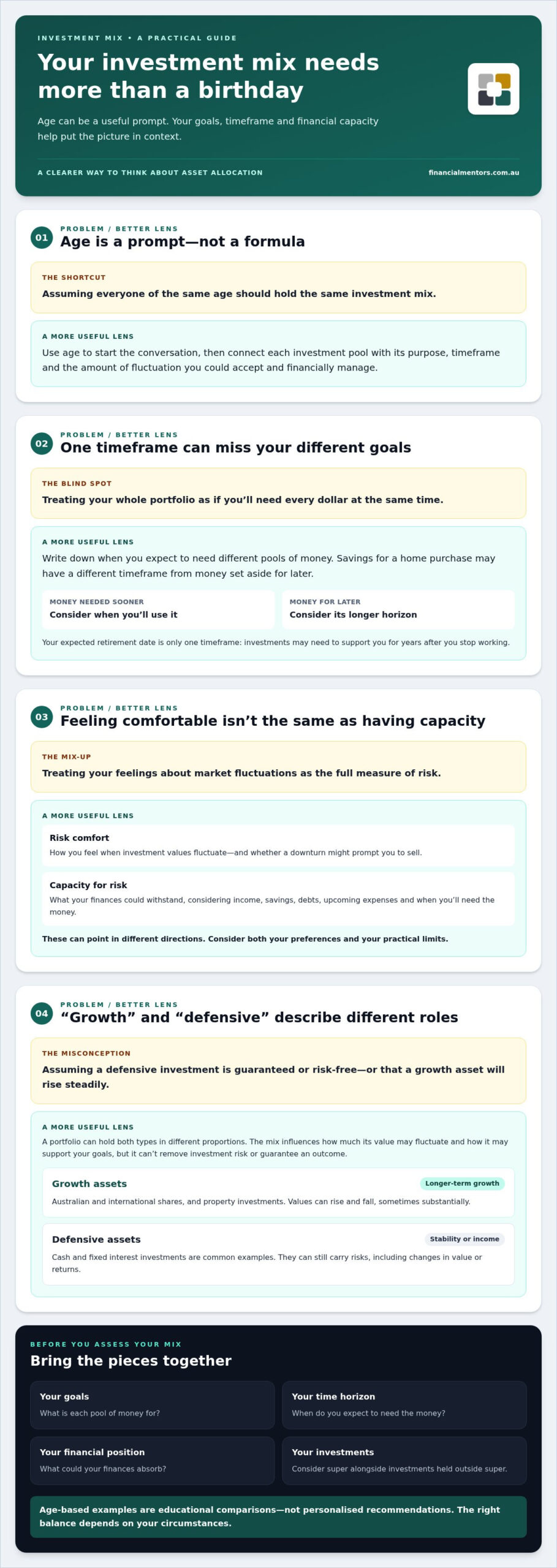
The idea behind asset allocation by age australia is that your investment mix may shift as your circumstances and the time available to pursue your goals change. Age can be a useful prompt, but it isn’t a complete guide. Your goals, time horizon, financial position and financial commitments all help determine what mix may be suitable.
What do growth and defensive assets mean?
Growth assets are generally held to support longer-term growth. Their values can rise and fall, sometimes substantially, so their value when you need to sell may differ from what you paid. In broad terms, Australian and international shares and property investments are commonly treated as growth assets.
Defensive assets are generally used to provide more stability or income within a portfolio. Cash and fixed interest investments are common examples. They can still carry risks, including changes in value or returns, so “defensive” doesn’t mean guaranteed or risk-free. You can read a general overview of What is Asset Allocation? to explore how different investment types may be combined.
A portfolio can hold both types in different proportions. The mix influences how much its value may fluctuate and how it may support your goals, but it can’t remove investment risk or guarantee a particular outcome.
Why age-based rules are only starting points
Age may help you think about your investment time horizon: how long you expect to invest before using the money. If a goal is many years away, you may have more time to ride out short-term fluctuations. If you’ll need some of the money sooner, you may give greater weight to how accessible and steady that part of your portfolio needs to be. The right balance depends on the goal, not age alone.
Two people of the same age can have very different priorities. One may be building savings for retirement, while another is preparing for a home purchase or managing significant financial commitments. Their income, assets, debts and ability to absorb losses may also differ. That means a single age-based formula can’t reflect every person’s circumstances.
Use age-based examples as educational comparisons, not personalised recommendations. They can help you ask useful questions about your mix, but they don’t determine what you should hold. A sound starting point is to connect each investment pool with its purpose and likely timeframe, then consider how much fluctuation you could accept and financially manage.
How age, time horizon and risk capacity can shape your investment mix
Age can prompt useful questions, but it doesn’t tell the whole story. Your investment mix also depends on when you’ll need the money and how well your financial position could withstand a fall in value. These factors work together, rather than forming a formula that automatically changes on a birthday.
Age, time horizon and risk capacity each offer a different lens: age is a prompt, time horizon sets the timeframe, and risk capacity reflects what your finances can withstand. This is a practical way to think about asset allocation by age australia without assuming that everyone at the same life stage needs the same approach.
How your investment time horizon changes with your goals
Your expected retirement date is only one timeframe to consider. Investments may need to support you for years after you stop working, so the period you’ll be investing can extend well beyond retirement. You may also have separate timeframes for a home purchase, family plans or another goal. If you expect to use part of your savings sooner, that money has a different purpose and horizon from funds set aside for later.
There isn’t one retirement age that applies to every Australian. Your plans may change with work, health, caring responsibilities or personal preferences. It can help to write down when you expect to need different pools of money, rather than assigning one timeframe to your entire portfolio.
Risk comfort and financial capacity are not the same
Risk comfort is how you feel when investment values fluctuate. If a downturn would make you anxious or prompt you to sell, that reaction matters when considering a mix you can stay with. Capacity for risk is your financial ability to absorb losses, taking account of factors such as income, savings, debts, upcoming expenses and when you’ll need the money. The two can point in different directions.
You might feel comfortable with market movements but have limited financial capacity because you’ll soon need your savings for a major expense. Or your finances may be able to withstand a loss, while fluctuations still feel unsettling. Recognising the difference can help you discuss both your preferences and practical limits without treating either one as a complete answer.
Example: same age, different priorities
Imagine two people of the same age. One expects to use savings for a home purchase in the near future and has regular loan repayments. The other has no planned large expense and expects to invest for longer. Their timeframes and financial commitments differ, as may their capacity to absorb a downturn. Age alone can’t settle how either person should invest.
Before considering a change, note when you expect to use each part of your savings, how you might respond to market fluctuations, and what your financial position could manage. If these factors seem to conflict, tailored financial planning advice can help you connect your investment decisions with your goals and retirement plans.
Comparing age-based asset allocation approaches in Australia
Age can be used in different ways when considering investment choices. A rule may use age as an input, a super option may use a life-stage label, or a person may build an approach around a specific goal. The table compares these broad methods. It doesn’t rank them or identify a preferred option, as the details and suitability depend on the investor and the investment being considered.
| Approach | Basic logic | Potential use | Key limitation |
|---|---|---|---|
| Fixed age-based rule | Uses a formula that links a person’s age with an investment mix. | Can offer a simple reference point for comparing broad allocation ideas. | A general formula may leave out personal goals and account details. |
| Life-stage option | Uses an age or life-stage label to describe an investment option. The label alone doesn’t explain its mix or operation. | Can help you identify an option to examine in a super fund’s information. | You need to read the option details; the label doesn’t establish whether or how its mix changes. |
| Goal-led allocation | Organises investment choices around a stated objective and the money set aside for it. | Can help separate investments by purpose, such as retirement or a planned expense. | Goals and related assumptions may need revisiting as plans develop. |
A default or example allocation isn’t automatically suitable for everyone. Fixed rules can make an idea easier to compare, but the formula may not reflect the details of your situation. A life-stage label also isn’t enough to understand an option. Check its current product information for the stated investment mix, how it is managed and any conditions that apply. Super funds can use different labels and descriptions, so compare the details rather than relying on a name.
Fixed age-based rules versus life-stage investment options
A fixed rule applies a set age-linked formula as a point of reference. A life-stage option is identified by a description tied to age or stage of life, but that description alone doesn’t confirm how it works. Before drawing a comparison, read the fund’s current information for the option’s objectives and investment mix. Without those details, it isn’t possible to say how a specific option relates to a fixed rule.
Superannuation and investments outside super
Super is one part of your wider financial picture. If you also hold investments outside super, looking at each account on its own may not show how the holdings combine. For instance, two accounts might have different labels yet invest in similar asset types. Note each account’s broad holdings and purpose so you can compare the overall picture, rather than making a decision based on one account’s name.
This broader view can also help frame retirement planning. Consider how each investment pool relates to your intended plans and the questions you still need to resolve. You can connect those considerations with planning for retirement as you compare allocation approaches.
How to review your asset allocation as your circumstances change
A useful review is a chance to check whether your investment mix still supports your plans. It doesn’t mean you need to make a change. Work through your goals, timeframes and overall holdings first, then consider whether any adjustment is appropriate. This keeps a decision grounded in your circumstances rather than a short-term market movement.
A practical checklist before changing investments
Take these steps in order to build a clear picture before acting:
- Restate your goals. Note what you’re investing for, including retirement income, a home purchase or other planned expenses. Include expected timing and any income needs.
- Check your time horizons. Identify when you may need to draw on each pool of money. A near-term expense and a longer-term goal may call for different considerations.
- Assess your overall holdings. List your super investments and investments outside super. Include other assets and financial commitments where relevant, so you can see your broader financial position rather than judging each account alone.
- Consider changes carefully. Record what has prompted the review and why you think a different mix may better suit your plans. If a market fall or rise is the main reason, pause to consider whether your goals or circumstances have actually changed.
If you’re considering a change, also account for relevant fees, tax implications and super rules. These details can depend on your circumstances and may change, so check current, reliable Australian information before acting. Don’t assume an older estimate or general example applies to your situation.
Rebalancing means adjusting investments to bring your portfolio back towards a mix you have chosen. It isn’t a way to predict market movements or guarantee an outcome. A review may show that rebalancing is worth considering, or that your current mix remains aligned with your plans.
When a periodic review may be useful
A change in your life can be a natural prompt to review your strategy. You might be nearing retirement, receive an inheritance, change your work plans or take on new financial commitments. These events could affect when you’ll need your money, how much income you expect to draw, or the way you view investment fluctuations.
Still, a review doesn’t mean an automatic change. It may confirm that your existing approach remains suitable, or highlight questions to explore before making a decision. Your asset allocation by age australia should be considered alongside your goals and changing circumstances, not treated as a timetable for switching investments.
For another way to organise your retirement preparations, use this retirement planning checklist alongside your portfolio review. If you’d like to connect your investment choices with your goals and retirement plans, arrange an appointment to discuss financial planning.
Make age-based allocation part of a retirement plan that fits you
What would you like your retirement years to make possible? A clearer picture of the life you’re working towards can help turn broad financial ideas into choices with personal meaning. You might think about the pace of life you prefer, the activities you want to make room for and the flexibility you value.
Connect investment choices with your wider financial position
Use that picture to identify the questions you want your retirement plan to answer. For example, consider which priorities feel essential and where you could adapt if plans change. This can give wealth creation strategies in Australia a more personal context, rather than treating them as decisions made in isolation.
What to expect from a tailored planning conversation
A useful conversation can help you put your priorities into words, identify assumptions you may want to test and clarify what you still need to learn. You can bring questions even if your plans are still taking shape. Each step towards understanding what matters to you can make the future feel more considered and achievable.
Give your next financial decision a clear purpose
Your investment choices can support more than a target retirement date. They can help shape the flexibility, income and options you want in the years ahead. Use asset allocation by age australia as a prompt to think about what you want your money to do, then consider how that fits with your wider plans.
If you’re weighing competing priorities or feel unsure how your investments work together, a tailored conversation can help you explore the choices in light of your circumstances. The aim is not to follow a rule for its own sake, but to make considered decisions that reflect what matters to you.
Take the next step with financial planning and give your future goals a thoughtful place in the conversation. A clearer plan can help you move forward with confidence.
Frequently Asked Questions
Is asset allocation by age a reliable way to choose investments in Australia?
It can help you compare broad approaches, but it can’t select investments for you. Treat asset allocation by age australia as a question to investigate, then check whether an option’s stated investment aim and mix make sense for the decision you’re considering. Before choosing, make sure you understand what the option holds and how its information describes investment risk. If the explanation is unclear, seek guidance before acting.
Can two people of the same age need different asset allocations?
Yes. Personal circumstances can differ even if two people share an age and a retirement date. For instance, one person may have a partner with a separate source of retirement income, while another may expect to rely more heavily on their own investments. Consider your household’s expected income sources and who may depend on them, rather than using another person’s allocation as a direct comparison.
Should I include my superannuation when reviewing my asset allocation?
Yes. Include your super in the information you gather, and note the investment option and balance for each account. Check whether different accounts hold similar underlying investments, as account names alone may not make overlap obvious. Keep a simple record of what you’ve included and the date of the information. This makes it easier to discuss your portfolio using a consistent set of details.
Does an age-based investment option automatically change as I get older?
Don’t assume it does. The name of an option alone doesn’t establish whether its investment mix changes with age, how any change works or whether you need to take action. Check your super fund’s current product information and account details for the option’s design and any conditions. If the documents don’t make the process clear, seek an explanation before relying on an expected change.
Can I change my asset allocation when markets fall?
You can consider a change, but first write down what you expect it to achieve and what would prompt you to reconsider it. Compare that reason with the purpose you originally set for the investment. If you’re considering selling or switching, check the transaction details and any consequences that apply to your account before proceeding. Taking time to understand the decision can help you act deliberately rather than under pressure.
How often should I review my asset allocation?
Use the review arrangements in your financial plan as a guide, rather than choosing a timetable from a general article. Keep a brief record of each review, including the date, the information you considered and any decision to leave things unchanged. That record can help you see what has changed since the last discussion and explain your reasoning if you seek advice later.