

When markets are volatile, the most useful response may be to revisit what you’re investing for, rather than trying to predict what happens next. Comparing investment strategies for a volatile market can feel difficult when prices are moving and you’re unsure whether to hold, sell or make a change.
It’s understandable to want a clear answer. But a short-term market move doesn’t automatically mean your investment approach no longer fits. Your goals, financial position and timeframe can help you assess your options without relying on predictions.
This guide compares investment approaches and sets out practical steps for reviewing your investments. You’ll see how to connect decisions with your long-term goals and medium-term goals, and how a periodic review can help you consider whether your approach still reflects your needs as they change.
Key Takeaways
- Learn why short-term changes in investment values don’t automatically mean your long-term goals are off track.
- Compare investment strategies for a volatile market, including diversification, regular investing, cash reserves and rebalancing.
- Weigh the trade-offs of holding your current approach or changing your investment allocation.
- Review your goals, timeframe, financial position and investments before deciding what to do next.
- See how tailored financial planning can connect investment decisions with your personal goals and retirement plans.
What market volatility means for your investment strategy
Market volatility describes how much and how often investment values rise and fall. It describes price movements, not what will happen next. A temporary fall in value is not the same as a permanent loss: the value may recover, or it may not. A loss is realised when you sell an investment for less than you paid, while an investment that becomes worth less than you paid has also lost value, whether or not you sell.
Different assets can respond to the same conditions in different ways. Shares, bonds, cash and property investments each have distinct features and financial risks. A change in one part of a portfolio doesn’t mean every other part will move in the same direction. This is one reason to assess your investment approach as a whole, rather than judge it by one price movement. The broad Investment Strategy Overview describes approaches such as buy and hold and momentum trading, and explains how time horizons can shape investment decisions.
A short-term change in value doesn’t, by itself, show whether you’re making progress towards your long-term goals. Ask whether your investments still fit their purpose, your timeframe and the level of financial risks you can accept. You can’t answer that by predicting where markets will move next.
Why volatile markets can feel difficult to navigate
Uncertainty can make a quick, reassuring answer appealing. Headlines often focus on the latest rise or fall, making day-to-day changes feel more significant than the plan you started with. Reacting while unsettled may lead you to sell or change an investment before considering how that decision affects your wider goals. First separate what has changed in the market from what has changed in your life. This can help you make a more considered decision.
How your goals and timeframe shape the question
Money you expect to need soon for a home deposit, study or another commitment raises different questions from investments intended to support retirement in the future. When a goal is closer, the timing of withdrawals may matter more. A more distant goal may give you more time to follow a planned approach, depending on your circumstances and comfort with changing values. Neither timeframe makes one response right for everyone.
Your timeframe can change as your circumstances do. A new family commitment, a change in work or approaching retirement may affect when you need access to money and how much uncertainty feels manageable. If retirement is becoming a nearer priority, the retirement planning checklist can help you consider broader questions alongside your investments. Personal changes deserve attention alongside market movements.
Investment strategies for a volatile market: how the main approaches differ
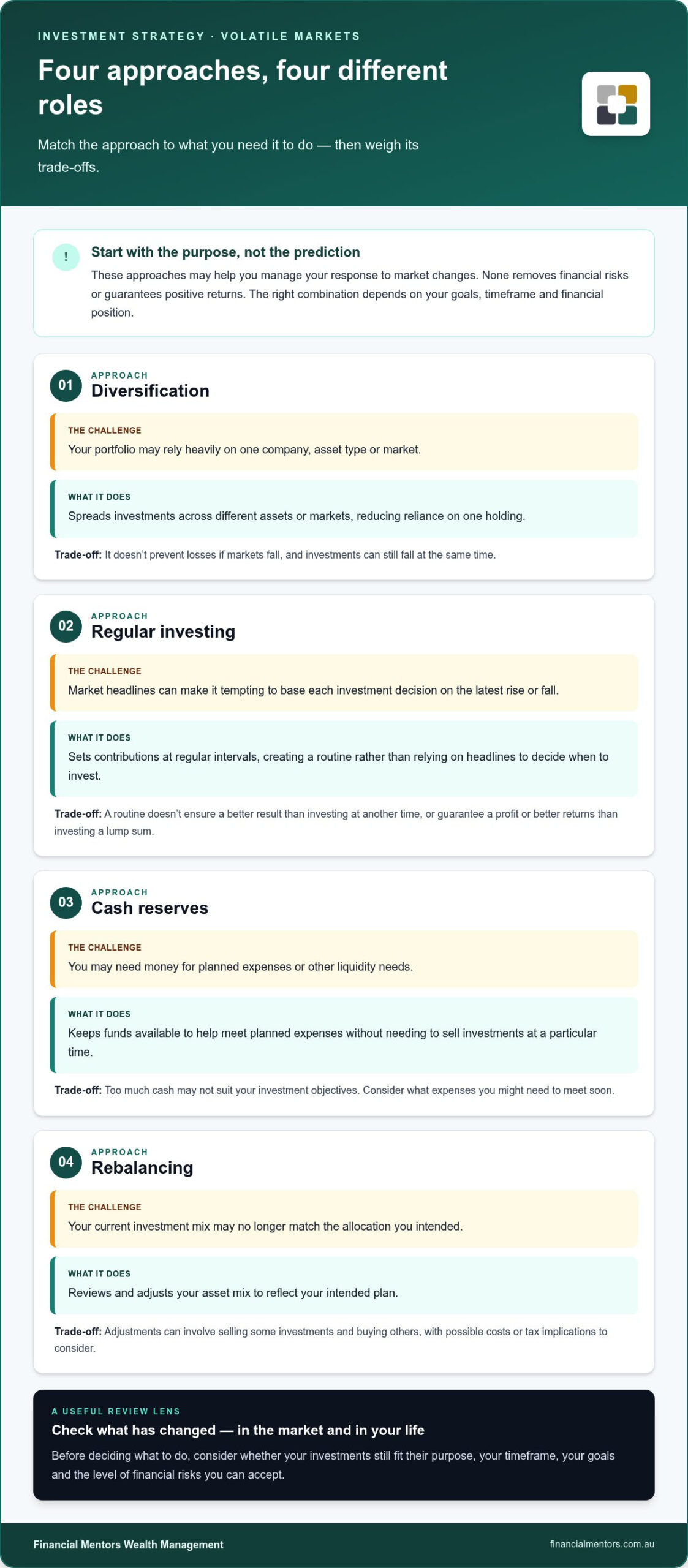
These approaches have different purposes. Diversification spreads exposure across investments. Regular investing sets a contribution routine. Cash reserves can help you access money when needed, while rebalancing brings your investment mix back towards a planned allocation. These approaches may help you manage your response to market changes, but none removes financial risks or guarantees positive returns. The right combination depends on your goals, timeframe and financial position.
Use this comparison to see what each approach is designed to do and what to consider before acting.
| Approach | Purpose | Trade-offs | Discussion point |
|---|---|---|---|
| Diversification | Spread investments across different assets or markets. | Can reduce reliance on one holding, but doesn’t prevent losses if markets fall. | Is your portfolio too dependent on one area? |
| Regular investing | Invest at set intervals rather than deciding based on headlines. | Creates a routine, but doesn’t ensure a better result than investing at another time. | Does the schedule suit your income and goals? |
| Cash reserves | Keep funds available for planned expenses or liquidity needs. | May offer access to money, but too much cash may not suit your investment objectives. | What expenses might you need to meet soon? |
| Rebalancing | Review and adjust your asset mix to reflect your intended plan. | Can involve selling some investments and buying others, with possible costs or tax implications to consider. | What would prompt a review of your mix? |
Diversification and rebalancing: managing portfolio concentration
Diversification means spreading investments rather than relying heavily on one company, asset type or market. For example, holding different types of investments may reduce the effect that a poor result in one area has on your overall portfolio. For investors considering tangible real estate as part of their broader wealth strategy, consulting specialists like Acquire2Retire can help in building a resilient property portfolio. It doesn’t ensure gains, and investments can still fall at the same time. Rebalancing is different: you check whether your current mix still matches the allocation you intended, then decide whether an adjustment is appropriate.
Regular investing and cash reserves: different roles
Regular investing, sometimes called dollar-cost averaging, means contributing at set intervals. When prices vary, the same contribution may buy more units at lower prices and fewer at higher prices. A routine can help you avoid reacting to headlines, but it doesn’t guarantee a profit or better returns than investing a lump sum. Cash reserves serve another purpose: they can help you meet planned expenses without needing to sell investments at a particular time. The amount you keep in cash and how you invest depend on your circumstances, not a universal rule.
If you’re weighing these options, tailored financial planning advice can help you relate them to your goals and financial position before deciding what to do next.
Should you change investments when markets are volatile?
A market move doesn’t call for the same response from every investor. Two people with similar investments may have different goals, timeframes, income needs and capacity to absorb losses. A change may be worth considering if your circumstances or original plan have shifted. A price movement alone doesn’t tell you whether changing your investments is appropriate.
Your investment strategy should reflect your goals and financial position, not a single market movement. Holding to your plan may keep you aligned with your goals and help you avoid reacting to short-term noise. But staying invested without reviewing your needs may leave you with an allocation that no longer suits you.
Changing your allocation may make sense if your objectives, timeframe or need for access to money have changed. Selling based on a prediction creates a timing challenge: you need to decide when to sell and when to invest again. If prices move between those decisions, the outcome may differ from what you intended. Neither holding nor changing guarantees a better result. Focus on the reason for a decision rather than trying to call the market.
When a portfolio review may be more useful than a quick reaction
Before making a change, separate personal developments from market activity. Has your goal changed? Do you need the money sooner? Has your income or a financial commitment shifted? These changes may justify reviewing your approach. If only the market value has moved, compare your current allocation with the plan you chose. A measured review can help you decide whether action is needed instead of defaulting to an automatic buy or sell.
- Goals: Are you still investing for the same purpose?
- Timeframe: Has the date you expect to use the money changed?
- Income and commitments: Do you need more access to your investments?
- Allocation: Does your current mix still match your intended plan?
Write down what has changed, separating personal developments from market movements. If your circumstances have shifted, consider whether your plan needs updating. If they haven’t, ask what a change would achieve and what trade-offs it could bring.
How to think about risk without making a market forecast
Your comfort with fluctuations and your capacity for loss aren’t the same. You may feel uneasy when values move, even if you don’t need to access the money soon. Or you may feel comfortable with market changes but have financial commitments that mean you can’t afford a large fall in money you’ll need shortly. Your feelings and practical circumstances both matter.
Consider when you may need to withdraw money, how much you might need and whether you could meet planned expenses without selling investments at an inconvenient time. These questions connect financial risks with your timeframe without relying on predictions about recoveries, downturns or future asset performance. If your answers have changed, review whether your allocation still fits.
A practical process for reviewing your investment strategy
A review can turn a general concern about market movements into specific questions about your plan. Set aside time to gather current information, then work through your goals, timeframe, financial position and investment mix. Include superannuation and other investments where relevant, so you see the wider picture rather than one account in isolation. These steps can help you identify what needs attention without relying on market predictions.
What to gather before reviewing your plan
Start with a snapshot of your finances. Bring together information about your current investments, income needs, assets, debts and regular financial commitments. Note upcoming changes involving family, work or retirement that could affect what you’re investing for or when you may need access to your money.
- List your investments, including superannuation and other holdings where relevant.
- Record income needs, assets, debts and ongoing financial commitments.
- Note planned changes that could affect your goals or timeframe.
- Mark which details are current and which are estimates that need updating.
Record the date and source of each figure to help identify gaps. If an estimate of an asset’s value is out of date, label it as an estimate rather than treating it as a current amount. You’re aiming for a useful overview of your financial position, not perfect records before you begin.
Review your strategy step by step
Once you’ve gathered the information, use it to test whether your approach still reflects your circumstances. Work through these steps at your own pace:
- Revisit your goals. Write down what each investment is intended to support, such as a home purchase, future income or retirement.
- Check your timeframe. Note when you expect to use the money. If a goal is closer than before, consider how that affects your plans and access needs.
- Update your financial position. Compare your current income, assets, debts and commitments with the information you used to make your plan.
- Review your allocation. Consider whether your current mix still aligns with your objectives and your ability to manage financial risks.
- Set out next steps. Record what you’ll keep under review, what needs further consideration and when you’ll revisit the plan.
Questions to guide a considered review
Ask yourself: does your approach still suit your long-term goals and timeframe? Would a proposed change address a real need, or is it mainly a response to recent headlines? If your circumstances have changed, note what that means for your objectives. A periodic review can help you reassess your plan as life evolves. You might schedule one around a meaningful change, such as a shift in income or retirement plans, and revisit it at other suitable intervals.
For more context on aligning investments with personal objectives, explore wealth creation strategies in Australia. If you’d like support connecting your review to your goals and financial position, arrange an appointment to discuss your financial plan.
How financial planning can support decisions in uncertain markets
Financial planning connects investment choices with the life those investments are meant to support. A tailored financial plan considers your goals, financial position, income needs and retirement plans together, rather than judging an approach by one market movement. This can help you identify which questions need attention now and which decisions still fit your longer-term intentions.
There isn’t one set of investment strategies for a volatile market that suits every investor. Your age, responsibilities, income and plans all shape what may be appropriate. Financial advice can help you assess those factors and consider options, but it can’t remove investment risks or guarantee a particular outcome.
What a tailored financial plan can bring together
Your investment decisions are connected to the rest of your finances. A financial plan can consider how investments relate to expected income needs, retirement planning and other goals, then assess whether your approach fits your circumstances. Tax return preparation can also sit alongside broader financial planning, helping you consider another part of your financial picture. Recommendations should reflect your situation, rather than assume one approach works for everyone.
This broader view can help if you’re weighing a change, approaching retirement or adjusting plans after a shift in income or family circumstances. It gives you a way to discuss trade-offs in context: when you need the money, what you’re working towards and which financial risks you’re comfortable taking. Advice should be personal to your circumstances, and investment outcomes remain uncertain.
When an appointment may help you move forward
If your goals, income needs or financial position have changed, an appointment gives you space to explain what’s different and what you hope to achieve. The initial meeting is step 01 of the advice process. It’s an opportunity to discuss your priorities and circumstances, then consider possible next steps without needing every answer in advance.
Financial Mentors Wealth Management has provided professional planning advice since 2000. While experience can’t make market outcomes certain, tailored planning can help you work through decisions with your personal goals in view. Discuss what matters most to you, the questions you’d like answered and whether a financial plan could bring your priorities together.
If you’d like to talk through how investment decisions relate to your goals and retirement plans, speak with Financial Mentors about a tailored financial plan.
Take your next step with your goals in view
You don’t need to settle every investment question at once. Write down the decision you’re considering, what prompted it and what you hope it will change. This gives you a practical starting point for a calm discussion, instead of letting pressure to act set the agenda.
As you consider investment strategies for a volatile market, keep your attention on the future you’re planning for. If you’re unsure how an investment decision fits your wider circumstances, tailored advice can help you explore the options and understand the trade-offs. Your plan should reflect your individual goals and circumstances, and investment outcomes can’t be guaranteed.
When you’re ready to discuss what matters to you, discuss your financial goals with Financial Mentors. A thoughtful conversation can help you identify a clear next step and move forward with greater confidence.
Frequently Asked Questions
Is it better to sell investments during a volatile market?
Not automatically. Selling may be worth considering if you need the money soon, an investment no longer fits your plan or your circumstances have changed. Before acting, check what you’d be selling, why you bought it and what you’d do with the proceeds. Consider transaction costs and possible tax consequences too. If the only reason is a worrying headline, pause before deciding.
Should I keep investing when the market is volatile?
That depends on your circumstances and the plan behind your contributions. If you invest regularly, check that the schedule still suits your income, upcoming expenses and goals. For example, a change in work hours may affect what you can comfortably contribute. Investment strategies for a volatile market include different approaches, not a universal instruction to keep investing. Make sure any contribution remains affordable for you.
Can diversification protect my investments from market falls?
No. Diversification can reduce reliance on a single investment, but it can’t prevent your portfolio from falling in value. For example, investments across several industries may limit your exposure to one company’s difficulties, yet a broader market decline can still affect several holdings at once. Review what you own and what drives each investment, rather than treating the number of holdings as proof of diversification.
What should I review before changing my investment strategy?
Before changing your strategy, write down why you’re considering the change and what you expect it to achieve. Check how it could affect your access to money, the balance of your investments and the costs of making the change. Consider whether another approach could meet the same need. If an investment is held through superannuation, include the fund’s investment option and relevant information in your review.
How often should I review my investment strategy?
There’s no single review schedule that suits everyone. Choose a regular time to check whether your investments still match your aims, and review sooner if something material changes. This might include a new job, a major expense, a change in family responsibilities or approaching retirement. A review doesn’t require you to change your investments; it can simply confirm that your current approach still fits.
Does investing through superannuation change how I respond to volatility?
Superannuation doesn’t remove investment risk, but it can affect how you assess your choices. Start by identifying your super investment option and the role it plays alongside your other investments. Then consider when you expect to rely on super for income and whether that timeframe has changed. If you have more than one super account, include each one to view your investments together.
Can a financial planner help me compare investment strategies?
Yes. A financial planner can help you compare approaches against your goals, income needs, timeframe and financial position. Bring details of your investments, including superannuation, and discuss how each option’s trade-offs relate to your circumstances. Advice should be tailored to you, and it can’t guarantee investment results. The conversation can help clarify what further information you need and which questions to consider before deciding.