

What if you could transform fragmented personal investments into an organised wealth engine without surrendering nearly half your returns to tax? If you are building wealth in Australia, you likely already feel the sting of high individual tax brackets eroding your hard-earned returns. Managing your financial position often brings real concerns about commercial liability, alongside confusion surrounding Australian Taxation Office rules like Section 100A. Exploring the key family trust tax benefits australia provides can help you protect what you have earned while keeping more investment income within your household.
Setting up a discretionary structure gives your family a reliable path to legally manage earnings, shield personal assets from financial risks, and build a lasting legacy. In this guide, you will learn how income streaming and capital gains tax concessions function in plain English. You will also discover how to navigate ongoing compliance smoothly, giving you the clarity and confidence you need before your initial appointment to plan for your long-term goals.
Key Takeaways
- Income streaming allows you to distribute investment returns across adult family members on lower marginal rates, protecting your household financial position.
- Key family trust tax benefits australia offers include preserving the 50 percent capital gains tax discount for individuals while shielding investments from potential financial risks.
- Staying fully compliant with the Australian Taxation Office requires navigating Section 100A rules to ensure all distributions deliver genuine economic benefits to beneficiaries.
- Evaluating trusts alongside bucket companies and self-managed super helps you choose the right structure for your medium-term goals.
- Practical guidance prepares you for your initial appointment, making it straightforward to integrate a trust into your broader estate planning and wealth creation strategies.
What Is a Family Trust and How Does It Function in Australia?
A discretionary family trust is a legal arrangement where a trustee holds assets on behalf of chosen beneficiaries, typically members of the same family. Rather than owning investments directly in your personal name, the trust owns the assets while you guide the decisions. A major reason wealth builders evaluate family trust tax benefits australia wide is that the trust itself generally pays no income tax. Instead, its net taxable earnings distribute to beneficiaries each financial year, who then pay tax at their personal marginal rates.
The Core Roles Within a Discretionary Trust
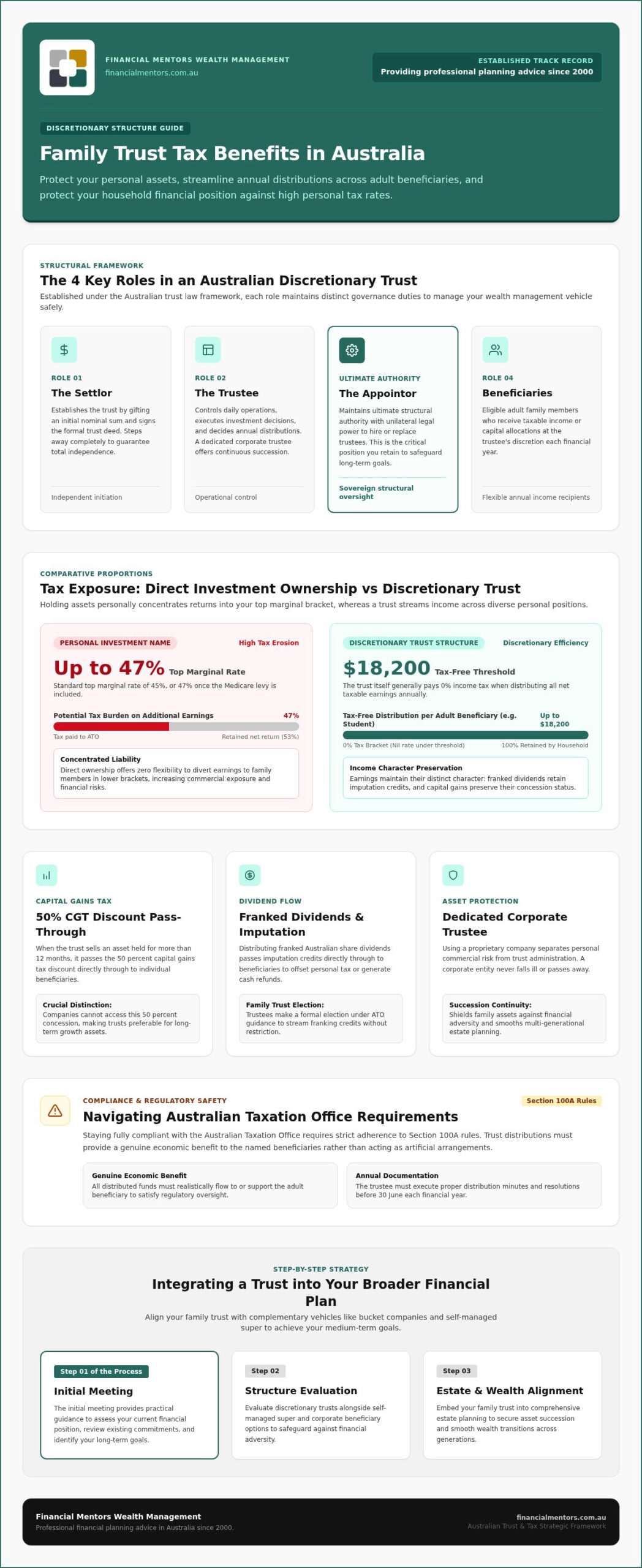
Every discretionary trust established under the Australian trust law framework relies on four distinct roles to operate smoothly:
- The Settlor: Establishes the trust by gifting an initial nominal sum and signs the trust deed, stepping away completely to maintain independence.
- The Trustee: Controls daily operations, executes investment decisions, and determines annual distributions. Using a dedicated corporate trustee provides superior continuity, as a proprietary company never falls ill or passes away, separating personal risk from trust administration.
- The Appointor: Holds ultimate structural authority, including the unilateral legal power to hire or remove trustees. If you want ongoing oversight of your wealth management vehicle, this is the position you retain.
- The Beneficiaries: Family members eligible to receive income or capital allocations at the trustee’s discretion.
How Discretionary Distributions Operate
Unlike a fixed trust where unit holders own rigid percentages, a discretionary trust gives the trustee complete flexibility each financial year. You can allocate varying amounts of trust income to different adult family members depending on their financial position and personal commitments. Investment income also maintains its distinct character as it flows through the structure. Franked dividends retain their imputation credits, while capital gains keep their eligibility for concessions. This adaptable mechanism allows you to support changing family needs while safeguarding your long-term goals against unexpected financial adversity.
Core Family Trust Tax Benefits Australia: Key Advantages for Wealth Builders
Holding investment assets directly exposes you to individual tax rates as high as 45 percent, or 47 percent with the Medicare levy. Structuring your portfolio through a discretionary entity allows you to manage this exposure methodically. Securing key family trust tax benefits australia offers means you can align annual earnings with your household’s actual needs, preserving capital that would otherwise go toward excessive tax liabilities.
Income Streaming Across Adult Beneficiaries
Income streaming lets you allocate investment earnings to adult beneficiaries sitting in lower tax brackets. For example, distributing up to $18,200 of taxable earnings to an adult child studying full-time can generate substantial annual tax savings compared to assessing that income against a high earner’s bracket. Distributing franked Australian share dividends also passes through imputation credits directly, which can offset tax or produce cash refunds for low-earning beneficiaries. To stream franking credits without restriction across family members, trustees typically make a formal election based on official ATO guidance on family trusts and elections.
Capital Gains Tax Concessions and Wealth Accumulation
When your trust sells an asset held for more than 12 months, it passes the 50 percent capital gains tax (CGT) discount through to individual beneficiaries. Companies cannot access this concession. By allocating capital profits to individuals with lower marginal rates, or to family members with accumulated capital losses, you cut the taxable gain substantially. Connecting asset structuring with deliberate wealth creation strategies Australia builds serious momentum for your long-term goals. If you want to explore how these distribution options fit your current financial position, you can arrange a preliminary financial planning consultation to review your situation.
Asset Protection and Safeguarding Your Family Legacy
Separating investment capital from personal trading risks provides genuine peace of mind. Because trust assets belong legally to the trustee rather than to you individually, personal creditors or commercial litigants cannot easily reach that capital during sudden financial adversity. This boundary safeguards an intended inheritance for your children while keeping investments distinct from personal liabilities. It also establishes an enduring structure for your family that remains intact across generations, so long as transfers comply with standard insolvency regulations.
Navigating ATO Compliance, Section 100A, and Tax Rules
Gaining the full advantage of family trust tax benefits australia allows requires strict adherence to Australian Taxation Office (ATO) regulations. While discretionary structures offer genuine tax planning flexibility, modern tax compliance demands clear documentation and commercial transparency. Ensuring every distribution aligns with current tax law safeguards your wealth from unwanted penalties.
Understanding Section 100A and Legitimate Family Dealings
The ATO scrutinises trust allocations under Section 100A anti-avoidance measures. Under these provisions, any arrangement where income is distributed on paper to a low-bracket beneficiary, but the actual funds are redirected to benefit someone else, can be treated as a reimbursement agreement. In such cases, the ATO assesses the trustee at the top marginal rate of 47 percent. To remain fully compliant with ATO Section 100A reimbursement agreement rules, ensure adult beneficiaries retain genuine physical access to their allocated funds. Transparent bank records and clear commercial rationale confirm your arrangements represent ordinary family dealings.
Distribution Limits for Minors and Division 6AA Restrictions
Trustees often wonder if they can distribute passive investment returns to minor children to use their tax-free thresholds. Under Division 6AA, unearned income allocated to children under 18 faces steep penalty tax rates. Minors can only receive up to $416 tax-free each year. Amounts between $417 and $1,307 face tax at 66 percent, while distributions exceeding $1,307 attract the highest individual rate of 45 percent, or 47 percent with the Medicare levy. Discretionary trusts are unsuitable for streaming passive investment yields directly to young children.
Year-End Trust Minutes and Lodgment Obligations
Timing is critical for valid distributions. Trustees must formally draft and sign written distribution resolutions on or before 30 June each year. Missing this deadline means trust income is treated as unallocated, triggering an automatic assessment to the trustee at the top 47 percent rate under Section 99A. Coordinating your annual resolutions with professional tax return preparation guarantees all calculations align with your broader wealth management goals and prevent costly reporting oversights.
Comparing Family Trusts with Alternative Investment Structures in Australia
Choosing how to hold your investments shapes your financial path for decades. While you can hold assets personally, in a company, or through superannuation, weighing the unique family trust tax benefits australia offers against these alternatives helps clarify the best vehicle for your medium-term goals.
Family Trust Versus Direct Personal Ownership
Holding shares or property in your personal name requires minimal administrative paperwork. However, any net earnings get added straight to your personal income, which can push you into top marginal brackets. If you use negative gearing, personal ownership allows you to offset rental losses directly against your salary. In contrast, trust tax losses remain trapped inside the trust until future profits absorb them. Once your investment portfolio begins producing consistent, positive taxable yields, transitioning to a trust structure helps protect your growing capital.
Family Trust Versus Corporate Beneficiaries (Bucket Companies)
A proven strategy involves directing surplus trust distributions to a corporate beneficiary, often called a bucket company. Passive investment earnings distributed to a bucket company are capped at a flat 30 percent corporate rate rather than the highest individual rate. However, companies cannot access the 50 percent capital gains discount. If the bucket company loans funds back to you or the trust to finance new assets, you must manage complying Division 7A loan agreements and statutory benchmark interest rates to avoid penalty tax assessments.
Integrating Trusts with Superannuation and Estate Planning
A self-managed super fund offers an attractive 15 percent tax rate on earnings, yet your capital remains strictly locked away until you meet preservation age. A family trust acts as a flexible accumulation vehicle during your working life, giving you access to capital whenever family priorities shift. Because trust assets do not form part of your personal estate, they bypass probate and help protect your intended inheritance from Will disputes. Coordinating your trust structure with expert estate planning advice ensures your wealth passes smoothly to the next generation. You can also evaluate your trust assets against a retirement planning checklist australia to balance super balances and potential Centrelink entitlements with your long-term goals. To review your structure, schedule your initial financial planning appointment today.
How to Establish and Manage a Family Trust: Step-by-Step Strategic Advice
Setting up an investment trust requires thoughtful preparation before signing any paperwork. While capturing the family trust tax benefits australia offers is appealing, the structure must directly support your broader financial position and medium-term goals. Taking a methodical approach ensures you build a sustainable foundation without creating unnecessary administrative complexity.
Assessing Suitability for Your Family Financial Position
Begin by evaluating your existing investment assets, household earnings, and financial commitments. A trust structure carries ongoing accounting and compliance obligations, so your anticipated investment returns should comfortably justify its operational costs. Booking an initial appointment acts as step 01 in mapping out a clear roadmap. Professional planning advice across Australia since 2000 has shown that aligning structural decisions with your personal life stage ensures your financial plan delivers lasting peace of mind.
Setting Up the Structure and Regulatory Compliance
Once you confirm that a trust suits your family, accredited professionals prepare the trust deed to reflect your specific succession wishes. An independent settlor executes the deed by contributing the initial settlement sum. From there, you establish a corporate trustee, apply to the ATO for a trust tax file number and Australian Business Number, and lodge the deed for stamp duty where state law requires. Opening dedicated trust bank accounts is vital. Keeping trust transactions strictly isolated from personal accounts protects your asset separation and preserves full tax integrity.
Ongoing Governance and Periodic Review
Managing a trust effectively involves disciplined record-keeping and proactive oversight. You need to document every major investment decision, store transaction records carefully, and prepare formal distribution minutes well before 30 June each year. Conducting an annual periodic review with your wealth management advisor ensures your structure adapts as your circumstances change. As adult children begin full-time careers or as you transition toward retirement, reviewing your distribution framework keeps your wealth creation strategies responsive to your family’s evolving needs.
Securing Your Family Wealth for the Generations Ahead
Building a resilient financial position takes thoughtful planning and proactive decision-making. A discretionary trust gives you the structural flexibility to distribute earnings efficiently, protect personal capital from business risks, and safeguard an enduring inheritance for your children. Capturing the proven family trust tax benefits australia provides isn’t just about reducing individual marginal tax rates today; it’s about establishing an orderly wealth foundation that supports your medium-term and long-term goals.
Navigating annual distribution resolutions, corporate trustee obligations, and Australian Taxation Office compliance becomes straightforward when you have an experienced guide by your side. Providing professional planning advice across Australia since 2000, Financial Mentors Wealth Management helps families coordinate strategic wealth management with tailored advice. Step 01 of the process is an initial meeting dedicated entirely to understanding your personal aspirations and reviewing your financial position. When you are ready to bring clarity and structure to your family’s future, book your initial appointment with Financial Mentors Wealth Management and take the next step with complete confidence.
Frequently Asked Questions
How does a family trust reduce tax for Australian families?
A family trust reduces your household tax burden primarily through discretionary income streaming. By allocating investment profits across adult beneficiaries in lower tax brackets, you make full use of multiple tax-free thresholds and lower marginal rates. Beneficiaries also preserve the 50 percent capital gains tax discount on assets held for over a year. Maximising family trust tax benefits australia wide helps you retain more capital inside your broader wealth management strategy.
Can I distribute family trust income to my children to save tax?
You can only distribute income tax-effectively to adult children aged 18 and over. Distributing unearned investment earnings to minors under 18 triggers punitive Division 6AA tax rates. After a tiny $416 tax-free allowance, minor distributions face penalty tax rates up to 66 percent, and 47 percent on larger amounts. While adult children studying at university make ideal beneficiaries, distributing passive trust earnings to minors doesn’t generate tax savings.
What is Section 100A and how does it impact family trust distributions?
Section 100A is an integrity rule targeting artificial arrangements where trust earnings are appointed to one person on paper, but paid to or enjoyed by someone else. If the Australian Taxation Office determines a distribution is not an ordinary family dealing, the arrangement gets disregarded. The trustee is then assessed at the highest individual rate of 47 percent. Genuine, documented transfers where adult beneficiaries retain and control their entitlements remain fully compliant.
Do family trusts pay tax directly to the Australian Taxation Office?
Family trusts generally do not pay income tax directly, provided all net taxable income is fully distributed to beneficiaries before 30 June. The taxable income simply flows through to each beneficiary, who reports and pays tax on their allocation at individual marginal rates. If the trustee fails to execute distribution minutes by the annual deadline, untargeted income gets taxed to the trustee at the top penalty rate of 47 percent.
Does a family trust protect my assets from divorce or legal bankruptcy?
A family trust provides strong protection against personal business liabilities and commercial bankruptcy, but offers limited insulation in family law disputes. Because trust property belongs to the trustee rather than you personally, personal trade creditors cannot readily seize trust investments. However, the Federal Circuit and Family Court of Australia can treat trust assets as financial resources or property if one party effectively controls the structure, ensuring fair division during a divorce.
What are the main costs associated with establishing and running a family trust?
Establishing a family trust typically involves initial setup costs alongside ongoing administrative and accounting expenses. Setting up the structure generally requires professional deed preparation, corporate trustee incorporation fees with ASIC, and state stamp duty where applicable. Annual expenses include ASIC company review fees, bookkeeping, tax return preparation, and ongoing compliance. When balancing these running costs against potential family trust tax benefits australia provides, portfolios producing consistent investment yields easily justify the structure.
Can a family trust hold residential or commercial investment property?
Yes, a family trust can hold both residential and commercial investment property, offering flexibility and long-term asset protection. Holding property in a trust allows you to pass through the 50 percent capital gains tax discount upon sale and stream rental yields efficiently. However, you cannot use trust property rental losses to offset your personal PAYG salary. Trust tax losses remain quarantined inside the trust to offset future net property income or capital growth.