

A binding death benefit nomination (BDBN) is a legally binding direction to your superannuation fund trustee specifying who receives your super balance and life insurance payout when you pass away. Without a valid BDBN, the trustee retains discretion over who receives your accumulated wealth. Securing this direction gives you clarity over your estate planning goals.
Key Takeaways: A binding death benefit nomination is a legal document that forces your superannuation fund trustee to pay your balance to your chosen dependants.
- Except when rigid legal instructions remove flexibility during sudden relationship changes or shifting financial commitments.
- Select non-lapsing nominations for permanent peace of mind if you want to avoid expiration.
- Draft cascading beneficiary clauses in SMSF trust deeds to prevent trustee discretion if nominees die.
Before you lock anything in, three decision questions shape the rest of this guide: do you need a binding direction, should it expire after three years or stay non-lapsing, and when would a rigid nomination work against the future you want? Answer those in order and you can create the future you want with a structure that fits your life.
Three super scenarios show which estate option fits you
Selecting an estate planning strategy depends on your personal circumstances and future goals. With clients we see that complex work arrangements, local requirements, or a past divorce often create confusion around super assets. Professional advice clarifies these paths so your money goes exactly where you intend.
Here is a short segment guide drawn from those patterns:
- Straightforward family setup and a life still changing: use a lapsing nomination that expires after three years so you can refresh beneficiaries as goals shift.
- You want a direction the trustee cannot override: use a binding nomination so your super balance transfers to the dependants you name.
- You run a self-managed super fund and face sudden transitions or financial adversity: rely on tailored trust deeds and cascading clauses so the fund can still follow your intent.
Each option serves a different need. Choosing the right path protects your hard-earned wealth. You can learn how to structure these choices during an initial appointment. More on this: Financial Mentors Wealth Management.
Long-standing professional guidance helps secure your financial position through every major milestone. One client path shows how that works in practice. A commenter in the forumwealth.com thread "Forum Wealth Management: Home, Financial advisers…" came in after a long accountant relationship and needed steady investment direction rather than one-off tips:
"Forum Wealth Management was recommended to me by my accountant whom I had known for 20 years. As a consequence, Forum Wealth Management has advised me on investments since January 2010." (https://forumwealth.com/)
Situation: you need continuity after years of trusting one professional pathway. Action: step into ongoing advice on investments and legal structures for super. Outcome: advice in place since January 2010, with estate assets able to pass to loved ones as personal circumstances change. Decades of consistent financial advice help you select the right legal structures for your superannuation so that continuity holds when life does not.
A binding nomination directs your super when you cannot
A binding death benefit nomination is a legal document directing your super fund trustee on who receives your super balance when you die.
Your superannuation sits outside your traditional estate, so the trustee decides who gets your balance unless you create a valid instruction. Managing your investments, super, and insurance alone can feel overwhelming, and mistakes cause real financial adversity for grieving families. Working alongside our advisers ensures your estate planning aligns with your overall financial plan. Treat this document as an express path that bypasses general estate delays and delivers funds directly to your chosen dependants. More on this: Financial Mentors Wealth Management.
You can select a lapsing nomination or a non-lapsing option depending on your fund rules. Regular periodic review keeps your instructions accurate as your personal situation evolves. Taking these practical steps now protects your loved ones from future financial risks.
Tip: Always confirm whether your super fund allows non-lapsing terms or requires a periodic review every 3 years to remain legally valid.
Lapsing and non-lapsing forms differ on expiry and renewal
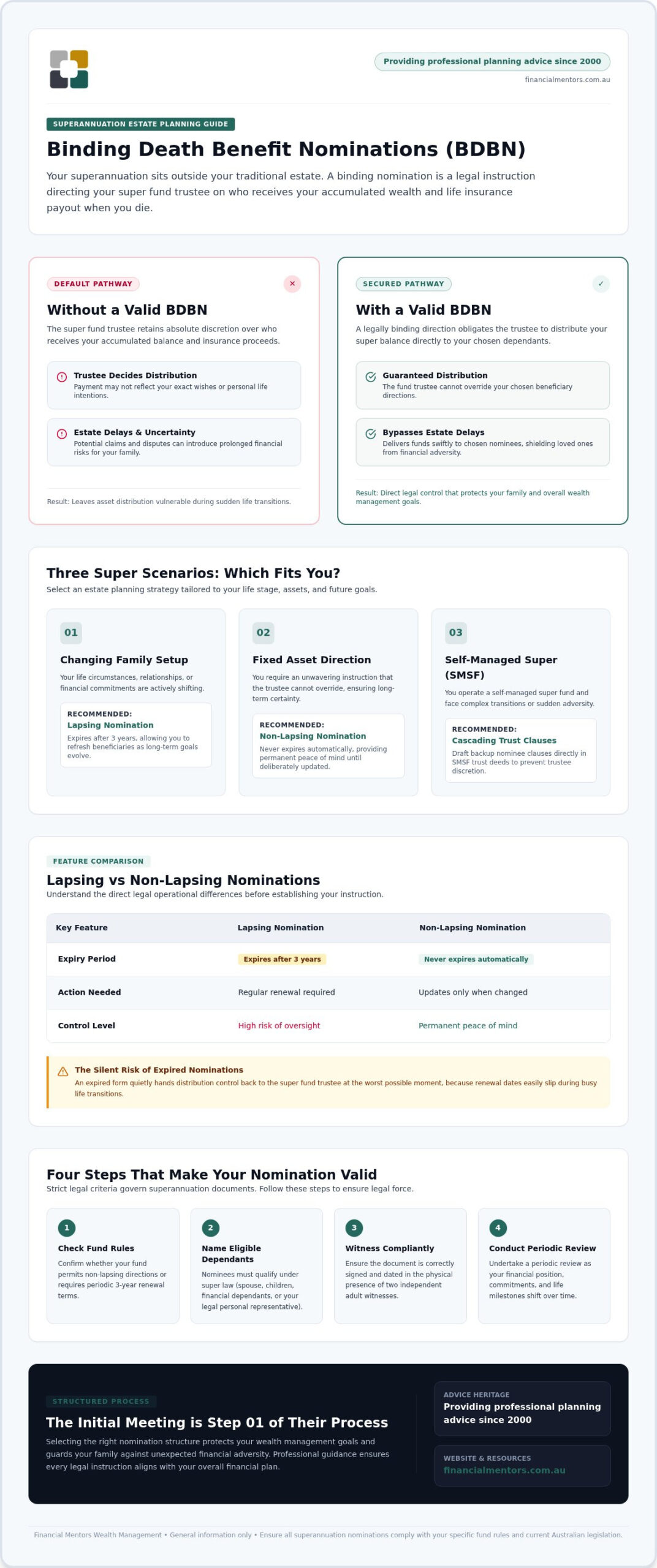
A lapsing nomination expires after three years, whereas a non-lapsing form stays active until you update it.
You can protect your family from future financial adversity by locking in a non-lapsing form. Securing your super benefits on standing instructions supports certainty for your estate planning goals.
| Feature | Lapsing Nomination | Non-Lapsing Nomination |
|---|---|---|
| Expiry Period | Expires after 3 years | Never expires automatically |
| Action Needed | Regular renewal required | Updates only when changed |
| Control Level | High risk of oversight | Permanent peace of mind |
What few people think of: an expired form quietly hands control back to the super fund trustee at the worst possible moment, because renewal dates slip during busy life transitions.
Choosing a non-lapsing direction prevents accidental lapses during stressful life events. You can manage these forms confidently with our advisory team during your initial meeting, which is step 01 of their professional process. More on this: Financial Mentors Wealth Management.
Working with dedicated professionals ensures your wealth management strategies line up directly with your intentions. Among the firm’s Google reviews, a client (5★) wrote:
"Amazing guy. Really helped me out with my tax returns. Super professional and prompt."
Seeing how financial advice resolves real-world stress shows why securing your super directions with expert help brings lasting reassurance.
Name a backup beneficiary before you need one
If your primary beneficiary dies before you, your superannuation benefit usually defaults to fund trustee discretion.
When reviewing active estate planning strategies, advisers often notice that major household changes leave people needing to reorganise how their finances are looked after. Setting up multi-layered instructions directs your wealth safely if an unexpected loss occurs. You can establish a primary nominee and a secondary backup within your instructions so the structure still holds if one person is no longer there.
If you use a self-managed super fund, cascading clauses protect your intentions. Without these structured layers, your death benefit might suffer delays. The Australian Securities and Investments Commission (ASIC) reported in 2024 on death benefit claim handling, highlighting that funds must process claims efficiently. Establishing secondary outcomes reduces administrative friction for surviving relatives.
To review your options, seek tailored advice through future planning support. Updating your setup protects your family from financial adversity and keeps your long-term goals secure.
Tip: Draft cascading beneficiary clauses in your SMSF trust deed or formal nomination forms to prevent your super falling under trustee discretion if a primary nominee passes away.
A commenter in the forumwealth.com thread "Forum Wealth Management: Home, Financial advisers…":
"Finding a financial adviser open to creating an ethical portfolio with thoughtful analysis, supportive commitment and good results has been very reassuring."
Seeking thoughtful, supportive guidance helps you structure secondary beneficiaries correctly so your estate plan remains secure.
Four steps that make your nomination valid
Executing a valid death benefit nomination requires completing the official paperwork correctly and meeting all fund requirements.
If your previous adviser relationship or business setup changed, you may need a fresh financial plan to secure your superannuation. Keeping your documentation current places authority over your future in your hands, and you can learn more about Aiker Wills and Trusts to ensure your wider estate is equally protected.
- Check your fund rules. Verify if your fund allows a lapsing nomination after three years or a non-lapsing option.
- Choose your beneficiaries. Nominate your dependants or legal personal representative to receive your superannuation death benefit.
- Sign the form correctly. You must sign the document in front of two independent witnesses who are not named as beneficiaries.
- Submit the document. Send the completed paperwork directly to your superannuation fund trustee for formal registration.
Set up this way, the nomination keeps your money on the path you intend. If you are worried about making errors, seeking financial advice helps you complete these practical steps with confidence.
When a Binding Nomination May Be the Wrong Choice
Binding death benefit nominations lock superannuation payouts into strict legal directions.
From our advisory practice, sudden personal or work changes can make a rigid legal instruction unsuitable for your new lifestyle. A fixed directive removes flexibility if your relationship circumstances alter or your financial commitments shift unexpectedly.
Your chosen beneficiaries might face distinct tax outcomes depending on your employment status when you pass away. If your career path changes suddenly, binding choices can create unexpected financial adversity for your loved ones. Non-binding options or a lapsing nomination let fund trustees consider current circumstances instead.
Flexibility helps your estate planning adjust as life moves. Maintaining a periodic review of your superannuation settings protects your long-term goals when plans shift.
For those with interests abroad, particularly in the United States, The Probate & Estate Planning Co. offers specialised guidance on probate and comprehensive estate management to ensure your global assets are protected.
If you are unsure about your current arrangements, make a time with Financial Mentors Wealth Management to clarify your options and safeguard your family.
Frequently asked questions
What is a binding death benefit nomination?
A binding death benefit nomination is a legal instruction that forces your superannuation fund trustee to pay your remaining balance to your chosen dependants. It gives you certainty for your estate planning goals. Without this document, trustees decide who receives your funds when financial adversity hits a family unprepared.
How often does a BDBN expire?
A standard binding direction is a lapsing nomination after three years. You must review and renew it regularly to keep your strategy valid. Routine revisions to your records keep distribution aligned with your precise wishes.
What are non-lapsing nominations?
A non-lapsing nomination stays valid indefinitely until you formally cancel or replace it. This standing option removes the need for periodic updates every three years and gives your family a stable instruction they can rely on.
Secure Your Legacy Today
The same three questions you started with still apply: do you need a binding direction, should it lapse or stay non-lapsing, and when would rigidity hurt the people you care about? Understanding what a binding death benefit nomination is helps you protect your superannuation assets for your family. A lapsing nomination can leave your hard-earned wealth open to unexpected trustee decisions, so taking action in 2026 helps your estate planning match your exact wishes.
Our team provides personal estate planning guidance to walk you through every step. Book your initial consultation today and build a solid foundation: make a time with us. More on this: Financial Mentors Wealth Management.