

What if your annual tax bill wasn’t just an unavoidable expense, but a strategic lever you could pull to reach your financial milestones years earlier? Many Australians feel a lingering sense of anxiety that they’re missing out on legitimate deductions or that their current setup isn’t quite right for the shifting landscape of 2026. It’s frustrating to watch a significant portion of your wealth growth be hampered by tax obligations that feel increasingly complex and difficult to manage. If you’ve ever felt overwhelmed by the intricacies of the Australian tax system, you’re certainly not alone in that experience.
This article will show you how integrating tax planning for wealth management clients australia into your broader strategy can protect your hard-earned assets and provide a clearer path forward. We’ll explore the implications of the May 2026 Federal Budget and the updated income tax brackets. By the end of this guide, you’ll have a practical understanding of how to align your tax and wealth goals. This clarity helps ensure you’re not just compliant, but positioned to thrive with the confidence that comes from being truly prepared for the future.
Key Takeaways
- Understand the vital difference between basic annual compliance and a proactive tax strategy that works to accelerate your long-term wealth creation.
- Learn how to effectively use superannuation contribution caps and Capital Gains Tax discounts to protect your investment returns from unnecessary erosion.
- Discover how choosing the right ownership structure, such as a discretionary trust, can provide both asset protection and tax efficiencies for your family.
- Stay ahead of the curve by identifying critical 2026 deadlines and learning how integrated tax planning for wealth management clients australia can simplify your financial life.
- Gain peace of mind by aligning your personal life milestones with a professional strategy that treats tax as a tool for progress rather than just a yearly expense.
Why Tax Planning is a Cornerstone of Australian Wealth Management
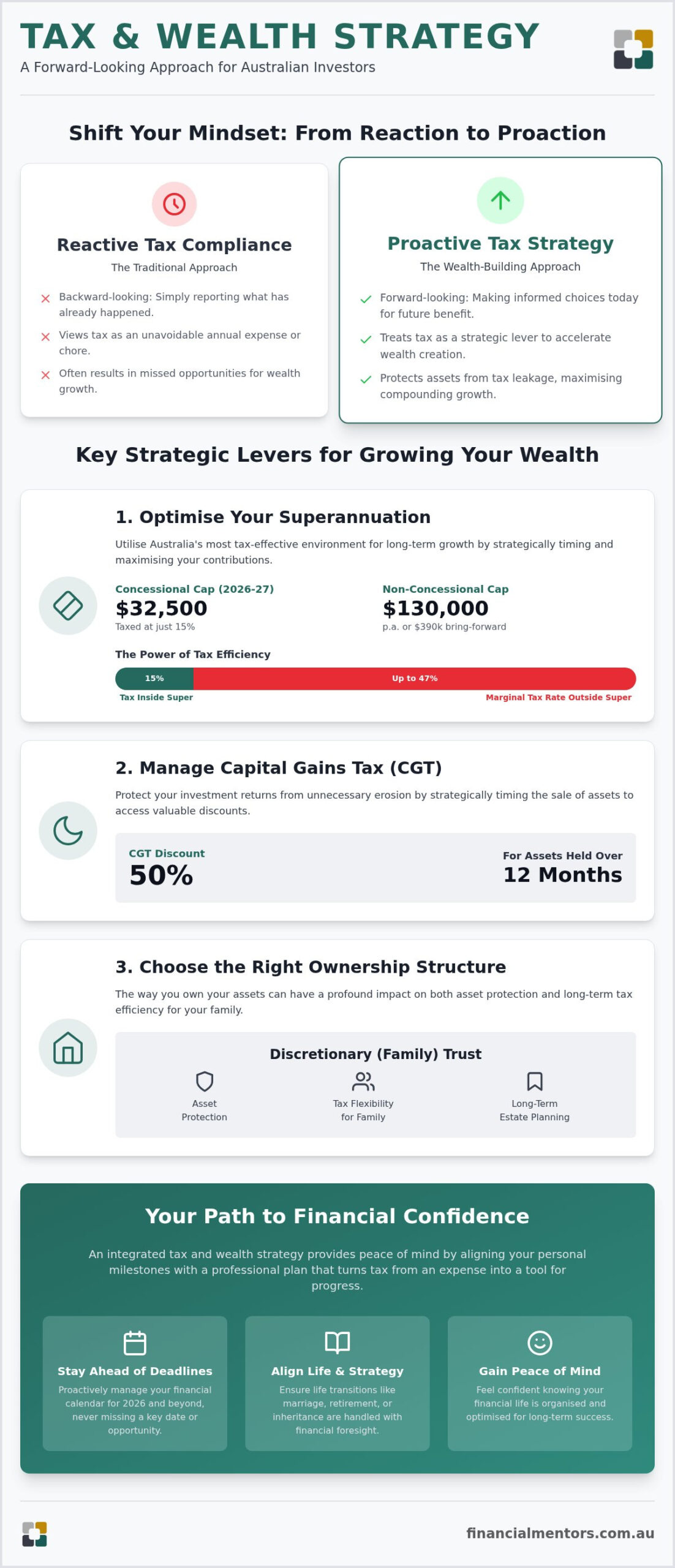
Most Australians view the end of the financial year as a deadline to be survived rather than an opportunity to be seized. If you’ve ever felt a sense of dread when June approaches, it’s likely because you’re treating tax as a backward-looking chore. Strategic tax planning for wealth management clients australia is the exact opposite. It’s a forward-looking process that treats tax as a primary variable in your wealth creation journey, rather than a final, painful calculation.
There’s a significant difference between simple tax compliance and a proactive strategy. Compliance is about following the rules of the Australian taxation system to report what has already happened. Strategy is about making informed choices today that will influence your financial position for years to come. When you manage your affairs with foresight, tax becomes a silent partner in your portfolio. Every dollar you don’t lose to unnecessary tax leakage is a dollar that remains invested, allowing you to benefit from the relentless power of compounding growth.
The Synergy Between Tax and Wealth Creation
If you ignore the tax implications of your investments, you’re essentially walking with a leak in your bucket. Reducing this leakage is one of the most effective ways to accelerate your progress toward retirement or other life goals. A tax-aware approach doesn’t just look at this year’s return; it views your finances through a multi-year lens. This perspective is vital because the decisions you make now, such as how you structure an investment or when you choose to realise a gain, can have ripple effects for a decade or more. By ensuring you keep more of your earnings within your control, perhaps through the specialised legal guidance offered by TaxLawAdvisory, you give your wealth the best possible chance to flourish over the long term.
When Should You Start Planning?
Waiting until June to consider your tax position is a missed opportunity for growth. By that stage, many of the most effective levers, such as restructuring assets or making specific superannuation contributions, are no longer available. A year-round approach ensures you’re always prepared for whatever life throws your way. Life transitions like marriage, the birth of a child, or the transition into retirement often trigger new tax needs that require a steady hand and a wise perspective. Tax planning is a proactive wealth tool that aligns your financial decisions with your long-term aspirations to minimise unnecessary costs. If you stay organised and attentive to these shifts, you can maintain the confidence that your wealth and tax strategies are always in perfect harmony.
Key Strategic Tax Levers for Growing Your Wealth
Growing your wealth in Australia is often a journey of small, deliberate choices that accumulate over time. When we look at tax planning for wealth management clients australia, we see a few key levers that can significantly change your financial trajectory. It isn’t just about what you earn; it’s about how you keep it working for you. To build a resilient portfolio, you need to understand the tools at your disposal and how to apply them with quiet confidence.
Optimising Your Superannuation
One of the most effective ways to legally reduce tax is through the superannuation system. For the 2026-2027 financial year, the concessional contributions cap has increased to $32,500. If you have the capacity, utilising this cap allows you to move funds from a high-tax environment, where you might be paying up to 45% plus the Medicare levy, into a 15% tax environment. This shift is a foundational step in ensuring your planned retirement remains secure and on track. You might also consider non-concessional contributions, with a cap of $130,000 per year, or up to $390,000 using the three-year bring-forward rule, depending on your total super balance. If your income exceeds $250,000, you’ll need to account for Division 293 tax, but even then, super often remains the most tax-effective environment for long-term growth.
Managing Investment Income and CGT
Managing your investment income also requires a keen eye on Capital Gains Tax (CGT). Currently, the 50% CGT discount remains a vital tool for individuals and trusts holding assets for more than 12 months. However, with major reforms proposed to take effect from July 2027, the timing of asset sales has never been more critical. If you hold Australian shares, franking credits can serve as a powerful tax offset, effectively reducing the tax you pay on other income. Similarly, while negative gearing rules are set to tighten for residential properties in 2027, properties held before 12 May 2026 remain exempt under grandfathering provisions. This makes your current record-keeping and cost-base adjustments essential for protecting your future returns. Every asset class is taxed differently, so your strategy needs to be as unique as your life goals. If you’d like to explore how these pieces fit your specific situation, reviewing your wealth creation strategies with a professional can offer significant peace of mind.
Structuring Your Portfolio for Long-Term Tax Efficiency
Choosing how you own an asset is often just as important as the asset itself. If you hold an investment in your personal name, you’re subject to your individual marginal tax rate, which could be as high as 45% plus the Medicare levy for high earners in the 2026-2027 financial year. Strategic tax planning for wealth management clients australia involves looking at alternatives like companies, trusts, or superannuation funds to ensure your structure supports your long-term goals rather than hindering them. The right foundation provides a steady path for growth while protecting what you’ve already built.
The Role of Discretionary Trusts
Discretionary trusts have long been a favourite for Australian families because they offer incredible flexibility. They allow you to distribute investment income to beneficiaries in lower tax brackets, effectively reducing the overall tax your family unit pays. However, it’s vital to stay informed about the May 2026 Budget announcements. A new 30% minimum tax on discretionary trust distributions is set to begin on 1 July 2028. While trusts still offer robust asset protection and estate planning benefits, these upcoming changes mean we need to be more deliberate in how we use them. Maintaining a trust does require extra administration and annual resolutions, but for many, the peace of mind regarding family stewardship makes it a worthwhile pursuit.
Individual vs. Entity Ownership
Sometimes, moving assets out of your personal name and into a company structure makes sense, especially if you intend to reinvest profits rather than drawing them as personal income. A company tax rate of 25% or 30% is often far more attractive than the top individual rates. This choice must be balanced against the fact that companies don’t receive the 50% Capital Gains Tax discount that individuals and trusts currently enjoy. If you’re looking for the most tax-effective environment, a Self-Managed Super Fund (SMSF) remains hard to beat, with a maximum tax rate of 15% on earnings and potentially 0% in the pension phase.
Your choice of structure should always align with your broader wealth creation strategies australia to ensure every part of your financial life is pulling in the same direction. It’s also essential that these structures reflect your wishes for the future. A well-considered ownership model simplifies the process of passing wealth to the next generation, making it a critical component of receiving sound estate planning advice. When your tax structure and estate plan are in harmony, you can feel confident that your legacy is secure and your tax obligations are managed with wisdom.
Navigating the Australian Tax Calendar with Confidence
Staying organised with your financial obligations doesn’t have to be a source of stress. It’s a rhythm. By understanding the milestones ahead, you can move through the year with a sense of order rather than a feeling of urgency. Effective tax planning for wealth management clients australia relies on hitting specific deadlines to ensure you don’t miss out on opportunities to optimise your position before the clock resets on 30 June 2026.
While the standard deadline for self-lodged returns is 31 October, working with a registered tax agent often grants you access to extended lodgement deadlines, sometimes as late as May the following year. This extra time is invaluable for complex portfolios, as it allows for a more methodical review of your affairs once all managed fund and annual tax statements have arrived. If you have significant investment income, you’ll also need to manage quarterly PAYG instalments. Keeping these payments up to date prevents a large, unexpected bill at the end of the year and helps maintain a steady cash flow for your ongoing investment activities.
The EOFY Checklist for Wealth Clients
The weeks leading up to 30 June are a critical window. To ensure a smooth transition into the new financial year, start by gathering your dividend statements, interest summaries, and any Annual Managed Investment Trust (AMIT) member annual statements. It’s also the time to review deductible expenses related to your portfolio, such as interest on investment loans or professional advice fees. If you’re planning to make additional superannuation contributions to lower your taxable income, remember that these funds must be physically received by your super fund by 30 June 2026 to count for this financial year. Simply making the transfer on the final day isn’t always enough; aim to have these completed at least a week prior to avoid any processing delays.
Working with Your Tax Adviser
A successful partnership with your adviser is built on transparency and proactive communication. When it comes to tax return preparation, providing a complete picture of your financial life allows your mentor to spot opportunities you might have overlooked. During your annual review, consider asking how the latest budget changes affect your specific structures or if there are better ways to manage your realised capital gains. This collaborative approach ensures that your tax strategy is always a reflection of your personal aspirations. If you’re ready to bring this level of order to your financial affairs, we invite you to organise a professional tax and wealth review to ensure you’re fully prepared for the year ahead.
How Financial Mentors Organises Your Tax and Wealth Strategy
Achieving true financial peace of mind often comes down to how well the different parts of your financial life talk to each other. If your tax agent and your financial planner are operating in separate silos, you might find yourself stuck in the middle, trying to translate complex advice between the two. At Financial Mentors, we believe that tax planning for wealth management clients australia should be an integrated, seamless experience. By housing professional tax return preparation and strategic financial advice under one roof, we ensure that every decision you make is informed by both its growth potential and its tax efficiency. This integrated approach to tax planning for wealth management clients australia removes the guesswork and creates a unified strategy for your family’s future.
Our ‘Wise Mentor’ approach is built on the understanding that you aren’t just a collection of numbers on a spreadsheet. You have unique aspirations, family milestones, and perhaps a few anxieties about the future that deserve careful, personalised attention. We take the time to listen and observe, acting as a reliable partner sitting across the table from you. This partnership aims to reduce the stress of complex decision-making, allowing you to focus on what matters most while we handle the technical intricacies of compliance and strategy.
For business owners, this level of care often extends to on-site guidance; you can discover SY Mathews for dedicated support that ensures your small business operations are as efficient as your tax strategy.
A Tailored Roadmap for Your Future
We specialise in creating a clear path that aligns your immediate tax obligations with your long-term retirement and estate goals. If you’re wondering how the 2026 budget changes will impact your family’s wealth, then having access to our AFSL-licensed strategic advice provides the clarity you need. We’ve been operating under the AFSL since 2003, giving us the experience to simplify the complex and provide steady, step-by-step guidance. This roadmap is designed to be practical and forward-looking, ensuring that your wealth is protected today and well-positioned for the transitions of tomorrow.
Taking the First Step
Reflecting on your current situation is the first step toward better stewardship of your wealth. Are your tax and wealth strategies truly aligned, or do they feel like separate tasks on a never-ending to-do list? If you’re looking for a partnership that values your long-term well-being and provides a sense of order, then it might be time for a different kind of conversation. We invite you to explore how a coordinated strategy can bridge the gap between your current position and your future goals. When you’re ready to move forward with confidence, you can find the right wealth management office for your needs and begin the journey toward a more secure financial future.
Securing Your Financial Legacy with Confidence
Managing your wealth is a journey that requires both a big-picture vision and a steady hand on the technical details. We’ve explored how a proactive approach to tax planning for wealth management clients australia can turn an annual obligation into a powerful tool for growth. By aligning your portfolio structure with your retirement goals and staying ahead of shifting regulations, you can protect what you’ve built for the next generation. It’s about more than just numbers; it’s about the peace of mind that comes from knowing your strategy is sound.
As authorised representatives with over 20 years of experience, we’ve seen how integrated tax and financial planning services can simplify even the most complex lives. Our team specialises in Australian retirement and estate planning, ensuring your wealth and tax strategies are always in harmony. If you’re looking for a partner who values your long-term stewardship as much as you do, we’re here to help. If you’re ready to organise your wealth, let’s start a conversation today. Your future deserves the care of a trusted guide who understands the road ahead.
Frequently Asked Questions
Is tax planning legal for wealth management clients in Australia?
Tax planning is entirely legal and is a fundamental part of managing your financial affairs in Australia. It involves making informed choices to arrange your investments and income within the boundaries of the law to ensure you aren’t paying more than necessary. While tax evasion is illegal, strategic tax planning for wealth management clients australia focuses on using legitimate structures, offsets, and deductions to protect your assets and support your long-term goals.
How does tax planning differ from tax return preparation?
Tax return preparation is a backward-looking process where you report your income and expenses for the year that has already passed. Strategic tax planning is forward-looking and proactive. It involves making deliberate decisions today, such as choosing an ownership structure or timing an asset sale, to influence your future tax outcomes. While preparation ensures you’re compliant, planning ensures your wealth continues to grow efficiently by reducing unnecessary leakage over the long term.
Can tax planning help me retire earlier in Australia?
Yes, it certainly can. By reducing the amount of tax you pay on your investment earnings and income, you keep more capital working for you. Over time, this extra capital benefits from the power of compounding growth, which can potentially shave years off your working life. If you align your tax strategy with your retirement planning, you can reach your financial independence milestones much faster than you might through simple saving alone.
What are the most common tax mistakes wealth management clients make?
One of the most common mistakes is waiting until June to think about tax, as many effective strategies require months of preparation. Other frequent errors include poor record-keeping for capital gains cost bases and holding assets in the wrong ownership structure, which can lead to higher individual tax rates. By being observant and organised throughout the year, you can avoid these pitfalls and ensure your wealth management strategy remains robust and compliant.
Do I need a financial adviser or an accountant for tax planning?
While an accountant focuses on compliance and technical filing, a financial adviser looks at how tax fits into your broader life goals. For the best results, you need both perspectives working in harmony. Choosing a firm that provides integrated tax return preparation and wealth management services ensures that your technical tax filing and your long-term investment strategy are perfectly aligned, giving you a much clearer path toward your aspirations.
How often should I review my tax and wealth management strategy?
You should review your strategy at least once a year, ideally well before the end of the financial year. However, life doesn’t always follow a calendar. If you experience a major transition, such as starting a family, receiving an inheritance, or preparing for retirement, it’s wise to sit down for a review immediately. These milestones often trigger new tax needs that require a thoughtful, step-by-step adjustment to your existing plan.
Can I claim the cost of financial advice on my tax return?
In many cases, the portion of a financial advice fee that relates to managing your existing income-producing investments is tax-deductible. However, the initial cost of creating a financial plan is typically considered a capital expense and isn’t deductible. Because these rules can be nuanced, it’s helpful to have your adviser provide a clear breakdown of their fees so your tax return preparation is as accurate and beneficial as possible.
What happens if Australian tax laws change in 2026?
If tax laws change, as they often do following a Federal Budget, your strategy should be reviewed to see if it’s still fit for purpose. For example, the 2026 changes to discretionary trust distributions mean many families will need to rethink their income-splitting tactics. Having a trusted guide who monitors these regulatory shifts allows you to adjust your course calmly and deliberately, ensuring you remain compliant while still pursuing your personal financial goals.