
What if the constant noise of market headlines and conflicting financial news isn’t something you have to master on your own? It’s completely natural to feel a sense of unease when you see your hard-earned savings exposed to the unpredictable swings of the Australian market. You’ve worked far too hard to see your progress eroded by unnecessary taxes or a strategy that doesn’t quite fit your family’s long-term needs. If you’ve ever felt a flicker of worry about whether your retirement savings will truly go the distance, you’re definitely not alone in that reflection.
Partnering with a professional investment advisor can transform that quiet anxiety into a clear, steady sense of direction. By aligning your portfolio with current Australian regulations and tax-effective strategies, you can ensure your wealth is working as hard as you did to earn it. This guide explores how to choose a mentor who understands the local landscape and how to organise a roadmap that reflects your personal values. We’ll show you how to protect what you’ve built while securing a stable, tax-effective future for your loved ones.
Key Takeaways
- Understand the vital difference between a transactional broker and a strategic investment advisor who organises your wealth for long-term stability.
- Learn why asset allocation and diversification are the non-negotiable foundations of a portfolio designed to withstand Australian market fluctuations.
- Discover how professional mentorship provides “behavioural alpha” to help you stay the course during market dips while reclaiming your personal time.
- Find out how to verify an advisor’s credentials and fee structure to ensure your financial roadmap is built on transparency and trust.
- Explore the value of integrating your tax return preparation with your wealth strategy to build a more secure and tax-effective legacy.
What is an Investment Adviser? Why You Need One in 2026
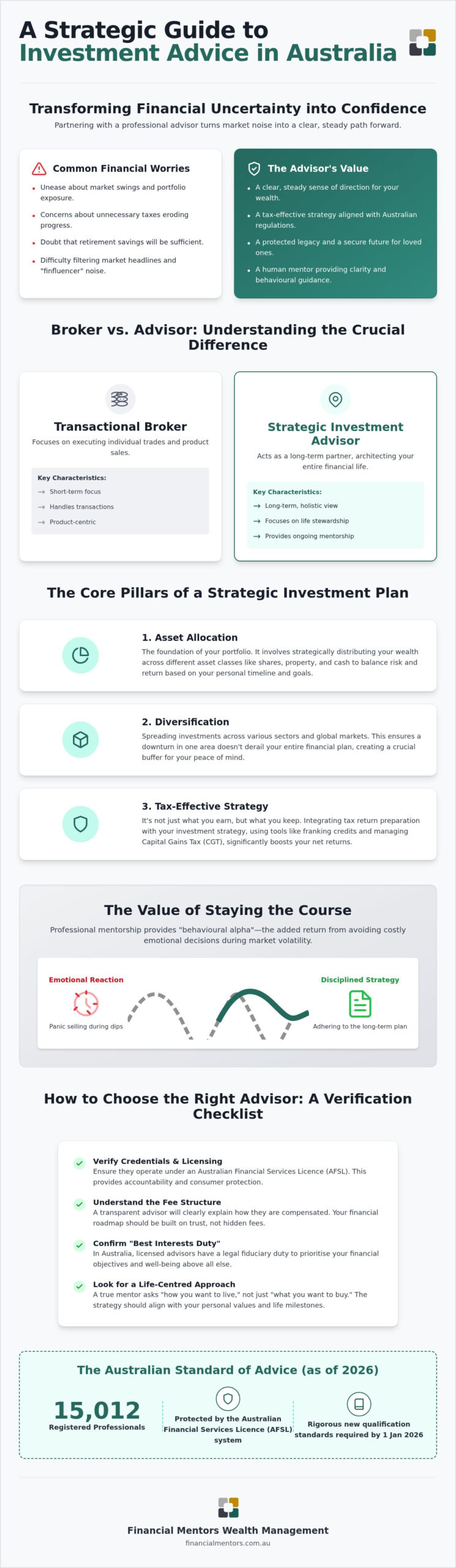
If you have ever wondered exactly What is a Financial Adviser?, you aren’t alone. Many people initially confuse them with stockbrokers, but the roles are fundamentally different. While a broker typically handles transactional trades, an investment advisor acts as a strategic partner. They help you organise, grow, and protect your wealth by looking at your entire financial life rather than just a single trade or asset. Think of them as the architect of your financial house, ensuring every brick serves a purpose in the final structure.
By the start of 2026, the Australian landscape for professional advice reached a significant milestone. Existing advisers were required to meet rigorous new qualification standards by 1 January 2026, ensuring that the 15,012 registered professionals in the industry possess a high level of technical expertise. In an era of digital noise and “finfluencers,” having a human mentor to filter out the static is more valuable than ever. Finding the right investment advisor means moving beyond simple numbers to focus on your specific life milestones, such as starting a family or transitioning into a comfortable retirement.
The Shift from Portfolio Management to Life Stewardship
Modern advice has moved away from just chasing market returns. It’s now about life stewardship. If you’re planning for a grandchild’s education or ensuring your partner is looked after if you aren’t there, your advisor focuses on these “whys” first. They shouldn’t just ask what you want to buy; they should ask how you want to live. A financial roadmap isn’t a static spreadsheet; it’s a living plan for your future. This partnership approach ensures that every decision made is a step toward your personal goals, not just a response to the latest market dip.
Navigating the Australian Regulatory Environment
Trust is the foundation of any mentor relationship. In Australia, this trust is backed by the Australian Financial Services Licence (AFSL) system. Financial Mentors has operated under its own licence since 2003, providing a layer of accountability and consumer protection. When you work with a licensed professional, they are bound by the “Best Interests Duty,” which is a legal requirement to prioritise your well-being above all else. In 2026, an Australian advisor’s fiduciary duty requires them to provide personalised advice that prioritises your specific financial objectives and circumstances above all else.
The core differences between transactional and strategic support include:
- Transactional (Brokers): Focus on individual product sales and execution of trades.
- Strategic (Advisors): Focus on holistic wealth creation, tax effectiveness, and long-term legacy.
- Mentorship: A continuous relationship that adapts as your life stages change.
The Core Pillars of a Strategic Investment Strategy
A strategic portfolio isn’t just a collection of assets; it’s a reflection of your life’s timeline. Your investment advisor should begin by carefully assessing your risk tolerance and timeframe. Asset allocation determines how your wealth is distributed between shares, property, and cash. For those investing in property development, specialized support from ML Traffic Engineers Australia can help manage the technical complexities of project approvals. Diversification then spreads that risk across different sectors and global markets. This ensures that a downturn in one area doesn’t derail your entire plan. It is about creating a buffer that protects your peace of mind while allowing for steady progress toward your goals.
Developing wealth creation strategies australia requires a deep understanding of your personal goals. Are you building for a specific milestone or general security? Regular reviews are essential because life rarely stays the same. Your plan should evolve as your family grows or your career path shifts. Finding the right investment advisor ensures your financial roadmap is built on transparency and is flexible enough to handle unexpected changes.
Integrating Tax and Investment for Better Returns
Market returns are only half the story. What you keep after the Australian Taxation Office (ATO) takes its share is what truly matters. This is where tax return preparation becomes a strategic tool. An advisor who understands the nuances of franking credits and Capital Gains Tax (CGT) can help you structure investments to be more tax-effective. For example, timing the sale of an asset or utilising specific investment vehicles can significantly impact your tax liability. It is about being wise with your resources and ensuring your portfolio is as efficient as possible.
Protecting the Future with Retirement and Estate Planning
As you look toward the horizon, your strategy must bridge the gap between today’s growth and your planned retirement. It’s about more than just superannuation balances; it’s about stewardship and legacy. Seeking estate planning advice ensures that your assets are distributed according to your wishes. If you’re wondering how to choose a financial adviser, look for someone who integrates these pillars into a single roadmap. You might find that speaking with a mentor helps clarify these complex intersections and provides the stability your family deserves for years to come.
Investment Advisor vs. DIY: Calculating the Real Value
Have you ever spent a Sunday afternoon trying to decode a complex tax statement or researching the latest market trends, only to feel more confused than when you started? Managing your own wealth can quickly become a second full-time job. While the DIY approach might seem cost-effective initially, the real value of an investment advisor often lies in the time they give back to you. Instead of staring at spreadsheets, you could be spending that time with your family or pursuing the hobbies you love. Professional guidance isn’t just about picking shares; it’s about reclaiming your life while an expert handles the heavy lifting.
It’s also about what industry experts call “behavioural alpha.” This is the value an advisor adds by acting as a steady hand during market volatility. When headlines turn fearful, a mentor helps you avoid the emotional urge to sell at the bottom. They provide access to institutional research and non-retail opportunities that aren’t typically available to the general public, ensuring your portfolio is built on more than just “gut feel.” The cost of missed opportunities, such as poor super structures or missed tax rebates, can far outweigh the price of professional advice over the long term.
The Hidden Costs of Managing Your Own Wealth
The digital age has brought a new challenge: information overload. If you’re sifting through endless conflicting opinions online, it’s easy to make a small error that leads to a large tax bill or a structural inefficiency in your superannuation. Rebalancing a portfolio and staying on top of Australian tax compliance requires a methodical approach that many DIY investors find overwhelming. Professional stewardship provides a sense of order, ensuring your wealth is organised and your growth isn’t hampered by avoidable mistakes.
When is the Right Time to Seek Professional Advice?
There usually comes a point where your financial situation crosses a “complexity threshold.” This often happens during major life transitions like receiving an inheritance, getting married, or preparing for a transition to retirement. If you’re managing multiple trusts or a self-managed super fund (SMSF), the risk of a compliance mistake increases. Before you make a commitment, it’s wise to perform your due diligence by checking ASIC’s Financial Advisers Register to verify a professional’s history and credentials. If your portfolio has grown beyond your comfort zone, it might be the right time to seek an investment advisor who can help you carry the weight of those decisions.
How to Choose the Right Investment Advisor for Your Needs
Choosing an investment advisor is one of the most significant decisions you’ll make for your family’s future. It’s a relationship built on trust, which is why the selection process should be methodical and calm. To help you find the right fit, consider these four essential steps:
- Verify Credentials: Confirm their AFSL status and professional history on the ASIC register to ensure they meet the 2026 qualification standards.
- Demand Fee Transparency: A professional should be open about their costs; transparency is a marker of someone who values your partnership over a transaction.
- Assess Specialisation: Ensure their expertise aligns with your current life stage, whether that’s aggressive wealth creation or a stable transition into retirement.
- The Chemistry Test: A mentor should listen more than they talk, showing a genuine interest in your unique aspirations and personal challenges.
If you’re nearing retirement, an advisor focused solely on high-growth tech stocks might not be the right fit. Trust your instincts during the initial meeting. A mentor should be deeply curious about your life goals rather than just reciting market statistics or pushing specific products. This partnership is about your peace of mind, not just a spreadsheet.
Questions to Ask During Your Initial Consultation
Success in wealth management isn’t just a percentage on a screen. Ask them: “How do you measure success beyond investment returns?” This helps you understand if they value your long-term stability and the achievement of your specific life milestones. You should also ask about their approach to risk management during market volatility. If they can’t explain how they integrate your tax return preparation and estate planning into the broader strategy, they might be missing the bigger picture of your financial health.
Understanding Different Fee Models in Australia
In the Australian market, “fee-for-service” has become the gold standard for transparency. Since 2013, commissions on most financial products have been legally prohibited, ensuring that your advisor’s interests are aligned with your own. You might encounter fixed annual fees or a percentage of assets under management. The right model depends on your portfolio size and the complexity of your needs. What matters most is that you understand exactly what you’re paying for and why. If you’re ready to see how a transparent, mentor-led approach can work for you, contact our team to start a conversation about your future.
Partnering with Financial Mentors: A Life-Centred Approach
Choosing an investment advisor is about more than just finding someone to manage a portfolio; it’s about finding a partner who understands the weight of your family’s aspirations. Since 2003, Financial Mentors has operated under its own Australian Financial Services Licence (AFSL). This 20 year history provides a level of stability and continuity that is rare in an ever-changing industry. When you walk into our wealth management office, you aren’t just another client file. You’re a person with a unique story, and our role is to act as the steady hand that helps you write the next chapter.
Led by Murray Frean, our team focuses on a mentor-style relationship that prioritises your long-term well-being. We believe that financial advice should be approachable and human. This is why we’ve made it a priority to integrate tax return preparation, retirement planning, and estate strategy under one roof. By having your tax and investment strategies working in harmony, we can identify efficiencies that a disconnected approach might miss. It’s about simplifying the complex so you can focus on what truly matters to you.
Your Tailored Financial Roadmap
If you’ve ever felt overwhelmed by broad financial goals, we help you move toward a specific, actionable strategy. We don’t believe in “one-size-fits-all” solutions because your life doesn’t fit into a template. We take the time to organise your assets for maximum tax efficiency and growth, ensuring every decision aligns with your personal values. This roadmap isn’t just about reaching a number; it’s about the realisation of your aspirations, whether that’s a secure retirement, supporting your children’s education, or building a lasting legacy for your family.
Taking the First Step Toward Peace of Mind
The first meeting with a Financial Mentors advisor is designed to be a calm, jargon-free conversation. We start by listening to your concerns and your dreams for the future. If you’re feeling anxious about market volatility or confused by conflicting advice, our goal is to provide clarity. We explain every step of our process in plain English, ensuring you feel prepared and confident in the path ahead. If you’re ready to organise your future and experience the difference that true mentorship makes, Connect with a Financial Mentors advisor today.
Your Path to a Clearer Financial Future
Building wealth in the Australian market doesn’t have to be a source of constant stress or confusion. By now, you’ve seen how a strategic approach that integrates tax, superannuation, and estate planning provides a level of security that DIY methods often miss. Choosing an investment advisor is about finding a mentor who values your personal aspirations as much as you do. It’s about moving from a place of uncertainty to a state of quiet confidence.
At Financial Mentors, we have provided this steady stewardship under our own AFSL since 2003. Led by Murray Frean, our team specialises in creating tailored financial roadmaps that bring your tax return preparation and investment strategy under one roof. This integrated focus ensures your wealth is organised, efficient, and future-proofed against life’s inevitable changes. You deserve to feel prepared for the milestones ahead, knowing your family’s legacy is in safe hands.
Secure your financial future with a tailored roadmap from Financial Mentors Wealth Management. Your journey toward financial peace of mind starts with a single, calm conversation.
Frequently Asked Questions
What is the difference between an investment advisor and a financial planner?
While the terms are often used interchangeably in Australia, a financial planner usually looks at your entire financial life, including insurance and budgeting. An investment advisor focuses more specifically on the construction and management of your portfolio. Both roles should function as a mentor to help you achieve your long-term goals through professional stewardship and steady planning.
How much does an investment advisor typically cost in Australia?
Fees in Australia vary depending on the complexity of your situation and whether you require one-off advice or an ongoing relationship. Most professionals use a fee-for-service model, which might be a fixed annual amount or a percentage of assets under management. It’s best to discuss these costs openly during your initial consultation to ensure the value provided aligns with your specific needs.
Can an investment advisor help me with my tax return?
Yes, some specialised firms, including Financial Mentors, integrate tax return preparation with your broader wealth strategy. This approach is highly effective because it ensures your investment decisions and tax obligations are working in harmony. Having these services under one roof simplifies your life and helps ensure your portfolio remains as tax-effective as possible throughout the year.
Do I need a certain amount of money to work with an advisor?
There is no legal minimum, but the right time to seek help is often when your financial complexity outweighs your comfort in managing it yourself. If you have reached a life milestone or have a portfolio that requires professional rebalancing, an advisor can add significant value. The focus is on the potential for improvement through planning rather than just the size of your current balance.
How often should I meet with my investment advisor to review my plan?
Most clients find that a formal review once or twice a year is sufficient to keep their roadmap on track. However, you should also reach out during major life transitions, such as marriage, receiving an inheritance, or starting a family. These moments often require a steady, observant guide to adjust your strategy and ensure your long-term stability remains protected.
What happens to my investments if I change advisors?
Your investments are generally held in your name or within a structure like a super fund, so they remain yours even if you change mentors. Moving to a new investment advisor typically involves a simple administrative process to update the authority on your accounts. A professional will guide you through this transition to ensure there is no disruption to your long-term wealth creation strategy.
Is an investment advisor legally required to act in my best interests?
Yes, in Australia, all licensed advisors are legally bound by the “Best Interests Duty.” This requirement ensures that every recommendation made must prioritise your well-being and financial objectives above all else. This legal framework provides a layer of protection and peace of mind, knowing that your mentor is committed to your success and acting with transparency.
Can an advisor help me choose the right superannuation fund?
Absolutely, as superannuation is a cornerstone of retirement planning for most Australians. An advisor can help you compare different funds, assess fee structures, and ensure your super is invested in a way that aligns with your risk tolerance. They help you organise your super to act as a powerful engine for your future-proofing and long-term security.