

What if the best retirement income choice isn’t an either-or decision? The annuity vs account based pension question often comes down to how you balance predictable income with access to your super and flexibility over time.
It’s understandable to want your savings to last while still having room to respond to changing plans or expenses. An annuity provides income under agreed product terms, while an account based pension pays income from an invested super balance. Each option has trade-offs, and the right fit depends on your circumstances and the product terms.
This article explains how the options work and what to compare, including income certainty, access to your super, investment risk and Centrelink entitlements. It also outlines why your partner’s circumstances and goals for leaving an inheritance may be relevant. Use the questions and checks below to clarify what matters to you before seeking tailored retirement advice.
Key Takeaways
- Compare annuity vs account based pension by looking beyond the product name to payment terms, access to your money and investment exposure.
- Check how an annuity’s agreed terms affect its income, as payment certainty and access can vary by product.
- Consider how your choice may interact with Centrelink entitlements and tax, based on your circumstances and current rules.
- Start by estimating your regular income needs and essential expenses, then consider your super, savings, other income and your partner’s circumstances together.
- Use your goals and financial position to guide the comparison, and identify what to check before seeking tailored retirement planning advice.
Annuity vs account based pension: how each can support retirement income
Choosing how your super will support you in retirement can feel like a significant decision. You’re weighing how much income certainty you want against how much control you’d like over your super. The annuity vs account based pension comparison starts with how each provides income: an annuity pays according to agreed product terms, while an account based pension pays from an invested super balance.
The product name alone doesn’t tell you how it will work in practice. Features can depend on the provider, product terms, your eligibility and current rules. Before deciding, check when and how payments are made, whether you can access your money and what happens if your circumstances change.
What does an annuity do?
An annuity provides payments under agreed terms. Depending on the product, payments may be set for a chosen period or continue for life. This can make income more predictable, but the level of certainty and any guarantees depend on the specific terms. Access to the money used to purchase the annuity, payment choices and beneficiary arrangements can also vary. Read the product information to understand exactly what applies.
How does an account based pension work?
An account based pension is a superannuation income stream drawn from an account that remains invested through a super fund. Your balance can rise or fall with investment performance, and it is also affected by withdrawals and fees. A general overview of pension plans explains defined-contribution arrangements, which provide useful context for understanding an account-based approach. Australian super rules and your fund’s terms determine the details that apply to you.
Payments come from your account balance, so how much remains over time depends on investment returns, withdrawals and fees. You may have choices about payment amounts and timing, but account access and payment rules are subject to current requirements and fund conditions. Check these details before relying on a particular level of flexibility.
An annuity pays according to agreed terms, while an account based pension provides income from an invested balance that can change over time. This distinction is a useful starting point. Next, compare the terms of specific products with the income you need and the access you want in retirement.
Annuity vs account based pension: compare certainty, access and investment exposure
The practical difference between these options is how they provide regular income and handle access to your retirement savings. The right balance depends on what matters most to you, not on one option being the clear winner for everyone. Use this comparison to identify what to investigate, then check the terms of any product you’re considering.
| What to compare | Annuity | Account based pension |
|---|---|---|
| Payment certainty | Payments follow the selected product’s terms. The amount and certainty depend on those terms. | Payments are drawn from your account balance, so the amount available can change over time. |
| Access | Access to the purchase money and any payment options depend on the product. | You can draw income from the account, subject to fund conditions and current requirements. |
| Investment exposure | How investment outcomes affect payments depends on the product’s structure and terms. | The balance remains invested, so investment performance can affect its value. |
| Possible term | Some products provide payments for a set term; others may pay for life. | Payments continue from the account while there is a balance and applicable rules are met. |
When might predictable income matter most?
If you’d value a defined payment stream to help meet essential expenses, an annuity may be worth considering. Check whether payments are for a set term or for life, and what the product says about changes in your circumstances. Payment choices, access and beneficiary arrangements vary, so review the terms rather than assuming every annuity works the same way.
When might access and flexibility matter more?
If you want to retain access to an account balance, an account based pension may offer flexibility, subject to fund conditions and current rules. Consider how withdrawals and investment outcomes could affect the amount left in your account. The account-based pension guidance from Moneysmart explains key features and investment choices to review.
An annuity can offer income certainty under its terms, while an account based pension keeps your balance accessible but exposed to withdrawals and investment outcomes. Consider whether you’re comfortable managing income needs that may change, and how much access you want to preserve. To discuss how either option may fit your broader retirement plans, explore tailored retirement planning advice.
How Centrelink entitlements and tax can affect the comparison
The annuity vs account based pension decision can affect more than how you receive income. Your Age Pension eligibility and other Centrelink entitlements may depend on how your income and assets are assessed. Tax outcomes can also vary with your age, income source and personal circumstances. Neither option will increase or reduce your entitlements in every case.
Product structure matters. Annuities can have different terms and may be assessed differently from account based pensions. Your wider financial position, including other assets, income and your partner’s circumstances, may also be relevant. Treat general comparisons as a guide, not a prediction of your individual outcome.
What should you check about Centrelink entitlements?
Services Australia provides current information about Age Pension eligibility and assessment. Before acting, check how the specific product you’re considering may be treated under the rules that apply to you. The assessment can involve more than the product itself, so consider your household circumstances and other income and assets too.
For example, when comparing an annuity with an account based pension, ask how each product’s income and underlying assets may be assessed in your situation. You can also check Moneysmart’s guide to annuities in retirement to understand product features, then confirm any Centrelink questions directly with Services Australia or a suitably qualified adviser.
What tax questions belong in your decision?
Tax treatment may depend on your age, the source of your payments and your circumstances. Don’t assume two retirement income products will have the same tax outcome, or that a general rule applies to you. Ask what tax treatment may apply to your income and any investment earnings, and check current rules before making a decision.
A suitably qualified tax professional can help you understand how the choice fits with your wider tax position. For related context, see this tax return preparation guide. You may also want to bring your product documents and details of your other income and assets to a discussion with an adviser.
Before committing, check:
- How the product’s income and assets may be assessed under current Centrelink rules.
- Whether your partner’s circumstances affect the overall assessment.
- Which tax questions need to be confirmed for your age and income sources.
These checks can help you compare the options in light of your own circumstances, rather than relying on a general rule of thumb.
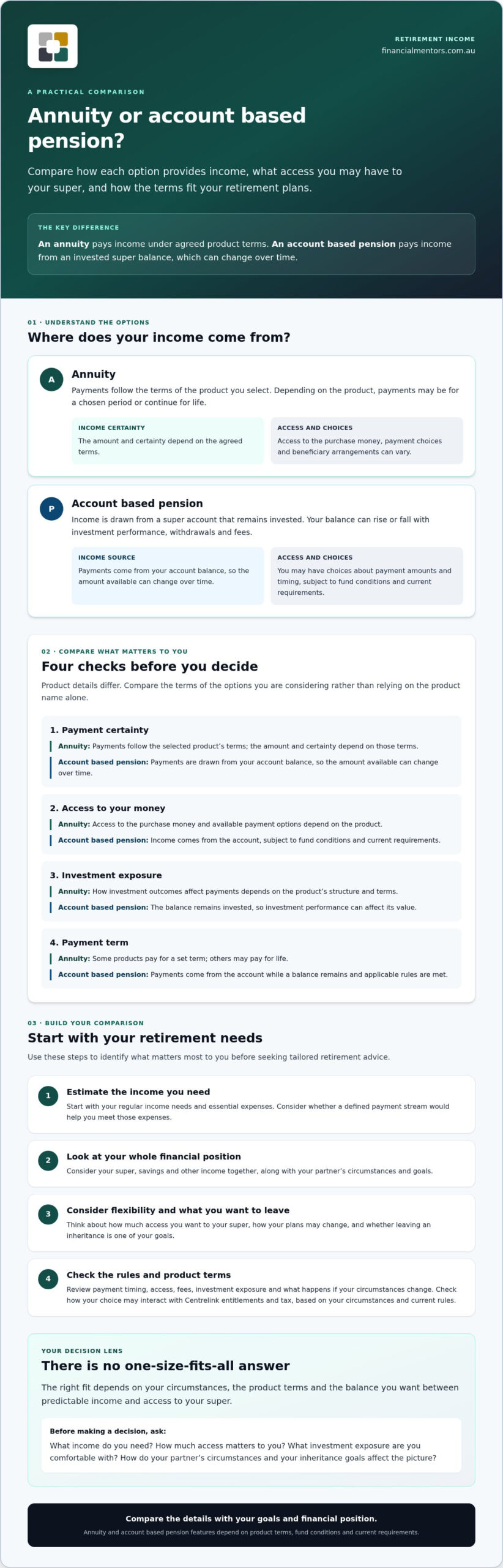
Use this decision framework to assess your retirement income needs
Start with the life your income needs to support, rather than choosing a product first. The steps below can help you compare an annuity and an account based pension against your plans, priorities and financial position.
Map your income needs and preferences
- Estimate your regular income needs. List essential expenses, such as housing, food and bills, separately from flexible spending and personal goals. There’s no standard retirement budget, so use your own expected costs.
- Bring your resources together. Consider savings, super, other income and your partner’s circumstances as part of the same household picture. This helps you see what income may need to come from retirement products.
- Think about how needs may change. Consider whether predictable income would help with regular essentials and how your spending priorities might shift through retirement. Also consider how much access to funds you’d like for changing plans or unexpected costs.
- Match the options to your preferences. Would you value payments set under product terms, or prefer access to an invested account balance? Think about your comfort with investment decisions and monitoring withdrawals over time.
- Check the wider effects. Consider how each option may fit with Centrelink entitlements and your tax position. Outcomes depend on your circumstances and current rules, so don’t treat a general comparison as a personal assessment.
Check the details before choosing
Read the provider information for each product before deciding. Check eligibility, payment conditions, access rules and beneficiary provisions. Compare any fees, and understand which investment decisions you’ll need to make or which choices are set by the product terms.
Write down anything that remains unclear. This could include how payments work if your needs change and how the product may be assessed for tax or social security purposes. A broader retirement planning checklist can help you organise other preparation steps alongside this comparison.
Once you’ve gathered these details, an appointment with a financial adviser can help connect product features with your income needs and wider financial position. For tailored retirement planning advice, discuss your retirement income options.
Bring annuity vs account based pension into your retirement plan
There’s no single answer to the annuity vs account based pension question that suits everyone. The right option depends on your goals, financial position and the product terms. Consider each choice as part of your broader retirement plan, including the income you need, the access you prefer and how your super and other assets work together.
Tailored retirement planning can help you weigh these factors side by side. An adviser can discuss how the options may fit your expected income needs, Centrelink entitlements and wider plans, while identifying details to check against current rules. Financial Mentors Wealth Management’s initial meeting is step 01 of its advice process.
Questions to take to an appointment
An appointment can help you move from a general comparison to questions about your own circumstances. You could ask:
- How might each option fit the income you expect to need and the access you want to retain?
- What could current tax and social security rules mean for your personal situation?
- How does the choice fit with your other super, assets, estate planning and long-term goals?
- Which product terms or conditions should you understand before making a decision?
These questions help you explore the trade-offs without assuming one option is automatically right. They can also clarify how the decision may affect your household over time.
Make the next step a considered one
Before an appointment, gather your super statements, information about any products you’re considering and a household budget. Include relevant details about other income and assets, as well as your partner’s circumstances. Having these together can make it easier to discuss your priorities and identify what still needs to be confirmed.
For broader preparation, read this planned retirement guide. It can help you reflect on plans beyond this product comparison.
If you’re ready to explore how your options fit your circumstances, you can discuss your retirement plans with Financial Mentors Wealth Management. Use the conversation to clarify what to check next and how each choice may support the retirement you want.
Take a considered next step towards retirement
The annuity vs account based pension decision is about more than choosing a product. An annuity may provide payments under agreed terms, while an account based pension draws income from an invested balance. Your priorities around certainty, access and investment involvement can guide the comparison.
Your financial position, product terms and personal circumstances matter too. Check how each option may fit your income needs, Centrelink entitlements and wider retirement plans, including your partner’s circumstances and long-term goals. Tax and social security outcomes depend on individual circumstances and current rules, so confirm the details before acting.
Retirement planning advice can help you consider these choices as part of your broader financial plan. At Financial Mentors, the initial meeting is step 01 of the advice process. Bring your questions and relevant information, then take time to understand your options.
Discuss your retirement plans and take a considered next step. A clearer view of your choices can help you decide what to explore further.
Frequently Asked Questions
What is the main difference between an annuity and an account based pension?
An annuity pays income under agreed product terms, while an account based pension draws payments from an invested super account. An annuity may provide payments for a set term or for life, depending on the product. With an account based pension, the balance can change with investment performance, fees and withdrawals. The annuity vs account based pension choice often comes down to how you weigh predictable payments against access to an invested balance.
Is an annuity safer than an account based pension?
It depends on what you mean by “safer” and on the product’s terms. An annuity may provide greater certainty about payments, but its features and guarantees depend on the selected product. An account based pension remains invested, so its balance can rise or fall with market performance and withdrawals. Compare the risks that matter to you, including payment certainty, investment exposure and access to your money.
Can you have an annuity and an account based pension at the same time?
It may be possible to use both, subject to your circumstances, eligibility, super rules and the terms of the products. Some people consider combining options to balance a more predictable income stream with access to an invested account. Before deciding, check how each product works alongside your other super and income, and whether the combined approach fits your goals, cash-flow needs and Centrelink entitlements.
How does an annuity affect Centrelink entitlements?
An annuity may affect your Centrelink entitlements because its payments and purchase value can be assessed under income and assets tests. For qualifying lifetime annuities purchased on or after 1 July 2019, 60% of income payments are assessed under the income test, and a portion of the purchase price is assessed under the assets test. Your individual result depends on your circumstances and current rules, so confirm details with Services Australia before acting.
What happens to an account based pension if investment markets fall?
If markets fall, the investments in your account based pension may lose value, reducing your account balance. Withdrawals and fees also affect how much remains. A market fall doesn’t necessarily mean payments stop, but continued withdrawals from a lower balance may affect how long your savings last. Check your fund’s investment options and payment conditions, and consider how your income plan would respond to changing investment values.
Can you access your money after buying an annuity?
Access depends on the annuity’s terms. Some products may provide limited options to change payments or access capital, while others may not allow you to withdraw the purchase amount as a lump sum. Before committing, check whether payments can change, what happens if your circumstances shift and whether beneficiary provisions apply. Don’t assume all annuities offer the same access or flexibility; read the product information carefully.
How do you choose between an annuity and an account based pension?
Start by estimating your essential expenses and regular income needs, then consider your savings, super, other income and your partner’s circumstances together. Compare the products’ payment terms, access conditions, investment exposure and fees. Also check how each may affect your tax position and Centrelink entitlements under current rules. The suitable choice depends on your goals, financial position and product details, so tailored retirement planning advice can help you assess the options.