

What if the very same habits that helped you build your nest egg are the ones now standing in the way of a comfortable retirement? For most of your working life, the goal was simple: grow your balance as large as possible. However, as you reach your preservation age, the transition from accumulation to drawing a steady income can feel like learning a whole new language. It’s completely natural to feel a pinch of anxiety about market volatility or the complexity of superannuation rules. You’ve worked hard for your savings, and you deserve to feel certain that they will last as long as you do.
This article explores practical investment strategies for retirement australia designed to help you move from chasing growth to mastering consistent cash flow. We’ll show you how to structure your assets to be more tax-effective and how to coordinate your private savings with Age Pension eligibility. By the end of this guide, you’ll have a clearer understanding of how to build a reliable income stream. We’ll walk through the popular bucket strategy for managing risk and explain how a personalised roadmap can provide the peace of mind you’ve been looking for.
Key Takeaways
- Understand why your financial goals should shift from simply growing a balance to creating a sustainable, reliable income stream.
- Learn how to organise your assets using a three-bucket approach to help provide stability and peace of mind during market downturns.
- Discover how to make the most of tax-free superannuation benefits and transition to retirement strategies to maximise your future position.
- Explore effective investment strategies for retirement australia that help protect your nest egg from sequencing risk and the fear of outliving your savings.
- See how a personalised roadmap can simplify complex legislative changes, allowing you to focus on the life milestones that matter most.
The Great Shift: Moving from Accumulation to Retirement Income
For decades, your financial life has likely followed a single, clear direction: up. You’ve worked hard to build your balance, watching the numbers grow through regular contributions and market gains. This is what we call the accumulation phase, a time when time itself is your greatest ally. But what happens when the regular paycheque stops? Suddenly, you enter the pension phase, and the rules of the game change completely. It’s no longer just about how much you have, but how much you can safely spend without the fear of running out.
This transition requires a significant psychological shift. It’s the move from being a builder to being a steward of your hard-earned legacy. If you feel a sense of weight or responsibility when looking at your accounts, that’s a completely natural reaction. You aren’t just managing numbers on a screen; you’re managing your future peace of mind. Effective investment strategies for retirement australia must account for this emotional reality, ensuring you feel secure even when the market feels anything but steady. If you can change your perspective from “saving” to “stewardship,” you’ll find it much easier to make the logical decisions required for this new chapter.
Why Your Current Strategy Might Not Fit Retirement
If you stay too focused on high-growth assets, you might find yourself in a difficult position when you need immediate cash. While growth is still important for the long term, you can’t pay for your daily expenses with potential capital gains. In 2026, Australian retirees are also facing the reality of higher living costs. Inflation can quietly erode the purchasing power of a fixed income if your strategy isn’t flexible enough to adapt. This is why having a planned retirement is so vital. It sets a firm baseline for what you actually need to live well, rather than just guessing and hoping for the best.
The Three-Legged Stool of Australian Retirement
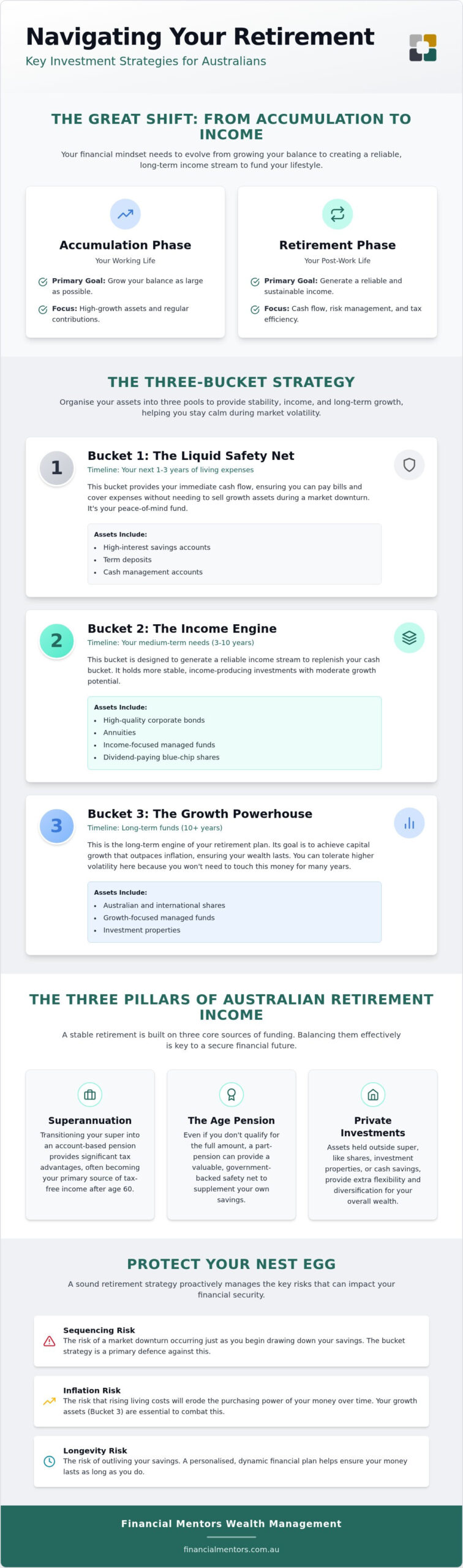
Think of your retirement income as a three-legged stool. If one leg is shorter than the others, the whole structure becomes unstable. The three pillars include:
- Leg 1: Superannuation. This involves Superannuation in Australia transitioning into an account-based pension, which offers significant tax advantages once you reach 60.
- Leg 2: The Age Pension. Even if you don’t qualify for a full payment, many Australians find that a part-pension provides a valuable government-backed safety net.
- Leg 3: Private Investments. This includes assets held outside of super, such as shares, investment properties, or simple cash savings.
Balancing these three sources is the core of smart investment strategies for retirement australia. When these elements work together, they create a reliable stream of income that supports your lifestyle while protecting your capital for the years ahead.
The Three-Bucket Strategy: Organising Your Assets for Stability
How do you keep a calm head when the share market takes a tumble? It’s a question many Australians ask as they approach their finish line. One of the most effective investment strategies for retirement australia is the “three-bucket” approach. This framework isn’t just about spreadsheets; it’s about psychological security. By dividing your wealth into three distinct pools: Cash, Income, and Growth, you create a buffer between your daily life and the volatility of the markets. This structure allows you to ignore short-term noise because you know exactly where your next paycheque is coming from.
The Cash Bucket acts as your primary source for the first two to three years of living expenses, providing a reliable stream of funds regardless of what the Australian Stock Exchange is doing on any given day.
Bucket 1: The Liquid Safety Net
Start by determining your “cash floor.” This is the minimum amount you need in the bank to feel safe. If you have enough cash tucked away in high-interest accounts or term deposits, you can afford to wait for the market to recover if there’s a temporary dip. This simple structure helps prevent “panic selling,” which is one of the biggest threats to a long-term retirement plan. As you develop an investing plan, you’ll see that liquidity is the foundation of your confidence. It’s much easier to stay the course when you aren’t worried about how you’ll pay for next month’s groceries or an unexpected car repair.
Bucket 2 & 3: Sustaining and Growing Your Wealth
Once your immediate needs are met, your remaining assets can go to work. The Income Bucket focuses on assets that provide regular distributions, such as Australian shares with healthy franking credits or fixed-interest securities. This bucket’s job is to refill your cash bucket over time. Finally, the Growth Bucket holds your long-term investments, like international equities or property. These are essential for protecting your lifestyle against the rising costs of living we’re seeing in 2026.
Balancing these different timeframes is a core part of effective wealth creation strategies australia. It ensures your money stays ahead of inflation while still being there when you need it. To keep this system working, you’ll need to periodically “rebalance” your buckets. If your growth assets have had a stellar year, you might move some of those gains into your cash or income buckets to keep them topped up. It’s a methodical way to harvest wins and maintain your safety net. If you’d like to see how these buckets might look for your specific situation, speaking with a mentor can help you find the right balance for your goals.
Optimising Superannuation and Tax for Retirees
Did you know that reaching age 60 marks one of the most significant milestones in your financial journey? For most Australians, this is the point where superannuation benefits generally become tax-free. It’s a breath of fresh air after years of seeing a portion of your earnings go to the tax office. However, simply reaching this age isn’t the end of the story. To truly secure your future, you need to understand how to move your wealth into the most efficient structures possible. If you’re still working but want to start boosting your super, a Transition to Retirement (TTR) strategy can be an excellent way to reduce your tax bill while keeping your retirement savings on track.
These sophisticated investment strategies for retirement australia work best when they’re part of a joined-up plan. This is where professional tax return preparation becomes more than just an annual chore. It’s a strategic review that ensures your investment income, pension payments, and any remaining work earnings are all working together. You also need to keep a close eye on the Transfer Balance Cap in 2026. This limit dictates how much you can move from your “accumulation” account into the tax-free “retirement phase” account. If you go over this limit, you could face unnecessary tax penalties that are easily avoided with a bit of foresight.
Account-Based Pensions vs. Lump Sums
Should you take your super as a regular income stream or a single lump sum? An account-based pension is often the preferred choice because it provides a steady “paycheque” while the remaining balance stays invested in a tax-effective environment. If you’re considering a lump sum, it’s usually best for specific goals, such as clearing a mortgage before you stop work. Keep in mind that your choice impacts the Age Pension assets test. For a single homeowner in 2026, the threshold for a full pension is $333,000. Every dollar over that limit can affect your payments, so the way you structure your withdrawals matters deeply for your long-term stability.
The Role of SMSFs in Custom Strategies
For some, a Self-Managed Super Fund (SMSF) offers the ultimate sense of stewardship. It gives you direct control over assets like commercial property or specific Australian shares that you might already know and trust. However, with great control comes a higher level of responsibility. The compliance burden for SMSFs is significant, and the rules are always evolving. This is where a mentor can be invaluable, helping you weigh up whether the flexibility of an SMSF is worth the extra administration. Whether you choose a retail fund or an SMSF, the goal remains the same: a tax-effective structure that supports your unique life goals.
Managing Risk: Protecting Your Nest Egg from Volatility
How do you feel when you see headlines about share market turbulence? If you’re still working, a market dip is often just a blip on the radar. However, if you’re about to retire, those same headlines can feel much more personal. This brings us to a concept called sequencing risk. It’s the danger that the market performs poorly just as you begin to draw down your savings. If your portfolio loses value at the same time you’re withdrawing funds for living expenses, you’re effectively selling assets at the bottom. This leaves less capital in your account to benefit from a future recovery, which can significantly shorten the life of your nest egg.
Effective investment strategies for retirement australia must also address longevity risk. With current projections showing Australian men living to 83 and women to 86 on average, your capital might need to support you for thirty years or more. It’s a long-distance marathon, not a sprint. To manage this, we look at broad diversification across different asset classes and global geographies. By not having all your eggs in one basket, you reduce the impact if one particular sector or country faces a downturn. This is why regular reviews with a wealth management office are so vital. They help you adjust your strategy as your life changes and the world evolves.
Inflation: The Silent Eroder of Wealth
While market crashes are loud and scary, inflation is the silent eroder of your purchasing power. In 2026, we’ve seen how quickly the cost of daily essentials can climb. If your retirement income stays exactly the same while the price of healthcare and groceries goes up, your standard of living will slowly decline. To stay ahead, your portfolio needs a healthy dose of growth assets, like Australian equities or property, which historically have the potential to outpace rising costs. A wise mentor can help you find the right draw-down rate that balances your current needs with the necessity of future-proofing your wealth.
Estate Planning: Investing for the Next Generation
Your investment journey doesn’t just affect you; it’s also about the legacy you leave for those you love. Integrating your financial plan with professional estate planning advice ensures your hard-earned assets are distributed exactly as you intended. For example, passing superannuation death benefits to non-dependant adult children can lead to significant tax implications that catch many families off guard. By structuring your assets thoughtfully now, you can protect your beneficiaries from unnecessary stress and costs later. If you’d like to ensure your family’s future is as secure as your own, starting a conversation with a trusted partner is a great first step toward true peace of mind.
Crafting Your Personalised Roadmap with Financial Mentors
When you look at the broad range of investment strategies for retirement australia, it’s easy to see why a one-size-fits-all approach often misses the mark. Your life isn’t a carbon copy of your neighbour’s or a generic case study in a textbook. You have your own unique set of aspirations, family dynamics, and comfort levels with risk. If your financial plan doesn’t reflect your personal values, it won’t provide the peace of mind you truly deserve. A tailored roadmap is essential because it aligns your hard-earned assets with the specific lifestyle you’ve spent decades dreaming about.
As we move through 2026, the landscape of Australian retirement continues to grow more complex. With shifting Age Pension thresholds and evolving superannuation caps, trying to keep up with every legislative change can feel like a full-time job. This is where the value of a mentor becomes clear. Instead of you having to master every technical detail, we act as your guide, filtering out the noise and focusing only on what impacts your journey. We help you organise the moving parts of your finances so that you can stop worrying about spreadsheets and start focusing on your family, your hobbies, and your health.
The Financial Mentors Difference
We believe that financial advice should feel like a supportive partnership rather than a cold, corporate transaction. Our approach is grounded in empathy and validation, acknowledging that the transitions you’re facing are as much about emotions as they are about economics. With our AFSL active since 2003, we’ve spent more than two decades helping Australians navigate the highs and lows of the market. We take a holistic view of your world, ensuring that your wealth creation, tax return preparation, and estate planning all point in the same direction. This integrated style of stewardship means nothing is left to chance.
Taking the First Step Toward Certainty
If you’re feeling a little uncertain about the future, the best remedy is a clear, documented plan. Our collaborative process begins with a conversation where we listen to your story and identify the milestones that matter most to you. We move at your pace, providing a steady, step-by-step narrative that turns confusion into clarity. During an initial consultation, we’ll explore the possibilities for your capital and begin building a strategy that feels practical, wise, and forward-looking.
Imagine waking up on a Tuesday morning, knowing that your day is yours to spend exactly as you wish, with the quiet confidence that your financial foundations are rock-solid and fully taken care of. This sense of certainty is the ultimate goal of our work together. By choosing to act now, you’re not just managing money; you’re securing the freedom to enjoy your retirement years without the weight of financial worry. When you’re ready to start this new chapter with a reliable partner by your side, we’re here to help you find the way forward.
Your Path to a Confident Australian Retirement
Transitioning into this new chapter is about more than just numbers; it’s about the freedom to enjoy the fruits of your hard work. We’ve explored how shifting your focus from growth to reliable cash flow can reduce stress, especially when you use frameworks like the three-bucket strategy to manage volatility. By refining your investment strategies for retirement australia, you can move forward with certainty, knowing your immediate lifestyle is protected while your long-term wealth continues to grow.
Since 2003, we’ve operated as specialists in strategic retirement and estate planning under our own AFSL. Our team provides integrated tax and wealth management services to bring every part of your financial life into harmony. If you’re ready to move from uncertainty to a documented, strategic plan, we invite you to begin your journey to a secure retirement with a tailored roadmap from Financial Mentors Wealth Management. You deserve the peace of mind that comes from being prepared for whatever the future holds.
Frequently Asked Questions
What is the best investment strategy for retirement in Australia?
The most effective approach is one that prioritises a sustainable income stream over simple capital growth. While there is no single “best” plan for everyone, successful investment strategies for retirement australia typically focus on managing sequencing risk and ensuring you have enough liquid cash to weather market downturns. By balancing defensive assets like cash with growth assets like shares, you can create a resilient portfolio that supports your unique lifestyle goals.
How much money do I need to retire comfortably in Australia in 2026?
The amount you need depends entirely on your personal definition of a comfortable life and your expected longevity. While industry standards often suggest a couple might need around $72,000 per year for a comfortable lifestyle, the rising costs we’ve seen in 2026 mean your specific “number” might be higher. It’s helpful to consider your essential expenses versus your “nice-to-haves” to determine a baseline that provides genuine peace of mind.
Can I still contribute to superannuation after I retire?
Yes, you can generally make voluntary contributions to your super until you turn 75, even if you are no longer working. For the 2026-2027 financial year, the annual cap for after-tax (non-concessional) contributions is $130,000. This can be a wise way to move personal savings into a more tax-effective environment, provided you stay within your total super balance limits and understand the rules around the “bring-forward” arrangement.
How does the Age Pension interact with my private investments?
The Age Pension acts as a safety net that is adjusted based on your private wealth through the income and assets tests. For example, as of July 2026, a single homeowner can have up to $333,000 in assessable assets and still receive the full pension. If your private investments grow beyond certain thresholds, your pension payments may reduce. Coordinating these two income sources is a vital part of a professional financial roadmap.
What is the “bucket strategy” for retirement income?
The bucket strategy involves dividing your total savings into three distinct pools based on when you need the money. Your first bucket holds 2-3 years of cash for immediate living costs, the second holds income-producing assets like bonds or high-dividend shares, and the third focuses on long-term growth. This structure is one of the most reliable investment strategies for retirement australia because it helps you avoid selling growth assets when prices are low.
Should I pay off my mortgage before I retire?
For many Australians, entering retirement debt-free is a top priority for both emotional and financial reasons. Your family home is generally exempt from the Age Pension assets test, so using surplus cash to clear the mortgage can sometimes improve your pension eligibility. If you don’t have a mortgage, your ongoing cost of living is significantly lower, which reduces the pressure on your investment portfolio to generate high returns every single year.
What are the tax benefits of an account-based pension?
Once you reach age 60 and start an account-based pension, the income you receive and the investment earnings within the fund are generally tax-free. This is a significant advantage compared to keeping money in a standard bank account or a personal share portfolio where you would pay tax at your marginal rate. It’s a powerful way to make your retirement savings last longer by keeping more of your returns in your own pocket.
How often should I review my retirement investment strategy?
You should ideally review your strategy at least once a year or whenever a significant life event occurs, such as a health change or a large inheritance. Regular reviews allow you to rebalance your “buckets” and ensure your asset allocation still matches your risk tolerance. Because legislative rules regarding superannuation and the Age Pension change frequently, staying in close contact with a mentor ensures your plan remains practical and forward-looking.