
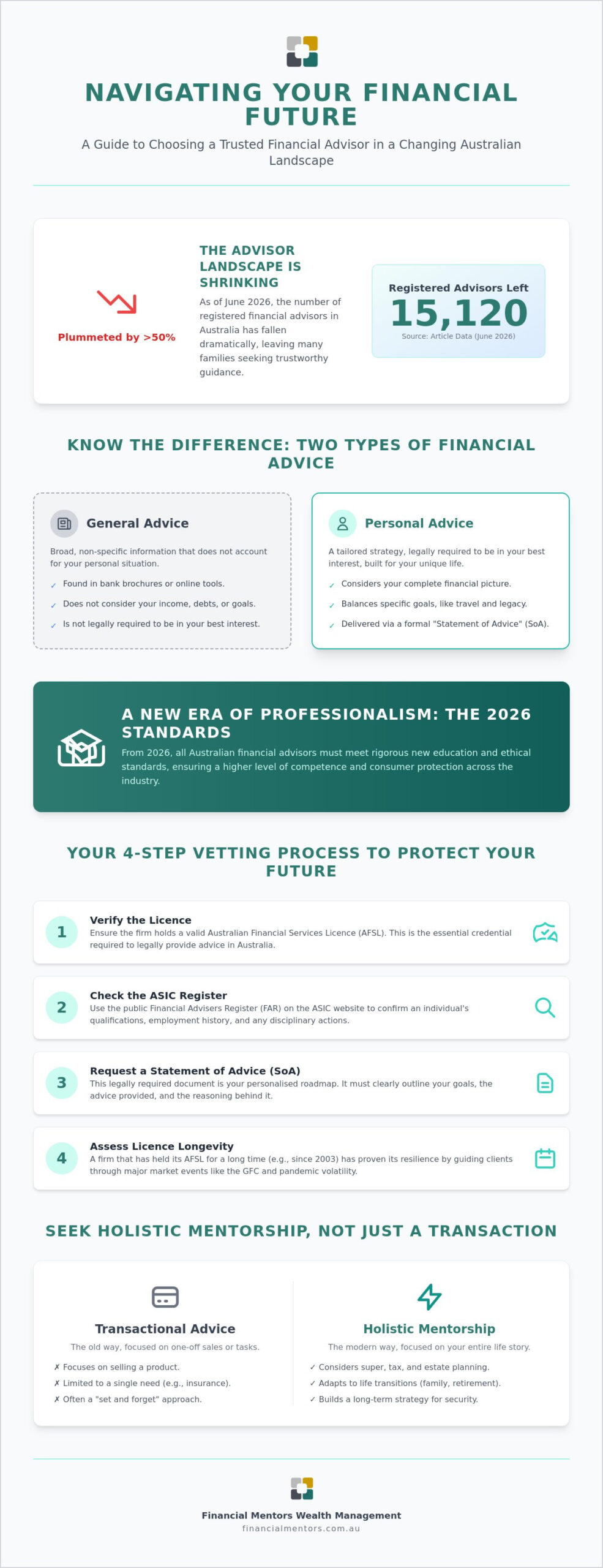
Did you know that as of June 2026, there are only 15,120 registered financial advisors left in Australia? This number has plummeted by more than half since the Hayne Royal Commission, leaving many families feeling adrift and wondering who they can actually trust with their life savings. When you’re trying to make sense of shifting tax laws and the sheer complexity of superannuation, that sense of uncertainty is heavy. It’s perfectly natural to worry about hidden fees or, even worse, the nagging fear that you might eventually outlive your hard-earned retirement funds.
We understand that you’re looking for more than just a spreadsheet; you want a partner who listens to your story and values your legacy. This guide is designed to help you find a trusted mentor who can simplify the noise and help you create a secure wealth strategy with confidence. We’ll walk you through the new 2026 professional standards, the importance of integrated tax preparation, and how a clear roadmap can finally give you the feeling of being truly looked after as you plan for the years ahead.
Key Takeaways
- Learn how to distinguish between transactional advice and holistic wealth mentorship to ensure your financial plan reflects your unique life goals.
- Understand the importance of the AFSL framework and how to verify that your financial advisors meet the strict 2026 professional education standards.
- Discover the different ways advice is priced, helping you move past the fear of hidden fees and focus on the long-term value of professional guidance.
- Follow a clear, step-by-step process for vetting a potential partner, including how to use the ASIC register to protect your family’s future.
- Explore why an integrated approach, combining strategic wealth creation with expert tax preparation, provides a more cohesive path to financial security.
What Do Financial Advisors Actually Do? Defining Modern Wealth Stewardship
Many people assume that meeting with professional financial advisors is simply about picking the right shares or comparing insurance policies. While those technical elements matter, modern wealth stewardship is much deeper than a one-off transaction. A Financial adviser acts as a strategic partner, helping you manage the inevitable transitions that life throws your way. If you are starting a family, receiving an inheritance, or preparing to stop work, how do you ensure your long-term security is protected? These mentors provide the steadying influence you need to answer that question with confidence.
Instead of the old model of “product-pushing,” where the focus was on selling a specific fund, holistic mentorship prioritises your personal values. It’s about looking at your entire financial life as a single, connected story. This includes your superannuation, your tax preparation, and your plans for your family’s legacy through estate planning. The ultimate goal isn’t just a higher number on a balance sheet; it is the quiet confidence that comes from knowing you have a plan in place. This peace of mind is the most valuable thing an advisor can deliver.
The Difference Between General and Personal Advice
You might encounter “general advice” through bank brochures or automated online tools. This information is broad; it doesn’t consider your specific income, your debts, or your unique family dynamics. In contrast, personal advice is a tailored strategy built specifically for you. Under Australian law, personal recommendations must be in your “best interest.” If your advisor understands that you want to travel in retirement while still leaving a deposit for your grandchildren’s first homes, they’ll build a roadmap that balances those specific desires. A mentor looks at the person behind the portfolio.
Why 2026 is the Year to Seek Professional Guidance
The economic environment in Australia is shifting quickly. As of 2026, new education standards mean that every practising professional has met rigorous qualifications, ensuring a higher level of competence across the industry. With changes to superannuation caps and new tax thresholds becoming effective this year, the “set and forget” approach of the past no longer works. You need to ensure your wealth creation strategy is still fit for purpose. Professional financial advisors provide the necessary stability during periods of market volatility by anchoring your decisions in logic rather than emotion.
The Australian Framework: Understanding AFSLs and Professional Standards
If you’ve ever felt overwhelmed by the legal jargon surrounding your money, you aren’t alone. The Australian financial system is designed to be robust, but for many, it feels like a maze of acronyms. At the heart of this system is the Australian Financial Services Licence (AFSL). Think of this as the essential credential that permits a firm to provide advice. It’s the primary way the Australian Securities and Investments Commission (ASIC) keeps the industry accountable. Every professional financial advisor you speak with must be linked to an AFSL, ensuring they meet strict operational and ethical standards.
When you decide to move forward with a plan, you’ll receive a Statement of Advice (SoA). This isn’t just a compliance document; it is your bespoke roadmap. It details where you are now, where you want to go, and exactly how your advisor plans to get you there. By documenting these recommendations, the law ensures that your interests are always placed ahead of any corporate profit. To truly feel secure, it’s wise to use the Financial Advisers Register (FAR). This public database allows you to verify an individual’s qualifications and check for any history of misconduct. It’s a simple step that provides immense peace of mind before you even sit down for a consultation.
Why Licence Longevity Matters
How do you know if a firm is built to last? Why does the age of a licence matter? If a firm has held its AFSL since 2003, like Financial Mentors AFSL Pty Ltd, it tells a story of resilience. They’ve guided clients through the Global Financial Crisis and the volatility of the early 2020s. This depth of experience means they’ve seen almost every market condition imaginable. Working with an established wealth management office provides a level of stability that newer, untested firms simply can’t match. It’s the difference between following a trend and following a proven path.
Your Rights as a Client
As a client, you are protected by the “Best Interest Duty.” This means financial advisors are legally obligated to provide advice that benefits you, not their own bottom line. Transparency is the cornerstone of this relationship. You should always know exactly what you’re paying and why. The Financial Advice Association Australia plays a vital role in promoting these professional standards across the country. If you’re ready to see how a long-term perspective can change your outlook, you might consider reaching out for strategic financial planning that puts your goals first.
Assessing Financial Advisor Fees and the Return on Professional Advice
If you’ve ever hesitated to book a consultation because you’re worried about high costs, you’re certainly not alone. Understanding how financial advisors charge for their expertise is a vital part of building a trusting relationship. Most professionals use a combination of fixed fees for a specific Statement of Advice and ongoing service fees for year-round support. While percentage-based models still exist, the industry has moved toward greater transparency to ensure you know exactly what you’re paying for. For a deeper look at standard industry practices, ASIC’s MoneySmart guide to financial advice offers a helpful breakdown of what to expect.
It’s tempting to look for the lowest price, but “cheap” advice often carries a hidden cost. If a strategy fails to account for a complex tax rule or misses a retirement contribution deadline, the long-term impact on your wealth can be far greater than the initial fee you saved. The real return on investment isn’t just a percentage on a screen; it’s the hours of time you reclaim and the reduction in late-night anxiety about your family’s future. This intangible value, often called the “peace of mind premium,” is what truly defines a successful partnership with a mentor.
The Value of Integrated Tax Return Preparation
One of the most common frustrations for Australians is the disconnect between their accountant and their wealth planner. If your advisor doesn’t understand your tax position, they might recommend a strategy that looks good on paper but creates an unnecessary liability. By choosing a firm that specialises in both strategic advice and tax return preparation, you ensure that every part of your financial life is working in harmony. This integrated approach doesn’t just save you from repeating your story to two different offices; it ensures your wealth creation is as tax-efficient as possible.
Quantifying the ‘Advice Gap’
Research consistently shows a significant “advice gap” between those who seek professional guidance and those who go it alone. Currently, about 1.92 million Australians receive active advice, and they often report higher levels of financial security and confidence. Even small adjustments to your superannuation contributions, when made early enough, can compound into hundreds of thousands of dollars over several decades. In the end, the true ROI of professional mentorship is measured by the peace of mind you gain from avoiding costly estate planning mistakes that could otherwise diminish your legacy.
A Step-by-Step Guide to Choosing the Right Financial Planner for You
Finding the right person to guide your financial journey is a deeply personal choice. It’s about more than finding someone with the right degree; it’s about finding a mentor who understands your family’s unique rhythm. If you’re feeling a little overwhelmed by the process, taking a methodical approach can help replace that anxiety with a sense of control. By following a few clear steps, you can ensure that the professional you choose is truly aligned with your aspirations.
The first step is to sit down and identify your core life goals. Are you focused on aggressive wealth growth, or is your priority ensuring a lasting legacy for your grandchildren? Once you have this clarity, you can move to the practical vetting stage. This involves checking the ASIC Financial Advisers Register to review an individual’s history. While we touched on this earlier, it’s worth a deep dive to ensure there are no past misconduct issues. From there, we recommend interviewing at least two different financial advisors. This isn’t just a technical check; it’s a “personality fit” test to see if you feel comfortable sharing your life story with them. Finally, always review the Fee Disclosure Statement (FDS) with a critical eye to ensure you understand exactly what you’re paying for.
Questions to Ask in Your Initial Consultation
When you meet with a potential guide, don’t be afraid to ask direct questions. You might start by asking, “How do you charge, and what specific services are included in that fee?” It’s also vital to know if they have a particular area of expertise. For instance, do they specialise in ensuring your planned retirement is secure, or is their focus primarily on early-stage wealth creation? Knowing how often you’ll meet to review your progress is another essential detail that helps set expectations for a long-term partnership.
Red Flags to Watch Out For
Trust your instincts during these early conversations. If you encounter high-pressure sales tactics or promises of “guaranteed” returns, it’s usually a sign to walk away. Genuine financial advisors will never rush you into a decision or provide vague explanations about their fees or commissions. A lack of interest in your personal life milestones, such as starting a family or transitioning to part-time work, is another warning sign. A true mentor focuses on your journey, not just the products they can offer. If you’re ready to start a conversation with a team that values your story, you can connect with a dedicated financial mentor to explore your options.
Beyond the Numbers: How Financial Mentors Wealth Management Protects Your Legacy
At Financial Mentors Wealth Management, we believe that true success isn’t just about the figures on your yearly statement. Led by Murray Frean, our approach is built on the philosophy that financial advisors should serve as life-long mentors rather than distant corporate entities. Since our AFSL was registered in 2003, we have focused on helping Australian families align their wealth with their deepest personal values. By operating as a national wealth management office with deep local expertise, we offer the best of both worlds; the resources of an established firm and the personalised care of a trusted guide sitting across the table from you.
One of the most significant benefits of this partnership is having a single point of contact for your entire financial life. Whether you are seeking estate planning advice, preparing your annual tax return, or adjusting your retirement strategy, our team ensures every element is synchronised. This reduces the administrative burden on you and ensures that no detail is overlooked as you move through different life stages. When your tax strategy and wealth creation are managed under one roof, you gain a level of clarity that is rarely found in traditional, fragmented financial services.
A Stewardship Approach to Wealth Creation
We often talk about stewardship rather than just management. If you view your wealth as a tool to support your family’s future, then our role is to help you protect and nurture that tool. Managing assets is a technical task, but stewarding a legacy requires an understanding of the emotional nuances involved in major life changes. We help you navigate these transitions with quiet confidence, ensuring your plan remains resilient regardless of market shifts. For those looking to refine their long-term growth, exploring modern wealth creation strategies australia can provide the necessary foundation for a thriving future.
Starting Your Journey Today
The most common regret we hear from clients is that they didn’t start their planning sooner. Delaying a financial review often means missing out on years of compounding growth or failing to take advantage of current tax incentives that could benefit your family. When you first reach out to our team, you can expect a calm, thoughtful conversation focused on your goals, not a high-pressure sales pitch. We take the time to listen and understand where you want to be in ten, twenty, or thirty years. If you’re ready to organise your future and experience the peace of mind that comes from professional financial advisors, we invite you to Connect with Financial Mentors Wealth Management today.
Taking the Next Step Toward Lasting Security
Choosing to partner with professional financial advisors is one of the most significant decisions you can make for your family’s future. We’ve explored how the 2026 regulatory landscape prioritises your protection and why verifying an AFSL is the first step toward building a relationship based on trust. By integrating your tax preparation with strategic wealth creation, you move away from fragmented advice and toward a cohesive plan that respects your unique life milestones.
At Financial Mentors Wealth Management, we’ve held our AFSL since 2003, providing a stable foundation for our boutique mentorship approach. We don’t believe in one-size-fits-all solutions; instead, we focus on being the steady partner you need through every market cycle. If you’re ready to move past the complexity of superannuation and tax laws, we are here to guide you with quiet confidence. Why wait to feel secure about your legacy? You can Book a consultation with our expert financial mentors today to start crafting a roadmap that truly reflects your aspirations. Your future self will thank you for taking action today.
Frequently Asked Questions
What is the difference between a financial advisor and a financial planner?
In the Australian market, these terms are often used interchangeably to describe a professional who helps you manage your money. Both must meet the same rigorous 2026 education standards and be registered on the government’s Financial Advisers Register. While some people associate “planners” with long-term roadmaps and “advisors” with specific investment choices, a holistic mentor will typically provide both services to ensure your strategy is complete.
How much does a financial advisor cost in Australia in 2026?
The cost of professional advice depends entirely on the complexity of your personal situation and the level of ongoing support you require. Most financial advisors provide a transparent Fee Disclosure Statement (FDS) that breaks down the costs before you commit to a plan. Whether you need a simple one-off strategy or a comprehensive mentorship, you’ll be able to discuss a fee structure that reflects the value and security provided to your family.
Can a financial advisor help me with my tax return preparation?
Yes, certain firms offer an integrated approach that combines strategic wealth advice with professional tax return preparation. This is a significant advantage because it ensures your investment strategy and your tax obligations are perfectly synchronised. By having one point of contact for both, you can avoid the common disconnect that occurs when an accountant and a wealth planner aren’t communicating effectively.
Do I need a lot of money to see a financial advisor?
You don’t need to be wealthy to seek professional guidance; in fact, the best time to start is often before you’ve reached your peak earnings. Many people seek a mentor when they are navigating a major life transition, such as starting a family or planning for a future retirement. Advice is about creating a path toward wealth, so starting early can help you make the most of compounding growth over time.
What should I bring to my first meeting with a wealth management office?
To help your mentor understand your story, it’s useful to bring a summary of your current financial life. This includes your most recent superannuation statements, bank balances, mortgage details, and your latest tax return. If you have existing insurance policies or a basic budget, bring those along too. Having this information ready allows for a much deeper and more productive conversation during your initial consultation.
Is financial advice tax-deductible in Australia?
The deductibility of advice fees depends on whether the service relates directly to producing assessable income or managing your tax affairs. While the initial fee for a financial plan is often considered a capital expense, the portion of the fee related to tax return preparation is generally deductible. It’s best to ask your advisor for a breakdown of their fees so you can accurately claim any eligible deductions on your next return.
How often should I meet with my financial advisor?
Most families find that a formal annual review is the best way to stay aligned with their long-term goals. This yearly check-in allows you to adjust your strategy for any changes in tax laws or market conditions. Of course, if you experience a major life event like a career change or a family inheritance, you can always reach out for an extra conversation to ensure your plan remains resilient.
What happens if I am not happy with the advice I receive?
If you have concerns about the guidance you’ve been given, your first step should be to have an open conversation with your advisor. If the issue isn’t resolved, you can use the firm’s formal internal dispute resolution process. Australians are also protected by the Australian Financial Complaints Authority (AFCA), which provides a free and independent service to help resolve disagreements between consumers and financial firms.