

Could a significant portion of your life’s savings be lost to the tax office simply because of how your beneficiaries are classified? Many Australians are surprised to learn that while their super may be tax-free for them after age 60, the rules change dramatically when passing that wealth to adult children. Understanding the tax on superannuation withdrawal australia is not just about your own retirement lifestyle; it is about ensuring the legacy you have built remains intact for the people you love.
It’s completely natural to feel overwhelmed by the shifting landscape of preservation ages, low rate caps, and the new $3 million balance thresholds. You’ve worked hard to build your nest egg, and you deserve the peace of mind that comes from knowing exactly where you stand. This guide will help you manage these complexities, showing you how to structure your withdrawals to maximise your income and protect your family from unnecessary tax burdens.
We will explore the crucial distinction between the tax-free and taxable components of your balance, clarify the rules for those transitioning to retirement in 2026, and provide a clear strategy to help you move into your next chapter with confidence.
Key Takeaways
- Learn to distinguish between your tax-free and taxable components to understand how your savings are treated by the ATO.
- Discover why the age of 60 is a pivotal milestone for the tax on superannuation withdrawal australia, potentially making your retirement income completely tax-free.
- Compare the benefits of taking a lump sum versus an account-based pension to see which structure best supports your lifestyle goals.
- Identify the “death tax” pitfalls that could see your adult children lose a portion of their inheritance and learn how to protect your legacy.
- Understand how a personalised strategy can help you navigate the 2026 cap increases and avoid costly mistakes during your transition to retirement.
Understanding the Components: Tax-Free vs Taxable Superannuation
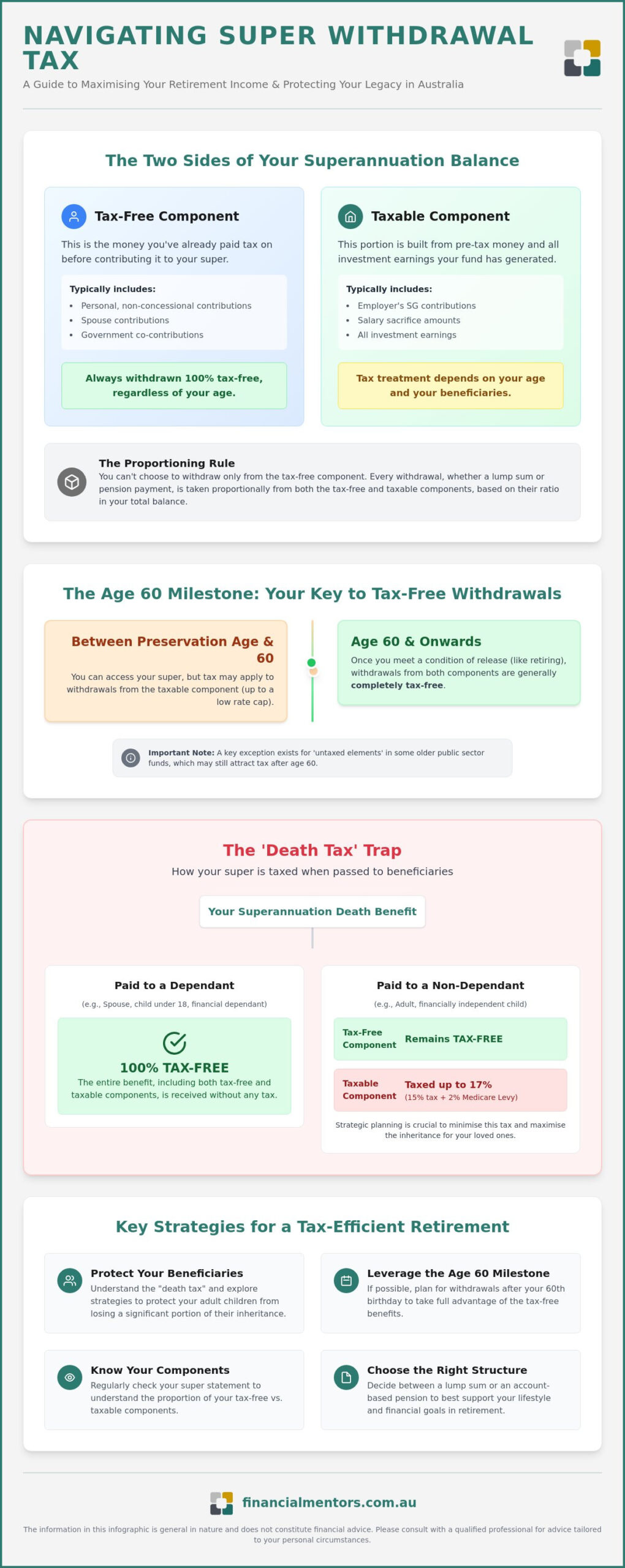
Have you ever looked at your super statement and wondered why your balance is broken down into different components? It might seem like a bit of unnecessary detail, but these figures are the foundation of how much you’ll actually keep when you stop working. When calculating the tax on superannuation withdrawal australia, the ATO doesn’t look at your total balance as a single sum. Instead, they see two distinct parts: the tax-free component and the taxable component.
The proportioning rule is perhaps the most misunderstood part of this process. If you decide to take out $50,000, you cannot simply tell your fund to take it all from the tax-free portion to save on costs. The law requires every withdrawal to be taken proportionally from both components based on the total value of your account. This structure is a core part of the Taxation of superannuation in Australia, which governs how benefits are treated when they finally reach your bank account. Ultimately, the specific ratio of these two components within your account is the single most important factor in determining your final tax obligation.
The Tax-Free Component: Your Personal Contributions
Think of this as the money you’ve already paid tax on. It’s usually made up of non-concessional contributions, like when you add your own savings into your fund from your bank account. Because you didn’t claim a tax deduction for this money, it’s yours to take back without any further tax obligations, regardless of your age. If you can build a higher tax-free proportion, you’re effectively future-proofing your retirement against potential tax changes. It’s a wise way to protect your beneficiaries from the “death tax” later on.
The Taxable Component: The ATO’s Share
This is where things get a bit more complex. This component includes your employer’s SG contributions, any salary sacrifice you’ve made, and all the investment earnings your fund has generated over the decades. For most Australians, this is the largest part of their balance because it’s built from pre-tax income. Within this category, there are two elements:
- Taxed elements: Where the fund has already paid the standard 15% tax on contributions.
- Untaxed elements: More common in certain older public sector funds where tax hasn’t been paid yet.
Understanding this balance is vital. It’s the taxable component that the government may want a slice of if you withdraw before age 60 or leave your super to non-dependant children. Managing the tax on superannuation withdrawal australia often involves strategies to manage this specific portion of your nest egg, and professional firms like Cairns Quality Accounting can help individuals and small business owners navigate these complexities.
For SME owners balancing retirement planning with business growth, Marketing Angels offers the strategic branding and marketing support needed to ensure your enterprise continues to flourish and build value.
In addition to strategic marketing, ensuring your business is structured for peak performance is essential; michelboutinstudio offers the executive consulting services needed to help both start-ups and established organisations achieve sustainable growth.
Age and the 60-Year Milestone: When Withdrawals Become Tax-Free
In the Australian retirement system, your 60th birthday is often more than just a personal milestone; it is the moment the tax landscape shifts significantly in your favour. For the vast majority of Australians, this is the age when the tax on superannuation withdrawal australia essentially vanishes. Once you turn 60 and meet a condition of release, such as retiring or starting an account-based pension, both your lump sum withdrawals and your regular income stream payments become completely tax-free.
It’s helpful to distinguish between your preservation age and the age of 60. While they are now the same (60 years) for anyone born after 30 June 1964, those born earlier may have already reached their preservation age. Reaching your preservation age allows you to access your super, but it doesn’t automatically grant you the tax-free status that comes with your 60th birthday. If you are unsure how your birth year dictates your access, a tailored approach to retirement planning can help you map out the most tax-effective timeline for your transition.
While the “tax-free after 60” rule is a standard for most, there’s a notable exception for those in certain public sector funds. If your super contains “untaxed elements” (common in older government schemes where the fund didn’t pay tax on contributions), you might still face a tax bill after 60. These untaxed components are generally taxed at 15% up to a certain limit, known as the untaxed plan cap, which for the 2026/27 financial year is $1,935,000.
Withdrawing Super Between Preservation Age and 60
If you’ve reached your preservation age but haven’t yet celebrated your 60th birthday, you can still access your savings, but the ATO will likely want a portion. You’ll benefit from the “low rate cap,” which for the 2026/27 financial year sits at $260,000. This is a lifetime limit on the taxable component you can withdraw at a 0% tax rate. Anything above this cap is generally taxed at 15% plus the Medicare levy. You can find more detail in Moneysmart’s guide to tax on super to see how these thresholds apply to your specific balance.
Accessing Super Before Your Preservation Age
Accessing super early is a difficult decision and is usually only possible under very strict conditions of release, such as severe financial hardship or compassionate grounds. If you find yourself in this position, be aware that the tax implications are quite high. The taxable component of an early withdrawal is typically taxed at 22% (including the Medicare levy) or your marginal tax rate, whichever is lower. Because of this heavy penalty, most advisors consider early access a last resort for wealth management.
Lump Sums vs Account-Based Pensions: Choosing Your Structure
Deciding how to access your nest egg is a deeply personal choice that requires a balance between your immediate lifestyle dreams and your long-term security. It’s not just about the convenience of having cash on hand; it’s about how your choice influences the tax on superannuation withdrawal australia over the next twenty or thirty years. You generally have the choice of taking a lump sum, starting a regular income stream, or a combination of both. While a lump sum provides immediate access to capital for a specific purpose, a phased pension structure often yields a higher net benefit over time because of the ongoing tax-free status of both the payments you receive and the investment earnings within the fund.
When you move your super from the “accumulation phase” to the “retirement phase” via an account-based pension, the investment earnings on your balance are taxed at 0% instead of the usual 15%. This creates a compounding effect that can significantly extend the life of your savings. It’s a way of ensuring that more of your money stays within your control, rather than being eroded by annual taxes on the fund’s growth.
The Strategic Advantage of an Account-Based Pension
If you’re over the age of 60, an account-based pension allows you to receive a regular income stream that is completely tax-free. This isn’t just about the money hitting your bank account; it’s about keeping your remaining capital “working” in an environment where every dollar of growth stays in your pocket. You’ll need to meet minimum withdrawal requirements each year, which are calculated as a percentage of your balance on 1 July. These rates, such as 4% for those under age 65, are designed to help you enjoy your savings throughout your lifetime while maintaining a tax-effective structure for your wealth.
When a Lump Sum Withdrawal Makes Sense
There are certainly moments when a lump sum is the right choice. Perhaps you’re looking to clear the remaining balance on your mortgage or fund a long-awaited lifestyle goal, like a caravan for a trip around the country. However, it’s vital to consider how a large withdrawal might affect your eligibility for the Age Pension. Because superannuation is assessed under both the assets and income tests, taking a large sum out of the fund and placing it in a bank account could change your Centrelink entitlements. This is why professional retirement planning is so important before you make a move. A mentor can help you weigh the emotional satisfaction of a debt-free home against the long-term tax benefits of keeping more of your money within the super system. If you choose to take a lump sum, you must also be mindful of the $2.1 million general transfer balance cap, which limits how much you can move into the tax-free pension phase, impacting the total tax on superannuation withdrawal australia for those with larger balances.
The ‘Death Tax’ Trap: Protecting Your Super for Your Beneficiaries
While you might be enjoying the benefits of a tax-free retirement, have you considered the legacy you’ll eventually leave behind? It’s a common and painful surprise for many Australian families to discover that the money they’ve worked so hard to save can be heavily taxed when it passes to the next generation. Even if the tax on superannuation withdrawal australia is zero for you right now, the rules change significantly the moment that balance is paid out as a death benefit to anyone who isn’t considered a tax dependant.
The core of the issue lies in the taxable component we discussed earlier. If this portion of your super is paid to an adult child, the ATO generally applies a tax rate of 15% plus the 2% Medicare levy. For a child inheriting a $500,000 taxable balance, this “death tax” could wipe out $85,000 of their inheritance. It feels inherently unfair that a balance you could have withdrawn tax-free while alive suddenly becomes a tax liability for your heirs, but with the right stewardship, this outcome is often avoidable.
Who Counts as a Dependant for Tax Purposes?
Confusion often arises because there are two different definitions of “dependant” in the super world. Under superannuation law (the SIS Act), your adult children are dependants and can receive your super directly. However, the Tax Act is much stricter. For a death benefit to be paid tax-free, the recipient must usually be a spouse, a former spouse, or a child under the age of 18. Because most adult children don’t meet these criteria, they are hit with the full tax on superannuation withdrawal australia. This is a critical detail to address when seeking estate planning advice to ensure your family isn’t left with an unexpected bill.
Strategies to Eliminate the Super Death Tax
One of the most effective ways to protect your children’s inheritance is through a “re-contribution strategy.” If you’re over 60 and have met a condition of release, you can withdraw a portion of your taxable super balance tax-free and then contribute it back into your fund as a non-concessional contribution. This simple move effectively “washes” the money, turning a taxable component into a tax-free one. When your beneficiaries eventually receive this portion, it will be completely tax-free for them, regardless of their age or dependency status.
Timing is everything with these moves. These strategies need to be implemented while you are still in good health and have the capacity to manage your affairs. A dedicated wealth management office can help you coordinate these withdrawals and contributions within the 2026 contribution caps to maximise the tax-free portion of your estate. If you haven’t reviewed the tax status of your super components recently, now is the time to ensure your hard-earned savings are fully protected for the people you love.
Don’t let the ATO become the primary beneficiary of your superannuation. To see how a re-contribution strategy could work for your specific balance, book a consultation with our team today.
Navigating Your Retirement: Why Strategic Advice Matters
Retirement isn’t simply a finish line; it’s the beginning of a new chapter that requires careful, ongoing stewardship. As we have explored, the tax on superannuation withdrawal australia is rarely a fixed cost. It is a variable that depends on a delicate interplay between your age, the specific components of your balance, and the structures you choose for your income. When these elements are managed in isolation, it’s easy to miss opportunities or fall into traps that could have been avoided with a more holistic view of your wealth.
Part of this stewardship involves maintaining clear physical records; to support your organisational needs, you can discover Mega Office Supplies for premium office products and storage solutions.
For individuals with complex portfolios that include US-based assets, coordinating your Australian retirement plan with experts like Wright CPAs, LLC ensures that your global tax obligations are handled with the same level of care as your local superannuation.
The true value of a wise mentor lies in their ability to see the connections you might miss. An expert doesn’t just look at your super balance; they look at how your withdrawal strategy affects your Age Pension eligibility, your annual tax obligations, and the eventual legacy for your children. By integrating your long-term retirement goals with professional tax return preparation, you ensure that your yearly filings are perfectly aligned with your broader wealth strategy. This joined-up approach provides a level of clarity that simply isn’t possible when your financial life is managed in fragments.
Moving From Confusion to Confidence
If you feel a sense of trepidation about making these big decisions, please know that your feelings are completely valid. The rules surrounding superannuation are notoriously complex, and the stakes are high. However, confusion often vanishes when you have a clear, personalised roadmap in front of you. A well-constructed plan reduces the tax burden on your savings and ensures you aren’t paying a cent more to the ATO than is legally required. The first step in any successful transition is to gain a clear understanding of your current tax-free and taxable proportions, allowing you to move forward with quiet confidence rather than uncertainty.
Partnering with Financial Mentors
At Financial Mentors Wealth Management, we pride ourselves on being more than just a financial institution; we are a reliable partner sitting across the table from you. Led by Murray Frean and backed by an AFSL registration held since 2003, our team focuses on the human side of finance. We understand that your goals are unique, whether you’re looking to clear the mortgage, travel the world, or ensure your family is well-provided for. We specialise in organising the complexities of the tax on superannuation withdrawal australia into a steady, step-by-step narrative that makes sense for your life. We invite you to start a dialogue with us today to ensure your path to retirement is as secure, stable, and tax-effective as it can possibly be.
Take Control of Your Retirement Journey
Your superannuation is more than just a balance on a screen; it’s the result of decades of hard work and the key to your future independence. By understanding the tax on superannuation withdrawal australia, you’ve already taken the first step toward a more secure retirement. You now know that reaching age 60 can unlock tax-free income, but you also understand the importance of protecting your adult children from the “death tax” trap through smart re-contribution strategies.
Managing these moving parts doesn’t have to be a solo effort. Our AFSL-licensed professionals specialise in reducing tax liabilities for Australian families by providing integrated tax and wealth management services. We’re here to act as your trusted guide, ensuring every decision you make today strengthens your position for tomorrow. If you’re ready to move from uncertainty to clarity, secure your retirement future with a personalised plan from Financial Mentors Wealth Management. You deserve the peace of mind that comes from being perfectly prepared for the chapters ahead.
Common Questions About Superannuation Tax
Is superannuation withdrawal tax-free after age 60 in Australia?
Yes, for most Australians, withdrawals from a taxed super fund are completely tax-free once you turn 60. This applies to both lump sums and regular income streams from an account-based pension. If you are in a public sector fund with untaxed elements, you might still face some tax, so it’s wise to check your specific fund’s structure before making any large decisions.
How much tax do I pay on a super lump sum withdrawal under 60?
If you are under 60, the tax on superannuation withdrawal australia depends on whether you have reached your preservation age. For those under their preservation age, the taxable component is generally taxed at 22 percent, which includes the Medicare levy. If you’ve reached your preservation age but are still under 60, you can use the low rate cap to receive a portion of your taxable balance tax-free.
Can I withdraw my super early due to financial hardship?
Yes, but it is considered a last resort due to the strict eligibility criteria and high tax costs. You must have received eligible government income support for 26 continuous weeks and be unable to meet reasonable family living expenses. If approved, the withdrawal is taxed as a lump sum, which can significantly reduce the actual amount that reaches your bank account.
What is the superannuation low rate cap for the 2026 financial year?
For the 2026/27 financial year, the low rate cap is $260,000. This is a lifetime limit that allows you to withdraw the taxable component of your super at a 0 percent tax rate if you have reached your preservation age but are not yet 60. Any amount you withdraw above this lifetime limit is typically taxed at 15 percent plus the Medicare levy.
Do my children have to pay tax on my super when I die?
It depends on their age and financial relationship with you. If your children are over 18 and not financially dependent, they will likely pay 15 percent tax plus the 2 percent Medicare levy on the taxable component of your super. This is why many families use re-contribution strategies to wash their balance into a tax-free component while they are still alive, ensuring their children receive the full inheritance.
How does the proportioning rule affect my super withdrawal?
The proportioning rule means you cannot choose to withdraw only the tax-free portion of your balance. Every time you take money out, it must contain a mix of both tax-free and taxable components in the exact same ratio as your total account balance. This rule makes it vital to understand your account’s breakdown before you start your retirement transition.
Is an account-based pension better than a lump sum for tax purposes?
In many cases, an account-based pension is more tax-effective because the investment earnings within the fund are taxed at 0 percent. While a lump sum gives you immediate cash, a pension keeps your remaining capital in a tax-free environment where it can continue to grow. For those over 60, the regular payments you receive from this pension are also entirely tax-free.
Do I need to include my super withdrawal in my tax return?
If you are over 60 and your super comes from a taxed fund, you generally don’t need to include these tax-free payments in your tax return. However, if you are under 60 or receiving payments from an untaxed fund, your super fund will provide a PAYG payment summary. You’ll then need to include these details to ensure your overall tax on superannuation withdrawal australia is calculated correctly.