
What if your annual tax lodgment wasn’t just a deadline to survive, but the most important wealth-building meeting of your year? For many Australians, the end of the financial year brings a familiar wave of stress. You might worry about making a small mistake that triggers an ATO audit, or perhaps you feel a nagging sense that your tax return preparation is disconnected from your long-term retirement plan. It’s common to feel that tax is simply a cost to be managed rather than a strategic opportunity to grow your family’s security.
We understand these concerns, and we believe you deserve more than just a processed form. This guide shows you how professional advice can move beyond simple compliance to become a powerful tool for your long-term wealth and retirement security. You’ll discover how to align your tax outcomes with your personal aspirations, giving you both peace of mind today and a clear plan for the next financial year. We will explore the practical steps to bridge the gap between your current financial position and the future you’re working so hard to build.
Key Takeaways
- Learn to view your annual lodgment as a strategic review of your financial position rather than just a compliance task.
- Discover how identifying valid deductions for investment properties and share portfolios can support your medium-term goals.
- Evaluate the long-term benefits of professional tax return preparation compared to simple online lodging to ensure you don’t miss wealth creation opportunities.
- Establish a methodical system for tracking your financial commitments to make your next appointment smooth and productive.
- Align your tax outcomes with your broader retirement goals to build a more secure future for yourself and your family.
What is Strategic Tax Return Preparation?
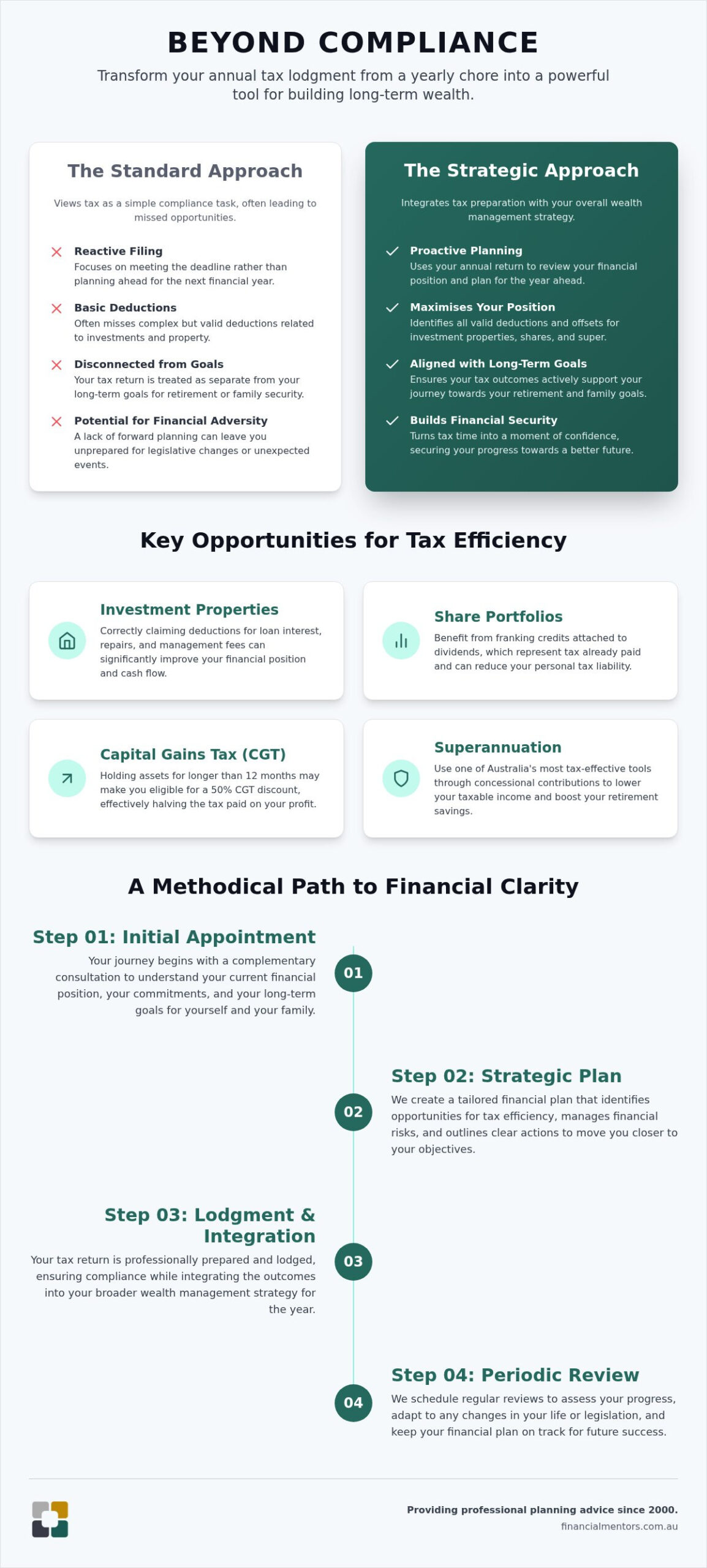
Think of your annual tax lodgment as a snapshot of your financial health. Most people view it as a simple administrative hurdle, but when we approach it through the lens of wealth management, it transforms into a holistic review of your entire financial position. Strategic tax return preparation is about much more than just filling out forms; it’s a process of ensuring every dollar you earn or invest is working toward your future security. By looking at the bigger picture, you can identify how your current income, investments, and expenses align with where you want to be in ten years.
Simple filing is reactive, but strategic preparation is proactive. The Australian tax system is designed with specific incentives that reward those who plan ahead. Understanding the historical context and rules surrounding Tax returns in Australia helps you see that the ATO isn’t just a collector; it’s a regulator of a system that allows for significant wealth creation if managed correctly. A professional review helps identify potential financial risks before they lead to financial adversity, ensuring your progress remains steady and predictable.
The Role of the ATO in Your Financial Life
Your relationship with the Australian Taxation Office (ATO) involves more than just meeting a deadline. Understanding your obligations is the baseline, but the real value lies in knowing how the ATO distinguishes between personal income and investment growth. With the 2025-2026 financial year bringing confirmed changes to resident income tax rates and HELP repayment thresholds, staying ahead of legislation is vital. For instance, the minimum HELP repayment threshold has lifted to $67,000, and repayments are now calculated on a marginal basis. If you don’t adjust your financial plan to account for these shifts, you might find your cash flow impacted unexpectedly.
Moving Beyond Compliance to Wealth Creation
For many Australians, especially those with complex portfolios or a growing family, basic software often fails to capture the nuance of their situation. Your tax return should reflect your progress toward long-term goals like buying a home or securing a comfortable retirement. If your return feels like a disconnected chore, it’s likely because it hasn’t been integrated into your broader wealth strategy. We validate that tax season can feel overwhelming; the fear of making a mistake or missing a deduction is real. However, shifting to a methodical, professional review provides a calmer path. It turns a stressful obligation into a moment of quiet confidence, knowing that your compliance is handled and your wealth is being steered in the right direction.
Maximising Your Financial Position through Deductions and Offsets
Improving your financial position starts with understanding the specific tools available during your annual tax return preparation. While many people focus on immediate work-related expenses, a strategic approach looks at how deductions and offsets interact with your broader wealth. It’s essential to distinguish between the two. A tax deduction reduces your total taxable income. If you’re in a higher tax bracket, every dollar deducted provides a proportional saving. A tax offset is different; it directly reduces the actual tax you owe, dollar-for-dollar. Understanding this difference helps you prioritise which financial commitments to track throughout the year.
For those with investment properties or share portfolios, the impact on your return can be significant. Valid deductions for property include loan interest, repairs, and management fees. If you hold shares in Australian companies, you may benefit from franking credits. These credits represent tax already paid by the company, which can reduce your personal tax liability or even result in a refund of the excess credit. If you’re unsure where to start with these complexities, reviewing the official guide on how to lodge your tax return provides a helpful baseline for compliance.
Investment Strategies and Tax Efficiency
Managing capital gains tax (CGT) is a vital part of long-term wealth creation. If you hold an asset for longer than 12 months, you may be eligible for a 50% CGT discount, which effectively halves the tax you pay on the profit. Strategic planning also involves the instant asset write-off for eligible investors or sole traders, allowing for the immediate deduction of the cost of certain assets. Balancing these elements requires a clear view of your financial position to ensure you aren’t paying more than necessary.
Superannuation as a Tax Management Tool
Superannuation is one of the most tax-effective environments in Australia. Concessional contributions, such as salary sacrifice or personal deductible contributions, are generally taxed at a flat rate of 15% within the fund. This is significantly lower than most marginal tax rates, providing an immediate tax benefit while growing your retirement nest egg. If you manage a self-managed super fund, you have even more control over how these outcomes influence your yearly tax position. Planning your contributions carefully allows you to reduce your current tax liability while staying focused on your long-term goals. This methodical approach ensures that your tax outcomes are always working in your favour.
Professional Tax Preparation vs. DIY: Finding the Best Value
Choosing between a DIY app and professional tax return preparation is often a question of value rather than just price. While basic software promises a quick result, it frequently misses the nuanced opportunities that a human expert identifies. When your financial position begins to include investment properties, share portfolios, or trust structures, the “simple” path can lead to missed deductions or, worse, unintended errors that trigger an ATO review. A professional advisor acts as your authorised representative, providing a layer of protection and peace of mind that an algorithm simply cannot match.
It’s helpful to consider that the fees you pay for professional advice are generally tax-deductible in the following year. This means the net cost of expert guidance is often much lower than the initial quote suggests. While the official guide on How to lodge your tax return outlines several methods for filing, the choice of who prepares your documents determines the strategic quality of the outcome. To help manage these costs, many professional firms use smartAR to provide flexible fee funding options, ensuring you can access expert support without immediate cash flow pressure. Investing in professional support helps you avoid the risk of future financial adversity by ensuring every claim is substantiated and aligned with current legislation.
There comes a point in every wealth journey where basic tax apps are no longer sufficient. If you’ve recently started a family, purchased an investment property, or received an inheritance, your tax situation has likely outgrown a standard template. Algorithms are designed for the average user; they don’t have a mentor’s eye for spotting how a specific deduction might influence your long-term goals. Multiple income streams and complex trust structures require a level of steady, thoughtful analysis that software cannot provide. A human partner looks beyond the data to understand the “why” behind your financial commitments, and engaging with an advisory firm like Samios Partners ensures your strategy remains sophisticated and compliant.
The true return on investment for professional preparation isn’t just found in a larger refund. It’s measured in the hours of stress you save and the confidence of knowing your affairs are in order. When your tax outcomes are integrated with broader Wealth Creation Strategies Australia, you begin to see your tax return as a stepping stone rather than a yearly headache. This methodical approach ensures that your financial plan remains on track, allowing you to focus on your career and family while we handle the technical complexities of the Australian tax system.
Organising Your Records: A Methodical Approach to Tax Time
Have you ever felt that sinking feeling at the bottom of a shoe box full of faded receipts? Many Australians find that the stress of tax season stems from a lack of order rather than the tax itself. Effective tax return preparation begins long before the June 30 deadline. It starts with a simple, consistent system for tracking your financial commitments throughout the year. When you maintain clear records, you move from a state of reactive panic to one of quiet confidence. You’re no longer just “getting through” tax time; you’re actively managing your progress.
Establishing a methodical approach means your annual appointment becomes a productive conversation about your future. If your records are organised, your advisor can spend less time sorting through paperwork and more time identifying opportunities for your wealth. This level of preparation is the foundation for a successful periodic review. It ensures that every valid deduction is captured and every financial decision is backed by solid data. Digital record-keeping has made this easier than ever, allowing you to scan and store documents as they arrive.
Essential Documentation Checklist
Gathering the right information is the first step toward a stress-free experience. You should aim to have these documents ready for your tax return preparation:
- Income Evidence: This includes your income statements, dividend summaries from your share portfolio, and bank interest certificates.
- Work and Investment Expenses: Keep receipts for work-related travel, professional development, and charitable donations. If you have an investment property, collect records of loan interest and maintenance costs.
- Family and Health: Records relating to specific family life stages, such as private health insurance statements and certain out-of-pocket medical expenses, are often vital.
Future-Proofing Your Record Keeping
Transitioning to a paperless system is one of the kindest things you can do for your future self. Digital folders or dedicated apps allow you to organise your financial life by category and date, making it easy to retrieve information during a periodic review. This habit of stewardship extends beyond your yearly tax lodgment. For example, maintaining a clear history of asset purchases and costs is a critical component of professional Estate Planning Advice. If you have a clear paper trail, your family will face much less complexity when managing your estate in the future.
Being prepared is about more than just compliance; it’s about respecting the hard work you’ve put into earning your income. If you’re ready to see how an organised approach can change your financial outlook, you can book your initial appointment to begin the process.
Integrating Tax with Your Wealth Management and Retirement Goals
If you’ve ever looked at your tax refund and wondered how it could work harder for your future, you aren’t alone. Many Australians view their annual lodgment as an isolated event, yet it’s actually one of the most consistent data points in your financial life. When we align your tax return preparation with your broader objectives, we turn a yearly obligation into a strategic review. This process allows you to use tax outcomes to fund medium-term goals, like a family holiday or home renovation, while staying focused on the long-term stability of your household.
Your tax return is a vital component of your Planned Retirement. It provides the clarity needed to ensure your investment structures are as efficient as possible. Beyond your own comfort, professional tax preparation plays a significant role in protecting your inheritance and legacy. By managing your assets wisely today, you reduce the complexity your loved ones might face later, ensuring that your hard-earned wealth is preserved for the next generation. At Financial Mentors Wealth Management, we don’t just look at the numbers; we look at the life those numbers support.
Strategic Alignment for Retirement
As you approach the later stages of your career, the interaction between tax and government benefits becomes increasingly important. A well-structured tax position can help maximise your Centrelink entitlements, ensuring you receive the support you’re eligible for. We also focus on managing your various income streams to reduce your tax liability once you stop working. This level of coordination is why tax planning is an essential service for any professional Wealth Management Office. It ensures that every part of your financial plan is moving in the same direction, providing you with the peace of mind that comes from being truly prepared.
Your Next Step: The Initial Appointment
Taking control of your financial future doesn’t have to be a daunting task. We’ve been providing professional planning advice since 2000, and we’ve found that the best results come from a steady, step-by-step partnership. Your initial appointment is “Step 01” of our process. During this meeting, we move beyond the basic requirements of tax compliance to explore how we can create real wealth for you and your family. We’ll look at your current financial position, discuss your aspirations, and begin building a roadmap that aligns your tax outcomes with your life goals. It’s an invitation to stop reacting to tax season and start using it as a tool for your success.
Taking Control of Your Financial Future
Your annual tax return preparation doesn’t have to be a source of stress. By shifting your focus from simple filing to strategic wealth alignment, you turn a yearly requirement into a powerful tool for your future. As we’ve explored, the difference between a basic lodgment and a professional review is the opportunity for genuine wealth creation. Whether it’s identifying complex investment deductions or ensuring your tax position supports your retirement goals, the right approach provides both peace of mind and a clear path forward.
We’ve been providing professional advice since 2000, helping families build stability through tailored wealth management strategies. Our empathetic, mentor-led approach ensures that your unique aspirations are always at the heart of our partnership. Ready to see how your tax return can work for your future? Book your initial appointment with Financial Mentors today.
Taking the first step toward a more organised and secure financial life is one of the most rewarding decisions you can make. We’re here to help you move closer to the future you’ve imagined.
Frequently Asked Questions
What are the key dates for tax return preparation in Australia for 2026?
The standard deadline for individuals lodging their own tax return is October 31, 2026. Since this date falls on a Saturday, the effective deadline is Monday, November 2, 2026. If you engage a registered tax agent before the end of October, your tax return preparation deadline can often be extended to May 15, 2027. Staying aware of these dates helps you maintain order and reduces the stress of last-minute filing.
Can I claim the cost of a financial advisor on my tax return?
Yes, you can generally claim the cost of managing your tax affairs as a deduction. This includes fees paid to a registered tax agent for the preparation and lodgment of your return. While some general financial planning fees may not be deductible, the portion of the fee relating to specific tax advice is often claimable in the following year. It’s a practical way to reduce the net cost of receiving professional guidance for your family.
How do I know if my financial position requires a professional tax preparer?
You’ll know it’s time for professional tax return preparation when your financial position involves more than just a standard salary. If you’ve recently started a family, purchased an investment property, or begun managing a share portfolio, the complexity of your affairs has likely increased. A professional review helps identify valid deductions that basic software might miss, providing the quiet confidence that your tax outcomes are fully aligned with your long-term goals.
What is the difference between a tax agent and a wealth management advisor?
A tax agent primarily focuses on your past financial year to ensure your lodgment is accurate and compliant with ATO regulations. In contrast, a wealth management advisor looks forward, helping you structure your assets to achieve specific life milestones. At Financial Mentors, we integrate both roles. We view your annual tax return as one part of a holistic financial plan that steers you toward a secure and comfortable retirement.
How can I reduce my tax liability through superannuation contributions?
Making concessional superannuation contributions is a powerful way to reduce your taxable income. These contributions are generally taxed at a flat rate of 15% within the fund, which is often much lower than your marginal tax rate. By choosing to salary sacrifice or make personal deductible contributions, you can lower your current tax liability while simultaneously building your nest egg. It’s an effective strategy for both short-term savings and long-term security.
What happens if I miss the deadline for my tax return preparation?
If you miss the deadline for your tax return preparation, you may be subject to a failure to lodge on time penalty from the ATO. Additionally, if you have a tax debt, the ATO applies a General Interest Charge of 11.43% per annum for the July to September 2026 quarter. If you’re feeling overwhelmed by the deadline, seeking professional help early can often secure an extension and provide a clear plan to resolve any outstanding obligations.
Are there specific tax offsets available for families in Australia?
There are several offsets and thresholds designed to support Australian families. For the 2025-2026 year, the family income threshold for the Medicare levy is $47,238, increasing by $4,338 for each dependent child. You might also be eligible for the Seniors and Pensioners Tax Offset depending on your circumstances. Understanding these options ensures that your family’s financial position is protected and that you aren’t paying more tax than required through missed opportunities.
How does estate planning advice interact with my yearly tax return?
Estate planning advice and your yearly tax return are deeply connected through asset record-keeping. Your tax return tracks the cost base of investments, which is vital for calculating potential capital gains tax for your beneficiaries. By maintaining methodical records today, you’re practicing good stewardship of your inheritance and legacy. This integrated approach ensures that your wealth is managed wisely during your life and transitions smoothly to the next generation without unnecessary financial adversity.