

What if the professional you trust to look after your past is the wrong person to build your future? It’s a common dilemma for many Australians standing at a crossroads; do you need a financial advisor vs accountant australia to help you make sense of the 2026 landscape? If you have recently looked at the new 15% tax bracket or the updated superannuation caps, you might be wondering how these changes affect your specific goals. It’s completely normal to feel a bit overwhelmed by shifting rules, especially when you want to ensure your hard-earned money is working as hard as it can.
If you have ever felt anxious about your retirement savings or confused by professional fees, you are not alone. This guide will help you discover the distinct roles of accountants and financial advisors and show you how to choose the right partner for your wealth journey. We will explore the new 2026 education standards, the limits of tax advice, and how to create a clear plan that maximises your tax efficiency while protecting your legacy. By the end, you will have the clarity needed to move forward with confidence and peace of mind.
Key Takeaways
- Understand that while an accountant focuses on your tax compliance and historical data, a financial advisor acts as the architect for your future wealth and lifestyle aspirations.
- Identify the specific “trigger moments” in your life, such as receiving an inheritance or planning for retirement, that require the specialised guidance of a financial advisor vs accountant australia.
- Learn how to evaluate the value of professional advice by focusing on the long-term return on investment and the peace of mind that comes from being prepared.
- Discover why a 20-year retirement plan requires a different strategic approach than a standard yearly tax return to ensure your long-term financial security.
- See how an integrated approach can simplify your life by ensuring your tax strategy and wealth creation plans are perfectly aligned and working toward the same goals.
Understanding the Roles: What Do an Accountant and a Financial Advisor Actually Do?
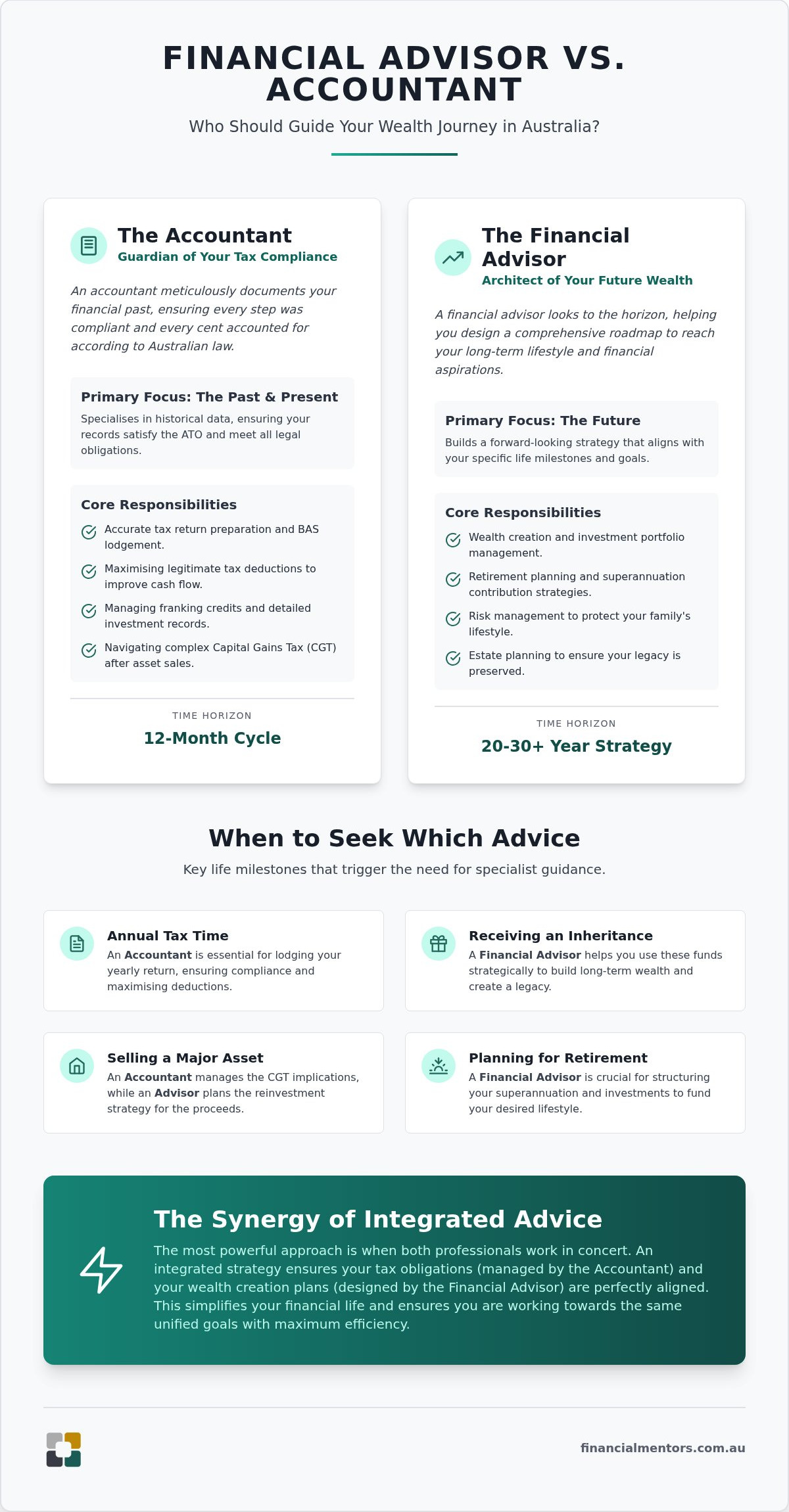
Think of your financial life as a family estate that spans generations. You wouldn’t expect the person who meticulously harvests the fruit each season to be the same person who designs an irrigation system for a drought ten years away. For many Australian families, understanding the difference between a financial advisor vs accountant australia starts with where these professionals focus their gaze. Your accountant is primarily looking at the ground you have already covered. They ensure every step was legal and every cent was accounted for. Conversely, a financial advisor looks at the horizon. They help you decide which path leads to the future you have imagined for your family. This dual approach creates a sense of stewardship. It means your personal financial ecosystem is both protected today and prepared for tomorrow.
The Accountant’s Realm: Tax, Compliance, and the ATO
Your accountant acts as the essential guardian of your tax compliance. Their relationship with the Australian Taxation Office (ATO) is the cornerstone of their work. If you have ever felt the stress of a looming tax deadline, you know the value of someone who can accurately prepare your tax return or Business Activity Statement (BAS). They are experts in the fine details of the law. They specialise in precision. By maintaining meticulous records, they help you avoid unnecessary penalties and ensure you meet every legal obligation with quiet confidence.
A qualified accountant is your primary contact for:
- Accurate tax return preparation and BAS lodgement
- Maximising legitimate deductible expenses to improve cash flow
- Managing franking credits and detailed investment records
- Navigating complex Capital Gains Tax (CGT) events after asset sales
The Financial Advisor’s Vision: Strategy, Super, and Growth
While the accountant manages the past, a Financial adviser serves as the architect of your future wealth. Their role is to help you build a comprehensive financial roadmap that aligns with your specific life milestones. Whether you are aiming to grow your investment portfolio or seeking to understand the 2026 superannuation concessional contribution caps, their focus remains on strategy and growth. Understanding the distinction between a financial advisor vs accountant australia is the first step toward true financial freedom.
In Australia, this professional must operate under an Australian Financial Services Licence (AFSL). This ensures they meet strict regulatory and educational standards, particularly the rigorous requirements effective from January 2026. They help you answer the big “if-then” questions. If you want to retire at sixty, how should your super be structured today? If you receive an inheritance, what is the most effective way to create a legacy? Their strategy often includes:
- Wealth creation and investment portfolio management
- Retirement planning and superannuation contribution strategies
- Risk management to protect your family’s lifestyle
- Estate planning to ensure your legacy is preserved
This forward-looking partnership turns a collection of assets into a purposeful strategy. It’s about moving beyond simple savings and toward genuine lifestyle design.
Key Differences: Compliance vs. Strategy in the Australian Financial Landscape
If you have ever felt confused about whether to call your tax agent or your planner, it helps to look at their time horizons. An accountant generally operates on a twelve-month cycle. They focus on the past and present, ensuring your records satisfy the law. A financial advisor, however, might build a strategy spanning twenty or thirty years. This distinction is the core of the financial advisor vs accountant australia debate. One ensures you are doing things “right” according to the tax code, while the other ensures you are doing the “right things” to reach your personal goals. They serve different masters; the accountant answers to the law, while the advisor is bound by a “best interest duty” to your specific aspirations.
Compliance vs. Strategy: A Practical Breakdown
Think of an accountant as the person who ensures your ship is seaworthy and your logs are accurate. They are essential for meeting your legal obligations. A financial advisor is the navigator who helps you decide which port you want to reach and how to manage the winds of inflation and market volatility along the way. These roles often overlap during significant life transitions. If you are selling a business, for example, your accountant will calculate the Capital Gains Tax (CGT) implications. Your advisor will then determine how to reinvest those proceeds to fund your lifestyle for the next two decades. This collaboration ensures that your immediate tax bills don’t derail your long-term security.
Regulatory Oversight: Who Governs Whom?
The Australian financial landscape is strictly regulated to protect your interests, but different bodies oversee each profession. Financial advisors are regulated by the Australian Securities and Investments Commission (ASIC). Since January 2026, all advisors must hold an approved degree and have passed a national exam, ensuring a high level of professional standard. Accountants who provide tax advice are regulated by the Tax Practitioners Board (TPB). It is a critical first step for any Australian to check the Financial Advisers Register (FAR) before engaging a professional. This transparency allows you to verify that your chosen partner has the right qualifications and a clean record.
When you are ready to move beyond simple record-keeping, Choosing a financial adviser who understands your unique journey is paramount. If you are looking for a team that understands how these pieces fit together, our integrated wealth creation strategies can bridge the gap between compliance and growth. This joined-up approach ensures your tax strategy and your lifestyle goals are always pulling in the same direction.
When to Seek Which: Life Milestones That Trigger the Need for Professional Advice
Life has a way of presenting us with “fork-in-the-road” moments. While you might see your accountant every July, there are specific seasons where the choice of financial advisor vs accountant australia becomes a critical decision for your family’s future. If you are buying an investment property, your accountant is usually the primary contact to discuss depreciation schedules and tax structures. However, if you have just received a redundancy package or a significant inheritance, a financial advisor is essential to ensure that capital is preserved and put to work effectively. They help you move from a reactive state to one of steady, purposeful progress.
Setting up a Self-Managed Super Fund (SMSF) is a classic example of a “grey area” where both professionals must sit at the table. You need an advisor to determine if the strategy is appropriate for your long-term goals, and an accountant to manage the rigorous annual audits and compliance required by the ATO. Proactive planning during these transitions prevents the stress of “firefighting” later when tax bills or market shifts catch you off guard. It’s about having a team that looks at your life from every angle.
Retirement and Estate Planning: The Advisor’s Speciality
Planning for the day you stop working is about more than just a balance in an app. It’s about calculating exactly how much super is enough to fund your desired lifestyle without the fear of running out. This is where Choosing a financial adviser becomes a wise investment in your future peace of mind. Beyond growth, they focus on stewardship through estate planning. For instance, the “death tax” on certain superannuation components can significantly reduce what your adult children receive. An advisor structures your affairs to minimise these impacts, ensuring your legacy stays exactly where you intended.
Tax-Time Complexity and Wealth Creation
As your wealth grows, the risk of “DIY” tax returns increases. If your investment portfolio has expanded to include multiple asset classes or international shares, the complexity often outstrips basic software. An accountant ensures your wealth creation strategies remain tax-effective by managing Capital Gains Tax (CGT) when you need to rebalance your portfolio. Deciding between a financial advisor vs accountant australia often comes down to the complexity of your holdings. Your accountant provides the practical guardrails that keep your strategy legal and efficient, while your advisor suggests which assets to sell to maintain your target risk level. When these two professionals work in harmony, you move from simply “doing your taxes” to actively managing a growing estate.
Evaluating the Cost and Value: How Professional Advice Impacts Your Long-Term Wealth
Many Australians view professional fees as a hurdle to overcome rather than a tool to use. However, when you weigh up the choice of a financial advisor vs accountant australia, it’s helpful to shift your perspective from “cost” to “investment.” Think of it like maintaining a family estate. You don’t pay a gardener just to prune hedges; you pay for the longevity and beauty of the entire garden. The ROI of professional advice isn’t always immediate, but it is profound. Peace of mind is a vital, non-monetary return that reduces the stress of complex decision-making. While you might worry about the price of a consultation, the cost of a single strategic error, like miscalculating a tax threshold or choosing a poor superannuation structure, often far exceeds the professional fee.
Understanding the Fee Structure in 2026
The Australian financial landscape has moved toward total transparency. By 2026, the industry has firmly embraced fee-for-service models over old-fashioned commission structures. This means you know exactly what you are paying for from the start. During your initial “discovery” phase, a mentor will listen to your unique challenges and aspirations to determine if a partnership is the right fit. An accountant typically provides a flat fee for a tax return, which is a practical necessity for yearly compliance. A financial advisor vs accountant australia comparison shows that wealth management involves a more comprehensive service package. It includes retirement planning and estate strategies that go far beyond a yearly lodgement. You are investing in a roadmap that covers decades, not just the next financial year.
Quantifying the Value of a Mentor
How do you quantify the value of a steady hand? When markets fluctuate, emotional investing often leads to poor outcomes. A mentor provides the objective distance needed to keep you on track, preventing the “panic selling” that can erode years of growth during a temporary downturn. There is also the tangible benefit of “found money.” These are the savings discovered through sophisticated tax optimisation and superannuation strategies that most people miss when working alone. For example, ensuring your super is structured to avoid unnecessary taxes for your beneficiaries can save your family tens of thousands of dollars. The value of professional advice is the measurable difference between a DIY financial outcome and a professionally managed roadmap designed to reach your specific life goals.
Secure your future by booking a consultation for our wealth creation strategies today.
The Synergy of Integrated Advice: Why a Financial Mentor Offers the Best of Both Worlds
Many Australians treat the choice of a financial advisor vs accountant australia as a fork in the road where they must pick a single path. But what happens when your tax agent suggests one investment structure while your planner recommends another? This friction often leaves you feeling like a middleman in your own financial life. It creates an unnecessary administrative burden and, more importantly, leads to missed opportunities. When these two worlds remain separate, your wealth strategy can become a collection of disjointed parts rather than a cohesive whole. True peace of mind comes when your tax compliance and your growth strategy finally speak the same language.
At Financial Mentors Wealth Management, we act as the bridge between these two essential roles. We believe that for your wealth to truly flourish, your professionals must work in harmony. This “joined-up” approach ensures that every decision made for your future is grounded in the practical realities of today’s tax laws. It’s about having a trusted guide who sees the whole picture, not just a single piece of the puzzle.
The Benefits of a Unified Approach
Imagine a scenario where your tax return automatically informs your long-term wealth strategy. In a unified environment, this seamless information sharing is the standard. It ensures that your estate planning advice is perfectly aligned with current tax compliance, protecting your legacy from unexpected ATO claims. By centralising your financial stewardship, you reduce the time spent chasing documents or explaining your situation twice. If your tax professional and your advisor sit at the same table, they can collaborate on complex decisions. They might find the best timing for a superannuation contribution or identify the most tax-effective way to draw a pension during your first year of retirement. This level of coordination removes the guesswork and replaces it with a clear, efficient path forward.
Starting Your Mentorship Journey
Transitioning from a “tax-only” relationship to a comprehensive wealth plan is a significant milestone. It marks the moment you decide to move beyond simple compliance and toward genuine stewardship of your future. This shift requires a personalised roadmap that reflects your unique Australian life, from your family goals to your specific retirement dreams. If you’re ready to stop juggling multiple contacts and start building a unified future, we’re here to help you navigate the financial advisor vs accountant australia landscape with confidence. For ministry leaders and executives, MissionAligned Advisory offers specialised coaching to help align professional mission with personal stewardship. It begins with a simple, supportive conversation about your long-term security. We invite you to reach out and discover how a steady, integrated plan can protect your legacy and provide the stability your family deserves.
Building Your Unified Financial Legacy
Your wealth journey is a unique story that deserves careful stewardship. We have explored how the choice of a financial advisor vs accountant australia is rarely about picking one professional over the other; it’s about finding a way for compliance and strategy to work in perfect harmony. By understanding that your accountant protects your history while your advisor architects your future, you can move away from reactive decision-making and toward a clear, purposeful plan. If you feel ready to replace anxiety with confidence, remember that professional guidance is an investment in your family’s long-term stability.
At Financial Mentors Wealth Management, we have been acting as a trusted guide under our own AFSL since 2003. We specialise in bringing tax return preparation and wealth creation together, ensuring your strategy reflects your specific life milestones. If you want to protect your legacy and maximise your efficiency, we invite you to book a consultation to harmonise your tax and wealth strategy. Taking this first step is the best way to ensure your future is as bright as you have imagined. You don’t have to navigate these complex rules alone; we are here to walk beside you every step of the way.
Frequently Asked Questions
Can an accountant give financial advice in Australia?
No, an accountant can only provide specific financial product advice if they hold an Australian Financial Services Licence (AFSL). While they’re experts in tax law, the law requires a different level of licensing for wealth strategy. If you need help choosing a specific investment or superannuation fund, you must speak with a licensed professional. This ensures you receive guidance from someone who meets the strict 2026 educational standards.
Is a financial advisor worth the cost if I only have a modest super balance?
Yes, seeking a professional often makes the most sense when you’re starting out or have a modest balance. It’s about the power of early strategy and compounding. If you establish a solid wealth creation plan now, you avoid the cost of making expensive mistakes later. A mentor helps you maximise every dollar, ensuring your super’s structured efficiently to grow steadily over the next twenty or thirty years.
What is the difference between a tax agent and a financial planner?
The primary difference lies in their focus; a tax agent manages your compliance with the ATO, while a financial planner architects your future goals. When comparing a financial advisor vs accountant australia, remember that one handles the past and present through tax returns. The other designs a future roadmap for your lifestyle. Both are essential, but they serve different roles in your personal financial ecosystem.
Do I need a financial advisor to set up a Self-Managed Super Fund (SMSF)?
While you can technically set up an SMSF yourself, engaging a financial advisor’s highly recommended to ensure the strategy’s in your best interest. They help you determine if the costs and responsibilities of an SMSF align with your long-term retirement goals. You’ll also need an accountant to manage the annual audits and compliance, making this a classic scenario where both professionals must collaborate for your success.
How often should I meet with my financial advisor and accountant?
You should generally meet with your accountant once a year to prepare your tax return and review your compliance. Meeting with your financial advisor depends on your current life stage and the complexity of your goals. If you’re approaching retirement or experiencing a major life transition, more frequent check-ins might be necessary. Regular reviews ensure your strategy remains relevant as your circumstances and Australian laws evolve over time.
Can I claim the cost of financial advice on my tax return?
You can typically only claim the cost of ongoing financial advice that relates to producing your assessable income. The fee for your initial financial plan’s generally considered a capital expense and isn’t tax-deductible. It’s best to ask your accountant to review your specific invoices. They can help you identify which portions of the professional fees are deductible, ensuring you maximise your tax efficiency each year.
What should I bring to my first meeting with a financial mentor?
You should bring your latest superannuation statements, recent tax returns, and a clear list of your family’s lifestyle goals. Having your bank statements and details of any debts ready will also help your mentor understand your current position. This discovery phase’s about reflecting on your aspirations. The more information you provide, the better your guide can tailor a roadmap that feels practical and supportive of your unique journey.
What happens if my accountant and financial advisor disagree on a strategy?
If a disagreement occurs, it’s best to facilitate an open conversation between both professionals to find a unified path forward. Disagreements often arise when one focuses on immediate tax savings while the other prioritises long-term growth. When comparing a financial advisor vs accountant australia, the best outcome usually involves an integrated approach. Having both experts in one office ensures that your tax strategy and wealth goals are always pulling in the same direction.