

A long list of investments isn’t necessarily a diversified portfolio. To understand how to build a diversified investment portfolio, spread your investments across different companies, sectors, regions and asset classes. There’s no single allocation for everyone; a familiar example is 60% in shares and 40% in bonds, adjusted to suit your goals and comfort with risk.
If you’re wondering whether your investments are too concentrated, that’s a sensible place to start. Diversification can reduce reliance on any one company or market, but it doesn’t eliminate investment risk. This guide explains how to diversify within asset classes, assess managed funds, ETFs and LICs, and rebalance as investments change in value. It also covers overseas investments and the role different asset classes can play. The aim is to give you practical steps for building a portfolio that reflects your circumstances and supports your long-term goals.
Key Takeaways
- Spread investments across companies, sectors and regions so your portfolio isn’t reliant on one part of the market.
- Choose a mix of asset classes that reflects your goals, investment timeframe and comfort with risk.
- Use managed funds, ETFs or LICs to access a range of investments through a single investment, and understand how each option works.
- Review your portfolio and rebalance when its mix drifts from your intended allocation, while considering the tax effect of selling.
Diversifying across company sizes, sectors and regions
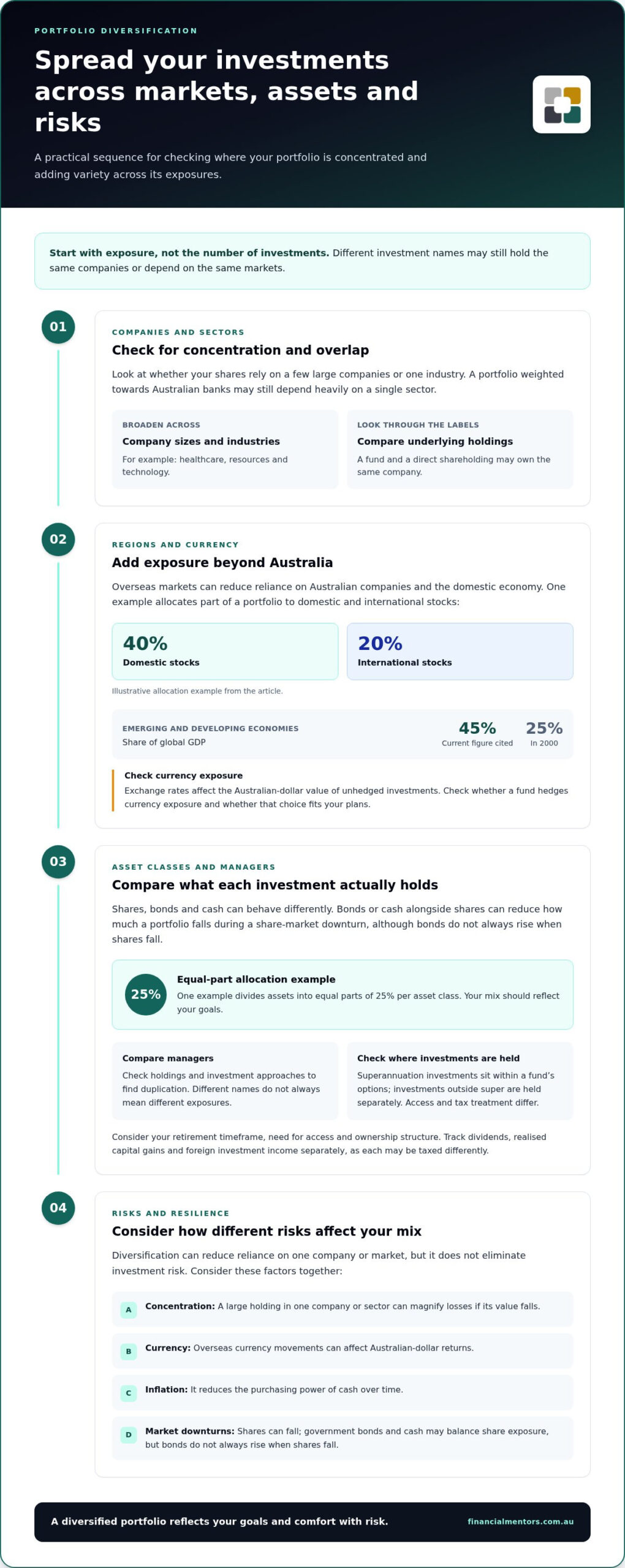
Spread investments across assets, businesses and markets rather than relying on a single source of returns. Use these steps to spot concentration and balance different exposures.
-
Spread investments across company sizes and sectors
Check whether your shares are concentrated in a few large companies or sectors. A portfolio weighted towards Australian banks, for example, may still rely heavily on one sector. Consider businesses of different sizes and industries, such as healthcare, resources and technology. Then look at underlying holdings, not just investment names, to find overlap. A fund and a direct shareholding may own the same company.
-
Invest across regions and manage currency risk
Include overseas markets to reduce reliance on Australian companies and the domestic economy. One example allocates 40% to domestic stocks and 20% to international stocks. Emerging and developing economies account for 45% of global GDP, compared with 25% in 2000. Overseas assets can add geographic variety, but exchange rates affect the Australian-dollar value of unhedged investments. Check whether a fund hedges currency exposure and how that choice fits your plans.
- Compare diversification across asset classes and investment managers. Shares, bonds and cash can behave differently; bonds or cash alongside shares can reduce how much a portfolio falls during a share-market downturn. One example divides assets into equal parts of 25% per asset class, but your mix should reflect your goals. Compare managers’ holdings and investment approaches to find duplication, rather than assuming different names mean different exposures.
Superannuation investments sit within a fund’s investment options, while investments outside super are held separately. Access and tax treatment differ, so consider your retirement timeframe, need for access and ownership structure. In Australia, tax outcomes depend on how assets are held and the income or gain involved. Track dividends, realised capital gains and foreign investment income separately, as each may be taxed differently.
- Consider concentration, currency exposure, inflation and downturn risks together. A large holding in one company or sector can magnify losses if its value falls, while overseas currency movements can affect Australian-dollar returns. Inflation reduces the purchasing power of cash over time, and shares can fall during market downturns. Government bonds and cash may balance share exposure, though bonds do not always rise when shares fall.
Diversifying within asset classes
To understand how to build a diversified investment portfolio, give each asset class a role in your plan. Consider your timeframe, comfort with changes in value, and the income or growth you need.
-
Match asset allocation to risk tolerance and goals
Set your target mix by considering when you’ll need the money and how you’d respond to falls in value. A conservative example holds 40% in stocks and 60% in bonds; an aggressive example holds 80% in stocks and 20% in bonds. These are illustrations, not personal recommendations. Check that the mix supports your goals without taking more risk than you can accept.
-
Balance defensive and growth assets
Separate investments by their purpose. Shares are growth assets: they have historically produced higher returns than traditional asset classes, but can fall in value in any year. Bonds and cash can provide a more defensive balance. Cash is accessible and has a very low risk of loss, but inflation reduces its purchasing power over time. Consider how much stability and growth your timeframe calls for.
-
Use multi-asset funds
Compare multi-asset funds if you want one investment to hold several asset classes. Check the fund’s target mix, underlying investments, costs and approach to changing market conditions. Some funds maintain a set allocation; others adjust it over time. A fund may simplify managing separate holdings, but it doesn’t remove investment risk. Make sure its strategy fits your goals and doesn’t duplicate investments you already own.
-
Consider stocks and ETFs for diversification
If you’re deciding how to build a diversified investment portfolio, review the range of holdings rather than aiming for a set number of stocks or ETFs. There’s no single number that suits every portfolio: diversification depends on exposure across companies, sectors and markets. A single fund can provide access to hundreds or thousands of securities. Check what it tracks and whether its holdings overlap with your other investments.
If your investments support family plans or future beneficiaries, connect portfolio decisions with estate planning advice.
Rebalancing a portfolio
To build a diversified portfolio with regular contributions, compare your current investments with your target mix. Direct new contributions towards asset classes below target, then review whether rebalancing is needed.
- Record your target allocation and current holdings. Market movements can shift your asset allocation, increasing overall risk or volatility. For example, a portfolio targeting 60% in shares could drift to 75% after strong share-market performance. A clear record makes that change easier to spot and compare.
- Set a review routine, such as annually or every 6 months to a year. At each review, compare each asset class with its target. One approach is to consider rebalancing when an asset class drifts more than 5%-10% from target. Treat that range as a guide, not an automatic instruction to trade.
- Use contributions to restore balance before selling. If shares have grown beyond their target allocation, direct new contributions towards bonds or cash instead. This can bring the mix closer to your strategy without selling existing holdings. Check the effect of each contribution across your whole portfolio, including investments held in different accounts.
- If contributions aren’t enough, rebalance by selling some investments and buying others. Weigh the benefit of correcting the allocation against the financial consequences of a sale. Selling investments to rebalance may create a tax bill. Consider potential tax impacts and transaction costs alongside the change you want to make to your portfolio.
- Update your target if your goals, timeframe or capacity to accept investment changes shift. A periodic review should consider market movements as well as your personal circumstances. If your original strategy still fits, restore its intended mix. If your priorities have changed, reassess the target before making trades.
Diversifying through managed funds, ETFs and LICs
Funds and listed investments can provide exposure to a range of securities through a single holding. Compare their structure, investments and costs before deciding how each fits your portfolio.
-
Choose between managed funds, ETFs and LICs
Compare how each investment is managed and traded before you choose. Managed funds and ETFs can hold hundreds or thousands of securities, spreading exposure across companies and industries. An ETF tracking the S&P/ASX 200 gives exposure to Australia’s largest 200 companies through one investment. LICs are listed companies that invest in a portfolio of assets, so check their holdings and approach too.
-
Consider fees and tax implications
Review each fund’s fees, including management charges and transaction costs, and consider how they affect returns over time. Australian ETFs and managed funds can distribute income and capital gains, which may have tax implications. The outcome depends on the investment’s structure and activity, as well as your circumstances. Keep distribution statements and transaction records to support your tax return preparation.
- Look through a fund’s holdings before adding it. Two ETFs with different names may track similar markets or own the same major companies, increasing overlap rather than diversification. Check the stated index or investment approach, the range of assets held, and whether exposure is concentrated in particular industries. For example, a broad Australian share ETF differs from a fund focused on one sector.
- Consider how the investment may perform in different market conditions. A fund holding shares can still fall when share markets decline, and diversification doesn’t prevent losses. Check whether a managed fund can change its holdings, how an ETF tracks its market, and how a LIC’s market price relates to its underlying assets. These details help you understand what you own.
If your investments need to reflect who may receive your assets, connect portfolio decisions with estate planning advice.
Financial Mentors Wealth Management: Financial Planning
Financial Mentors Wealth Management can help connect your investment choices with your wider financial goals through Financial Planning. If you’re weighing up asset allocation, managing investments across super and other accounts, or preparing for retirement, a financial plan can bring those decisions together in a considered strategy.
As your circumstances change, Retirement Planning and Wealth Creation Strategies can help you review how your investments relate to future plans. Estate Planning Advice can also help you consider how your assets fit into arrangements for your family. The right next step depends on what you’re working towards and the decisions you need to make.
If you’d like to discuss your financial goals, contact Financial Mentors Wealth Management or visit financialmentors.com.au.
Give your investment plan room to grow with you
Your financial priorities can change as work, family and retirement plans evolve. A useful next step in understanding how to build a diversified investment portfolio is to connect investment decisions with the life you want your investments to support. Look beyond market movements and consider what you want your money to make possible over time.
Financial Mentors Wealth Management offers Financial Planning, Retirement Planning and Wealth Creation Strategies to help you consider these decisions together. If your goals are shifting, a conversation can help clarify which questions deserve attention and what you want your investments to support next.
Contact Financial Mentors Wealth Management to discuss your financial planning needs. A thoughtful next step can help you move towards your future with greater clarity.
Frequently Asked Questions
What is diversification?
Diversification spreads investment exposure so your outcomes don’t depend entirely on one holding or market. For example, owning several funds may seem varied, but if each holds the same major companies, your exposure may still be concentrated. Look through the investments underlying each fund and consider how they might respond to different economic conditions. Diversification can reduce concentration, but it can’t eliminate investment risk.
What does diversification mean in an investment portfolio?
In a portfolio, diversification means considering how all your investments work together rather than judging each one on its own. A useful check is to list your holdings by company, sector, region and asset class, then identify where several investments depend on the same market. For instance, a fund and individual shares might both give you exposure to the same businesses. This broader view can reveal overlap that product names don’t show.
How should asset allocation vary by age, goals, and risk tolerance?
Asset allocation should reflect when you need the money, what it must support and how you would handle falls in value. Age alone doesn’t determine a suitable mix. Someone approaching retirement may need to consider upcoming withdrawals, while a younger investor saving for a distant goal may have more time to ride out market changes. Consider debts, income needs and your comfort with fluctuations before setting targets.
How to choose a mix of Australian and international shares, bonds, cash, and property?
Start by matching each investment type to a purpose. Australian shares provide exposure to the domestic market; international shares add companies from other economies. Bonds and cash can support stability or liquidity, while property adds another type of investment exposure. Consider how soon you’ll need access to funds, your reliance on Australian markets and overseas currency movements. Check whether property exposure is direct or through an investment fund.
How often should an investment portfolio be rebalanced, and how?
Review your portfolio regularly, with an annual review or a schedule of every 6 months to a year as practical options. Compare current holdings with your chosen targets, then decide whether new contributions can restore the balance before selling. If you sell, consider the possible tax consequences. Revisit the targets if your goals or timeframe have changed, rather than rebalancing automatically after every market movement.
How do index funds, ETFs, and actively managed funds compare for diversification?
Index funds aim to follow a market index, while ETFs are funds traded on an exchange and may track an index or use another strategy. Actively managed funds have a manager select investments. Any of these may hold a broad range of securities, but the label alone doesn’t show how diversified a fund is. Check its underlying holdings, investment approach and overlap with your existing investments.