

An enduring power of attorney can give someone you trust authority to manage your financial affairs if you lose decision-making capacity. The financial decisions it covers may include paying bills, accessing bank accounts, signing documents and dealing with property, depending on the authority you grant and the rules in your state or territory. Without an appointment, loved ones may need to apply to a court or tribunal to have someone appointed to manage your finances.
It’s understandable to want a clear picture of what authority you’re granting and what remains outside it. This article explains how an enduring power of attorney works, which financial decisions it can cover, and how it differs from arrangements for personal or health decisions. You’ll also learn what may happen if you lose capacity without an appointment, helping you consider your next steps with greater confidence.
Key Takeaways
- Choose someone you trust who can understand your wishes and manage responsibilities carefully.
- Separate financial authority from personal and health decisions, as these may require different appointments.
- Without an appointed attorney, someone may need to apply to a court or tribunal for authority to manage your finances.
- Set clear limits on financial powers, which may cover tasks such as paying bills, accessing accounts or dealing with property.
What is an enduring power of attorney?
An enduring power of attorney is a legal document that appoints someone to manage specified affairs if you lose decision-making capacity. An enduring power of attorney for financial decisions can set out the financial authority you give that person. Its operation, forms and witnessing requirements vary across Australian states and territories.
Choosing a trusted attorney
Choosing an attorney means appointing a person you trust to act carefully and follow your wishes. In Australia, an enduring attorney must be over 18 years old and have decision-making capacity. Consider whether they understand your priorities, can manage practical responsibilities and are willing to act. You can appoint one or more attorneys and define the authority each person receives.
Enduring and general powers compared
An enduring power continues if you lose capacity, while a general power may stop. In Victoria, a general power ends when the principal loses the ability to make decisions, but an enduring power continues. If no enduring power is in place, someone may need to seek an arrangement to manage the person’s financial affairs. An enduring power operates during your lifetime; your Will takes effect after your death.
When financial authority takes effect
The document and local rules determine when your attorney can begin acting. An enduring power of attorney for financial decisions may start immediately, for a specified period, after you lose capacity, or when the appointed decision-maker decides support is needed. In Victoria and NSW, the power continues if you lose decision-making capacity. In Western Australia, it can direct the attorney to act when a doctor states that you lack capacity.
Making an enduring power
To make one, choose an attorney, set the authority and trigger, then meet your state or territory’s requirements. In Victoria, the maker signs before two witnesses, including at least one eligible witness. NSW has specified authorised witnesses. Western Australia requires two adult witnesses with full legal capacity, including one authorised to witness statutory declarations. South Australia requires a prescribed form and eligible witness. Queensland, Tasmania, the ACT and the Northern Territory have different arrangements; the Northern Territory uses the name Advance Personal Plan. Make sure the document follows the relevant local signing rules.
Financial and personal or health enduring powers of attorney
Financial authority and personal or health decision-making are distinct, and the appointment you need depends on your state or territory. Understanding the boundary helps you plan separately for money, property and care.
Financial and personal powers
A financial enduring power covers authorised financial matters, while personal or health appointments address other decisions. Names and scope vary across Australia, so one document may not cover every type of decision.
In NSW, an enduring power of attorney covers financial and property decisions; an enduring guardian may make accommodation, healthcare, lifestyle and medical decisions. In Victoria, an enduring power for personal matters can cover care and personal welfare, but not medical decisions. South Australia uses separate enduring powers for financial and personal or health decisions. These distinctions help identify the authority needed for each part of your affairs.
Attorney responsibilities and the person’s wishes
An attorney must use their authority for the person’s benefit and consider their wishes. An attorney should consider the person’s wishes and views when making decisions. Across Australia, an attorney should keep the person’s money and property separate from their own, maintain financial records, act with care and diligence, and avoid conflicts of interest.
Misuse can include taking money for personal use or making decisions that serve the attorney’s interests. Separate accounts, clear records and careful attention to conflicts help reduce these risks. In NSW, an application can be made to NCAT to challenge an appointment if misuse is suspected.
Investment powers and prudent decisions
Investment authority depends on the powers granted and the rules in the relevant jurisdiction. In Queensland, an attorney for financial matters must invest with reasonable diligence and make prudent decisions to protect the principal’s interests under section 66 of the POA Act.
Queensland also limits the investments an attorney may make: they must be authorised by QCAT or the Supreme Court, or meet trustee investment rules under sections 22 to 24 of the Trusts Act 1973. This means an attorney cannot treat investment authority as unrestricted. If real estate or other assets are involved, the document’s scope and the applicable rules shape what the attorney may do.
Consequences of not appointing an attorney
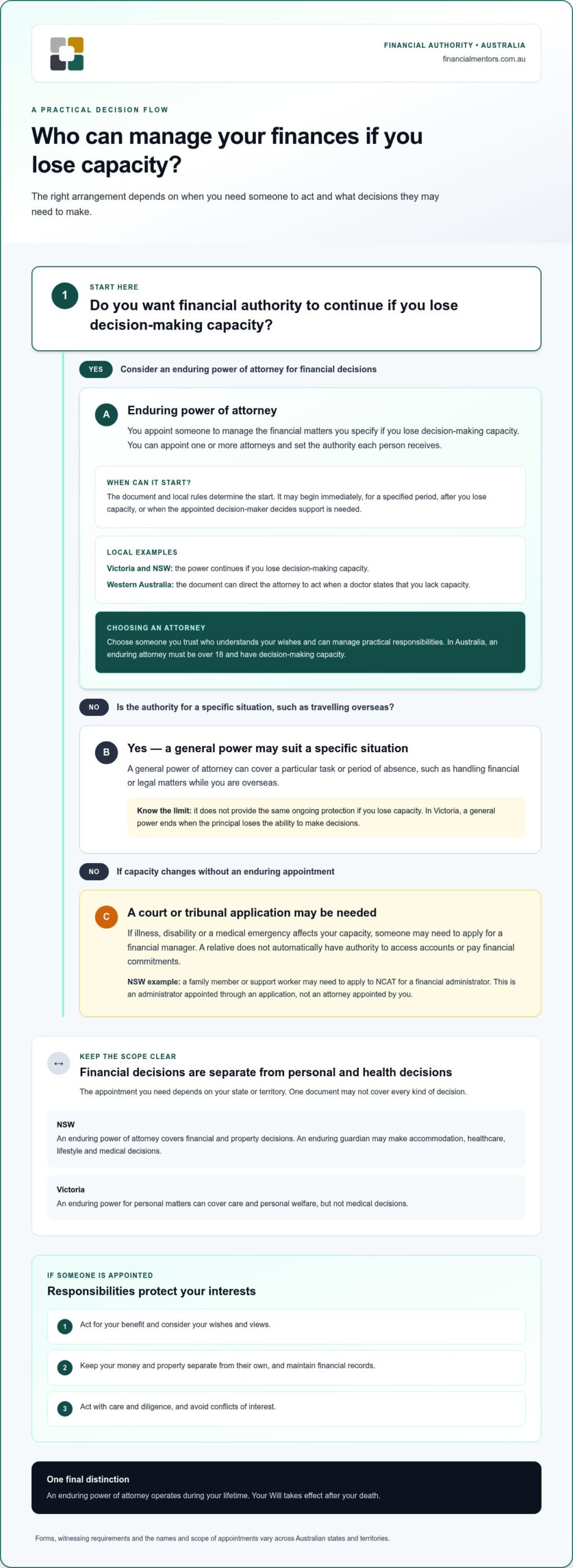
If illness, disability or a medical emergency affects your capacity, you may be unable to decide who manages your financial affairs. Without an enduring appointment, someone may need to apply to a court or tribunal for a financial manager. The process and decision-maker vary by state or territory, so a relative may not automatically have authority to access accounts or pay financial commitments.
In NSW, if a sudden change affects your capacity and no enduring power is in place, a family member or support worker needs to apply to NCAT to appoint a financial administrator. The application is for an administrator, not an attorney appointed by you. Planning while you can still make decisions gives you a say in who may act and how their authority is set out in the legal document.
Travel may call for a different arrangement. If you’re overseas and want someone to handle financial or legal matters during your absence, a general power of attorney can cover a specific situation, such as travelling. It does not provide the same ongoing protection if you lose capacity. Consider the task, period of absence and authority needed before choosing the document.
You can review an appointment as your circumstances or your chosen attorney’s availability changes. In NSW, you may update or cancel your power of attorney while you can still make decisions for yourself. Tell the attorney in writing when you cancel it, and notify relevant banks or businesses. If the document was registered, notify NSW Land Registry Services as well.
Capacity matters both when you appoint someone and when you change the document. Adults in Australia are presumed to have capacity unless evidence shows otherwise. In NSW, an enduring power of attorney must be made before you lose the ability to make decisions. If you’re concerned that an attorney is misusing their authority, an application can be made to NCAT to challenge the appointment. This process can help protect your interests.
Financial decisions covered by an enduring power
An enduring power of attorney for financial decisions can authorise someone to manage specific money and property matters on your behalf. The exact authority depends on the document’s terms and applicable state or territory rules. For example, an attorney may be authorised to pay bills, access bank accounts, sign binding documents, or buy and sell property.
You can set limits so the attorney’s authority matches the support you want. In NSW, you can limit an attorney to specific tasks, such as paying certain bills or selling your house. You can also set conditions for when the authority takes effect, such as immediately or if you lose capacity. Clear instructions define what the appointment allows your attorney to do.
Financial powers may extend to other affairs, depending on the document and jurisdiction. In South Australia, a financial enduring power can cover banking, investments, real estate transactions, tax affairs and business decisions. If you own property, the rules for dealing with it can have practical consequences. In NSW, registration with NSW Land Registry Services is required if your attorney is to deal with your NSW real estate.
There are firm boundaries. An attorney cannot make or change your Will, and financial authority does not grant power over health or welfare decisions. Your Will concerns your estate after death; an enduring power operates during your lifetime. An attorney should avoid conflicts of interest, keep your money and property separate, and maintain financial records. These safeguards help account for decisions made on your behalf.
Before signing, consider each task you want covered, any limits or conditions, and the person you trust to carry them out. A lawyer can explain how the document’s wording and local rules apply to your circumstances; similarly, for individuals managing cross-border estate administration or overseas assets, specialised practices like The Village Law Firm offer guidance on estate planning and asset transfer documentation. Store the original document safely and tell your attorney where to find it so they can act when the authority takes effect.
Financial Mentors Wealth Management: Financial Planning
Financial Mentors Wealth Management can help you connect financial planning with broader decisions about your future. If you’re considering who should manage your finances, financial advice can help you think through how that choice fits your goals, assets and ongoing commitments.
Its estate planning advice can support your wider planning, while financial planning, retirement planning and wealth creation strategies address related financial priorities. Together, these services can help you consider how your plans fit together, including the financial arrangements you want in place if your circumstances change.
If you’d like to discuss your financial plans, contact Financial Mentors Wealth Management to arrange a conversation.
Make your next planning step count
Use what you’ve learned to start a considered conversation with the person you may appoint. Talk about the values behind your choices, the financial decisions that matter most to you and how you’d like those choices approached. Their questions can help you see whether you share a clear understanding before making or updating an enduring power of attorney.
It may also help to write down the priorities you want your broader plans to reflect. For example, note what stability means to you, which commitments matter most and how your plans may change through different life stages. These reflections can provide a useful basis for future conversations about enduring power of attorney financial decisions and your wider financial future.
Take the next step at a pace that feels right for you. A thoughtful discussion now can help you make choices that reflect your wishes and bring greater clarity as you plan ahead.
Frequently Asked Questions
What happens when you appoint more than one attorney?
Your document can specify whether attorneys act jointly or separately, subject to your state’s rules. In Victoria, jointly appointed attorneys must decide together and all sign documents. Attorneys appointed severally can act independently, with one attorney able to sign. You can also appoint alternatives to act if your usual attorney becomes unable or unwilling. Clear arrangements can help avoid delays with everyday financial tasks.
Do I have to register it?
Registration rules vary by state and territory. In NSW, an enduring power of attorney does not need registration for your attorney to begin acting. However, it must be registered with NSW Land Registry Services if your attorney needs to deal with your NSW real estate. Most Australian jurisdictions do not require registration, but property transactions can have specific requirements.
Do you need a lawyer?
A lawyer is not the only possible witness or source of help in every state. Signing and witnessing requirements differ across Australia. For example, Victoria allows a Justice of the Peace, bail justice or lawyer to witness an enduring power of attorney. South Australia also recognises eligible witnesses such as a justice of the peace or legal practitioner. Professional advice may help you understand complex instructions or limits; general resources from legal practices such as botelholawgroup.com can also illustrate how qualified professionals assist individuals with protecting their legal and financial interests.
What decisions can my attorney make?
Your attorney can make financial decisions authorised by your document and local rules. In Queensland, gifts or donations must be of a kind you made, or might reasonably be expected to make, and reasonable in value for the circumstances. A financial attorney may also provide reasonable support for your dependants. Financial authority does not allow an attorney to make or change your Will or take on health and welfare decisions.
What does it mean to ‘lose capacity’?
In Victoria, you have decision-making capacity for a particular decision if you can understand and retain relevant information, then use or weigh it when deciding. Capacity relates to the decision at hand, rather than being a single label for every matter. Australian law presumes adults have capacity unless evidence indicates otherwise. This distinction helps keep decision-making with you whenever you can make that decision.
What does it cost to make an EPA?
The cost depends on your location, the form required and whether you pay for professional assistance. Some jurisdictions provide forms or guidance materials, while legal or other professional help may involve separate fees. The scope of support you seek and the complexity of your arrangements can affect the overall cost. Before proceeding, clarify what any quoted fee covers, including document preparation and advice.