

Money worries are easier to manage when you turn them into practical next steps. Learning how to stop worrying about money starts with identifying what is causing the stress, then making a clear budget and finding support that fits your situation. You don’t have to solve everything at once.
It’s understandable to feel tense when checking your balance or thinking about bills. Money concerns can affect your wellbeing, and avoiding them may make it harder to see what needs attention. A calm review of your income, expenses and financial commitments can help you separate immediate priorities from longer-term goals.
This article explains how budgeting and tracking spending can bring clarity, how financial stress may affect wellbeing, and where counselling resources may help. You’ll also learn when professional financial advice could support your next decisions, so you can take steady steps towards greater confidence and control.
Key Takeaways
- Start by listing your income, bills and everyday spending, then prioritise essentials before setting savings goals.
- Spread the cost of annual expenses across the year by dividing the total by 12 and setting money aside each month.
- Notice how money stress is affecting your wellbeing, and consider counselling support if it feels difficult to manage alone.
- Explore government and financial counselling resources to help identify practical options and achievable short-term goals.
- Professional financial advice can help you make a plan around your circumstances, priorities and future goals.
1. Budgeting and tracking spending
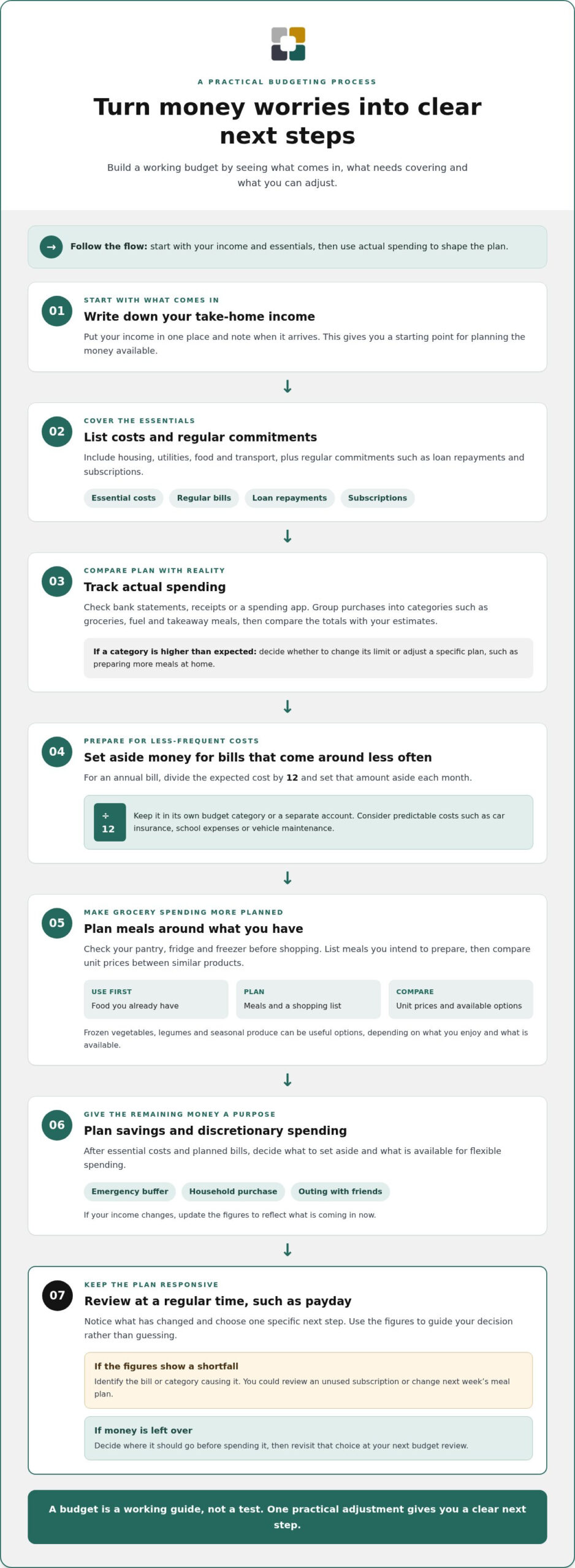
If you’re working out how to stop worrying about money, start by putting the figures in one place. Write down your take-home income and when it arrives, then list essential costs such as housing, utilities, food and transport. Add regular commitments, including loan repayments and subscriptions. This gives you a clearer picture of what must be covered before planning other spending. A budget is a working guide, not a test you pass or fail.
Next, compare your estimates with actual transactions. Use bank statements, receipts or a spending app to group purchases into categories such as groceries, fuel and takeaway meals. Review the totals regularly and adjust your categories if your spending differs from your plan. If takeaway costs are higher than expected, for example, decide whether to set a different limit or plan more meals at home. Tracking makes the decision specific rather than a guess.
Plan for expenses that arrive less often than monthly. For an annual bill, such as car insurance, divide the expected cost by 12 and set aside that amount each month. Record this as its own budget category or keep it in a separate account. That way, the money has a purpose before the bill arrives. Include other predictable costs, such as school expenses or vehicle maintenance, when they apply to your household. In regions where major commitments like housing are billed in large lump sums, services such as Rentify highlight how breaking down annual payments into monthly instalments can help ease cash flow pressure.
Healthy eating can fit into your grocery plan. Before shopping, check your pantry, fridge and freezer, then plan meals around food you already have. Vegetable soup made with pantry staples and vegetables that need using is one example. Write a list of the meals you intend to prepare and compare unit prices between similar products. Frozen vegetables, legumes and seasonal produce can all offer useful options, depending on what you enjoy and what’s available.
After essential costs and planned bills, make room in your budget for savings and discretionary spending. You might set aside money for an emergency buffer, a household purchase or an outing with friends. If your income changes, update the figures to reflect what is coming in now. Choose a regular time to review your budget, such as payday, and note what has changed. This keeps the plan responsive to your circumstances.
A monthly budget can help you see how to stop worrying about money by replacing uncertainty with a clear next action. If the figures show a shortfall, identify the bill or category causing it. You could review an unused subscription or change next week’s meal plan. If money is left over, decide where it should go before spending it. One practical adjustment gives you something specific to revisit at your next review.
2. Effects of financial stress on health
Financial difficulty is associated with mental health challenges. Research spanning nearly four decades has found an association between higher debt and outcomes including anxiety, depression and suicidality. These findings describe links, not proof that debt alone causes a health condition. They do show why ongoing money concerns deserve attention alongside practical financial steps.
Stress can affect your thoughts, mood and ability to focus on everyday tasks. You might repeatedly check your account, put off important conversations or struggle to concentrate at work. Notice what changes for you rather than assuming everyone responds in the same way. For a week, jot down when money worries arise and what you notice in your mood, sleep or body. This record can help you explain your experience to someone you trust or a health professional.
Physical signs are also worth noticing, even when you’re unsure what is causing them. For example, note whether you feel tense before opening a bill or have difficulty settling at bedtime after thinking about expenses. Treat these as observations, not a diagnosis. If a physical or mental health concern is affecting daily life, speak with a health professional about what you’re experiencing and what support may suit you.
Money conversations with a partner or family member can feel difficult, especially when you have different concerns. Choose a calm time, explain one specific worry and describe how it affects you, without assigning blame. For example, you could say, “I’m worried about keeping up with our bills, and I’d like us to look at them together.” Then agree on one next step, such as listing upcoming payments or arranging another conversation.
If the discussion feels overwhelming, set a clear limit. Agree to discuss one issue, such as an upcoming bill, rather than trying to solve every financial concern at once. Write down any decisions and who will take each action. If you and your partner disagree, pause and return to the discussion when you can both focus. A trusted support person or counsellor may also help you talk through the emotional strain.
Tracking your reactions can help you identify what support might be useful. Note the concern, how you feel and what would help next. For instance, if uncertainty about debt is keeping you awake, write down the questions you need answered before seeking practical guidance. If distress feels urgent or you may be at risk of harming yourself, contact emergency services or a crisis support service in Australia now. Your wellbeing matters as you work through money concerns.
3. Finding government and financial counselling resources
Start by matching support to the problem. A financial counsellor can help you understand debts, bills and possible next steps. For income support or other government assistance, look for information through Australian government services. Before making contact, gather recent bills, account statements and any letters from lenders. A short list of questions can help you explain what is happening and what you need.
If debt feels hard to manage, write down each lender, balance, interest rate, minimum repayment and due date. Contact a lender if you can’t meet a payment, and ask about its hardship support process. A financial counsellor can help you prepare for that conversation and compare options for your circumstances. Avoid taking on another loan to cover existing repayments without first understanding how its costs and terms affect your overall position.
How much should you save for an emergency fund in Australia? There is no single amount that suits every household. Work towards a buffer based on essential expenses, income stability and dependants. If saving feels out of reach, start with a manageable amount and increase it when your budget allows.
To manage credit card, buy now pay later and payday loan debt, list each balance, repayment and due date. Prioritise essential bills and avoid missing agreed payments. Contact each lender early if repayments are becoming difficult, and seek help from a financial counsellor to map out a realistic repayment approach. For consumers facing severe over-indebtedness, dedicated debt solutions such as Debt Pro SA demonstrate how structured debt review and consolidation programs can help negotiate manageable repayments and alleviate ongoing stress.
Understanding your stress can make support more useful. Note what triggers worry, such as opening a credit card statement, and the question you need answered. If anxiety affects sleep or daily routines, a therapist can help you work through emotional responses while a financial counsellor focuses on money concerns. These roles can complement each other without replacing one another.
Goals give your plan a practical direction. Choose a short-term goal you can work towards over the coming months, such as catching up on a bill or setting aside money for an expected expense. Add a longer-term goal, such as preparing for retirement or saving towards a home. Make each goal specific enough to guide a choice, then review it as your circumstances change.
A financial plan should cover essential commitments while recognising that money cannot be your only source of security. Write down your priorities, essential costs, debt repayments and next actions. For example, your first action might be to call a lender, followed by arranging counselling. If a goal changes, update the plan rather than treating it as a pass-or-fail test. A clear sequence helps you take the next step without solving every concern at once.
4. Getting professional advice
Professional financial advice can turn a broad concern into a decision you can act on. You might be weighing a home purchase, a change in work, retirement or the financial effects of a difficult event. An adviser can consider your income, expenses, assets, debts and priorities together. This wider view may reveal how one choice affects your other goals, rather than treating each decision in isolation.
Before an appointment, write down what is worrying you most. For example, you may be unsure whether to repay debt faster or build savings. Bring relevant information about your financial position, such as income, regular costs, debts and existing savings. Add questions about the choices you face and what matters to you. Clear details help keep the discussion focused on your circumstances, not general assumptions.
Use the conversation to understand what the advice will cover. Ask how recommendations relate to your stated goals, what alternatives were considered and which financial risks could affect the plan. If a recommendation is unclear, ask for a plain-language explanation. Before deciding whether it suits you, make sure you can describe the proposed next steps in your own words.
A useful plan connects actions with priorities. If you want to prepare for retirement, for instance, discuss how current spending, savings and superannuation fit that goal. If you’re planning for family changes, ask how they may affect household commitments and future plans. A written financial plan can set out strategies and recommendations, giving you a reference point when circumstances or priorities change.
Professional advice is not the same as financial counselling or therapy. A financial counsellor can help you work through debt and urgent money pressures, while a therapist can support your emotional wellbeing. A financial adviser focuses on financial decisions and planning. If you’re facing several challenges, decide which issue needs attention first. Different parts of the situation may call for different kinds of support.
After receiving recommendations, take time to review them. Check that the actions are practical, that you understand the commitments involved and that they reflect your goals. You could begin with one manageable step, such as gathering information or setting a savings contribution. Note what you have completed and what remains. This turns advice into a working plan rather than a document you set aside.
Advice can also support estate planning when you’re considering how assets should be managed for your future and family. Discuss your priorities and the questions you need answered, such as how a change in circumstances could affect your plans. Professional guidance can clarify the financial considerations and help you identify a practical next step.
5. What practical steps can help reduce anxiety about money?
When money worries rise, pause before making a decision. Try a breathing pattern: inhale for four seconds, hold for seven seconds, then exhale for eight seconds. Repeat the sequence and notice whether your body feels more settled. Use this pause before opening a bill or making an unplanned purchase, so you can respond deliberately rather than react immediately.
Give money tasks a defined place in your week. Choose a regular time to review one concern, such as an upcoming bill or repayment. Write down the next action, then stop when the task is complete. For example, you might schedule a call with a lender and note what information you need. A clear boundary can prevent financial checks from taking over every spare moment.
Notice the feelings behind spending and saving. Before buying something, ask what you hope it will provide: convenience, comfort, connection or a sense of control. If you feel restless after work, pause before shopping and consider whether planning an activity for the coming year would better meet that need. This reflection can help you make choices that feel more satisfying.
Make room for experiences that matter, while being honest about your financial position. A local café visit might support social connection and community; if spending is tight, choose a lower-cost way to meet someone. During festive periods, you could prioritise travel to spend quality time with family or friends instead of panic-buying gifts. The aim is to give spending a purpose, not to judge every purchase.
Movement can also form part of your stress routine. Aim for 30 minutes of exercise on most days, choosing an activity that fits your circumstances, such as walking around your neighbourhood. If that feels difficult to fit in, break the activity into shorter periods. Pairing movement with a set time, such as a walk after lunch, can make it easier to remember.
Build awareness of security that already exists in your life. Write down examples such as a trusted friendship, a secure neighbourhood or protections offered by where you live. These do not replace money or resolve bills, but they can remind you that security has more than one source. Notice them now, rather than waiting for a future savings target before allowing yourself a sense of steadiness.
Choose one step today: take a calming breath, contact someone supportive, or plan a meaningful activity within your means. If worry returns, return to that step rather than demanding that every concern disappear. Repeating practical actions can help you respond more steadily while you work through financial pressures.
Financial Mentors Wealth Management: Financial Planning
Financial Mentors Wealth Management can help you turn financial concerns into a plan shaped around your priorities. If you’re managing competing goals, preparing for retirement or considering how to grow wealth, financial planning can help you understand your options and decide on practical next steps.
You can also seek retirement planning advice to prepare for the future, or wealth creation strategies to support your longer-term objectives. If you’re considering how your assets should be managed for your family, estate planning advice can help you explore the financial arrangements involved. These services may suit you when you want professional guidance connecting today’s decisions with future plans.
Bring your questions and a clear picture of what you hope to achieve. Contact Financial Mentors Wealth Management to discuss your financial planning needs.
Take your next step towards financial confidence
Your next financial decision can begin with one clear priority. Think about what you want to feel more prepared for, then write down the question holding you back. If you’re considering how to stop worrying about money, focus on the decision in front of you rather than trying to settle every future concern at once.
Talking through that priority can help you see what information or guidance would make the next step clearer. You can start a conversation about your financial goals when you’re ready to explore your options.
Give yourself permission to move forward steadily. Each considered decision can help you shape a future that reflects what matters to you.
Frequently Asked Questions
Why does money make me anxious?
Money can feel anxiety-provoking when it represents uncertainty, personal expectations or choices with lasting consequences. You might feel uneasy about a decision before checking the details, particularly if past experiences shape how you view debt or security. Try naming the concern plainly, such as “I’m worried about choosing the wrong option.” This can help separate the practical question from the feelings surrounding it.
How can I make a realistic budget in Australia?
Match expected income dates with payment due dates to see whether timing creates pressure. If your pay varies, map out a lower-income period and plan around the money you can rely on. For example, a bill due before your next pay may need a different arrangement from one due afterwards. Keep the plan flexible enough to reflect changing work hours, household needs or other commitments.
What Australian government benefits and concessions can help with money stress?
Check Services Australia for information about support you may be eligible to receive, and look at your state or territory government’s concession information. Available assistance and eligibility requirements differ by programme and personal circumstances. Before applying, note your household details and gather documents relevant to the support you’re considering. If you’re unsure which category fits, use the government service’s guidance to identify the right application or enquiry pathway.
What should I do first if I can’t pay bills or rent in Australia?
First, identify which immediate needs are at risk, such as housing, power or access to food. Keep rent notices, bills and tenancy paperwork together, and record important due dates or decisions. If you need help with essentials, ask a local community service about emergency relief options. Don’t ignore formal notices; understanding what they say helps you identify the issue and decide what support to seek.
What habits help stop money worries from affecting sleep and mental health?
Keep your sleep space for rest rather than paperwork, account screens or difficult financial discussions. A steady wind-down routine, such as reading or listening to calm audio, can help mark a change in focus. If you wake worrying, avoid making financial decisions while tired; return to them when you can think clearly. If disrupted sleep continues, describe the pattern to a health professional, including when it began.
When should I seek professional help for financial anxiety in Australia?
Consider seeking help if worry makes it hard to keep up with daily responsibilities or leads you to avoid important decisions. Start by describing a recent moment when anxiety felt difficult to manage, what was happening and how it affected you. That concrete example can help a professional understand your concerns and discuss suitable support. If distress feels urgent or you feel unsafe, seek immediate assistance.