

What if the retirement date that feels right isn’t the one that best fits your super scheme? If you’re finding benefit statements hard to interpret or weighing up whether to retire gradually, you’re not alone. Public sector superannuation retirement strategies need to account for your scheme’s rules, not just the balance or pension shown on a statement.
Your scheme, retirement timing and wider finances can work together in a practical plan. This guide explains which scheme details may shape your options, how to consider retirement income alongside savings and Centrelink entitlements, and what information to prepare before making decisions. You’ll also see how to weigh your income needs against your personal goals, so your next steps are clearer.
Murray Frean and Financial Mentors Wealth Management are authorised representative and credit representative of Financial Mentors AFSL Pty Ltd ABN 68 976 248 467, AFSL 96323. This website contains information that is general in nature… you need to consider your financial situation and needs before making any decisions based on this information.
Key Takeaways
- Public sector superannuation retirement strategies start with understanding how your scheme calculates benefits and what conditions apply.
- Compare possible retirement dates alongside expected spending, other super, savings and debts to see how income timing may change.
- Gather scheme statements and details of your financial position, then record questions and decisions as you prepare your plan.
- Check scheme information at its source and note when you found it, so your decisions are based on current details.
- Bring scheme information together with your wider goals and potential Centrelink entitlements for a clearer view of retirement income.
Public sector superannuation retirement strategies start with your scheme
Scheme terminology and benefit statements can make retirement choices feel more complicated than they need to be. Start by identifying the type of benefit you have and the rules that apply to your membership. Public sector superannuation retirement strategies depend on those rules as well as your wider retirement goals, including when you hope to stop work and the income you may need.
Public sector retirement planning begins with identifying your scheme and understanding its benefit structure. Public sector employees don’t all belong to the same fund or arrangement, so one scheme’s conditions shouldn’t be treated as universal. Your scheme statement is a starting point, not a complete picture of your household finances. For general background on Australia’s super system, see this overview of superannuation in Australia.
What makes public sector super different from other super?
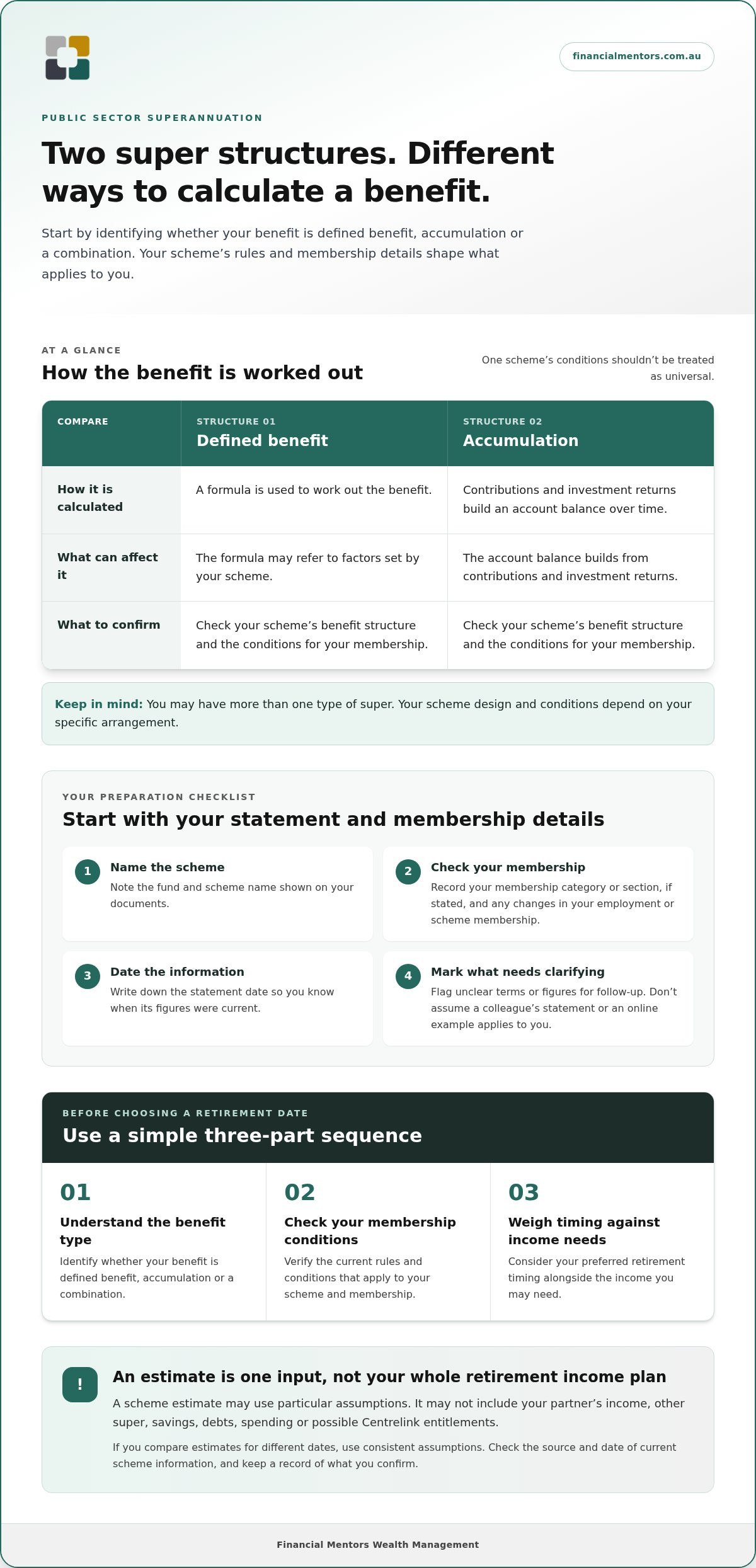
Some public sector schemes provide a defined benefit, where a formula is used to work out a benefit. The formula may refer to factors set by the scheme, so the result isn’t simply the balance of an individual investment account. Other arrangements use an accumulation approach, where contributions and investment returns build an account balance over time. You may also have more than one type of super.
The design and conditions depend on your scheme. Your scheme name and membership history help identify which rules apply, including whether your benefit is defined benefit, accumulation or a combination. Two colleagues with similar work histories may still have different arrangements if they joined under different membership terms.
Start with your scheme statement and membership details
Before weighing up retirement options, gather the details that identify your benefit. Check your latest statement and note:
- The fund and scheme name shown on your documents.
- Your membership category or section, if stated.
- The statement date, so you know when the figures were current.
- Your membership history, including any changes in employment or scheme membership.
Older and newer membership arrangements can have different conditions. Don’t assume a colleague’s statement or an online example applies to you. If a term or figure is unclear, mark it for follow-up and use your scheme’s information to understand it. Recording the statement date also helps you distinguish current information from an older estimate.
Next, set the scheme details beside your personal priorities. Are you considering a particular retirement date, a gradual transition from work or time to meet family commitments? These goals help you frame the questions that need answering, without assuming the scheme benefit alone will cover every need. For wider context on setting goals and preparing for retirement, explore this guide to building a planned retirement foundation.
How scheme benefits, retirement timing and access rules fit together
Once you’ve identified your scheme, follow a clear sequence before settling on a retirement date: understand the benefit type, check the conditions for your membership, then consider timing alongside your income needs. This keeps scheme rules at the centre of your decision without treating one estimate as the whole answer.
A scheme benefit estimate is one input to retirement planning, not a complete retirement income plan. It may show an estimated benefit under particular assumptions, but it won’t necessarily include your partner’s income, other super, savings, debts, spending or possible Centrelink entitlements. The Australian Government’s information on Australian Government superannuation schemes can help you locate official scheme material, including information about Commonwealth schemes.
Understand benefit estimates before choosing a retirement date
Read the estimate’s labels and notes before focusing on the projected amount. Identify the date it was prepared, the retirement date or scenario it assumes, the type of benefit shown and any choices or conditions attached. If it includes more than one payment form, note what each figure represents rather than comparing amounts that describe different options.
If your scheme provides a calculator or estimates for different dates, compare the scenarios using consistent assumptions. Set out the estimate for each date you’re considering, then note what else may change, such as work income or household spending. A higher estimate for one date doesn’t automatically make that date right for you. Eligibility and calculations depend on your scheme and membership details.
Check access conditions and payment choices carefully
Before relying on an estimate, verify the current access conditions, payment choices and timing using information from your scheme. Find out what conditions must be met, whether the estimate depends on a particular retirement date, and how long it remains relevant. Keep the response or source with your records, including the date you checked it.
Payment options can affect how income is received and may have different implications for your circumstances. Avoid assuming a choice that suits another member is right for you. Check scheme rules and seek guidance on tax or legal questions relevant to your situation before acting. General explanations can help you prepare, but they aren’t a personal tax or legal conclusion.
Then place the scheme estimate beside your household figures. List other super, savings, debts, expected spending and income from work or other sources. This helps you identify questions that still need answers, such as whether income would cover regular expenses during a transition from work or how different retirement dates affect the timing of funds.
Financial Mentors Wealth Management provides retirement planning advice to help you bring scheme information and wider income needs into one plan.
Compare retirement strategies using your whole financial position
A scheme benefit is only one part of the picture. To compare possible retirement strategies, consider expected income alongside your household assets, debts and spending. This can help you see what each option may mean for day-to-day finances, without assuming a particular retirement date or benefit will produce a set outcome.
Start by listing likely income sources and regular costs. Include your partner’s circumstances and shared financial commitments where relevant. Then note what you know, what you’re estimating and what needs checking. The framework below can help you compare scenarios side by side.
| Part of your financial position | What to record for each retirement date |
|---|---|
| Scheme income | The scheme estimate, the date it applies to and any assumptions or conditions shown. |
| Other super | Other super accounts or income sources, with estimates clearly labelled. |
| Savings and investments | Accessible savings and investments you may draw on, without assuming future returns. |
| Debts and commitments | Outstanding debts and regular commitments, including those shared with your partner. |
| Expected spending | Essential costs, such as household bills, and discretionary spending linked to your plans. |
| Centrelink entitlements | A potential factor to assess, not a guaranteed payment or assumed income source. |
Compare income sources against your retirement goals
Consider how income timing could differ if you retire on one date rather than another. An earlier date may mean your work income stops sooner, while a later date may mean you continue earning for longer. What happens to your scheme benefit or other income depends on your circumstances and scheme conditions, so compare estimates rather than guessing.
Keep each projection illustrative. Record the assumptions behind it, such as the retirement date, expected work income and spending level. If an estimate hasn’t been checked or is based on an old statement, label it clearly. For background on superannuation information, the Australian Taxation Office’s superannuation guidance is a useful starting point. It doesn’t replace scheme-specific information or advice about your circumstances.
Consider Centrelink entitlements and other assets
Your income and assets may affect your Centrelink entitlements. The assessment depends on current rules and your circumstances, so don’t include a payment as certain in a retirement budget. Check current information from official government sources before relying on an estimate, and avoid using old thresholds or another person’s result as a guide to your eligibility.
Include savings, investments, property and other super in your comparison, alongside your scheme benefit. For a broader preparation checklist, use this retirement income planning guide to organise the questions you still need to resolve. Financial Mentors Wealth Management’s retirement planning advice can help you consider these figures alongside your retirement goals.
A practical checklist for preparing your public sector retirement plan
Good preparation can make a complex decision easier to work through. Gather key records, set out what matters to you and keep a clear note of what still needs checking. This gives you a useful foundation for discussing your options and helps ensure your public sector superannuation retirement strategies reflect both scheme details and your life beyond work.
Documents and questions to prepare
Work through these steps in order. Add to your notes as new information comes to hand.
- Gather your records. Collect recent scheme statements and benefit estimates, details of any other super, and a household summary of savings, debts and regular financial commitments. Include relevant information about your partner if you share income or expenses.
- Write down your preferred timing. Note the retirement dates or gradual work changes you’re considering. Add the income priorities behind each option, such as meeting essential costs or making room for travel and other plans.
- Mark anything that’s unclear. Record unfamiliar scheme terms, figures you don’t understand and assumptions used in estimates. Avoid filling gaps with a colleague’s experience or an old statement.
- Prepare questions for verification. Note questions about benefit options, access conditions and payment timing. Include tax treatment and how your circumstances may relate to Centrelink assessment, so you can find current, relevant information.
- Keep a decision record. For each important detail, note the source and date you checked it. Record what you’ve decided, why it suits your current priorities and which questions remain open.
This record can help when you compare options or discuss your retirement plans. It also helps distinguish confirmed scheme information from estimates and personal assumptions.
Review the plan as your circumstances change
Your retirement plan should make room for change. A periodic review gives you a chance to revisit your goals, income assumptions and scheme information as your situation evolves. Consider updating your notes when a change could affect your choices.
A change in health, work, family plans or financial commitments may affect your timing or income needs. A new statement or updated scheme information may also lead you to revisit an earlier estimate. Update the assumptions, note what has changed and identify any details that need checking before you make a decision.
To connect scheme information with your wider goals, explore retirement planning advice and prepare for an appointment with your statements, priorities and questions.
How retirement planning advice can bring your scheme and goals together
Your scheme benefit matters, but a retirement plan also needs to reflect your income needs, other assets and the life you want to lead. Retirement planning advice can help bring these details into one view, so you can identify what’s clear, what needs further investigation and how your options relate to your goals.
What a retirement planning conversation can help you organise
A useful conversation starts with your circumstances, not an assumption that every public sector scheme works alike. Bring scheme information, benefit estimates, details of other super and savings, household commitments and the questions you’ve gathered. These details help frame a discussion about your preferred retirement timing and priorities.
You may want to understand how different retirement dates sit alongside expected spending, or how a partner’s income and shared commitments fit into the picture. You may also have questions about benefit options, tax treatment or potential Centrelink entitlements. Advice can help organise these questions, but it can’t guarantee a particular investment return, tax result, entitlement or retirement income. Your options depend on your circumstances and the rules that apply to your scheme.
Financial Mentors Wealth Management provides retirement planning and financial advice to individuals and families across Australia, with professional planning advice provided since 2000. The initial meeting is step 01 of the process. Bringing your scheme statements, goals and questions can help make that first conversation more focused. You don’t need to have every answer ready. A clear note of what you know and what you’re unsure about is a practical place to begin.
Take a measured next step
To discuss how your scheme information and wider goals fit together, arrange an appointment by calling 08 9429 8817 or emailing mfrean@financialmentors.com.au. Start by outlining the decisions you’re considering and the questions you’d like to work through.
Murray Frean and Financial Mentors Wealth Management are authorised representative and credit representative of Financial Mentors AFSL Pty Ltd ABN 68 976 248 467, AFSL 96323.
This website contains information that is general in nature. You need to consider your financial situation, objectives and needs before making any decisions based on this information.
Take your next step with a clearer sense of direction
Your retirement plan can grow as your priorities and circumstances change. Rather than trying to settle every question at once, choose one useful next step: identify what needs clarification, note what matters most to you and keep the information that will support your decision together. This can help turn public sector superannuation retirement strategies into a plan connected to your future.
Financial Mentors Wealth Management offers in-person consultations, online services, tools and calculators to support your planning process. Retirement planning advice can help you consider scheme information alongside your wider goals, at a pace that suits you.
Explore retirement planning advice and take a step towards a clearer plan.
Frequently Asked Questions
Is public sector superannuation always a defined benefit?
No. Public sector super isn’t one uniform arrangement, and scheme structures vary. A defined benefit is generally worked out under scheme rules or a formula, while an accumulation account reflects contributions and investment performance. Your statement and membership records can help identify your arrangement. Public sector superannuation retirement strategies should start with that information. Website information is general in nature, so consider your circumstances before acting.
Can I combine public sector super with another super account?
Possibly, but whether accounts can be combined, and whether that suits you, depends on your scheme and circumstances. Before considering a transfer, find out whether your public sector benefit has conditions or features that could be affected. Compare any fees, benefits and access implications using current scheme information. A decision that may suit an accumulation account won’t necessarily suit a defined benefit. Gather the relevant details before acting rather than assuming a transfer is suitable.
How is public sector super taxed when I retire?
Tax treatment can depend on your scheme, benefit type, age and payment choice, and rules may change. A pension and a lump sum, for example, may not receive identical tax treatment, so don’t assume the same explanation applies to both. Check current guidance from the Australian Taxation Office and your scheme, then seek advice relevant to your circumstances before deciding. This general information isn’t a personal tax assessment or a conclusion about your tax position.
Can I access public sector super before I retire?
Access may be possible in some circumstances, but it depends on applicable super rules, your situation and your specific scheme. Don’t rely on a general age or another member’s experience as confirmation that you can access your benefit. Review the scheme’s official information and consider how a proposed withdrawal or payment could affect your other retirement income and plans. This article provides general information only, not confirmation of your individual eligibility.
What happens to my public sector super if I change jobs?
Leaving a public sector role doesn’t have one universal effect on your super. What happens can depend on your scheme, membership history and employment arrangements. Before making decisions about a new role, get current information about your specific benefit and any choices or deadlines that may apply. Keep written details with your employment records. Don’t assume the benefit transfers automatically, remains unchanged or is lost when you leave.
Can I receive the Age Pension as well as public sector super?
Possibly, but receiving super doesn’t by itself establish whether you qualify for the Age Pension. Centrelink entitlements depend on your circumstances and the income and assets assessment rules that apply. Check current Services Australia information before including a possible payment in your retirement budget. Then consider how any assessed entitlement fits alongside your scheme benefit, other income and expected spending. Eligibility and payment amounts can’t be assumed from a general example.