

The lowest setup fee may not make a family trust the least expensive choice over time. The cost of setting up a family trust in australia depends on the trustee structure and the work involved. The trust deed is only one part of the picture: you also need to consider establishment tasks and the costs of running the trust.
It’s understandable to focus on the initial outlay, especially when trust deeds and trustee options can be hard to compare. But you’ll also need to consider recurring administration, such as accounting, record keeping and tax return preparation. The amount of work can depend on the assets held and the trust’s activity.
This guide explains the common establishment and ongoing cost categories, the factors that can affect your budget, and the questions to consider before proceeding. You’ll also see how to weigh a trust alongside your financial position, tax obligations and long-term goals.
Key Takeaways
- The cost of setting up a family trust in australia depends on its purpose, trustee structure and the work involved, not just the trust deed.
- Separate one-off establishment tasks from recurring tax and administration commitments to build a clearer budget.
- Compare individual and corporate trustee options by considering their costs alongside your plans for managing assets and succession.
- Before proceeding, clarify what the trust is intended to achieve and weigh its potential planning uses against its ongoing effort and costs.
- Financial advice can help you consider a trust as part of your wider financial position, wealth plans and estate planning.
What does the cost of setting up a family trust in Australia include?
A family trust is a structure for holding and managing assets for the benefit of beneficiaries, often members of a family. The trustee manages the trust according to its deed, which sets out the trust’s terms. Beneficiaries are the people or groups who may benefit under those terms. Because the structure involves several roles and tasks, the cost of setting up a family trust in australia is not one fixed item.
Establishment costs are one-off expenses involved in creating and arranging the trust. Recurring costs relate to administering it over time. Keeping these categories separate gives you a more realistic view of the financial commitment. The deed and initial setup work may be establishment costs, while accounting and tax return preparation may be ongoing needs.
Which parts make up a family trust?
The trust deed records the terms that guide how the trust operates. The trustee manages the trust and its assets under those terms, while beneficiaries are those who may receive a benefit. These roles help explain why the deed, trustee arrangement and intended beneficiaries all matter when you consider the structure. For a broad introduction to the legal framework, see this overview of Australian trust law.
A trustee may be an individual or a company. With an individual trustee, one or more people take on the role. With a corporate trustee, a company does so. These options can involve different setup and administration requirements, so neither is automatically right for every family. Consider the trust’s purpose, assets and plans for future management when weighing the options.
Why can setup costs differ between families?
Start by defining what you expect the trust to do. A structure intended to hold a small number of straightforward assets may require different work from one involving several assets, beneficiaries or connected entities. Additional advice or more involved arrangements can add tasks. The state or territory where the deed is executed may also affect establishment expenses, so a general estimate may not reflect every circumstance.
Consider the assets as well as the paperwork. Holding an investment asset, for example, can raise different planning and record-keeping questions from holding cash. The trustee arrangement can also shape the initial work and what needs to be maintained later. That’s why a quoted deed cost should not be treated as the full cost of setting up a trust.
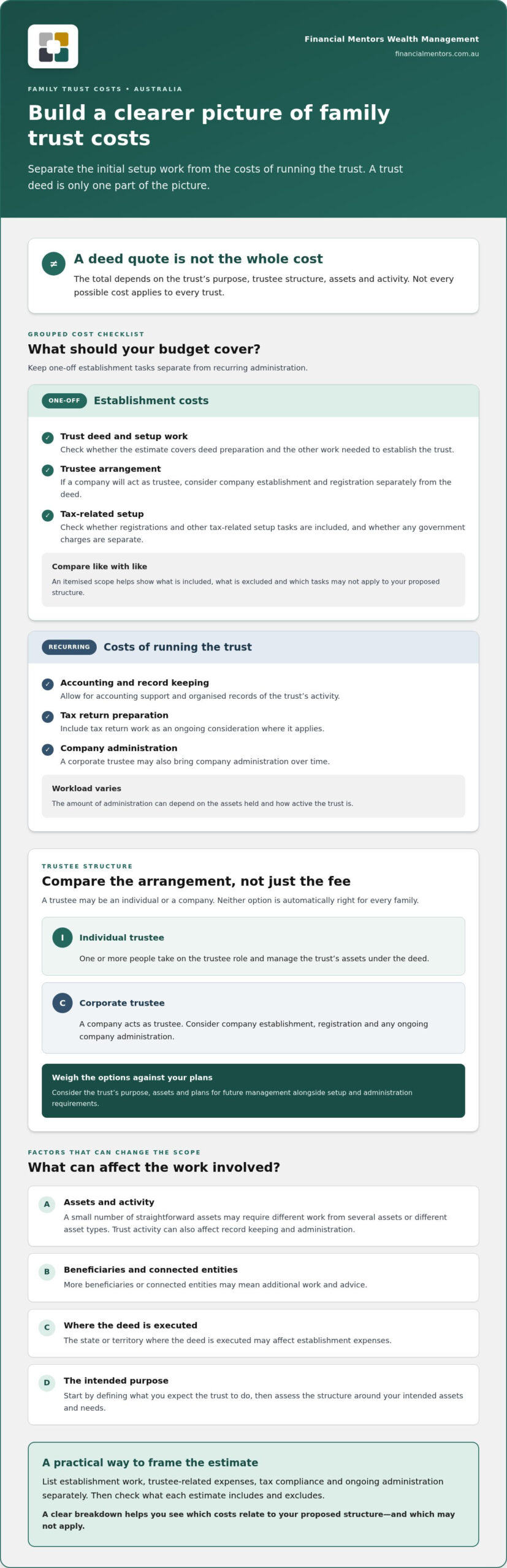
When comparing estimates, review what each one includes and excludes. Separate the deed and setup work from trustee-related expenses, registrations or other initial tasks, then list expected administration separately. Not every trust will incur every possible cost. A clear breakdown helps you identify which items relate to your proposed structure and which may not apply.
Assess the structure around your intended assets and needs, rather than choosing based on one initial figure. This gives you a clearer starting point for deciding whether the setup and ongoing commitments fit your plans.
Family trust setup and ongoing costs: what should your budget cover?
A useful estimate separates the work required to establish the trust from the costs of running it. The cost of setting up a family trust in australia is not necessarily the full amount you’ll spend: trustee arrangements, tax compliance and administration can bring expenses over time. The exact scope depends on the structure and its activity, so treat an estimate as a breakdown of possible costs, not a guaranteed price.
Compare trust deed and establishment work, trustee arrangements, tax compliance, and ongoing administration as separate cost categories. The table below provides a practical starting point. Not every item will apply to every trust.
| Cost category | What to consider | When it may arise |
|---|---|---|
| Establishment | Trust deed preparation and other work to set up the trust. | At the start, with scope shaped by the arrangement. |
| Trustee structure | Costs associated with using an individual trustee or establishing a company to act as trustee. | At setup, with company administration potentially continuing. |
| Tax compliance | Tax-related registrations, record preparation and tax return work, as applicable. | At setup or during ongoing operation. |
| Ongoing administration | Accounting, record keeping and any relevant company administration. | Regularly, depending on trust activity and assets. |
One-off establishment costs to identify
Review what the establishment estimate covers. It may include preparation of the trust deed and related setup work, while another estimate may cover only some of those tasks. If you choose a corporate trustee, company establishment and registration are separate considerations from the trust deed. An itemised scope makes it easier to compare like with like and identify tasks that sit outside the quoted work.
Professional fees can vary with the work involved. A straightforward arrangement may need less advice than one with more assets, beneficiaries or connected entities. Check whether the estimate includes tax-related setup tasks and whether any government charges are separate. A low headline price may not represent the full establishment cost.
Recurring costs that can affect the total
After setup, the trust may require accounting support, tax return preparation and organised records of its activity. The amount of work can depend on what the trust holds and how active it is. A trust with several transactions or different asset types may need more record keeping than one with limited activity. If a company acts as trustee, include company administration as a separate ongoing category.
Requirements and charges can change. Before budgeting for registrations, tax obligations, company charges or filing dates, refer to current information from the Australian Taxation Office and ASIC. This helps keep your estimate grounded in current requirements rather than assumptions.
As you compare estimates, record what is included, what is excluded and which costs may recur. If you’re weighing a trust against your wider financial position and long-term goals, financial planning advice may help you consider how the decision fits your broader plans.
Is a family trust worth the cost? Compare purpose, complexity, and trade-offs
A family trust may support particular ownership or planning goals, but it isn’t automatically a way to save tax or protect every asset. Whether the cost of setting up a family trust in australia makes sense depends on what you want the structure to do, how it fits your financial position and whether you’re prepared for its ongoing administration.
Compare the reason you’re considering a trust with the commitments it may bring. The potential uses below are planning considerations, not guaranteed outcomes.
| Potential reason to consider a trust | Commitment to understand |
|---|---|
| Holding selected investments or other assets through a separate structure | Initial setup work and ongoing records for the trust’s activity |
| Coordinating aspects of family wealth planning | Considering who may benefit and how the trustee will manage the arrangement |
| Including succession considerations in longer-term planning | Reviewing whether the structure remains suitable as family circumstances and plans change |
| Managing distributions among potential beneficiaries | Understanding that distributions and trust losses can have tax consequences, and that rules should be checked for your circumstances |
When might a family trust fit your plans?
You might consider a trust if you have a clear purpose, such as holding selected investments, planning how family wealth is managed, or considering succession over time. These are possible uses, not promises of a particular tax or asset protection result. The number of potential beneficiaries and their roles may also affect the amount of coordination and record keeping involved.
Think about your time horizon. If your plans involve managing assets over the long term, consider whether the structure’s responsibilities make sense alongside your long-term goals. If your plans are likely to change soon, weigh that uncertainty against the effort of establishing and maintaining the trust. Your overall financial position matters too: consider the trust alongside your other assets, commitments and plans.
What trade-offs should you weigh before proceeding?
Weigh any intended benefit against setup work, recurring administration and tax compliance. A trust with several beneficiaries or active investments may involve more coordination than a simpler arrangement. You’ll also need to understand the tax treatment of trust losses and distributions before deciding how the structure may work. Tax rules can change, so avoid relying on general assumptions or treating a trust as an automatic tax-saving strategy.
A trust may not suit every family or every asset. Compare its expected planning role with the time and cost of keeping the structure in order. Financial advice can help you consider the decision in the context of your broader plans. Tax and legal questions require advice on the relevant rules and documents. This gives you a steadier basis for deciding whether the structure supports your goals, rather than taking on complexity without a clear purpose.
How to estimate the cost of setting up a family trust in Australia
A useful estimate starts with the trust you’re considering, not a generic figure. Write down its purpose and intended assets first. Then separate one-off establishment work from trustee-related costs and recurring administration. This gives you a clearer way to compare estimates and see which assumptions may affect your total.
A practical checklist for building your estimate
- Set out the purpose and assets. Note what you want the trust to hold, such as investments or other assets, and what you hope the structure will support. If property may be involved, flag any proposed transfer for separate consideration.
- Record the people and roles. List potential beneficiaries and whether you’re considering an individual or corporate trustee. Include any assumptions about how the trust may be managed as family circumstances change.
- List establishment work. Write down the trust deed and other setup tasks as separate line items. If a company will act as trustee, include its establishment and registration considerations separately from the trust’s own setup.
- Build a recurring-cost list. Consider accounting, tax return preparation, record keeping and any applicable company administration. The work may depend on the assets held and how active the trust becomes.
- Compare estimates on the same basis. Review each estimate’s scope, exclusions and assumptions. For example, one may include tax-related setup work while another may address only some establishment tasks. Compare the inclusions before weighing the totals.
Keep one-off work and recurring costs in separate columns. Add a note beside any item that depends on future trust activity, such as the number of transactions or assets held. This helps you avoid treating a setup estimate as a forecast of every later expense.
Questions to resolve before acting
Does the proposed structure fit your financial position and long-term goals? Are you comfortable with the administration it may involve? If a property transfer is planned, don’t assume it will be free of tax or duty consequences. The treatment can depend on the circumstances and the relevant state or territory, so use current information when considering your plans.
Also, don’t assume that setup or administration costs are tax deductible. Tax treatment depends on the nature of the expense and the applicable rules. Keep records of the expenses and work involved, then seek advice on the tax treatment before claiming a deduction. Current Australian Taxation Office information, ASIC guidance for corporate trustee matters, and relevant state or territory guidance can help you understand the requirements. Where your circumstances require interpretation, obtain suitable tax or legal advice before proceeding.
Once you have a written list of costs, exclusions and open questions, you can assess the trust in the context of your wider plans. Financial advice may help you consider how the proposed structure fits your goals and overall financial position. You can discuss your financial planning options as you work through the decision.
Plan your next steps with family trust costs in view
A family trust decision is easier to assess when you look beyond the initial setup. Clarify what you want the trust to do, identify the establishment cost categories, and consider the administration you may need to manage over time. Then weigh those commitments against your family priorities, assets and long-term goals. The aim is to understand how the structure may fit your plans, not to assume it will produce a particular tax or asset protection outcome.
Bring the trust decision into your wider financial plan
Consider the proposed trust alongside your current financial position and other plans. For example, if you’re thinking about holding investments through a trust, consider how that choice relates to your wider approach to family wealth, tax planning and future asset management. If your priorities change, the structure and its ongoing work may need to be reviewed too.
Financial advice can help you place the decision within broader financial planning. Estate planning advice and tax return preparation may also be relevant as you consider how assets are managed and tax obligations are handled. Legal questions about trust documents or the legal effect of a trust require appropriate legal advice.
Before deciding, bring together your purpose for the trust, the assets you’re considering, your preferred trustee arrangement and a separate list of ongoing commitments. This gives you a clearer basis for considering how the decision relates to your wider plans. It can also help you identify questions that need tax or legal input, without treating a general estimate as a personal recommendation.
A supportive first step towards clearer planning
The initial meeting is step 01 of the Financial Mentors Wealth Management process. An appointment gives you an opportunity to discuss how a trust decision sits within your broader financial position and long-term goals. To take that step, call 08 9429 8817 or email mfrean@financialmentors.com.au.
Murray Frean and Financial Mentors Wealth Management are authorised representative and credit representative of Financial Mentors AFSL Pty Ltd ABN 68 976 248 467, AFSL 96323.
General information: This website contains information that is general in nature. It does not take into account your objectives, financial situation or needs. You need to consider your financial situation and needs before making any decisions based on this information. Consider whether the information is appropriate to your circumstances and seek professional advice where needed.
Take your next step with confidence
A family trust is one possible part of a wider financial plan, not a decision you need to make in isolation. Consider what you want your assets and plans to support over time, and whether the structure’s ongoing commitments fit alongside your other priorities. A clear view of the costs can help you weigh the decision against your circumstances, rather than focusing on a single estimate.
If you’d like to explore how your financial priorities fit together, a conversation about your plans can help you identify the questions to resolve before deciding. Financial Mentors Wealth Management provides financial planning and wealth management advice, retirement and estate planning advice, and tax return preparation for its clients. Take a practical step towards a plan that reflects what matters to you by calling 08 9429 8817 or emailing mfrean@financialmentors.com.au.
Frequently Asked Questions
How much does it cost to set up a family trust in Australia?
There’s no single fixed price for establishing a family trust. The cost of setting up a family trust in australia depends on the trustee arrangement, the establishment work included and the trust’s complexity. When reviewing estimates, check whether the trust deed, company setup if relevant, registrations and other initial tasks are included or treated separately. A written breakdown helps you understand what a figure covers before you budget.
What ongoing costs does a family trust have?
Ongoing expenses may include accounting, tax return preparation, record keeping and company administration if a corporate trustee is used. The work can change with the trust’s activity. For example, a trust receiving rent and paying property expenses may need records for those transactions as well as its other financial activity. A clear explanation of recurring work helps you consider it alongside the initial setup.
Does setting up a family trust automatically reduce tax?
No. Establishing a trust does not automatically reduce your tax. The result depends on the trust’s circumstances, how it operates and the relevant tax rules. Distributions may have tax consequences for the trust or recipients, so don’t assume that income distributed to family members will always mean a lower overall tax bill. Consider your circumstances and seek tax advice before relying on a trust for a tax outcome.
Is a corporate trustee more expensive than an individual trustee?
It can be. A corporate trustee may involve the separate cost of establishing and registering a company, as well as company administration over time. An individual trustee avoids those company-related items, but the suitability of either arrangement depends on your plans and circumstances. Compare the full setup and ongoing commitments, rather than judging the options only by their initial cost.
Can a family trust own an investment property?
A family trust can hold an investment property, but consider the arrangements before buying or transferring one. A transfer may have tax or duty implications, and the relevant rules can depend on the property and state or territory. Ownership also brings property income and expenses to record. Review current requirements and obtain suitable tax and legal advice before making a transfer or deciding how the property should be held.
Are family trust setup costs tax deductible?
Not automatically. Whether a particular expense is deductible depends on what the cost relates to and your circumstances, so avoid treating every setup or administration expense the same way. Keep invoices and descriptions of the work, then seek advice on the tax treatment before claiming a deduction. Current Australian Taxation Office guidance and professional tax advice can help you assess how the rules apply to your situation.
What information should I gather before estimating family trust costs?
Prepare a short summary of the trust’s purpose, intended assets, potential beneficiaries and proposed trustee arrangement. Note whether property may be involved, where it is located, and whether assets are already held in another name. Add any estimates you have, including their inclusions and exclusions, and list expected trust activity. These details help you identify what needs pricing and which tax, duty or administration questions need further attention.
Powered by DASH