

Two retirement portfolios can earn the same average return and still produce different outcomes once withdrawals begin. If markets fall early in retirement, you may need to sell more investments to fund your income, leaving fewer assets invested for a possible recovery. That’s the concern behind sequencing risk in retirement Australia, and it can feel different from the market ups and downs you experienced while saving.
The order of returns matters because you’re drawing on savings rather than adding to them. A market fall doesn’t automatically mean your retirement plans are off track, but it can make your withdrawal choices and spending flexibility more important. Understanding this risk can help you prepare to review your options calmly.
This article explains how return timing may affect retirement income, how sequencing risk differs from ordinary investment volatility, and what to consider about withdrawals and spending if returns are weaker. It also outlines how a financial plan can bring together income needs, investment choices and personal goals, giving you a clearer starting point for a conversation with a qualified adviser.
Key Takeaways
- Learn why the timing of investment returns can affect retirement savings once you begin drawing an income.
- See how similar average returns may lead to different outcomes when they occur at different times around withdrawals.
- Explore how investment mix, spending flexibility and accessible cash needs could form part of a discussion about sequencing risk in retirement Australia.
- Review your income needs, financial commitments and available retirement savings methodically if markets fall.
- Consider how a financial plan can connect retirement income, investment choices and personal goals, then adapt as your circumstances change.
What Is Sequencing Risk in Retirement, and Why Does It Matter?
Saving for retirement and drawing an income from savings are different stages. While you’re working, contributions can add to your investments. Once you start making withdrawals, the timing of investment returns may affect how much remains to support your income over time.
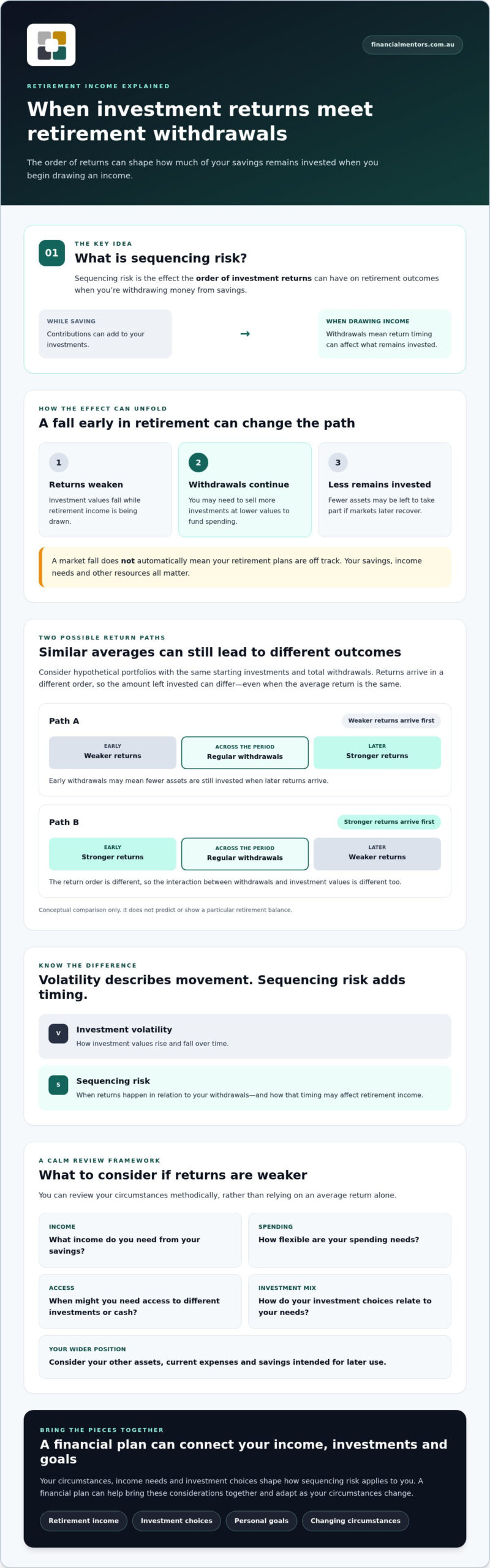
Sequencing risk is the effect that the order of investment returns can have on your retirement outcomes when you’re withdrawing money from savings. If weaker returns occur early in retirement, withdrawals may mean selling more investments while their values are down. This can leave fewer assets invested if markets later recover. Stronger returns earlier may give your savings a different starting point for later withdrawals.
Two investments can have identical average returns over a period but lead to different outcomes if those returns arrive in a different order. For example, regular withdrawals may affect the remaining savings differently when a retirement period begins with weaker returns rather than stronger returns, even if the average return is the same. An average alone may not show how an investment path interacts with your income needs.
In Australia, retirement income arrangements may involve superannuation and other sources. For broad background on pension arrangements that can form part of a retirement income plan, you can read this overview of pensions. Your circumstances, income needs and investment choices are what matter when considering sequencing risk in retirement Australia.
How Is Sequencing Risk Different from Investment Volatility?
Volatility describes how investment values rise and fall over time. It’s a feature of investing, but it doesn’t explain by itself how a change in value affects retirement income. Sequencing risk focuses on when returns happen in relation to withdrawals. The same market fall may have different effects depending on your savings, income needs and other resources. A fall alone doesn’t determine your personal retirement outcome.
When Can Sequencing Risk Become More Relevant?
The years around retirement are a useful time to review how your savings may support withdrawals, particularly as regular income begins. Your exposure depends in part on how much you need to draw, how flexible your spending is and when you may need access to different investments. Savings intended for later use may have a different time frame from funds needed for current expenses. There’s no single point when this consideration disappears.
How Returns and Withdrawals Can Shape Retirement Savings
Consider two hypothetical retirement portfolios with the same starting investments and the same total withdrawals. In the first, weaker returns occur early while regular withdrawals are being made. In the second, stronger returns come first and weaker returns arrive later. Even if the average return across both paths is similar, the timing of returns and withdrawals can leave different amounts invested.
The average return summarises performance across a period, while the path of returns shows when gains and falls occurred and how they lined up with withdrawals. That distinction helps explain sequencing risk in retirement Australia: an average alone doesn’t show whether you had to sell investments during a downturn to meet spending needs.
Why Can Early Retirement Losses Have a Different Effect?
If an investment’s value falls while you’re taking income from it, your balance may be lower after both the fall and the withdrawal. If you need to sell assets to fund spending, fewer may remain invested to participate in a later recovery. That can produce a different result from experiencing the same fall before withdrawals begin.
The effect depends on your circumstances. Your other assets, spending needs and investment mix all matter. A decline doesn’t automatically cause lasting harm to a retirement plan, and a recovery or changes in your circumstances may alter the picture. This comparison illustrates how timing can interact with withdrawals, not what will happen to your balance.
How Do Withdrawals Change the Comparison?
Imagine two portfolios exposed to the same sequence of market returns. One is left untouched during that period. The other pays for regular retirement spending. If the second portfolio falls, it may need to sell more units or assets at lower values to provide the same income. If values later rise, those sold investments can’t take part in the recovery.
For a clear illustration, state the assumptions: the portfolios start with the same balance, hold the same investments and face the same pattern of returns; only one makes withdrawals. If you use figures, keep them rounded and identify them as assumptions, not forecasts. This keeps the focus on how withdrawals interact with returns, rather than suggesting an example predicts your future balance.
For your own circumstances, consider how income needs and investment choices work together. An appointment to discuss retirement planning advice may help you identify relevant questions and possible next steps.
What Can Reduce Sequencing Risk in an Australian Retirement Plan?
There’s no way to remove investment risk or guarantee that your savings will last for a particular period. Planning can help you understand your choices and consider how much flexibility you have if returns are weaker while you’re drawing income. Useful discussion areas include your investment mix, spending needs and access to cash.
A short-term reserve may help cover planned expenses without relying on investment sales at a difficult time. The right approach depends on your circumstances, including how much income you need and what other resources are available. Holding cash also has trade-offs, so any reserve should suit your plan and be reviewed as your needs change.
Rather than relying on one strategy, consider how these parts fit together:
- Investment mix: Is the balance of growth and defensive investments appropriate for your needs and time frames?
- Spending flexibility: Which costs are essential, and which could be adjusted if your financial position changed?
- Accessible cash: What funds may be available for near-term expenses, and how often will you review that amount?
How Can Flexible Spending Support Your Plan?
Start by separating essential costs, such as regular bills, from discretionary spending that may be more adjustable. Ask what flexibility would feel realistic for your household if income or investment values changed. Weigh any adjustment against your wellbeing and long-term goals. The aim is to understand your options in advance, not to assume you’ll need to cut spending.
What Should You Consider About Super and Investment Choices?
Your superannuation settings and investment options can affect how retirement savings respond to market changes and withdrawals. Review when you may need access to the money, the income it needs to support and your comfort with fluctuations. Avoid assuming one asset mix, product or withdrawal rate suits everyone. Check current Australian product, tax and superannuation details before acting, as rules and your personal circumstances may affect what is appropriate.
A periodic review can bring these questions together as your circumstances change. Consider whether your investment mix, accessible cash and spending choices still support the retirement income you need, rather than reacting to a market fall in isolation.
How to Review Your Retirement Plan When Markets Fall
A market fall can make it tempting to change investments straight away. A calmer first step is to check how your income plan fits your current circumstances. This can help you focus on decisions that matter to your household rather than reacting to headlines. A considered review is especially useful when you’re thinking about sequencing risk in retirement Australia.
Work through these steps before deciding whether your plan needs to change:
- Set out your current income needs. List regular expenses and identify which costs are essential and which may be adjusted.
- Update your financial position. Note your available retirement savings, other income sources and ongoing financial commitments.
- Check your assumptions. Consider whether your expected spending, withdrawal approach and investment time frames still reflect your circumstances and long-term goals.
- Review possible next steps. If something has changed, consider your options and seek appropriate advice before making significant investment decisions.
A retirement planning checklist can help you organise the information and questions to take into a review.
Which Questions Should You Ask About Your Income?
Ask which expenses need to be met and which could be changed if circumstances require it. Check where your income is coming from and whether your withdrawal assumptions remain suitable. If you receive or may qualify for Centrelink entitlements, treat eligibility as a personal question and verify current details with Centrelink. An appropriate professional can help you review how your income sources relate to your plan.
When Is It Worth Getting Professional Guidance?
A review may be useful if your retirement timing, income needs or financial position changes. Professional advice can help connect investment decisions with your wider retirement goals, rather than considering a market fall on its own. You might also explore how a planned retirement strategy could reflect your circumstances.
To learn more about the service, read about retirement planning advice.
Build a Retirement Income Plan That Can Adapt Over Time
Sequencing risk is a planning consideration, not a prediction of your personal retirement results. The order of investment returns is outside your control, but you can review how your income needs, investment choices and personal priorities fit together. A plan can give you a clearer way to consider options as your circumstances change, without promising a particular outcome.
A financial plan is a written set of strategies and recommendations to help you work towards your financial goals. For retirement, it can connect the income you expect with your spending needs, investments and the life you want to lead. A periodic review can help you check whether those strategies still suit you if your income, expenses, health or family circumstances change.
What Should an Adaptable Retirement Plan Bring Together?
Your plan should reflect your own financial position, rather than assume that one approach suits every Australian retiree. Depending on your circumstances, it may consider:
- the income you expect from superannuation and any other relevant sources
- your regular spending needs and financial commitments
- the investments and other assets available to support your retirement
- the personal priorities and long-term goals you want your income to support.
These pieces are connected. A change in one area may affect the choices available in another, so it can help to review them together. For example, if your expected spending changes, you may want to revisit how your investments and income arrangements support your plans.
How Can Advice Help You Take the Next Step?
Tailored retirement advice starts with understanding your financial position and goals. An adviser can help you consider how income needs, investments and personal priorities relate to one another, then discuss possible next steps. This can make a conversation more focused while leaving room for your circumstances and preferences.
At Financial Mentors Wealth Management, the initial meeting is step 01 of the firm’s process. Before an appointment, you could write down questions such as: What income sources should I consider? Do my current assumptions still reflect my needs? What should I review if my circumstances change? There’s no need to have every answer ready.
If you’d like to explore how a retirement plan could reflect your circumstances, discuss retirement planning with Financial Mentors Wealth Management. A conversation can help you clarify your questions and consider possible next steps, without assuring a particular result.
Take a Steady Next Step with Your Retirement Plan
Sequencing risk in retirement Australia is a planning consideration, not a prediction of what your savings will do. The order of returns can affect outcomes when you’re withdrawing income, so it helps to look beyond average returns and consider how withdrawals fit with your needs.
A measured review can start with your current income, spending and available savings. From there, consider whether your investment choices, cash needs and spending flexibility still reflect your circumstances and long-term goals. A financial plan can bring these decisions together and be reviewed as your life changes.
Your retirement choices are personal. Financial Mentors provides retirement planning and tailored financial advice to Australian clients nationally. If you’d like to talk through your circumstances and possible next steps, discuss your retirement planning options with Financial Mentors.
Thoughtful planning and regular reviews can help you approach the future with greater clarity and take each decision at a pace that feels right for you.
Frequently Asked Questions
What is sequencing risk in retirement?
Sequencing risk is the effect that the order of investment returns can have on your retirement savings when you’re making withdrawals. If weaker returns happen while you’re drawing income, you may need to sell more investments at lower values, leaving fewer assets to participate in a recovery. The same average return can lead to different outcomes depending on when gains and falls occur relative to your withdrawals.
Why does sequencing risk matter when you retire?
Sequencing risk matters because retirement often involves drawing on savings rather than adding regular contributions. If investment values fall while you’re withdrawing income, the remaining balance may be affected by both the fall and the withdrawals. The effect depends on your savings, spending needs, investment mix and other income sources. A market decline doesn’t determine your personal outcome, but it can make a considered income plan valuable.
Can sequencing risk affect superannuation in Australia?
Yes. Sequencing risk in retirement Australia can be relevant if your superannuation investments are helping fund regular withdrawals. Investment values can rise or fall, and the timing of those changes may affect how much remains invested after you take income. Your super fund’s investment options, withdrawal arrangements and wider financial position all matter. Check current superannuation details and consider your personal circumstances before making changes.
How can you manage sequencing risk in retirement?
You can plan for sequencing risk by reviewing how your income needs, investment choices and spending flexibility work together. Consider which expenses are essential, what spending could be adjusted if needed, and how accessible funds may fit your circumstances. A suitable investment mix and any short-term reserve should be considered as part of your overall plan, not as guaranteed protection from losses. Review your approach as your needs change.
Should you change investments after a market fall in retirement?
Not automatically. A market fall can be unsettling, but reacting quickly may not suit your goals or circumstances. First, review your current income needs, financial commitments, available retirement savings and the assumptions behind your plan. Consider whether anything has changed beyond the market movement. If you’re unsure, discuss your options with an appropriately qualified financial adviser before making investment decisions.
Does sequencing risk disappear after the first years of retirement?
No set period marks the point when sequencing risk disappears. Its relevance depends on factors such as your ongoing withdrawals, investment time frames, spending needs and other resources. Your circumstances can also change over time, affecting how your plan responds to investment returns. Regularly reviewing your income needs and financial position can help you see whether your existing approach still fits, rather than relying on a fixed timeline.
Can an Australian financial adviser help with sequencing risk?
An Australian financial adviser can help you consider how investment choices, income needs and personal goals fit together. They can review your circumstances and discuss possible strategies, such as spending flexibility or how your savings are arranged to support withdrawals. Advice should reflect your individual financial position, and it can’t guarantee a particular outcome. Prepare questions about income sources, investments and changing needs for an appointment.