

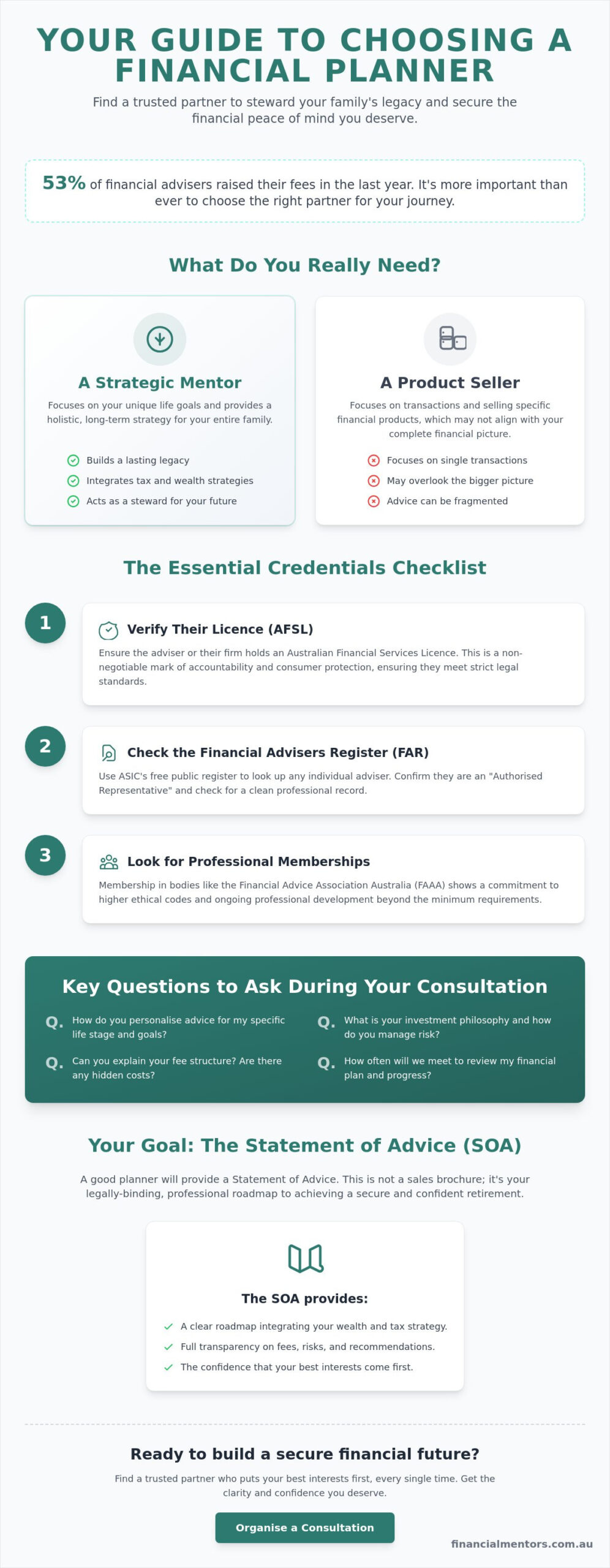
Did you know that 53% of financial advisors raised their fees in the last 12 months? If you’re feeling a bit uneasy about who to trust with your hard-earned super and savings, you aren’t alone. It’s completely natural to feel overwhelmed by industry jargon or the nagging worry that hidden costs might be eroding your future. Choosing a financial planner is one of the most personal decisions you’ll ever make; it’s really about finding a steward for your family’s legacy rather than just a strategist for your bank account.
We understand that you want more than just a spreadsheet. You want the confidence that comes from knowing you won’t outlive your retirement funds. In this guide, you’ll discover how to find a trusted partner who truly aligns with your unique life goals and provides the genuine peace of mind you deserve. We will walk through the essential steps to secure a clear financial roadmap, an integrated tax and wealth strategy, and a future that feels stable and bright. By the end, you’ll have a practical framework to identify a professional who puts your best interests first, every single time.
What You Will Discover
- Learn how to distinguish between a strategic mentor and a product salesperson to ensure your advice is truly personalised to your unique life stage.
- Understand the vital steps for choosing a financial planner, including how to verify their credentials and Australian Financial Services Licence (AFSL).
- Gain clarity on various fee structures and why the cheapest option might not provide the long-term stability your family’s legacy deserves.
- Discover the specific questions to ask during a consultation that reveal if a planner’s philosophy and empathy align with your own values.
- See how a Statement of Advice (SOA) acts as your professional roadmap for achieving a secure and confident retirement.
Understanding What You Really Need from a Financial Planner
If you’re feeling a mix of excitement and uncertainty about your future, you’re in good company. Whether you’re welcoming a new family member or finally planning that long-awaited retirement, your financial needs are as unique as your thumbprint. Understanding what is a financial planner involves looking beyond just numbers and spreadsheets. It’s about finding someone who views your wealth as a tool for living well, rather than just an end in itself. This person should be a partner who values your journey as much as your balance sheet.
The process of choosing a financial planner starts with a bit of honest self-reflection. Are you looking for someone to sell you a specific insurance policy, or do you need a mentor to help you build a lasting legacy? There’s a significant difference between a “product seller” who focuses on transactions and a “strategic mentor” who focuses on your life outcomes. A holistic approach is essential because your finances don’t exist in a vacuum. Your tax situation, your retirement dreams, and your estate planning are all interconnected. When these elements work together, the result is a profound sense of quiet confidence.
Identifying Your Life Milestones and Goals
What keeps you up at night? For some, it’s the fear of outliving their savings. For others, it’s the desire to set their children up for success. These primary drivers change as you move through different seasons of life. A planner who is a good fit today must be adaptable enough to support you ten years from now. Major transitions, like selling a business or entering retirement, bring a unique kind of stress. Your planner should act as a steadying hand, validating your concerns while keeping you focused on the bigger picture of your personal aspirations.
Simple Advice vs. Comprehensive Wealth Strategies
There are times when you might only need a quick answer to a single question. However, for most Australian families, “single-issue” advice often falls short. If you only fix one piece of the puzzle, you might accidentally create a problem elsewhere, particularly with tax or superannuation structures. This is where the concept of stewardship comes in. A comprehensive wealth strategy isn’t just a one-off document; it’s a living roadmap. It integrates your wealth creation goals with practical tax return preparation and long-term estate planning advice. When you are choosing a financial planner, look for someone who offers this level of depth. This ensures every dollar is working toward your peace of mind, providing the stability you need to enjoy the life you’ve worked so hard to build.
The Essential Qualifications and Credentials Checklist
Trust is the bedrock of any successful partnership, especially when it involves your life savings and retirement dreams. While a warm smile and a firm handshake are a great start, they aren’t enough on their own. When you’re choosing a financial planner, you need to verify that they have the legal and professional authority to guide your journey. This isn’t about being cynical; it’s about being a wise steward of your own future.
In the Australian market, the regulatory framework is designed to protect you. Every professional providing personal advice must be linked to an Australian Financial Services Licence (AFSL). This licence is a mark of accountability. It ensures the firm meets strict standards for conduct, training, and dispute resolution. Without this, you lack the protections that the law provides to consumers.
Verifying the AFSL and the Financial Advisers Register
How do you actually check these credentials? Your first stop should be the ASIC website to search the Financial Advisers Register (FAR). This is a free, public tool that allows you to look up any individual adviser. When you find their profile, check their status as an “Authorised Representative”. This term simply means they are legally permitted to provide advice on behalf of a licensee. For example, Financial Mentors AFSL Pty Ltd has held its licence since 2003, representing over two decades of commitment to Australian regulatory standards. A clean record on the FAR is a strong indicator of a planner’s professional integrity.
Professional Memberships and Education Standards
The bar for financial advice has never been higher. By 2026, all advisers must adhere to rigorous education standards and a strict fiduciary duty. This means they are legally and ethically bound to act in your best interests at all times. Look for planners who belong to professional bodies like the Financial Advice Association Australia (FAAA). These organisations require members to follow a higher code of ethics than the law alone requires. A qualified planner is a student of the markets and a guardian of your interests.
Ongoing education is also a vital piece of the puzzle. The financial world moves quickly, with changing tax laws and superannuation rules. A mentor who stays informed is better equipped to future-proof your wealth. If you’re looking for a partner who meets these high standards, exploring our professional financial planning approach is a wonderful next step in your journey toward peace of mind.
Evaluating Fees, Transparency, and the Value of Advice
Talking about money can feel uncomfortable, especially when you’re discussing the cost of the advice itself. If you’ve ever worried that professional guidance might be out of your reach, you aren’t alone. Many people hesitate because they fear hidden costs or complex fee structures that seem designed to confuse. However, choosing a financial planner who is open and honest about their pricing is the first step toward a partnership built on mutual respect. Think of these fees not as a mere expense, but as an investment in the clarity and stability of your future.
In Australia, transparency isn’t just a courtesy; it’s a legal requirement. When a planner provides you with a Statement of Advice (SOA), they must clearly disclose every fee, charge, and potential conflict of interest. This document serves as your personal roadmap, ensuring you know exactly what you’re paying for before any strategy is implemented. If a planner is reluctant to discuss their costs upfront, it may be a sign that they aren’t the right steward for your journey.
Understanding Fee Structures (Fixed vs. Asset-based)
How do you know which fee model is right for you? Most Australian planners use either a flat fixed fee or an asset-based percentage. A flat fee provides absolute certainty, making it easier to budget for your planning costs. On the other hand, an asset-based model often aligns the planner’s success with your own; as your portfolio grows, so does their incentive to manage it wisely. Since the Future of Financial Advice (FOFA) reforms, conflicted remunerations like commissions on investment products are banned. This ensures your mentor is focused on your goals rather than their own bottom line. Don’t be afraid to ask for a clear breakdown of these costs during your initial conversation.
The ROI of Integrated Tax and Estate Planning
One of the biggest mistakes people make is treating their tax and their wealth as separate silos. Why wait until the end of the financial year to find out your investment strategy wasn’t tax-efficient? By integrating tax return preparation with your broader wealth creation strategies, you ensure that every decision is optimised for your specific circumstances. This holistic view is where true value is found.
Similarly, professional estate planning advice protects your family’s legacy from being eroded by unnecessary “death taxes” on your superannuation. When you look at the potential savings from a smarter tax structure or a better-protected inheritance, the cost of the advice often pays for itself many times over. Professional fees buy you more than just a plan; they buy you the confidence that your hard work will benefit the people you love most for generations to come.
Key Questions to Ask During Your First Consultation
The first meeting with a potential adviser is much more than a simple interview; it’s a “chemistry test” for a relationship that might last decades. When you are choosing a financial planner, this initial dialogue reveals whether they see you as a person with dreams or just another portfolio to manage. You deserve a partner who speaks your language and respects your journey. If you leave the room feeling confused by technical terms or rushed into a decision, it’s a sign that the communication isn’t quite right for a long-term partnership.
A wise mentor will use plain English to explain complex concepts. They should be able to take a difficult topic, like the interaction between superannuation and tax, and make it feel manageable. This clarity is the foundation of the peace of mind you’re seeking. If they can’t explain their strategy in a way that makes sense to you, they may struggle to guide you through the inevitable ups and downs of the markets.
Assessing Personal and Cultural Fit
Why do you need to feel comfortable discussing your deepest fears and dreams? Money is deeply emotional, and if you can’t be honest about your worries, your plan will never truly fit your life. During the meeting, pay attention to the balance of the conversation. Does the planner ask more questions about you than they do about your money? They should be curious about your family, your health, and what a “good life” looks like to you. If the conversation feels like a lecture rather than a partnership, they aren’t the right mentor. You want someone who listens intently and validates your concerns before offering a solution.
Probing Expertise in Strategic Retirement and Estate Planning
Once you’ve established a rapport, it’s time to look at the practicalities of their expertise. Moving from working life into retirement is a major transition that requires a steady hand. You might ask: “How do you handle the transition from wealth creation to retirement income?” A good answer will focus on sustainability and protecting your lifestyle.
Because your wealth strategy shouldn’t exist in a vacuum, you should also ask: “How will my tax returns be integrated into my broader financial roadmap?” A truly integrated approach ensures that your tax return preparation and wealth creation strategies are working in harmony. This prevents missed opportunities and ensures your estate planning advice is robust enough to protect your family’s future legacy. Finally, ensure they have a clear, methodical process for reviewing your plan as your life inevitably changes. If you’re ready to start this dialogue with a team that puts your goals first, we invite you to book your initial consultation with us today.
Making the Final Decision: Why Partnership Matters Most
After you’ve done your research and sat through consultations, the final step is to listen to your intuition. Does this person feel like a steady partner who will stand by you through market volatility and life’s transitions? High-quality financial planning is never a one-off transaction. It’s an ongoing dialogue between your aspirations and the practical strategies required to reach them. When you’re choosing a financial planner, you’re looking for someone who offers more than just a plan; you’re looking for a mentor who provides the peace of mind you deserve.
Taking your time with this decision is a sign of wisdom. There’s no need to rush into an agreement if you still have unanswered questions. A trustworthy adviser will respect your need to reflect and will be happy to clarify any points of confusion. This methodical approach ensures that when you do commit, you do so with complete confidence in your future roadmap.
Reviewing the Statement of Advice (SOA)
The Statement of Advice is far more than just a legal requirement. It’s the blueprint for your financial house. This document outlines exactly where you are now, where you want to go, and the specific steps recommended to get you there. When you review your SOA, look for a clear connection between your personal goals and the proposed strategy. The fees should be transparent, and the language should be easy to understand. If the strategy feels overly complex or doesn’t reflect your values, don’t hesitate to ask for a revision. A well-crafted SOA should leave you feeling organised and prepared, not overwhelmed.
Starting Your Journey with Financial Mentors
At Financial Mentors Wealth Management, we believe that every individual deserves a secure retirement and a protected legacy. Our firm is built on the principles of partnership and stewardship, moving away from corporate clinicalism toward a human-centric approach. Murray Frean, an experienced authorised representative, leads our team with the goal of helping you achieve lasting stability.
Whether you need comprehensive retirement planning, strategic wealth creation, or integrated tax return preparation, we’re here to sit across the table from you as a reliable guide. By choosing a financial planner who prioritises your journey, you’re taking the first step toward a future defined by clarity and confidence. We invite you to explore our estate planning advice and wealth strategies to see how we can support your unique life milestones and provide the stability your family deserves.
Taking the First Step Toward Lasting Security
Choosing a financial planner is more than a logistical task; it’s the start of a partnership that protects your family’s future legacy. You deserve clarity. By focusing on transparency and prioritising a mentor who understands your unique life milestones, you move closer to the stability you’ve worked so hard to build. You now have the tools to verify credentials and ensure your tax and wealth strategies work in perfect harmony. This integrated approach is the key to reducing stress and finding the quiet confidence you need to enjoy your retirement years.
At Financial Mentors Wealth Management, we’ve been dedicated to this level of stewardship since our AFSL registration in 2003. Led by Murray Frean, an experienced authorised representative, we provide the specialised, integrated tax and estate planning advice your situation requires. If you’re ready to replace financial anxiety with a clear roadmap, we’re here to sit across the table and listen. Begin your journey with a trusted mentor at Financial Mentors Wealth Management and discover the difference that genuine partnership makes. Your future is worth the careful attention of a wise guide.
Common Questions About Choosing a Financial Planner
What is the difference between a financial planner and a financial adviser?
In Australia, the terms financial planner and financial adviser are used interchangeably and are governed by the same strict regulatory standards. Both roles require a high level of professional education and must be listed on the ASIC Financial Advisers Register to provide personal advice. When you are choosing a financial planner, the title is less important than their specific experience in areas like retirement planning or wealth creation strategies.
How much does a financial planner cost in Australia for 2026?
The cost of financial advice depends entirely on the complexity of your personal situation and the level of ongoing support you require. Most professional planners will provide a transparent fee structure, which might include a flat fee for a Statement of Advice or a percentage-based fee for managed portfolios. All costs must be clearly disclosed to you upfront, ensuring you understand the value of the advice before any strategy is implemented.
Can a financial planner help with my annual tax return preparation?
Yes, many planners offer integrated tax return preparation as part of a holistic wealth management service. By combining your tax obligations with your broader financial roadmap, you ensure that every investment decision is optimised for tax efficiency. This joined-up approach helps you manage your cash flow more effectively while working toward your long-term life goals.
Is financial advice tax-deductible in Australia?
Whether your advice is tax-deductible often depends on the specific nature of the service provided. Generally, the fee for an initial financial plan is considered a capital expense and is not deductible, but ongoing fees for advice related to earning assessable income often are. It is a good idea to discuss this with your mentor to see how current Australian Taxation Office (ATO) guidelines apply to your circumstances.
What should I bring to my first meeting with a financial planner?
It is helpful to bring documents that provide a clear snapshot of your current financial world. This usually includes your latest superannuation statements, bank balances, and details of any existing debts or insurance policies. Most importantly, bring a list of your primary life goals and any concerns you have about your future, as these will form the heart of your new strategy.
How often should I meet with my financial planner to review my plan?
Most families find that an annual review is the best way to ensure their strategy remains aligned with their evolving needs. If you experience a significant life milestone, such as a career change or a family transition, you should reach out for a review sooner. Regular dialogue ensures your plan stays relevant as market conditions and your personal priorities shift over time.
What happens if I am not happy with the financial advice I receive?
If you feel your advice hasn’t met your expectations, you have access to a formal dispute resolution process. Every licensed firm must have an internal complaints procedure to address your concerns directly and fairly. If you remain unsatisfied, you can take your matter to the Australian Financial Complaints Authority (AFCA), which provides a free and independent service for consumers.
Do I need a lot of money to start working with a wealth management office?
You don’t need a large portfolio to begin choosing a financial planner; you simply need a commitment to improving your future. Many people start their planning journey early to build wealth steadily through consistent, wise decision-making. A trusted guide will focus on your potential and your aspirations, helping you create a path toward stability regardless of where you are starting today.