

An estimate for investing super through a wrap platform puts total annual costs at 0.50% to 0.60%. Understanding the wrap account pros and cons in Australia means weighing that ongoing cost against investment choice and how your assets are held. A wrap account can let you select specific managed funds, ETFs or direct shares, while keeping your investments separate rather than pooled with other members’ money.
It’s reasonable to focus on fees, especially when you’re considering how they may affect your retirement income over time. But the lowest-cost option isn’t automatically the best fit: flexibility, investment choices and the tax treatment of pooled funds can all matter to your circumstances.
This guide explains how Australian wrap accounts work, what fees may apply and how costs can affect retirement outcomes. It also covers when direct investments may offer more control, why pooled-fund tax treatment deserves attention, and which trade-offs to weigh against a simpler super option.
Key Takeaways
- Assess the platform, investment and advice charges together, then weigh the total against features you expect to use.
- Consider whether choosing direct shares, ETFs or managed funds suits how involved you want to be in managing your investments.
- Look at how pooled-fund structures affect tax outcomes, as well as how directly held assets are recorded.
- Compare a wrap account with other super options in light of your retirement plans, investment needs and desired level of control.
Direct investment options and pooled-fund tax disadvantages
A wrap account is an investment platform that can hold selected assets together and provide consolidated reporting. You or your adviser can choose specific managed funds, ETFs and direct shares, rather than relying only on a pooled investment option. A wrap may sit inside superannuation or hold investments outside super.
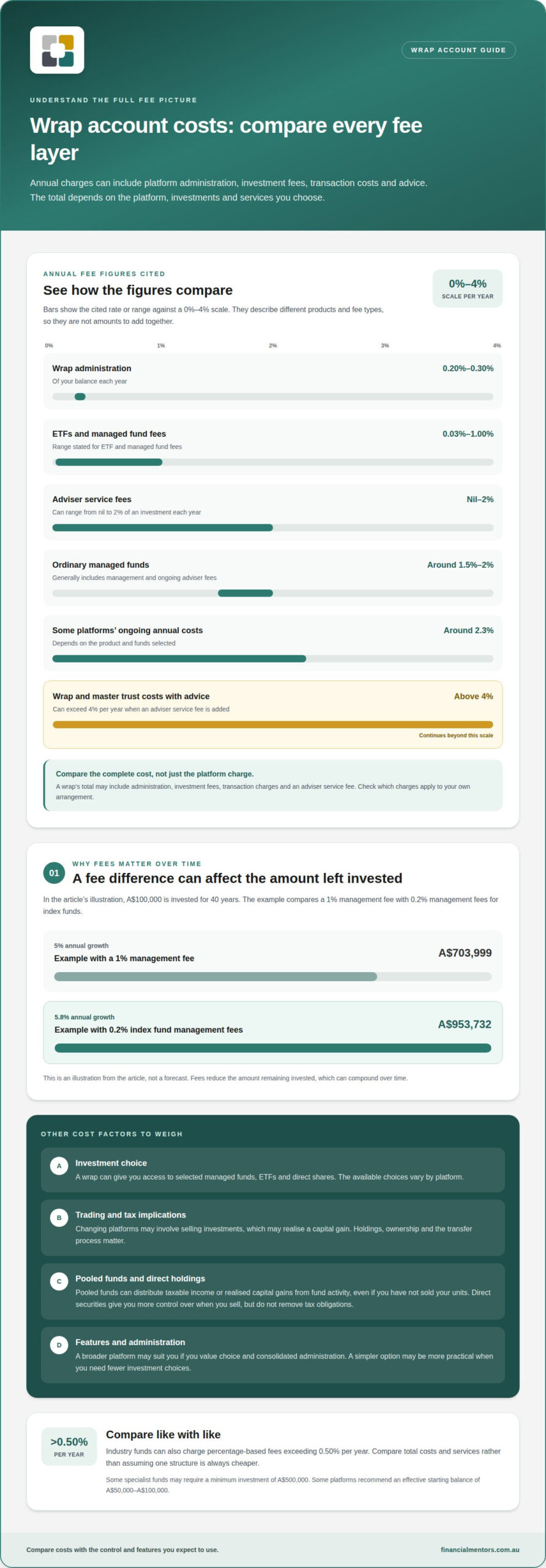
Fees depend on the platform and investments. Wrap administration may cost 0.20% to 0.30% of your balance per year, while ETF and managed fund fees typically range from 0.03% to 1.00% per year. Managed funds may add their own investment fees. Compare total costs, not just the transaction charge.
Australian wrap platforms can provide access to listed securities, ETFs and managed funds, with choice varying by platform. Some specialist funds have a minimum investment of A$500,000, while some platforms recommend an effective starting balance of A$50,000-A$100,000. A wrap may suit investors seeking tailored investment options and consolidated records; a simpler, lower-cost option may suit someone who wants fewer choices.
Pooled funds can distribute taxable income or realised capital gains from the fund’s activity, even when you haven’t sold your own units. Holding direct securities can give you more control over when you sell, but it doesn’t remove tax obligations. A wrap account does not provide blanket Financial Claims Scheme cover: protection depends on the underlying product and institution, while market losses remain an investment risk.
The main advantage is choice across assets, with reporting in one place. The trade-off is platform and investment fees, plus decisions about managing a broader portfolio. For example, a A$100,000 investment earning 6% annual after-inflation returns over 40 years illustrates why fees matter: they reduce the returns that remain invested. Compare costs against the control and features you’ll use.
Platform fees and potential cost disadvantages
“Wrap account” describes an investment platform; its technical name is an Investor Directed Portfolio Service, or IDPS. Costs may include platform administration, investment fees, transaction charges and an adviser service fee. Some Australian platforms can have ongoing annual costs around 2.3%, depending on the product and funds selected. Adding an adviser service fee can take total wrap and master trust costs above 4% per year.
Those charges compound: fees reduce the amount left invested to earn returns. A useful comparison includes every layer, not just the platform charge. Industry funds can also charge percentage-based fees exceeding 0.50% per year, so compare the total cost and services rather than assuming one structure is always cheaper.
Changing platforms can have tax consequences if investments need to be sold. A sale may realise a capital gain, while transferring investments without selling involves different practical and tax considerations. The holdings, ownership structure and transfer process all matter. In superannuation, a platform change may also affect how investments are administered within your existing super fund.
Platform technology and functionality continue to develop, but features differ. Investment Trends’ 2023 Platform Benchmarking Report, released in February 2024, ranked HUB24, Netwealth, Praemium, BT Panorama and Mason Stevens as the top five platforms for overall functionality. HUB24 and Netwealth are platform names, not investment options themselves; each platform’s available investments and tools depend on its offer.
A broader platform may suit you if you value choice and consolidated administration, but extra features can add cost. A simpler option may be more practical if you need fewer investment options. Compare fees, functionality, available investments and the implications of moving before deciding. If you’re weighing platform costs against retirement priorities, a review of your retirement strategy can help put those trade-offs in context.
What is a wrap account?
A wrap account combines investment administration with access to a portfolio of selected investments. Australian wrap fees may include administration of 0.20% to 0.30% of your balance per year, investment charges, and ongoing adviser fees.
Administration and investment fees
Administration fees cover platform services, while investment fees are charged by the funds or products in your portfolio. Together with advice fees, they determine the total ongoing cost you pay. Ordinary managed funds in Australia generally cost around 1.5% to 2% each year, including management and ongoing adviser fees. Some platforms pay a financial planner around 0.5% to 1% of an investment each year.
Percentage and flat-fee structures
A percentage-based fee is calculated against assets under management, so the charge rises as your portfolio grows. In one example, an adviser charges 10 times as much on A$3 million as on A$300,000, despite describing the work as the same. A flat fee is set as an amount rather than a share of your assets; adviser service fees can range from nil to 2% of an investment each year.
The difference matters over time. A comparison using A$100,000 over 40 years shows growth to A$703,999 at 5% annually, versus A$953,732 at 5.8% annually. The example compares a 1% management fee with 0.2% management fees for index funds. Fees reduce the amount remaining invested, which can compound into a sizeable difference.
To manage costs, ask for the fee components and services in writing, then look for overlapping charges. Compare a flat advice fee with a percentage-based arrangement, and consider whether each ongoing service remains useful. If your adviser’s fee is linked to your assets, ask how the charge changes as your balance grows. A clear comparison can help you decide which services and investment costs suit your portfolio.
How Australian wrap accounts work
Understanding the wrap account pros and cons in Australia can help you compare platform features with your investment needs. To open an account, choose the platform and account type, complete the application, then fund the account and select your investments.
How the platform operates
A wrap platform brings your selected investments and administration together under one account. Australian providers usually offer between 300 and 600 managed funds, and portfolios may include listed securities, cash and term deposits. The platform can show these holdings in consolidated reports, helping you see how each investment contributes to your overall position.
Your account may be held within superannuation or outside it. Some platforms can automatically rebalance your chosen mix, adjusting holdings when they move away from your selected allocation. Transaction timing varies: some platforms can execute orders on the same day, while others may take weeks.
Comparing, choosing and opening an account
Compare platforms by checking their investment range, administration tools, reporting and transaction processes. Then consider whether you need a superannuation account or an account for investments outside super. These choices affect how your capital is held and how the platform fits your financial arrangements. Weigh the wrap account pros and cons for Australian investors against your own priorities.
Next, review the account terms and charges, complete the application, and decide how much to invest and which options to select. For example, you might choose a mix of managed funds and shares, then use reports to monitor how your investment changes over time. Keep your objectives in view as you assess the available features.
If you’re considering how investments fit your long-term plans, discuss your financial future with a financial adviser.
Financial Mentors Wealth Management
Financial Mentors Wealth Management can help you consider a wrap account alongside your broader financial position, investment preferences and retirement plans. Through financial planning and retirement planning, you can explore how platform costs and investment choices relate to your long-term goals. Wealth creation strategies can also place investment decisions within a wider plan, rather than treating platform features as the only measure of suitability.
If you’re weighing a wrap account against other ways to invest, a discussion can help clarify the trade-offs that matter to you. Contact Financial Mentors Wealth Management to talk through your options.
Choose an approach that supports your next chapter
The decision is not simply whether a wrap account has more features. It’s whether its structure supports how you want to manage your finances and prepare for retirement. Consider how much control you want, what you need from ongoing advice and how investment decisions fit your wider financial plan.
Understanding the wrap account pros and cons in Australia can help you move from comparing platforms to a choice that reflects your priorities. If you’re unsure how that choice fits your retirement plans or broader wealth goals, Financial Mentors Wealth Management offers financial planning, retirement planning and wealth creation strategies to help you consider your next steps.
Contact Financial Mentors Wealth Management to discuss your plans. A considered next step can help you move forward with greater clarity.
Frequently Asked Questions
What are the benefits?
A potential benefit is having an account arrangement that can be reviewed alongside your wider financial plan. If your work situation or retirement timing changes, for example, you can reassess whether your investment approach still matches your priorities. A wrap may also suit you if you value adviser involvement and want an account structure that supports ongoing investment oversight.
What is a wrap product?
A wrap product is an account arrangement for accessing investments and related administration through a platform. Before applying, read the product disclosure statement and account terms. Check who makes investment decisions, what authority an adviser has, how withdrawals work and what happens if you transfer or close the account. These details help you understand the arrangement beyond its label.
What is an investment wrap account in Australia and how does it work?
In Australia, an investment wrap account is an investor-directed arrangement for holding investments through a platform. You decide whether to make investment decisions yourself or involve an adviser, in line with the account terms. Before signing, understand who can give instructions and how you can change that authority. This clarifies your responsibilities once the account is established.
How are Australian wrap accounts taxed, and what tax reports or benefits do they provide?
Tax outcomes depend on your account structure, investments and activity during the tax period. Use the platform’s tax documents as supporting records, then reconcile them with your transaction history and other income information before lodging a return. Keep purchase and sale confirmations as well as annual statements. These documents can assist with preparation, but they don’t determine your final tax position.
How do wrap accounts differ from master trusts, platforms, separately managed accounts and super accounts?
The terms describe different parts of an investment arrangement. A platform is the system; a wrap or master trust describes an account structure; a separately managed account describes how a portfolio is managed; and super identifies a retirement savings structure. To compare them, focus on who owns or directs the investments, who makes decisions and which account terms govern access.
What risks and disadvantages should Australian investors consider before opening a wrap account?
Consider whether you’re comfortable with the decisions and oversight the account requires. Review the investment mandate, how changes in your circumstances can be reflected, and the process for transferring or closing the account. Also consider market movements and the possibility that an investment may fall in value. Platform administration does not remove investment risk or guarantee a particular outcome.
Murray Frean and Financial Mentors Wealth Management are authorised representative and credit representative of Financial Mentors AFSL Pty Ltd ABN 68 976 248 467, AFSL 96323.
This website contains information that is general in nature… you need to consider your financial situation and needs before making any decisions based on this information.
Contact: 08 9429 8817 or mfrean@financialmentors.com.au. Powered by DASH.