

Could an investment that lowers your tax bill still leave you worse off overall? It’s a useful question to ask before choosing between super, shares and property. A practical guide to tax effective investment strategies australia starts with your goals and after-tax position, not the size of a possible deduction.
Tax rules can make investment options difficult to compare. Investment income and gains may be treated differently, and a strategy that suits one person may not fit your financial position, timeframe or comfort with risk. The aim is to weigh the possible after-tax outcome against what you want your money to achieve.
This guide covers tax considerations for common investment approaches, including super, shares, property and investment structures. It also explains scheduled changes to property and capital gains tax rules from 1 July 2027, and sets out a practical way to compare options with your goals. You’ll finish with a clearer idea of what information to gather before seeking financial advice. This website contains information that is general in nature and does not take into account your personal objectives, financial situation or needs. You need to consider your financial situation and needs before making any decisions based on this information.
Key Takeaways
- Understand why a lower tax bill doesn’t automatically make an investment the right fit.
- Learn how investment income, selling assets and deductions may affect your tax position.
- Compare super, shares and property by access, risk and purpose, not tax treatment alone.
- Use a practical process to assess tax effective investment strategies australia against your goals and financial position.
- Gather details about your goals, timeframe and finances before seeking advice.
What makes an investment strategy tax-effective in Australia?
Tax-effective investing means considering how tax may affect an investment while choosing it for its fit with your goals, risk tolerance, potential return and need to access your money. The aim isn’t simply to pay less tax. An investment with a tax benefit may still be unsuitable if it carries financial risks you’re uncomfortable with, restricts access to your funds or doesn’t support what you’re working towards.
When comparing tax effective investment strategies australia, look at the possible after-tax outcome alongside the investment’s purpose and its place in your wider financial position. Investment income, such as interest, dividends or rent, differs from a gain you may make when you dispose of an asset. Both can affect your tax, but the treatment depends on the investment and your circumstances. Your overall return also reflects changes in the investment’s value, not just its tax treatment.
How can tax change an investment’s overall return?
A pre-tax return is what an investment earns before applicable tax. The after-tax amount is what remains once relevant tax has been accounted for. For example, an investment might pay income while you hold it, then sell for more than you paid. The income and the gain on sale are separate considerations, and the tax outcome depends on the asset and your circumstances.
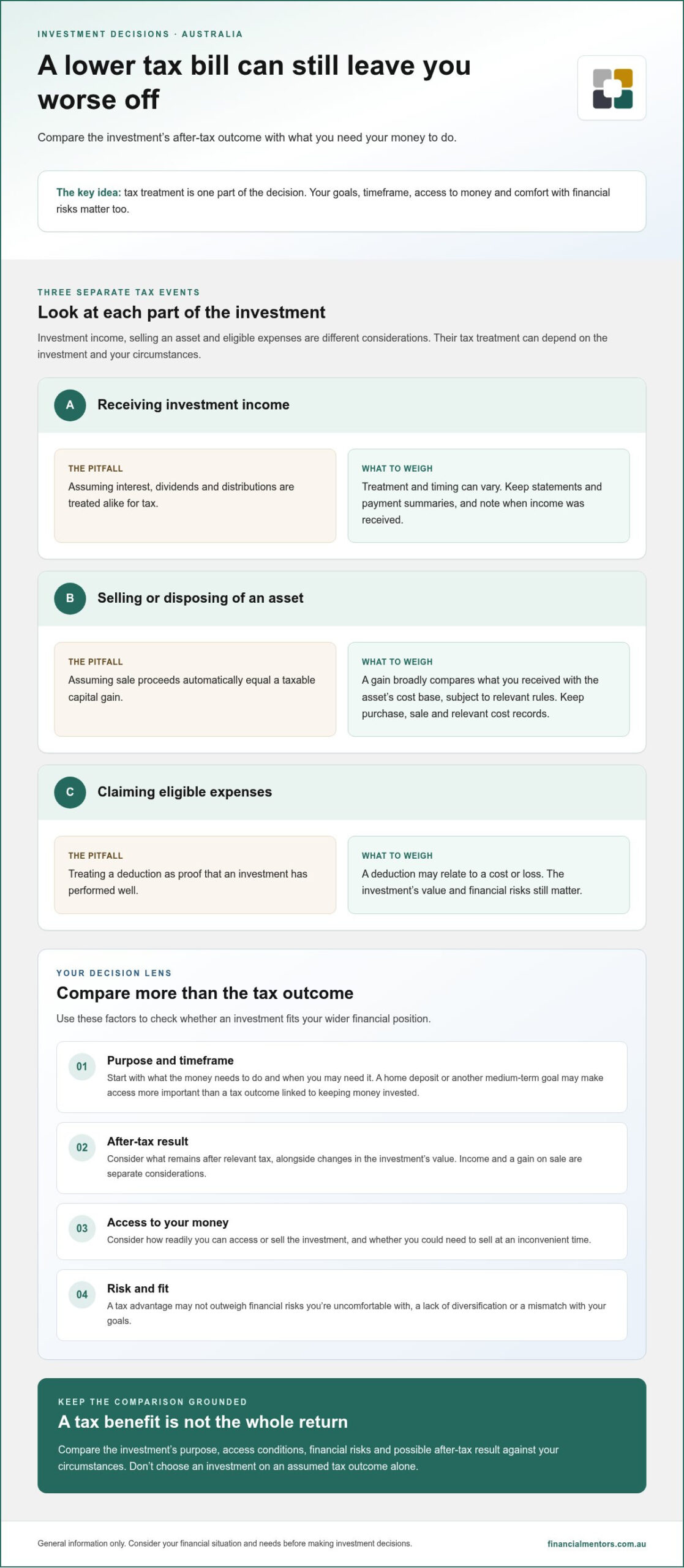
Comparing investments by headline income or expected growth alone can give you an incomplete picture. A tax deduction also doesn’t necessarily mean an investment has performed well. The deduction may relate to a cost or loss, while the investment’s value and risks still matter. Treat examples as illustrations, not predictions of your own tax outcome.
Why should your goals come before a tax-saving idea?
Start with what the money needs to do and when you may need it. If you’re saving for a home deposit or another medium-term goal, access to your money may matter more than a tax outcome linked to keeping it invested. If you’re building towards retirement, you may have a longer timeframe and different priorities. Your long-term goals, financial commitments and need for ready cash help shape what may suit you.
Consider liquidity, or how readily you can access or sell an investment, alongside its potential return and financial risks. A tax advantage may not outweigh a mismatch with your timeframe, a lack of diversification or the possibility of needing to sell at an inconvenient time. Before acting, compare the investment’s purpose, access conditions and possible after-tax result against your circumstances.
Superannuation is one part of Australia’s investment system. Wikipedia’s Superannuation in Australia overview provides background information, not personal financial or tax advice. Financial Mentors Wealth Management does not endorse or take responsibility for the content of external websites. This website’s information is general in nature. Consider your circumstances and needs before making investment decisions.
How investment income, capital gains and deductions affect tax
Before making an investment decision, understand three possible tax events: receiving investment income, disposing of an asset and claiming eligible expenses. These are separate considerations. The rules may depend on the investment, how it’s held and your circumstances. Keeping them distinct helps you understand how each tax event fits into your wider investment plan.
It also helps to distinguish an investment structure from an investment strategy. A structure is the way an investment is owned or held, such as in your own name or through superannuation. A strategy is the set of choices you make, including what to invest in, when to contribute or sell, and how the investment supports your goals. A structure may affect tax treatment, but it doesn’t determine whether the investment itself suits you.
What tax considerations can arise from investment income?
Interest, dividends and distributions from investments may count as income for tax purposes. Their timing and treatment depend on the investment and current rules, so don’t assume different types of income are treated alike. You may also see the term “franked dividend”. It generally refers to a dividend that carries a credit for tax paid by the company. How that credit applies depends on eligibility and your circumstances.
Keep statements and payment summaries, and note when income was received. These records can help with tax return preparation and give you a clearer view of an investment’s cash flow. For superannuation policy context, the Australian Treasury superannuation policy page outlines government policy in this area. Policy information isn’t a substitute for checking how current tax rules apply to your investment.
What happens when you sell an investment?
Capital gains tax (CGT) may arise when you dispose of an asset. A capital gain is not simply the sale proceeds. Broadly, it compares what you received with the asset’s cost base, subject to relevant rules. If the calculation produces a loss rather than a gain, different rules may apply. A sale can therefore have tax consequences without automatically creating a taxable capital gain.
The purchase date, purchase and sale records, costs that can be included in the calculation, and your circumstances may all matter. Before relying on a concession or exception, check current Australian Taxation Office (ATO) guidance. Don’t decide to sell based only on an assumed tax outcome.
Deductions need the same care. An expense connected with an investment isn’t automatically deductible. Eligibility depends on the expense, its connection to earning assessable income and the applicable rules. Keep receipts and records, and check current ATO guidance before claiming. This helps you compare tax effective investment strategies australia without treating a possible deduction as the investment’s purpose.
If you’re weighing a contribution, purchase or sale, financial advice can help you consider the tax question alongside your wider plans. Explore financial planning support as part of that decision.
Comparing tax-effective investment strategies: super, shares and property
Super, shares and property can serve different purposes, so no single option suits everyone. Compare what each investment is for, how it may be taxed, how easily you can access your money and which risks you’re prepared to accept. Use the table as a starting point, not a ranking.
| Investment | Purpose and tax considerations | Access and risks | Questions to explore |
|---|---|---|---|
| Superannuation | May support retirement savings. Contributions and investment earnings are subject to super rules and tax treatment. | Generally designed for retirement, with access governed by eligibility rules. Consider investment risk and limited access. | Does this suit your retirement timeframe and contribution capacity? |
| Shares | May provide dividends and potential growth. Income and a later sale can have separate tax considerations. | Can generally be sold, but prices can fluctuate and returns aren’t guaranteed. | How would share-market changes fit your timeframe and risk comfort? |
| Investment property | May produce rental income and a gain or loss on sale. Rental expenses and any loss are subject to relevant rules. | Selling can take time and involves property-specific risks, costs and borrowing considerations. | Can your finances manage periods of vacancy, expenses or changing borrowing costs? |
When might superannuation be part of an investment strategy?
How do shares and property bring different tax considerations?
Shares may generate dividends, while property may produce rent. Selling either can raise a separate question about capital gains tax. Ownership also matters: holding an investment personally or through another structure can change how it’s taxed and managed. Consider borrowing, concentration and the effect of market or property changes on your finances, not just possible tax treatment.
Negative gearing describes a situation where eligible expenses for an investment property exceed its rental income. A resulting loss isn’t a guaranteed benefit or proof that the investment is worthwhile. Rules are also changing: from 1 July 2027, restrictions apply to losses from certain residential properties acquired after 7:30 pm AEST on 12 May 2026. Check current ATO guidance and the rules relevant to your circumstances before relying on a tax outcome.
A tax deduction reduces taxable income when you’re eligible to claim it. It doesn’t erase the cost or financial risk that created it. Compare the investment’s purpose, likely cash flow, access and risks with its possible after-tax outcome. This is a more useful way to assess tax effective investment strategies australia than choosing an investment for a deduction alone.
A practical process for assessing tax-effective investments
A clear process can help you turn general tax information into decisions that fit your plans. Start with what you want your money to do, then compare options against your financial position, timeframe and comfort with risk.
- Set your goals and timeframe. Identify what you’re investing for, when you may need the money and whether the goal relates to family, retirement or another priority.
- Map your financial position. List your assets, liabilities, income, expenses and financial commitments. This helps you see what you can invest while allowing for everyday costs and planned expenses.
- Gather investment records. Note how each investment is owned, the income received and relevant purchase, sale or expense documents. Keep statements and receipts organised for tax reporting.
- Compare the whole outcome. Weigh possible after-tax returns alongside diversification, liquidity and financial risks. Consider how your plans could be affected if your income changes or you need to access money sooner than expected.
- Review when circumstances change. Revisit your choices if your goals, family circumstances, financial commitments or relevant tax rules change. A periodic review can help keep your investment approach aligned with your current plans.
What information should you gather before comparing options?
Bring together the details that will help you make a practical comparison:
- Your assets, liabilities, income, expenses and ongoing financial commitments.
- How existing investments are owned, the income they’ve produced and relevant transaction records.
- Your long-term goals, timeframe, need to access money and the level of financial risk you can accept.
This summary can help you spot gaps in your records and identify questions to explore before making a decision.
How can you keep tax planning connected to your wider plan?
Keeping records for your tax return supports accurate reporting, but it doesn’t answer whether you should buy, hold or sell an investment. Consider those decisions alongside family needs, retirement plans and other financial goals. If your priorities change, review whether each investment still serves its intended purpose.
Considering tax effective investment strategies australia is one part of building a financial plan around your circumstances. Website information is general in nature, so consider your own circumstances and needs before making decisions. If you’d like to discuss how investment choices fit into your wider plans, take a step towards a clearer financial plan.
Murray Frean and Financial Mentors Wealth Management are authorised representative and credit representative of Financial Mentors AFSL Pty Ltd ABN 68 976 248 467, AFSL 96323. Call 08 9429 8817 or email mfrean@financialmentors.com.au.
How Financial Mentors can help you consider investment and tax choices
Investment and tax decisions are easier to assess when you consider them as part of your wider financial position. Financial advice can help you explore how a choice fits your goals, timeframe, financial commitments and retirement plans. It can also help you weigh possible tax outcomes alongside investment purpose and risk, rather than treating a tax saving as the main measure of success.
What can a financial planning conversation help you consider?
You might be deciding whether to invest more, review an existing holding or set money aside for retirement. A financial planning conversation can help you organise the relevant details and consider the options in the context of your circumstances. Wealth creation strategies and retirement planning can form part of the discussion. Advice can help you weigh choices, but it can’t promise a particular tax saving or investment return.
Tax return preparation is also available alongside broader financial planning. Preparing a return involves reporting relevant information. It is not a substitute for advice about whether to buy, hold or sell an investment. For broader context on wealth management and financial advice, the published article Your Financial Future: Selecting the Right Wealth Management Office explores the topic.
Before a discussion, gather a summary of your goals, income, assets, debts, existing investments and upcoming financial commitments. Include relevant investment statements and transaction records. You don’t need to have every answer ready. A clear picture of what matters to you can help identify the questions you want to work through.
What information and disclosures should accompany the next step?
The initial meeting is step 01 of the process. It gives you an opportunity to discuss what you’re working towards and the financial questions you’d like to consider. If you’re exploring tax effective investment strategies australia, bring your timeframe, access needs and concerns about financial risks into the conversation. The aim is to consider your options in context, not to assume one approach suits everyone.
Website information is general in nature and doesn’t take account of your personal objectives, financial situation or needs. You should consider your own circumstances and needs before making a financial decision. External links on this website are provided with permission for information purposes only. They are not endorsements, and Financial Mentors Wealth Management is not responsible for the accuracy of their content.
Murray Frean and Financial Mentors Wealth Management are authorised representative and credit representative of Financial Mentors AFSL Pty Ltd ABN 68 976 248 467, AFSL 96323. To discuss a next step, call 08 9429 8817 or email mfrean@financialmentors.com.au. You can also explore the published article Wealth Creation Strategies Australia: A Guide to Building Your Financial Future in 2026 for further planning context.
Take your next step with a plan that fits
Your investment decisions can support more than a tax outcome. They can help shape the choices available to you in the years ahead. A considered approach to tax effective investment strategies australia keeps your plans connected to what matters in your life, while leaving room to adapt as your priorities change.
You don’t need to have every detail settled before taking a next step. Start by considering what you want your money to make possible, which questions are still on your mind and what would help you feel prepared. From there, work towards decisions that reflect your circumstances rather than a general rule or someone else’s approach.
Financial Mentors has provided professional planning advice since 2000. If you’re ready to discuss how your investment choices fit your wider financial future, take a step towards a clearer financial plan. Call 08 9429 8817 or email mfrean@financialmentors.com.au to take the next step.
Frequently Asked Questions
Is tax-effective investing the same as tax avoidance?
No. Tax-effective investing considers the tax treatment of lawful investment choices as part of planning, while tax avoidance generally involves arrangements designed to improperly reduce tax. If a proposal promises an unusually certain tax outcome or depends on hiding information, take care and seek advice. For tax effective investment strategies australia, focus on legitimate options that also make sense for your goals, timeframe and financial position.
Can an investment loss reduce the tax you owe in Australia?
Sometimes, but it depends on the type of loss and the rules that apply. A capital loss from an investment may generally be used to reduce capital gains, rather than other income such as salary. For instance, a loss on one asset may affect the taxable gain from another. Keep records of both transactions and check current ATO guidance before including a loss in your tax return.
Does negative gearing guarantee a tax benefit?
No. Negative gearing doesn’t guarantee a tax benefit or mean you’ll come out ahead financially. The investment’s expenses, income, ownership and applicable rules all matter, and you still need to fund any shortfall between rental income and costs. Changes to the rules may also affect some residential properties acquired after 7:30 pm AEST on 12 May 2026. Check current ATO guidance and consider the investment’s overall risks.
Are franked dividends tax-free in Australia?
No. A franked dividend isn’t automatically tax-free. It includes a franking credit for tax paid by the company, and you generally need to include the dividend and credit in your tax return. The credit may affect your tax assessment, but the result depends on your circumstances and eligibility. Keep the dividend statement from the company, as it records the amounts needed to report the payment accurately.
What records should I keep for investment tax purposes?
Keep statements showing income and ownership, such as bank interest records, dividend statements and managed fund distribution statements. Retain purchase and sale documents, receipts for investment-related expenses and loan records where relevant. These records help establish transaction details and support the information in your tax return. Store records in an organised, secure place, and keep them for the period required by current ATO rules. Check the ATO’s guidance if you’re unsure how long.