

If you’re asking, “how often should I review my financial plan?”, a regular check-in can help you see whether it still reflects your goals and circumstances. An annual review can be a useful calendar reminder, but the right timing depends on what is changing in your life and finances.
You don’t need to react to every market movement or headline. Instead, use a review to check what has changed, whether it affects your plans and what questions need attention. A change may call for a closer look, but it doesn’t automatically mean you need to alter your strategy.
This guide explains how to choose a review rhythm, which changes may justify an earlier check-in and what to prepare. You’ll also find practical prompts for reviewing your goals, income, expenses and financial commitments, including when you start a family, change jobs, buy a home or approach retirement.
Key Takeaways
- A financial plan sets out strategies and recommendations for your goals. A periodic review helps you check whether they still fit your circumstances.
- There’s no single schedule for everyone. Consider your goals and how quickly your circumstances may change when deciding how often should I review my financial plan.
- Personal changes may warrant attention sooner than a routine check-in. A market headline alone doesn’t mean your plan needs to change.
- Prepare for a useful review by gathering current information, comparing it with your goals, noting changes and questions, then recording next steps.
- If your questions or circumstances have become more complex, professional financial advice may help you consider your options.
Why a periodic review helps keep your financial plan relevant
A financial plan is a written document outlining strategies and recommendations to help you work towards your financial goals. It reflects your priorities and circumstances at a point in time. As these change, reviewing the plan gives you a chance to check whether it still relates to your life now, rather than assuming earlier recommendations remain suitable without reassessment.
A periodic review is a regular reassessment of your objectives, achievements and ongoing needs. It helps you compare your goals, circumstances and current strategies, then identify anything that needs clarification. A review doesn’t automatically mean changing investments or making an immediate decision. First establish what has changed and whether it affects your plans.
For background, this overview of financial planning is provided with permission for information purposes only. The practical focus of your review is how your written plan relates to your goals and financial position today.
What does a financial plan review check?
Start by comparing your current priorities with the objectives and recommendations in your plan. Then check whether your income, expenses, assets, liabilities or financial commitments have changed since it was prepared. For example, a new regular expense may affect your cash flow. Whether it changes what you can put towards a goal depends on your wider financial position.
Note which goals are on track, which have moved closer or further away, and which assumptions may no longer be accurate. Mark any recommendation you don’t understand and write down the question you need answered. This helps distinguish confirmed changes from points that still need investigation.
Why a set-and-forget approach can miss changes
Your priorities may shift after your plan is prepared. Starting a family can change your spending priorities and the goals you’re working towards. A work change may affect your income or financial commitments. As retirement approaches, you may have new questions about future income and how your plans support that stage of life. Wealth planning firms such as Zenith Wealth frequently emphasise how adapting strategies across these different life stages helps keep ongoing plans aligned with personal milestones.
Not every change calls for an overhaul. A review helps you understand what has changed and whether it matters to your plan. A market movement or headline can raise a question, but it doesn’t show by itself that your individual plan needs changing. Consider it alongside your goals, timeframes and wider circumstances.
If you’re wondering how often should I review my financial plan, start by asking whether it still reflects what you’re working towards and the life you have now. The answer can help you decide what deserves attention, while giving you time to explore your options before making decisions.
How often should you review your financial plan?
There isn’t one review interval that suits everyone. Treat a regular check-in as a chance to see whether the plan still fits, not as a rule that automatically calls for changes. The timing depends on your financial situation and needs, your goals and how quickly they may shift.
An annual check-in can be a practical calendar reminder, but it isn’t a personal recommendation for every reader. If your financial position and goals are relatively steady, a regular scheduled review may help you keep track. If your income, commitments or priorities are changing, you may want to revisit relevant parts of the plan sooner. The aim is to stay aware of whether it still reflects what matters to you.
Setting a regular review rhythm
Choose a recurring date that’s easy to remember, such as when you organise other financial records. Add it to your calendar and use it to compare your current position with your goals. Ask: Have my priorities changed? Have my income, expenses or commitments shifted? Are the assumptions in my plan still accurate? Are there decisions coming up that I need to prepare for?
A review may confirm that your current direction still makes sense, identify questions to investigate or help you set possible next steps. Finding no changes to make is useful too. Let your circumstances guide the rhythm. If you have an ongoing review arrangement, follow the agreed schedule and raise questions between meetings if a meaningful change occurs.
When should you review sooner?
Consider an earlier review if a change affects what you’re aiming for, what you can afford or the responsibilities you need to account for. A new family commitment may alter your priorities. A work change could affect your income or regular expenses. A decision to buy a home may add ongoing costs that change how much room you have for other goals.
A shift in your goals can also be a reason to bring a review forward. You might prioritise buying a home, change the timing of a retirement goal or find that existing commitments leave less room for another objective. Write down what has changed and the questions it raises. A difference is a reason to assess your position, not necessarily to make an immediate financial decision.
If you’re unsure whether a change affects your plan, professional financial advice may help you work through what to consider. Financial Mentors Wealth Management’s initial meeting is step 01 of its process. You can explore financial planning advice as one way to discuss your circumstances and questions.
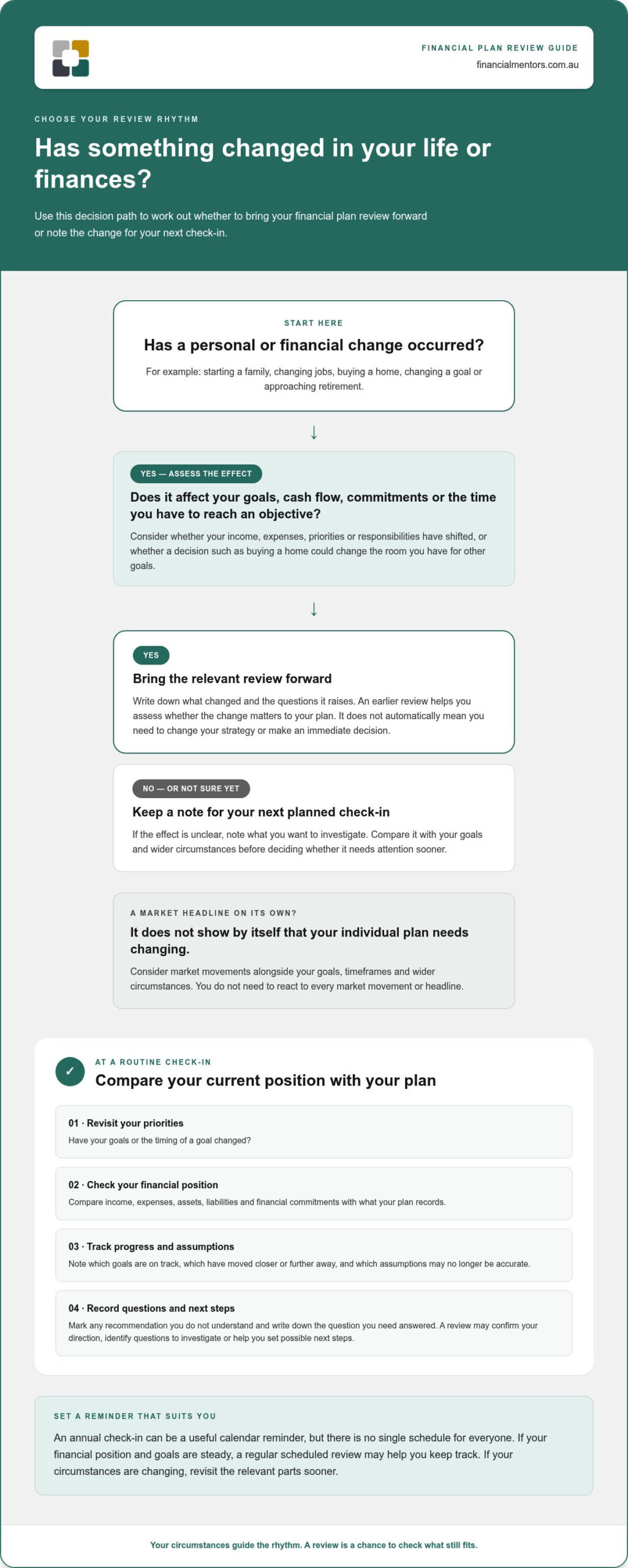
Which changes deserve attention, and which can wait for a routine review?
To assess a change, ask whether it affects your goals, cash flow, financial commitments or the time you have to reach an objective. A significant life event may justify an earlier conversation. A routine update may be noted for your next planned check-in. Neither automatically means you should change an investment or make another financial decision straight away.
Life and goal changes to consider
Changes in your family, plans to buy a home, a work transition, an inheritance or approaching retirement can affect your priorities or financial position. Note what has changed and consider how it may affect your goals, regular expenses and timeframes. If retirement is on your mind, a retirement planning checklist can help you organise the questions you want to consider.
Use the table as a prompt, not as a set of personal recommendations. For each change, consider whether it affects a current goal or raises a question you need to address sooner.
| Change | Possible relevance | Sensible next question |
|---|---|---|
| A new family commitment | Your priorities, expenses or responsibilities may shift. | Does this change what you need to save for or protect? |
| Buying a home | A new loan or housing cost may affect cash flow and other goals. | How might the ongoing costs fit with my other commitments? |
| A work transition | Income or employment arrangements may change. | Does my current plan still reflect my income and spending? |
| Receiving an inheritance | Your assets and available choices may change. | What goals or questions should I consider before deciding what to do? |
| Getting closer to retirement | Your timeframe and plans for future income may need attention. | What should I prepare or clarify as retirement approaches? |
Market and rule changes: assess before acting
News about markets, tax, superannuation or Centrelink can prompt you to check whether information in your plan remains current. A headline alone doesn’t establish that your individual plan needs changing. Ask whether the update applies to your circumstances and affects a goal, timeframe or financial commitment. If you’re unsure, write down the question rather than reacting immediately.
Rules and thresholds can change, and their effect depends on your circumstances. Before relying on an update about tax, superannuation or Centrelink entitlements, check current information from the relevant authority, such as the Australian Taxation Office or Services Australia. If it may affect your position, note it for your next review or seek advice about what it means for you.
If a headline doesn’t appear to affect your goals or circumstances, record it as something to monitor. This lets you stay informed without treating every market movement or reported rule change as a signal to alter your plan. When deciding how often should I review my financial plan, focus on whether a change matters to your situation, not just how prominent it is in the news.
How to review your financial plan in practical steps
A useful review doesn’t need to begin with a decision to change anything. Gather your information, compare it with your goals and identify what needs clarification. This is a practical way to organise your thinking, not personalised financial advice. Your own circumstances determine what any findings mean for you.
A financial plan review is a structured check of what’s changed, what remains on track and what questions need follow-up.
Five stages for a practical review
- Prepare. Gather your current financial plan and relevant information about your goals, income, expenses, assets, liabilities and financial commitments. Note changes since your last review, upcoming decisions and questions. Keep private financial details secure. Don’t share sensitive information in public spaces or through channels you don’t consider secure.
- Compare. Set your current circumstances alongside the plan’s objectives and recommendations. Look for differences, but don’t assume each one means something needs to change. A new expense, for example, is worth recording, but its effect depends on your broader financial position.
- Identify changes. Sort your notes into what remains on track, what has changed and what you’re unsure about. Include progress, such as reaching a savings milestone, as well as new commitments or goals. This gives you a balanced view of your position.
- Assess questions. Decide which points you can clarify with reliable, current information and which may need professional advice. If a question involves tax, superannuation or Centrelink, check current information from the relevant Australian authority. Consider whether any change means you should review your plan before the next scheduled check-in.
- Record next steps. Write down the review date, what you found, any actions and questions to revisit. If no action is needed, record that too. A clear note helps you pick up where you left off next time.
Make each next step specific. Instead of writing “look into retirement”, note the information you need or the question you want answered. Separate tasks you can complete from matters that need advice. Avoid making a significant financial decision just because a review has highlighted a difference.
If you’d value guidance on questions raised during your review, you can discuss financial advice with Financial Mentors Wealth Management.
When professional financial advice may help with a plan review
A review may raise questions that are difficult to resolve on your own. If your goals have shifted, your circumstances have become more complex or you’re unsure how different parts of your finances fit together, professional advice may help you understand what to consider. You can seek guidance before a question feels urgent.
What to expect when discussing a review
Before an appointment, note your goals, what has changed since your last review and the questions you’d like to discuss. You don’t need to arrive with every answer. A clear outline of what matters to you can help guide a conversation about your circumstances and the areas where you’d value support.
Financial Mentors Wealth Management provides financial planning, wealth creation strategies, retirement and estate planning advice, and tax return preparation. Appointments are available in person and through online services. Any advice should take account of your objectives, financial situation and needs. Website information is general in nature, so consider your own circumstances before acting on it.
A considered next step for your financial future
If you’re still weighing up how often should I review my financial plan, professional advice may help you consider the questions raised by a regular check-in or a change in your circumstances. You can explore financial advice and planning and decide whether you’d like to take the next step.
To discuss an appointment with Financial Mentors Wealth Management, call 08 9429 8817 or email mfrean@financialmentors.com.au. You can share the goals or changes you’d like to discuss and ask what information may be useful to bring. A review is a chance to understand your options and consider what may suit your circumstances, not a commitment to make a change.
Murray Frean and Financial Mentors Wealth Management are authorised representative and credit representative of Financial Mentors AFSL Pty Ltd ABN 68 976 248 467, AFSL 96323.
This website contains information that is general in nature; you need to consider your financial situation and needs before making any decisions based on this information.
Keep your next step connected to what matters
Your financial plan can be a reference point as your priorities take shape. Rather than aiming for perfect certainty, make time to check whether your plans still reflect the future you want. If you’re considering how often should I review my financial plan, let your goals and circumstances guide the timing, and revisit it when life changes.
Start simply: write down one question you’d like answered or one goal you want to bring into sharper focus. If the decisions ahead feel connected or difficult to weigh up alone, professional guidance may help you consider them in the context of your wider financial situation.
Explore financial advice and planning support and take a thoughtful next step towards the future you want to build.
Frequently Asked Questions
Is reviewing a financial plan the same as reviewing a budget?
No. A budget helps you track and organise money coming in and going out. A financial plan considers how your broader goals fit together over time. A budget can show whether regular spending leaves room for saving, while a plan may help you consider how that saving relates to a home deposit or retirement goal. The two can inform each other, but they serve different purposes.
Can you review your financial plan before your next scheduled check-in?
Yes. If a change or decision is on your mind, revisit the relevant part of your plan before your next calendar check-in. Write down what has changed and what you need to understand. If you’re considering reducing work hours, for example, note the expected income change and ask how it could affect your plans. You don’t have to wait for a particular date to raise a question.
Does a financial plan review mean you need to change your investments?
No. A review can help you assess whether your investments still relate to your goals and circumstances, but it doesn’t require you to make a change. Consider market movements alongside your objectives and timeframe rather than treating them as instructions to act. Investment decisions can have consequences, so seek advice that considers your situation if you’re uncertain about what a change could mean.
What if your goals have not changed since your last review?
That’s a useful finding, not a reason to skip checking in. Consider whether you’re making progress, whether the timeframes still suit you and whether your current circumstances continue to support those goals. A goal may be unchanged while your available time or regular commitments have shifted. If the plan still reflects your priorities, record that and note when you’d like to revisit it.
Can a financial plan review include estate planning questions?
Yes. You can raise questions about how your estate planning intentions relate to your assets, family circumstances and wider financial goals. A change in your family, for example, may prompt you to reconsider who you want to benefit from your estate. Financial advice can help you explore relevant considerations. Formal legal documents require appropriate legal advice. The questions to discuss depend on your circumstances and needs.
Should couples review their financial plans together?
Couples may find it helpful to discuss shared goals, especially where decisions affect both people, such as saving for a home or planning a change in household spending. Make room for individual priorities too. You could each note what matters to you, then identify shared questions to discuss. If your finances or goals are partly separate, be clear about which decisions affect you both and which need individual consideration.