

A tax-free inheritance can still carry tax consequences. Australia has no formal inheritance tax, estate duty or gift tax, but transferring an asset can trigger capital gains tax, including when it’s given for less than market value. Passing wealth to the next generation tax effectively starts with understanding how each asset and transfer may be treated.
You may want to support your children or grandchildren now, provide for them through your estate, or do both. It’s natural to want a plan that reflects your family’s needs while avoiding unexpected tax outcomes.
This article explains how lifetime gifts, trusts and inheritances can affect wealth transfers in Australia. It also covers why tax treatment for minors can depend on how income is distributed, and how superannuation death benefits may be taxed for adult children. These points can help you identify decisions to consider when planning for the next generation.
Key Takeaways
- Before helping family members financially, compare an outright gift with a documented loan and consider how staged support could fit your goals.
- When dividing an estate, consider how unrealised capital gains and beneficiaries’ capital losses may affect the family’s overall tax outcome.
- Explore whether a testamentary trust suits your family, including how income distributed to minors may be treated for tax purposes.
- Australia has no formal inheritance tax, but transferring or later selling assets can still have capital gains tax implications.
- Plan lifetime gifts with your broader financial position and Centrelink entitlements in mind, and review your arrangements as family circumstances change.
1. Who benefits most from a testamentary trust?
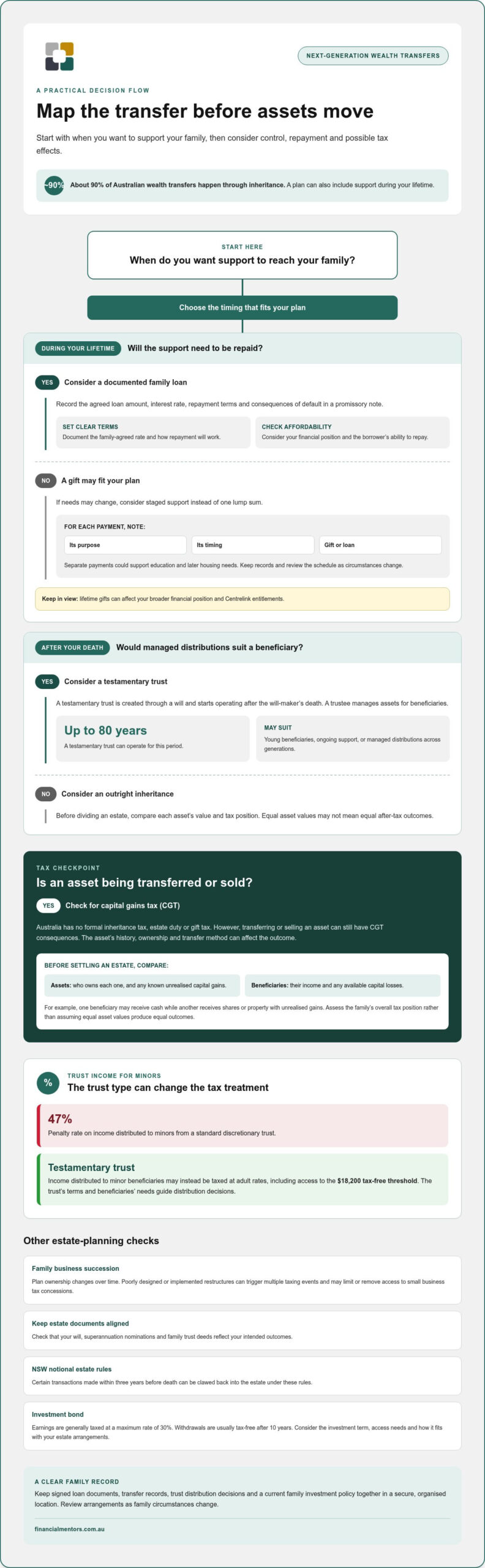
A testamentary trust is created through a will and begins operating after the will-maker’s death. It can suit families who want a trustee to manage assets for beneficiaries, rather than transferring everything outright. About 90% of Australian wealth transfers happen through inheritance. A trust can help structure that transfer and give family wealth a clear purpose.
Consider one if a beneficiary is young, needs support over time, or would benefit from managed distributions. A testamentary trust can allow income to be distributed among beneficiaries, including young children. It can operate for up to 80 years. That timeframe can matter if your plan aims to support children and later generations, rather than provide one immediate payment.
Tax treatment is another reason families consider this structure. Income distributed to minors from a standard discretionary trust is subject to a 47% penalty rate. Income distributed to minor beneficiaries through a testamentary trust may instead be taxed at adult rates, including access to the $18,200 tax-free threshold. The trust’s terms and beneficiaries’ needs should guide distribution decisions.
A documented family loan can be an alternative to an outright gift when providing support during your lifetime. Record the loan amount, agreed interest rate, repayment terms and consequences of default in a promissory note. Clear written terms explain the arrangement and help distinguish a genuine loan from a gift. They can also clarify expectations if a relationship breaks down.
Staged support can adapt to a child’s changing needs. For example, you could make separate payments for education and later housing support rather than provide a lump sum. Set out each payment’s purpose and timing, and state whether it is a gift or loan. Review the schedule as circumstances change, and keep records of transfers and repayments.
Applicable federal rates are not the benchmark to assume for an Australian family loan. Instead, document the interest rate agreed by the family and the repayment conditions. Consider how the loan fits the lender’s financial position and the borrower’s ability to repay. Clear terms help both sides understand the arrangement from the outset.
Keep digital records together in a secure, organised location. Save signed loan documents, transfer records, trust distribution decisions and a current family investment policy. The policy can describe who makes investment decisions, the family’s objectives, acceptable risks and how often to review arrangements. Clear records help family members follow consistent steps and understand the plan.
A testamentary trust is one option for supporting family wealth, but it is not the only one. Compare its control, administration and tax treatment with staged gifts or documented loans. If education, long-term support or protection for younger beneficiaries is central to your plans, define those priorities before deciding how assets should pass. This gives your family a clearer framework for future decisions.
2. Are there any tax implications to wealth transfer?
Yes. Australia has no formal inheritance tax, estate duty or gift tax, but transfers can still have tax consequences. Capital gains tax (CGT) may apply when assets are transferred or sold. The asset’s history, ownership and transfer method can affect the outcome. Planning to pass wealth to the next generation tax effectively starts with understanding these details.
Estate equalisation means considering what each beneficiary receives and the tax position of those assets. One child might receive cash, while another receives shares or property with unrealised capital gains. Selling an asset can bring those gains into account. Allocating assets with unrealised gains to beneficiaries with lower incomes or carried-forward capital losses may improve the family’s overall tax outcome.
Before settling an estate, list each asset, its owner and any known unrealised gain. Compare possible allocations with beneficiaries’ circumstances, including their income and available capital losses. Assess the family’s overall position rather than assuming equal asset values mean equal after-tax outcomes. This comparison can help you plan to pass wealth to the next generation tax effectively.
For a family business, plan ownership transitions over time and assess the tax effect of each proposed step. Poorly designed or implemented restructures can trigger multiple taxing events and may limit or remove access to small business tax concessions. Staged succession can also give the next generation time to learn the business and receive mentoring before taking control. For families managing international commercial interests or cross-border assets, specialist practices like israelcrossborderfamilylaw.com provide guidance on structuring multi-jurisdictional investments and business transitions.
Wills and estate planning can reduce uncertainty by specifying who receives assets and who makes relevant decisions. Keep your will, superannuation nominations and family trust deeds aligned with your intended outcomes. Discussing the plan with beneficiaries can clarify expectations and help reduce the chance of disagreement. In NSW, certain transactions made within three years before death can be clawed back into the estate under notional estate rules.
An investment bond is another structure to consider as part of estate planning. Its earnings are generally taxed at a maximum rate of 30%, and withdrawals are usually tax-free after 10 years. Consider the investment term, access needs and how the bond fits with your wider estate arrangements before choosing this approach.
Staggering a transfer gives you time to review its tax effects and your family’s changing needs. For example, business ownership might pass in stages, giving successors time to learn their roles while the structure is reviewed. Early planning matters because unintended tax consequences may be difficult to correct after a transfer. Record each decision and revisit the plan when circumstances change.
Consult an estate planning lawyer or tax adviser before transferring a business, changing ownership, or making a major gift. Early advice gives you time to assess CGT, concessions, successor control and how your will and trust arrangements fit together. A review of tax-aware estate planning can help organise financial decisions alongside that legal and tax work.
3. Testamentary trusts and tax treatment for minors
A testamentary trust is created through a will and begins operating after the will-maker’s death. It gives a trustee responsibility for managing assets and making distributions under the trust’s terms. This may suit families with young beneficiaries or children who need support over time. The arrangement can specify how funds may be used, such as for education, health or other intended needs.
Tax treatment is one factor to consider when a trust distributes income to a minor. Australian rules treat distributions from testamentary trusts differently from those from standard discretionary trusts. The source of the trust’s funds and the terms of the will matter. Before settling an estate plan, identify which assets may produce income and how the trustee could distribute it among eligible beneficiaries.
Income splitting through a trust needs careful planning. When deciding how to distribute income, a trustee considers beneficiaries’ needs and the trust terms. For example, income might support a child’s education while other assets remain invested for future needs. Keep records of the trustee’s decisions, the purpose of each distribution and the beneficiary receiving it.
Compare assets held in a trust with those held personally and benefits held in superannuation. List each asset, its owner and its intended recipient, then review how the arrangements fit together. Superannuation beneficiary nominations can guide the payment of death benefits, while a testamentary trust may manage assets passing under a will. Keep instructions consistent across different ownership arrangements.
A trust may help protect assets by placing management decisions with a trustee and setting conditions for distributions. It does not remove every risk or prevent all disputes. Consider who should act as trustee, how a replacement would be chosen and what happens if a beneficiary’s circumstances change. Clear terms help the trustee apply your intentions consistently. For families managing cross-border estates with fixed overseas instruments, legal practices such as The Irrevocable Trust Doctor assist with modifying irrevocable trusts through the court system.
The ATO issued Draft Taxation Determination TD 2026/D1 in early 2026, addressing testamentary trusts and the main residence CGT exemption. This highlights why a trust’s tax treatment should be considered alongside the assets placed within it. Include property in your asset review, and record how it is owned and intended to pass through your estate.
To assess whether a testamentary trust fits your plans, write down your intended beneficiaries, the support you want to provide and the assets involved. Consider who would manage the trust and how distributions could respond to changing needs. Reviewing these points alongside your broader estate plan can help align asset management, superannuation directions and your family’s intentions.
4. Is there an inheritance tax in Australia?
Australia has no formal inheritance tax, estate duty or gift tax. However, capital gains tax (CGT) can apply when you transfer or later sell certain assets. Ownership history and transfer method affect the tax treatment. Passing wealth to the next generation tax effectively means considering these details before deciding when and how assets should move.
Start by listing each asset, its owner, acquisition date and cost base. Note any unrealised capital gains, which may affect a beneficiary who later sells. For example, two beneficiaries could receive assets with similar market values, but an investment property may have a different potential tax outcome from cash. Comparing after-tax implications can help you plan a fair distribution.
A lifetime gift can have CGT consequences even if you receive no payment. If you transfer an asset for less than market value, CGT may be calculated using its market value under the market value substitution rule. Before gifting shares or property, compare the potential tax effect of transferring them now with retaining them for inheritance. The recipient and timing are relevant to that decision.
Inherited assets have specific cost-base considerations. For Australian assets acquired before 20 September 1985, the beneficiary’s cost base is reset to market value at the date of death. Keep acquisition records and relevant valuations with the estate documents. Those details can help a beneficiary work out the gain if they later sell the asset.
Sale timing can affect CGT. Beneficiaries may qualify for the 50% CGT discount when selling shares or property after the combined 12-month holding period. They may also reduce CGT payable by selling in a year when their overall income is lower. Consider the holding period, expected income and whether the sale needs to happen immediately.
The main residence CGT exemption may apply if the family home is sold within two years of death. Include the expected sale timing in estate administration planning. If the home is retained, its ownership, use and eventual sale timing may affect its tax position. Keep property and occupancy records with the estate documents.
Tax-aware asset planning starts with understanding which assets are held personally, in a trust or through another ownership structure. Compare their income, unrealised gains and intended recipients before changing ownership. Allocating assets with unrealised gains to beneficiaries with lower incomes or carried-forward capital losses may improve the family’s overall tax outcome. Weigh these choices together rather than comparing asset values alone.
Before making gifts or arranging asset sales, gather ownership details, cost-base records and your intended outcomes. Comparing transfer timing with beneficiaries’ circumstances can help you decide what to address next and keep your estate arrangements aligned with your family’s plans.
5. Lifetime wealth transfers to children and grandchildren
Australians can transfer wealth during their lifetime through gifts, trusts or other arrangements. The right approach depends on your circumstances, the assets involved and when your children or grandchildren need support. According to Services Australia, a person may gift up to A$10,000 in cash and assets in one financial year without exceeding the annual gifting limit.
That limit matters if you receive Centrelink entitlements. Gifting above the stated limits is assessed as an asset, and income from it is deemed for five years. Before giving money or assets, consider how the gift may affect your financial position and future support needs. Record the amount, date, recipient and purpose.
Lifetime wealth transfer is also a major national transition. Intergenerational wealth transfers are a significant part of Australia’s financial landscape. More than A$3.5 trillion in Australian wealth is expected to transfer between generations by 2050. These estimates provide context, but your plan should start with your family’s objectives and available resources.
For example, a case study considers a couple aged 62 with a A$3.8 million estate and two adult children. Their combined superannuation is A$1.6 million, while an investment property is valued at A$1.4 million with a A$550,000 cost base. Selling the property creates a potential capital gain, so timing and ownership matter when considering support for their children.
In that case study, applying the 50% capital gains tax discount and an approximate 45% marginal rate produces estimated capital gains tax of A$191,250 on the property sale. This illustrates why an asset’s cost base and the family’s tax position matter before transferring or selling it. A different asset mix or timing can change the outcome.
An investment bond may offer another structure for building wealth intended for a child or grandchild. Consider who owns the bond, who can access it and when the funds are needed. Its tax treatment also depends on the holding period. Compare it with a direct gift or trust distribution, and consider how each option fits your wider estate plan.
Plan step by step: define the purpose of each transfer, identify which assets may be gifted, then consider tax and Centrelink effects. Discuss the plan with intended recipients so they understand how and when support may be provided. Keep records and revisit the arrangement as family circumstances change.
If you’re planning gifts or other lifetime transfers, seek financial planning guidance to weigh the options against your goals and current financial position.
Financial Mentors Wealth Management: Financial Planning
Financial Mentors Wealth Management can help you connect wealth transfers with your wider financial goals. If you’re weighing lifetime gifts, family support or how assets may pass through your estate, financial planning advice can help you assess these choices together. Estate planning advice can help you consider how your intended beneficiaries, assets and future needs fit into your plans.
This guidance may also be useful when retirement planning affects how much you can give, or when you’re reviewing wealth creation strategies alongside support for children or grandchildren. A clear view of your financial position can help you decide what to prioritise and which questions need further attention.
To discuss your next steps, contact Financial Mentors Wealth Management or visit financialmentors.com.au.
Shape a plan that reflects your family’s future
The next step is to turn your intentions into decisions your family can understand and revisit. Consider what you want your wealth to make possible, who you hope to support and how much flexibility you want to retain as circumstances change. A shared understanding can help keep future conversations focused on your family’s priorities.
Planning to pass wealth to the next generation tax effectively means weighing transfer decisions against your own future needs. Write down the goals you want your plan to serve and the questions you still need to resolve. This gives you a practical starting point for conversations with family and professional advisers, and helps connect your choices to your long-term goals.
Financial Mentors Wealth Management offers Financial Planning, Retirement Planning and Wealth Creation Strategies to help you consider these decisions as part of your broader financial picture. If you’re ready to discuss your next steps, contact Financial Mentors Wealth Management. A thoughtful plan can help you move forward with greater clarity and care for the future you want to shape.
Frequently Asked Questions
Are there any tax implications to wealth transfer?
Yes. A transfer can have tax consequences even though Australia has no inheritance tax. A lifetime gift of an asset can trigger capital gains tax (CGT), and a below-market transfer may be assessed using market value. An inherited asset can also create CGT when sold later. Superannuation death benefits have separate tax treatment. Before transferring, identify the asset type, owner, cost base and recipient.
How can I ensure my wealth is used responsibly by the next generation?
Set out how you want funds managed and who should make decisions. For example, a trust can give a trustee responsibility for distributing assets in line with its terms, rather than passing a lump sum directly to a beneficiary. Explain your intentions to family members and record significant decisions. Clear communication can help recipients understand the arrangement’s purpose and their responsibilities.
How can I protect my wealth from legal or financial challenges after I pass away?
Keep your will, trust arrangements and superannuation beneficiary directions consistent, and document loans or transfers made during your lifetime. In NSW, certain transactions made within three years before death can be clawed back into the estate under notional estate rules. This makes accurate records and timing relevant to estate planning in that state. Review your arrangements when ownership, family relationships or intended beneficiaries change.
How is super taxed when it passes to adult children?
Australian superannuation death benefits paid to adult children who are not tax dependants are taxed at 17% on the taxable component or 32% on an untaxed element. The tax depends on the benefit’s components, so the headline rate does not necessarily apply to the entire payment. Reviewing your super fund’s beneficiary nominations can help direct the benefit in line with your wishes.
Is there an inheritance tax in Australia?
No. Australia does not impose a formal inheritance tax on assets or money received from a deceased person’s estate. However, an inheritance can have future tax implications. For example, a beneficiary who later sells inherited shares or property may have a capital gains tax outcome. The asset’s acquisition history and the timing of the sale can affect how that disposal is treated.
Who benefits most from a testamentary trust?
A testamentary trust can suit families who want a trustee to manage inherited assets for beneficiaries. It may be useful when a beneficiary is young, needs ongoing support or would benefit from distributions over time rather than immediate control of the assets. Consider who will act as trustee, how the trust terms guide decisions and whether the structure fits your family’s intended arrangements.
Does Australia have inheritance or estate tax?
No. Australia has no formal inheritance tax, estate duty or death tax. These terms describe taxes on wealth transferred after a person dies, but they do not apply as formal taxes in Australia. Tax can still arise through other rules, including capital gains tax on a later asset sale. Distinguish the absence of inheritance tax from the tax treatment of assets after transfer.
What taxes apply when inheriting assets in Australia?
Receiving an inheritance is not subject to a formal inheritance tax in Australia. If you later sell an inherited asset, capital gains tax may apply. The asset’s acquisition date and cost-base treatment are relevant, as are the circumstances of the sale. Inherited property and shares, for example, can have different records and ownership histories, so keep estate valuations and acquisition details with your financial documents.